
Who this guide is for
- Owners and boards of clubs or venues weighing whether and how to assemble a stadium project team
- Municipal and public-sector project sponsors planning stakeholder and role discussions
- Schools, colleges and universities scoping a sports facility before appointing professionals
- Property developers and investors preparing early-stage project briefs and role maps
- In-house project managers and facility managers organising who to involve and when
- Community groups or trusts researching the roles a venue project might require
Planning diagram
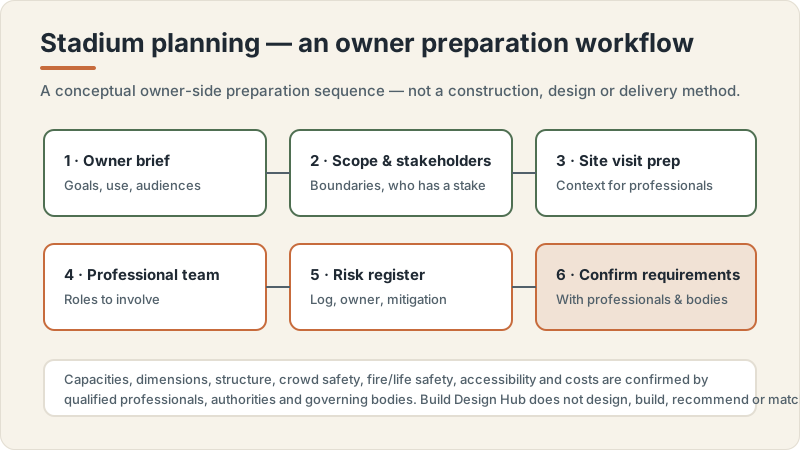
Stadium planning workflow concept
Conceptual editorial diagram — not a construction drawing, specification, to-scale plan or proof of a real project. It is not engineering, structural, fire/life-safety, crowd-safety or accessibility-compliance guidance. Capacities, dimensions, standards, requirements and costs vary by facility type, audience, site, use case and governing body, and are confirmed with qualified professionals, relevant authorities and governing bodies. Build Design Hub does not design, build, inspect, certify, recommend or match anyone.
What this guide helps you prepare
This guide helps you build a clear picture of the kinds of professional roles a stadium project may draw on, so you can enter early conversations organised and informed. Rather than telling you what to build or how a venue should be engineered, it helps you prepare the groundwork: a project brief that describes your intent and constraints, a map of which roles might be relevant to your situation, and a structured set of questions to raise with qualified professionals. The aim is to help you become a well-prepared client, not to substitute for the expertise you will engage.
Preparation of this kind reduces confusion later. When you can articulate your goals, the parties who have a stake in the outcome, and the open questions you need answered, conversations with professionals tend to be more productive and scopes tend to be clearer. This guide also helps you plan how to compare information you receive on a like-for-like basis, and how to keep decisions traceable. It does not design, engineer, cost, certify or approve anything, and it makes no claims about what your specific project will require.
- Draft a plain-language project brief describing your goals, site context and constraints as you understand them
- List the outcomes you want to discuss with professionals rather than solutions you have pre-decided
- Note the open questions and uncertainties you want qualified professionals to help you explore
- Identify which broad role categories might be relevant so you can plan who to approach and when
- Plan how you will record advice, decisions and the reasoning behind them for later reference
- Prepare a consistent structure for comparing information from different parties on a like-for-like basis
Mapping the professional roles a stadium project may involve
Stadium projects can involve many disciplines, and the exact mix depends entirely on your situation. A hub-and-spoke way of thinking treats a coordinating role such as a project manager or lead consultant as the hub, with specialist spokes connected to it. Architectural and design roles are one spoke; engineering disciplines are others; and a range of advisors sits alongside them. Thinking in these categories helps you plan conversations without assuming any particular role is required for your project. Which roles apply, how they are titled, and how they are appointed vary by location, facility type, use case, governing body, owner, site, authority, professional team and project scope; confirm with qualified professionals.
It also helps to separate roles by the kind of question they typically address, so you can prepare the right brief for each conversation. Some roles concern the shape and experience of the venue, others concern how it stands up and performs, and others concern operations, finance, planning, legal and regulatory matters. This guide describes categories in general terms only. It does not tell you which specialists your project needs, does not perform any of these roles, and does not recommend, rank, verify, introduce or match any firm or individual. Any role scope should be defined and confirmed with the qualified professionals you choose to engage.
- Coordinating hub roles: project or programme management and lead-consultant functions that connect the spokes
- Design-oriented spokes: architectural and related design roles that shape the venue concept and brief
- Engineering-oriented spokes: the various engineering disciplines relevant to how a venue performs and functions
- Specialist advisors: for example planning, cost, sustainability, operations and event-related expertise
- Regulatory and governing-body interfaces: authorities and bodies whose requirements a professional team helps interpret
- A general role map showing which categories might be relevant to your situation, to be confirmed with professionals
Planning how and when to engage each role
Once you have a sense of which role categories may be relevant, the next preparation step is thinking about sequence, scope and coordination rather than jumping to appointments. Some roles are typically involved earlier to help shape a brief and test feasibility questions, while others may become relevant as a project develops. Planning this ordering in advance, as a set of questions to confirm with professionals, helps you avoid gaps and overlaps in scope. It also helps you think about how the hub role coordinates the spokes so that information flows and decisions stay traceable across parties.
When preparing to engage any role, it helps to think about how you will describe the scope you have in mind, how responsibilities and interfaces between roles are defined, and how you will keep records of what was agreed. This guide helps you structure those preparations and compare information consistently; it does not appoint, contract, broker or match anyone, and it gives no legal, procurement, tax or insurance advice. Appointment terms, sequencing and responsibilities vary by location, facility type, use case, governing body, owner, site, authority, professional team and project scope; confirm with qualified professionals before proceeding.
- Sketch a provisional order of involvement to discuss and confirm, rather than assuming a fixed sequence
- Note where role scopes might overlap or leave gaps, and prepare questions to clarify boundaries
- Plan how the coordinating hub role would keep information flowing between the specialist spokes
- Prepare a consistent brief and question set for each role so comparisons stay like-for-like
- Decide how you will document scope, responsibilities and interfaces once discussed with professionals
- Consider how governing-body and authority interfaces would be managed within the team, to confirm with professionals
Planning questions before speaking with professionals
Before you approach any professional, it helps to answer some questions for yourself so you arrive with a coherent brief. These are internal, preparation questions about your own goals, constraints, decision-making and stakeholders, not technical questions with fixed answers. Working through them helps you describe intent clearly and identify where you genuinely need expert input. The clearer your own position, the easier it is for qualified professionals to understand what you are asking and to define an appropriate scope.
Treat these as prompts to organise your thinking rather than a template with correct responses. Your answers will be provisional and should be revisited as conversations progress. Nothing here implies a required set of roles or a required approach; those matters vary by location, facility type, use case, governing body, owner, site, authority, professional team and project scope, and must be confirmed with qualified professionals. This guide simply helps you prepare the questions worth raising.
- What are our core objectives for this venue, in plain language, and what constraints do we already know?
- Who are the stakeholders and decision-makers, and how will decisions be made and recorded?
- What do we already know about the site and context, and what remains uncertain?
- Which broad role categories do we think may be relevant, and where are we unsure?
- How will we structure information from different parties so we can compare it consistently?
- What is our internal process for documenting advice and the reasoning behind each decision?
Questions for qualified professionals
When you do speak with qualified professionals, it helps to have a prepared set of open questions that invites them to explain scope, roles and interfaces in your specific context. These questions are about understanding what a given role would and would not cover, how it relates to other roles, and how requirements, authorities and governing bodies come into play. They are framed to draw out expertise, not to confirm assumptions you have already made. Let the professionals define what applies to your project rather than seeking to have your own guesses validated.
Because this guide gives no requirements, capacities, dimensions, costs, timelines or standards, treat every technical or regulatory point as something to confirm with the relevant qualified professional, authority or governing body. The questions below are prompts you can adapt. What actually applies varies by location, facility type, use case, governing body, owner, site, authority, professional team and project scope; confirm with qualified professionals before relying on any answer.
- What does your role typically cover for a project like ours, and what falls outside it?
- How does your role interface with the other roles we may need, and where are the boundaries?
- Which authorities, governing bodies or requirements would apply, and how do we confirm them?
- What information would you need from us, and what should our brief clarify before you can advise?
- How would scope, responsibilities and coordination be defined and recorded between parties?
- What questions should we be asking that we have not thought to ask at this stage?
What this does not replace
This is an educational planning resource only. It is not a stadium construction manual and not structural, architectural, seating or stand engineering, crowd-safety, crowd-flow, evacuation, fire or life-safety, or accessibility-compliance advice, and it is not permit, zoning, inspection, certification, legal, tax, insurance or procurement advice. It does not design, build, engineer, specify, certify, inspect or approve anything, gives no capacities, dimensions, loads, revenue, ROI or costs, and offers no warranty interpretation or estimate. Requirements, standards, capacities and costs vary by location, facility type, use case, governing body, owner, site, authority, professional team and project scope, and are confirmed with qualified professionals, relevant authorities and governing bodies.
Build Design Hub does not design, build, engineer, inspect, certify, recommend, rank, verify, introduce, broker or match suppliers, contractors, consultants or professionals, and HELPERG LLC is publisher/operator only. Use this resource to prepare your own thinking and briefs, then have qualified professionals you engage directly review your project. Decisions about design, engineering, structure, crowd safety, fire and life safety, accessibility, compliance, capacity, procurement and cost must rest on those professionals, the relevant authorities and the governing bodies for your sport and location.
- Not a stadium construction manual and not structural, architectural or seating/stand engineering
- Not crowd-safety, crowd-flow, evacuation, fire/life-safety or accessibility-compliance advice
- Not permit/zoning, inspection, certification, warranty-interpretation, legal, tax, insurance or procurement advice
- Not a supplier, contractor, consultant or professional recommendation, ranking, directory or matching service
- Not an estimate and gives no capacity, dimension, revenue, ROI or cost figures — requirements and costs vary
- Qualified professional review is required before any stadium project decision
Stadium professional team preparation register
- 1Record your project goals and known constraints in plain, non-technical language
- 2Draft a project brief describing intent, site context and open questions
- 3List all stakeholders and decision-makers and note how decisions will be made
- 4Map the broad professional role categories that may be relevant to your situation
- 5Note where you are uncertain which roles apply, to raise with professionals
- 6Sketch a provisional order of involvement for roles, to confirm rather than assume
- 7Write down the questions you want each role to help you answer
- 8Prepare a consistent question and brief structure for like-for-like comparison
- 9Set up a place to record advice, decisions and the reasoning behind them
- 10Note which authorities and governing bodies may need to be identified with professional help
- 11List the interfaces and potential scope overlaps you want clarified
- 12Gather any existing documents about the site or context you already hold
- 13Record who is responsible for coordinating conversations and information flow
- 14Flag every technical, regulatory or cost point as one to confirm with qualified professionals
Common mistakes to avoid
- Assuming a fixed set of roles is required rather than confirming what applies with qualified professionals
- Stating capacities, dimensions, costs or timelines as facts instead of treating them as questions for experts
- Approaching professionals without a prepared brief, leading to unclear scope and mismatched information
- Deciding solutions before defining goals, so conversations validate assumptions instead of exploring options
- Leaving interfaces and scope boundaries between roles undefined, creating gaps or overlaps later
- Skipping any documentation of advice and decisions, making the reasoning hard to trace
- Comparing information from different parties inconsistently rather than on a like-for-like basis
- Assuming authority, code or governing-body requirements without confirming them with the relevant bodies
When to involve a professional
- When you need to know which professional roles actually apply to your specific site, use case and scope
- When any requirement, capacity, dimension, load, cost or timeline needs to be established or confirmed
- When authority, code, zoning, permit or governing-body matters must be interpreted for your project
- When scope, responsibilities or interfaces between roles need to be defined or agreed
- When feasibility, design, engineering, operations or safety questions arise that need expert judgement
- When legal, procurement, insurance, tax or contractual terms of appointment are involved
Frequently asked questions
Questions readers ask about this topic
Does Build Design Hub recommend or match professionals for my stadium project?
No. Build Design Hub is educational only. It does not design, build, engineer, inspect, certify, recommend, rank, verify, introduce, broker or match any architects, engineers, consultants, suppliers or contractors, and it gives no capacities, costs or requirements. This guide only helps you prepare your own thinking, briefs and questions so you can speak with qualified professionals you choose and confirm matters with them and the relevant authorities.
Can this guide tell me which roles my project needs?
No. It describes broad role categories in general terms so you can plan conversations, but which roles apply depends on your location, facility type, use case, governing body, owner, site, authority, professional team and project scope. Treat the role map as a prompt to confirm with qualified professionals, not as a required list.
What is the hub-and-spoke idea used in this guide?
It is simply a way to organise your thinking: a coordinating role acts as a hub connecting specialist spokes such as design, engineering and various advisors. It helps you plan how information and coordination might flow. It is a planning concept, not a recommendation about how your team must be structured, which you should confirm with qualified professionals.
Why does this guide avoid giving requirements, capacities or costs?
Because those vary widely and stating them as facts could mislead. Requirements, capacities, dimensions, loads, costs, timelines and standards depend on many project-specific factors and applicable authorities and governing bodies. This guide frames all such matters as questions to confirm with qualified professionals rather than presenting any figure or requirement as fixed.
Keep reading