
Who this guide is for
- Owners, boards and trustees of a club or sports organisation who need to describe a stadium project in plain terms before commissioning anyone
- Municipal and local-authority project leads preparing a brief for a community, civic or public stadium
- School, college and university estates teams scoping a spectator venue or grandstand project for their site
- Developers evaluating a stadium as part of a wider mixed-use scheme and needing to bound its scope
- Facility managers and operations leads preparing for a stadium upgrade, refurbishment or phased redevelopment
- Project sponsors and steering-group members who must align stakeholders on what is in and out of scope
Planning diagram
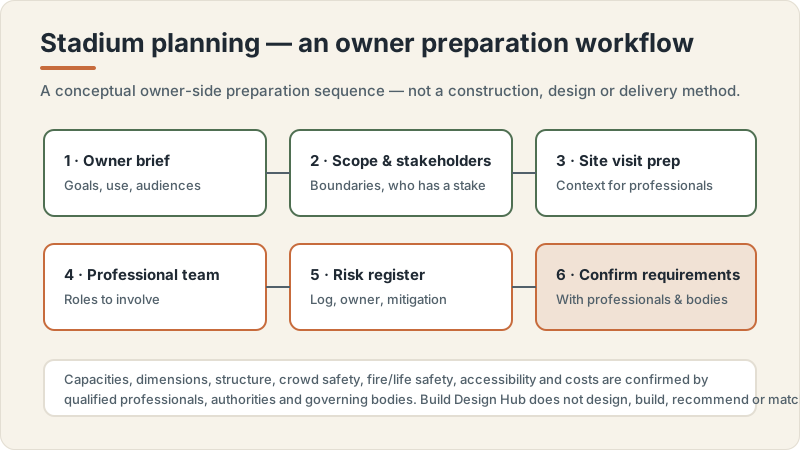
Stadium planning workflow concept
Conceptual editorial diagram — not a construction drawing, specification, to-scale plan or proof of a real project. It is not engineering, structural, fire/life-safety, crowd-safety or accessibility-compliance guidance. Capacities, dimensions, standards, requirements and costs vary by facility type, audience, site, use case and governing body, and are confirmed with qualified professionals, relevant authorities and governing bodies. Build Design Hub does not design, build, inspect, certify, recommend or match anyone.
What this guide helps you prepare
This guide helps you draft a scope outline for a stadium project: a structured description of what the project is intended to include, what it is intended to exclude, and where responsibility for each part is expected to sit. Rather than telling you what a stadium must contain, it gives you a way to record your current assumptions so they can be tested. A clear inclusion-and-exclusion picture, even a rough first draft, improves every later conversation, because the professionals you speak with can see the boundary you have in mind and tell you where it may need adjusting before it hardens into an expectation.
It also helps you think in terms of packages and the interfaces between them. A stadium is rarely delivered as a single undivided lump of work; project teams commonly break it into areas such as site preparation and groundworks, the playing surface or pitch system, the bowl and seating structures, roof and canopy elements, concourses and circulation, building services, lighting and audiovisual systems, hospitality and back-of-house fit-out, external works and car parking, and operational commissioning. Scope planning is largely about being honest regarding where one of those areas stops and the next begins, and who is assumed to be responsible at that line. This guide helps you capture those handover points as questions; it does not specify any element, set any capacity, dimension, load or standard, or describe how the work should be carried out.
- Record a plain-language statement of what the stadium project is intended to deliver, in your own words
- Capture which areas your group currently assumes are included and which are assumed excluded
- List the major packages of work you expect the project to be divided into
- Note the points where one package is expected to hand over to another
- Mark every assumption you are unsure about as a question for qualified professionals
- Keep the outline editable so it can change as professionals and authorities review it
Building a stadium inclusions and exclusions matrix
A practical way to organise stadium scope is a grid-style matrix: down one axis, the elements or zones of the venue; across the other, whether each is currently assumed in scope, out of scope, or undecided. The value of the matrix is not being correct on the first pass; it is making every undecided cell visible. An element you have not placed anywhere is exactly the kind of gap that later causes confusion, so the exercise forces each item into in, out or undecided and treats undecided as a live question for the professionals and authorities you engage. Because a stadium spans playing area, spectator areas, hospitality, back-of-house, external works and operations, the matrix can grow large; that breadth is the point, since it prevents whole zones from being silently assumed.
Exclusions deserve as much attention as inclusions. On a stadium it is common to assume something is part of the project simply because it is nearby or obviously needed, when in fact it may sit with a different party, a separate budget line, a later phase, a landlord, a governing body's own works, or outside the project entirely. Writing exclusions down explicitly, and noting your assumed reason for each, lets stakeholders challenge them before they become fixed expectations. The matrix is a preparation artefact for discussion only; it is not a specification, a schedule of works, a capacity statement or any kind of agreement, and it does not state what any element requires, how large it must be, or what it must comply with.
- List venue zones row by row: pitch or playing surface, bowl and seating structures, roof or canopy, concourses, services, lighting and AV, hospitality, back-of-house, external works, operations
- For each row, mark in scope, out of scope, or undecided rather than leaving it blank
- Write the assumed reason next to each exclusion so stakeholders can question it
- Flag any element that appears in two packages as a potential overlap or double-count
- Highlight items placed by guesswork as explicit questions to confirm with professionals
- Separate elements your group controls from elements that may depend on a landlord, authority or governing body
Mapping package interfaces and scope gaps
Once packages are listed, the higher-risk areas on a stadium project are usually the interfaces between them: the seams where, for example, groundworks meets the pitch system, where the seating bowl meets the roof structure, where structures meet building services and cabling, where concourses meet spectator seating, or where the venue's permanent systems meet temporary or event-overlay elements. Scope gaps tend to live at these seams because each package owner can reasonably assume the adjoining package will handle the boundary item. Preparing an interface list, even informally, lets you ask the right people the right questions, because you can point to a specific handover and ask who is assumed to be responsible on each side of it.
A useful preparation habit is to walk the project mentally from start to finish and note every transition where work or responsibility appears to pass from one party to another. For each transition, record what is assumed to cross the boundary, what is assumed to stay on each side, and whether anything in between is unassigned. The unassigned items are your candidate scope gaps, and on stadiums they often cluster around shared services, waterproofing lines, access and egress routes, and anything touching spectator areas that may involve a governing body or authority. This is an awareness exercise to inform discussion with qualified professionals; it is not a method for resolving responsibility, allocating risk, or instructing how interfaces should be built, sequenced or coordinated.
- List the major interfaces where one stadium package hands over to another
- For each interface, note what is assumed to cross and what stays on each side
- Identify any boundary item that is not clearly assigned to either package
- Record where timing or sequencing between packages is unclear to you
- Note interfaces that may involve a governing body, authority, landlord or third party
- Turn each unassigned or unclear interface into a question for qualified professionals
Planning questions before speaking with professionals
Before you bring in qualified professionals, it helps to organise your own thinking so the conversations are productive. The questions in this section are ones to ask yourself and your stakeholders: they are about clarifying intent, surfacing assumptions, and agreeing internally on what your group believes is in and out of scope for the stadium. Working through them requires no technical knowledge; it requires honesty about what you do and do not yet know, and a willingness to mark the uncertain items in your matrix rather than paper over them.
The goal of this internal preparation is to arrive at professional conversations with a scope outline that shows your assumptions clearly, including the parts you are unsure about. That makes it easier for advisors to focus on the genuine gaps and interfaces rather than reconstructing your basic intent. None of these questions produce final answers; they are inputs to a discussion, and every assumption they surface should still be confirmed with qualified professionals and any relevant authority or governing body for your sport and location.
- What, in plain words, is this stadium intended to be used for, by whom, and for which kinds of events?
- Which zones does our group currently assume are included, and on what basis?
- Which elements are we deliberately excluding, and why do we think they sit elsewhere?
- Where do we expect the project to be split into separate packages?
- At which handover points between packages are we least confident about who is responsible?
- Which scope assumptions would cause the biggest problem for us if they turned out to be wrong?
Questions for qualified professionals
When you engage qualified professionals, your stadium scope outline becomes a starting point for their input rather than a finished document. The questions in this section are framed for those conversations: they invite advisors to test your inclusions and exclusions, examine your package boundaries, and point out interfaces or scope gaps you may have missed. Because requirements vary by location, facility type, use case, governing body, owner, site, authority, professional team and project scope, the professionals you speak with are the right people to confirm what actually applies to your situation.
Treat their responses as guidance specific to your project and your jurisdiction, and expect your scope outline to change as a result. The questions below are prompts to help you get useful, project-specific input; they are not a checklist of requirements, and Build Design Hub does not provide the answers, recommend any approach, rank any option, or verify any party. Confirm everything that matters with qualified professionals, the relevant authorities and the applicable governing bodies.
- Looking at our inclusions and exclusions, where do you see scope that is missing, duplicated or wrongly placed?
- Which interfaces between packages tend to cause the most confusion on stadium projects like this?
- Where might responsibility for boundary items be unclear given how we have split the work?
- Which elements depend on a governing body, authority, approval or landlord we should confirm?
- How would you suggest we structure our scope so it can be compared fairly across quotes?
- What information would you need from us to assess whether this scope outline is complete?
What this does not replace
This is an educational planning resource only. It is not a stadium construction manual and not structural, architectural, seating or stand engineering, crowd-safety, crowd-flow, evacuation, fire or life-safety, or accessibility-compliance advice, and it is not permit, zoning, inspection, certification, legal, tax, insurance or procurement advice. It does not design, build, engineer, specify, certify, inspect or approve anything, gives no capacities, dimensions, loads, revenue, ROI or costs, and offers no warranty interpretation or estimate. Requirements, standards, capacities and costs vary by location, facility type, use case, governing body, owner, site, authority, professional team and project scope, and are confirmed with qualified professionals, relevant authorities and governing bodies.
Build Design Hub does not design, build, engineer, inspect, certify, recommend, rank, verify, introduce, broker or match suppliers, contractors, consultants or professionals, and HELPERG LLC is publisher/operator only. Use this resource to prepare your own thinking and briefs, then have qualified professionals you engage directly review your project. Decisions about design, engineering, structure, crowd safety, fire and life safety, accessibility, compliance, capacity, procurement and cost must rest on those professionals, the relevant authorities and the governing bodies for your sport and location.
- Not a stadium construction manual and not structural, architectural or seating/stand engineering
- Not crowd-safety, crowd-flow, evacuation, fire/life-safety or accessibility-compliance advice
- Not permit/zoning, inspection, certification, warranty-interpretation, legal, tax, insurance or procurement advice
- Not a supplier, contractor, consultant or professional recommendation, ranking, directory or matching service
- Not an estimate and gives no capacity, dimension, revenue, ROI or cost figures — requirements and costs vary
- Qualified professional review is required before any stadium project decision
Stadium scope matrix and interface register: what to record and ask
- 1Write a one-paragraph plain-language statement of what the stadium project is intended to deliver
- 2Record the intended uses, event types and stakeholders the venue is being scoped around
- 3List every zone and element down the rows of an inclusions-and-exclusions matrix
- 4Mark each row as in scope, out of scope, or undecided, leaving no cell blank
- 5Note the assumed reason beside every exclusion so stakeholders can challenge it
- 6List the major packages of work you expect the project to be divided into
- 7Record every interface where one package is assumed to hand over to another
- 8For each interface, capture what crosses the boundary and what stays on each side
- 9Flag boundary items that are not clearly assigned to either package as candidate scope gaps
- 10Flag any element that appears in two packages as a potential overlap or double-count
- 11Note which elements may depend on a governing body, authority, landlord or third party to confirm
- 12Mark every guessed or uncertain assumption as an explicit question for qualified professionals
- 13Keep a running list of scope questions to raise in stakeholder and professional conversations
- 14Version and date the matrix so it can be updated as professionals and authorities review it
Common mistakes to avoid
- Stating a capacity, dimension, load, gradient or lux level as if it were a fixed requirement, instead of a question to confirm with qualified professionals
- Assuming an element is included simply because it is nearby or obviously needed, without checking whether it sits with another party or phase
- Leaving matrix cells blank instead of forcing each element into in, out or undecided, which hides scope gaps
- Treating package interfaces as automatically covered by one side, so boundary items fall between two packages
- Double-counting an element that appears in two packages, or excluding it from both
- Writing exclusions without recording why, so stakeholders cannot challenge the assumption before it hardens
- Skipping professional review and treating the internal scope outline as a final specification or agreement
- Ignoring elements that may depend on a governing body, authority or landlord, and assuming they are within the project's control
When to involve a professional
- Before finalising any scope outline, so qualified professionals can test your inclusions, exclusions and package boundaries
- When an element could plausibly sit in more than one package, or in no package, and responsibility is unclear
- When any interface touches spectator areas, structures, roofs, egress routes or shared services that may involve a governing body or authority
- When scope decisions could interact with permits, zoning, code, accessibility, fire or life-safety matters that only qualified professionals and authorities can confirm
- When you need scope structured so quotes can be compared fairly, and want an advisor to review the structure
- When any assumption in your matrix would cause a significant problem for the project if it proved wrong
Frequently asked questions
Questions readers ask about this topic
Does Build Design Hub design, build, engineer, inspect, certify or match suppliers and contractors for stadium projects?
No. Build Design Hub does not design, build, engineer, inspect, certify, recommend, rank, verify, introduce, broker or match suppliers, contractors, consultants or professionals, and it gives no capacities, dimensions, loads, costs or requirements as fact. It is an educational planning resource only, published and operated by HELPERG LLC. Use it to prepare your own thinking, then have qualified professionals you engage directly review your project, and confirm anything that matters with those professionals, the relevant authorities and the applicable governing bodies.
Can this guide tell me what a stadium scope must include or exclude?
No. This guide helps you record what your group currently assumes is in and out of scope so those assumptions can be tested; it does not state what any stadium must contain. What actually applies depends on your location, facility type, use case, governing body, owner, site, authority, professional team and project scope, and only qualified professionals and the relevant authorities can confirm it for your situation.
How is a scope matrix different from a specification or a contract?
A scope matrix as described here is a preparation artefact for your own discussions: a grid that makes your inclusions, exclusions and undecided items visible. It is not a specification, schedule of works, capacity statement, quote or agreement of any kind, and it does not carry any legal or contractual weight. Developing an actual scope of works, specification or contractual document is work for qualified professionals you engage, and this guide does not provide legal, procurement or contract advice.
Why does this guide keep turning requirements into questions?
Because requirements vary by location, facility type, use case, governing body, owner, site, authority, professional team and project scope, and stating any figure or standard as fact could mislead you. Framing them as questions keeps the focus on what you should confirm with qualified professionals, relevant authorities and governing bodies, rather than on numbers this educational guide is not in a position to assert.
Keep reading