
Who this guide is for
- Owners and boards commissioning or refurbishing an indoor sports hall who need to frame a support-space brief
- Sports clubs planning a home venue and thinking through reception, offices and stores
- Schools and colleges scoping a sports hall alongside changing and first-aid needs
- Municipalities and community-facility teams preparing a project brief for public halls
- Developers and project managers assembling scope before engaging design professionals
- Facility managers who will operate the building and want operational needs captured early
Planning diagram
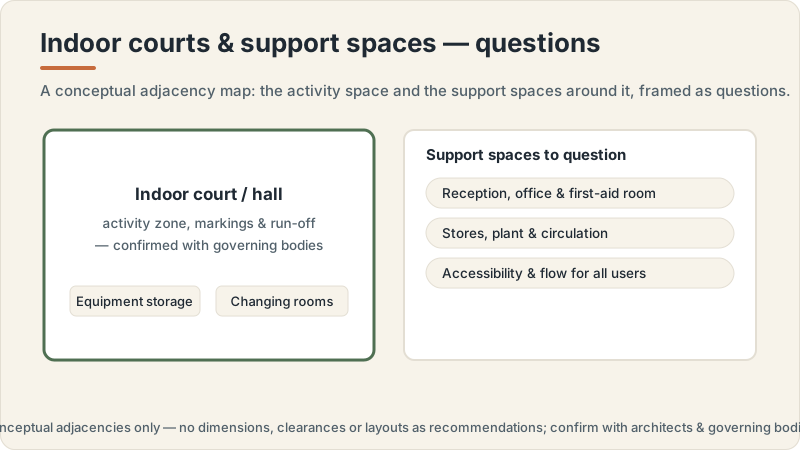
Indoor court and support-space planning concept
Conceptual editorial diagram — not a construction drawing, specification, to-scale plan or proof of a real project. It is not engineering, structural, fire/life-safety, crowd-safety or accessibility-compliance guidance. Capacities, dimensions, standards, requirements and costs vary by facility type, audience, site, use case and governing body, and are confirmed with qualified professionals, relevant authorities and governing bodies. Build Design Hub does not design, build, inspect, certify, recommend or match anyone.
What this guide helps you prepare
This guide helps you assemble the thinking and documentation you need before you sit down with architects and other qualified professionals about the spaces surrounding an indoor sports hall. It focuses on the support functions that wrap around the playing area, reception and entry, staff and booking offices, a first-aid or medical room, equipment and cleaning stores, and plant or service rooms, and it treats each as a topic to describe, question and hand to professionals rather than something to design here. The goal is a well-organised brief that captures how the hall will operate, not a set of drawings, dimensions or specifications.
Everything in this guide stays at the level of what to list, what to ask, and what documentation to request. It does not state room sizes, capacities, clearances, ventilation or lighting parameters, acoustic targets, fire or accessibility requirements, prices or timelines, because those depend on your specific location, facility type, use case, governing body, owner, site, authority, professional team and project scope, and must be confirmed with qualified professionals and the relevant authorities. By preparing your operational intent clearly, you give the professional team the context they need to make sound, code-aware decisions.
- Write down the main uses of the hall and the support functions each use implies
- List the support spaces you think you need without yet assigning sizes or specifications
- Capture who will use each space: public, players, staff, coaches, officials, contractors
- Note operational expectations such as opening hours, bookings and cleaning routines
- Identify which topics you already know must go to a qualified professional
- Assemble existing documents, site information and constraints to share with the design team
Mapping support spaces and how people move around the hall
A useful early step is to map the support functions around the hall against how people actually move through the building. Visitors, players, coaches, staff, officials and delivery or maintenance personnel often follow different routes, and the position of reception, offices, first-aid, changing and stores tends to follow those flows. Rather than deciding where anything goes, describe the journeys you expect: where people arrive, where they check in or pay, how they reach changing areas and the hall, and how equipment and deliveries move in and out. This gives architects a clear picture of intent while leaving the layout, routing and any compliance considerations to them.
Alongside movement, note adjacencies that matter to you operationally, for example wanting reception to have a view of the entrance, or stores to be reachable from the hall without crossing public areas. Frame these as preferences and questions rather than instructions, and be explicit that supervision, sightlines, separation of user groups, accessible routes and any safety-related arrangements are matters for qualified professionals to resolve against the relevant requirements. Requirements vary by location, facility type, use case, governing body, owner, site, authority, professional team and project scope; confirm with qualified professionals.
- List each user group and the route you expect them to take through the building
- Note where arrival, check-in, payment or booking should happen from an operational view
- Describe how equipment, deliveries and waste are expected to move in and out
- Record adjacencies you would prefer, such as reception near the entrance or stores near the hall
- Flag anything about supervision or separating user groups as a question for professionals
- Ask the design team how movement, sightlines and accessible routes will be handled
Framing each support function as an operational brief
Each support space is easier to discuss when you describe what happens inside it rather than what it should look like. For reception, that might mean who staffs it, what they do, and how visitors interact with it. For offices, it is which roles work there and what they need to function. For a first-aid or medical room, it is that you want a dedicated space and expect the design and any provision to follow professional guidance and relevant requirements, without you specifying contents, fittings or dimensions. For stores, it is what categories of equipment and materials need housing and how often they are accessed. For plant or service rooms, it is simply acknowledging that building systems need space and that their design belongs entirely to engineers.
Writing these operational briefs keeps ownership decisions with the owner and technical decisions with professionals. You are describing intended function, frequency of use, user groups and operational routines, all of which help the design team, while deliberately avoiding sizes, specifications, system design and compliance judgements. Be clear in your brief that anything touching structure, ventilation, lighting, acoustics, fire safety, accessibility, medical provision or storage of particular materials is to be confirmed with the appropriate qualified professionals and authorities.
- For reception: note staffing, visitor interactions and information or booking handled there
- For offices: list the roles, activities and general working needs you expect
- For a first-aid room: state that you want a dedicated space and will follow professional guidance
- For stores: list broad categories of equipment and how often each is accessed
- For plant rooms: acknowledge systems need space and defer their design to engineers
- Mark every technical or safety element as a question for qualified professionals to resolve
Planning questions before speaking with professionals
Before you engage architects and engineers, it helps to answer a set of questions among your own owner, operator and stakeholder group. These are decisions and preferences that only you can provide: how the hall will be programmed, who will run it, what the visitor experience should feel like, and how support functions fit your operating model. Getting alignment internally means the professional team receives one coherent brief rather than conflicting requests, and it reduces the chance of rework once design work begins.
Keep these questions focused on intent and operations, not on technical solutions. You are clarifying what you want the building to do and for whom, while leaving how it will be achieved, and whether it meets any requirements, to the professionals you will engage. Where a question starts to touch systems, safety, accessibility or code, note it as something to raise with the relevant professional rather than something to decide internally.
- What are the primary and secondary uses of the hall, and who are the main user groups?
- Who will operate the facility, and what support spaces does that operating model imply?
- How do you want visitors to experience arrival, reception and wayfinding?
- Which support functions are essential to your operation versus desirable if scope allows?
- What existing site information, constraints and documents can you provide to the team?
- Which topics do you already recognise must be handed to qualified professionals?
Questions for qualified professionals
When you meet architects, engineers and other specialists, your brief becomes the basis for their questions and yours. This is where technical, safety, accessibility and compliance matters belong. Rather than arriving with dimensions or system decisions, arrive with your operational intent and a list of things to confirm, so the professional team can advise on what is feasible, what is required, and what documentation you should expect at each stage. Build Design Hub does not design, engineer, inspect, certify or specify any of this, and does not recommend, rank or match professionals; these are conversations for the qualified team you engage.
Ask professionals to explain how each support space will be resolved against the relevant requirements, what governs those requirements in your location and for your facility type, and what records, drawings, approvals or certificates they will produce. Requesting documentation early, and asking who is responsible for each element, helps you plan handover and lifecycle needs later. Requirements vary by location, facility type, use case, governing body, owner, site, authority, professional team and project scope; confirm all of it with qualified professionals and the relevant authorities and governing bodies.
- How will support-space layout, sizing and adjacencies be determined for our facility type?
- Which authorities, codes and governing bodies apply to this project and who confirms them?
- How will ventilation, lighting, acoustics and temperature for these spaces be addressed?
- How are accessibility, fire and life-safety, and first-aid provision handled and by whom?
- What drawings, specifications, approvals and certificates will be produced and when?
- Who is responsible for each system, and what handover and maintenance documentation will we receive?
What this does not replace
This is an educational planning resource only. It is not an indoor sports facility construction manual and not structural or architectural design, HVAC/ventilation, lighting or acoustic engineering, fire or life-safety, or accessibility-compliance advice, and it is not permit, zoning, inspection, certification, legal, tax, insurance or procurement advice. It does not design, build, engineer, specify, size, certify, inspect or approve anything, gives no capacities, dimensions, clearances, lux, air-change rates, acoustic or temperature thresholds, revenue, ROI or costs, and offers no warranty interpretation or estimate. Requirements, standards, capacities and costs vary by location, facility type, use case, governing body, owner, site, authority, professional team and project scope, and are confirmed with qualified professionals, relevant authorities and governing bodies.
Build Design Hub does not design, build, engineer, inspect, certify, recommend, rank, verify, introduce, broker or match suppliers, contractors, consultants or professionals, and HELPERG LLC is publisher/operator only. Use this resource to prepare your own thinking and briefs, then have the qualified professionals you engage directly — architects, structural and building-services engineers, lighting, acoustic, accessibility and fire/life-safety specialists, and legal or procurement advisors where appropriate — review your project. Decisions about design, engineering, systems, safety, accessibility, compliance, capacity, procurement and cost must rest on those professionals, the relevant authorities and the governing bodies for your sport and location.
- Not an indoor sports facility construction manual and not structural or architectural design
- Not HVAC/ventilation, lighting or acoustic engineering, fire/life-safety or accessibility-compliance advice
- Not permit/zoning, inspection, certification, warranty-interpretation, legal, tax, insurance or procurement advice
- Not a supplier, contractor, consultant or professional recommendation, ranking, directory or matching service
- Not an estimate and gives no capacity, dimension, system-performance, revenue, ROI or cost figures — requirements and costs vary
- Qualified professional review is required before any indoor sports facility project decision
Support-space preparation worksheet
- 1Record the primary and secondary uses of the hall and the user groups each implies
- 2List every support space you think the operation needs, without assigning sizes or specifications
- 3Note who staffs and uses each support function and how often it is accessed
- 4Map expected movement routes for visitors, players, staff, officials and deliveries
- 5Write down operational preferences such as opening hours, bookings, cleaning and waste handling
- 6Capture desired adjacencies as preferences to discuss, not as fixed instructions
- 7Gather existing site information, plans, constraints and any prior reports to share
- 8Mark which topics you already know must go to qualified professionals and authorities
- 9Prepare an operational brief for reception, offices, first-aid, stores and plant separately
- 10List the documentation you will request from professionals at each stage
- 11Note questions about accessibility, safety and building systems to raise with specialists
- 12Record who in your group owns each decision and where stakeholder alignment is still needed
- 13Identify handover and lifecycle information you will want captured for operations later
- 14Assemble your questions for professionals into one organised list before engaging them
Common mistakes to avoid
- Stating room sizes, capacities or clearances in the brief instead of leaving them to professionals
- Assuming a requirement applies without confirming it with the relevant authority or governing body
- Treating ventilation, lighting or acoustic decisions as owner choices rather than professional design
- Specifying first-aid room contents or fittings instead of deferring to professional guidance
- Deciding layout and adjacencies as instructions rather than framing them as preferences to discuss
- Skipping internal stakeholder alignment, so the professional team receives conflicting requests
- Overlooking plant, service and storage space in the brief because it is not user-facing
- Postponing questions about documentation and handover until after design is well underway
When to involve a professional
- When any decision touches structure, ventilation, lighting, acoustics or temperature, involve the relevant engineer or designer
- When accessibility, fire and life-safety, or first-aid provision are in scope, involve qualified professionals and authorities
- When you need to know which codes, permits or governing bodies apply, confirm with professionals and the relevant authority
- When support-space layout, sizing or adjacencies must be resolved, engage an architect or design team
- When medical, hazardous-material or specialist storage needs arise, seek professional and authority guidance
- When you need drawings, approvals, certificates or handover documentation, ask the responsible qualified professional
Frequently asked questions
Questions readers ask about this topic
Does Build Design Hub design, build or certify the support spaces around a sports hall?
No. Build Design Hub is an educational resource that helps you prepare a brief and questions. It does not design, build, engineer, inspect, certify or specify anything, does not design HVAC, lighting or acoustic systems, and does not recommend, rank, verify or match suppliers, contractors or professionals. It also gives no capacities, dimensions, costs or requirements. Those all come from qualified professionals and the relevant authorities.
How big should a reception, first-aid room or store be?
This guide does not provide sizes, dimensions or capacities, because they depend on your location, facility type, use case, governing body, owner, site, authority, professional team and project scope. Describe how each space will be used and ask a qualified architect or design team to determine sizing against the applicable requirements.
Can I decide the ventilation, lighting or acoustics for these rooms myself?
No. Those are professional design matters, not owner decisions. You can describe how spaces will be used and then ask the relevant engineers and designers how each system will be addressed and what documentation they will provide. Requirements vary and must be confirmed with qualified professionals and authorities.
What should I bring to a first meeting with an architect?
Bring your operational brief: the hall's uses, user groups, expected movement routes, support functions, adjacency preferences, and any site information or constraints you have. Also bring your list of questions and the topics you know need professional input, so technical, safety and compliance matters can be discussed with the right specialists.
Keep reading