
Who this guide is for
- Owners, clubs and associations planning a new indoor sports hall, gym or multi-purpose training space
- Schools and education bodies scoping a sports hall, indoor court or shared-use facility
- Municipalities and public bodies preparing community indoor sports and recreation projects
- Developers and project sponsors assembling an accessibility-aware project brief
- Project teams and coordinators organising stakeholder input and specialist engagement
- Facility managers preparing operational and lifecycle considerations for inclusive use
Planning diagram
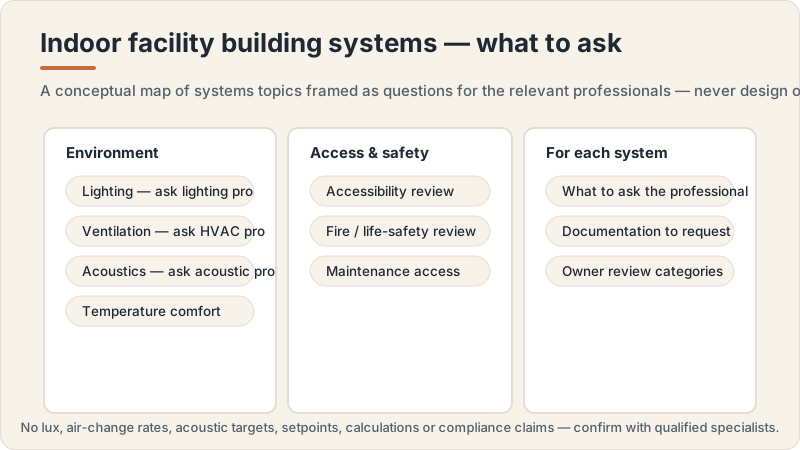
Indoor facility building-systems questions concept
Conceptual editorial diagram — not a construction drawing, specification, to-scale plan or proof of a real project. It is not engineering, structural, fire/life-safety, crowd-safety or accessibility-compliance guidance. Capacities, dimensions, standards, requirements and costs vary by facility type, audience, site, use case and governing body, and are confirmed with qualified professionals, relevant authorities and governing bodies. Build Design Hub does not design, build, inspect, certify, recommend or match anyone.
What this guide helps you prepare
Engaging an accessibility specialist goes far more smoothly when you arrive with a clear picture of who will use the facility, how the site is arranged, and what your project is trying to achieve. This guide helps you assemble that picture: the range of participants, spectators, staff and visitors you hope to serve; the journey they take from arrival through activity and back; and the spaces where accessibility questions tend to concentrate, such as entrances, circulation routes, changing and support rooms, activity areas and spectator zones. Preparing this context does not resolve any accessibility question, but it lets a specialist focus their expertise on your specific situation rather than on gathering basics.
The guide also helps you separate what you can reasonably decide as an owner, such as your inclusion aspirations and the user groups you want to prioritise, from what must be confirmed by qualified professionals and the relevant authorities, such as any technical requirement, dimension or standard. Throughout, the emphasis is on framing questions and identifying documentation to request. It deliberately avoids stating any requirement, measurement or compliance position, because those vary by location, facility type, use case, governing body, owner, site, authority, professional team and project scope, and are confirmed only through qualified review.
- A description of your intended participants, spectators, staff and visitors, kept as ranges rather than assumptions
- A simple map of the arrival-to-activity journey across your indoor spaces
- A list of the spaces where accessibility questions tend to concentrate for your facility
- A clear split between owner aspirations and matters that require professional and authority confirmation
- A running list of open questions to raise with an accessibility specialist
- Notes on what documentation and review outputs you plan to request
Where accessibility questions concentrate in an indoor facility
Indoor sports facilities present a recognisable set of zones where accessibility considerations tend to gather, and mapping these zones helps you prepare rather than prescribe. Common areas of focus include external approach and parking arrangements, the entrance and reception, horizontal and vertical circulation between levels, changing rooms and toilets, showers and support spaces, the activity floor itself, and spectator or waiting areas. Reception, wayfinding, signage, alarm and communication systems, and the interface between the building and its management all raise questions too. Listing these zones for your own facility gives a specialist a shared map to work from.
It is important to treat this as a prompt for questions, not a set of answers. How any of these zones should be handled depends on the specialist's assessment, the design professionals' work and the applicable authorities and governing bodies, and it varies by location, facility type, use case, owner, site and project scope. This guide does not state how any zone should be arranged, what dimensions or clearances apply, or whether any arrangement meets a requirement. Instead, it encourages you to record where questions arise so nothing is overlooked when the qualified review takes place.
- Which arrival and external approach elements do you want a specialist to review, and how should they connect to the entrance?
- How will you describe your circulation needs between entrance, activity areas and support rooms without assuming a solution?
- What questions do you have about changing, toilet, shower and support spaces for a range of users?
- How should spectator, waiting and social areas be considered for varied participants and visitors?
- What wayfinding, signage, alarm and communication questions should be raised with the specialist and design team?
- Which zones feel uncertain to you, and which should be flagged as priorities for professional review?
Framing inclusive intent without stating requirements
Owners can and should articulate what inclusive use means for their project: the participants they hope to welcome, the activities they want to be usable by as many people as possible, and the experience they want visitors to have. Framing this intent clearly is genuinely useful, because it tells the specialist and design team what you are trying to achieve and lets them advise on how it can be pursued. The key discipline is to express intent as aspiration and priority, not as a technical instruction, and to keep any question about how it is delivered firmly in the hands of qualified professionals and the relevant authorities.
This means avoiding statements about dimensions, ratios, clearances, counts or any standard, and instead recording open questions. Rather than deciding how an arrangement should work, note that you want it reviewed and confirmed. Rather than assuming a requirement applies or does not, ask the specialist to confirm what applies to your facility, location and use case. Because requirements vary by location, facility type, use case, governing body, owner, site, authority, professional team and project scope, this framing keeps your brief honest and keeps responsibility where it belongs. It also makes quote comparison clearer, because specialists respond to the same well-scoped intent rather than to guesses.
- Have you written your inclusion aspirations as priorities and user groups rather than technical specifications?
- Where you feel tempted to state a number or arrangement, have you converted it into a question for the specialist?
- Have you noted which governing bodies, authorities or funders may have a view, so the specialist can confirm what applies?
- Have you kept any 'must have' framed as an intent to be confirmed rather than a stated requirement?
- Have you asked the specialist to identify requirements you may not be aware of, rather than assuming your list is complete?
- Have you recorded assumptions explicitly so they can be tested rather than carried silently into design?
Planning questions before speaking with professionals
Before engaging an accessibility specialist, it helps to work through questions you can answer internally, because clarity here shapes the whole review. These are not technical questions; they are about your project's context, intentions and constraints. Who do you expect to use the facility, and in what roles? What activities and events do you anticipate, and how might that change over time? What is already fixed about your site or building, and what remains open? Working through these questions turns a vague ambition into a brief a specialist can respond to precisely.
It also helps to plan how you will organise the engagement itself: what you want the review to cover, at which project stages you want specialist input, how findings will feed the design team, and how you will keep an audit trail of advice and decisions. None of this substitutes for the specialist's judgement, and none of it should state or assume any requirement. Its purpose is to make sure that when you do engage qualified professionals, they receive a coherent picture and can focus on the questions that only they can answer for your location, facility type, use case and authorities.
- Who are the intended participants, spectators, staff and visitors, and what roles and needs should be considered?
- What activities and events are anticipated now, and how might use evolve over the facility's life?
- What is already fixed about the site or building, and what is still open to influence?
- At which project stages do you want accessibility input, and how will findings reach the design team?
- How will you record advice, assumptions and decisions to maintain a clear audit trail?
- What stakeholders, user representatives or governing bodies should be consulted as part of preparation?
Questions for qualified professionals
Once you engage an accessibility specialist and the wider design team, the goal is to ask questions that surface responsibilities, scope, methodology and documentation rather than to seek a shortcut around professional judgement. Useful questions clarify what the specialist will assess, which authorities and governing bodies they will confirm requirements with, how their advice will be recorded, and how it will coordinate with the architects, engineers and other consultants. Asking what documentation you will receive, and how it should be retained for later stages, helps you hold a clear trail of advice through design, construction, handover and operation.
It is equally important to ask what falls outside a given professional's scope, so gaps are visible early, and to confirm how accessibility findings interact with other building-systems decisions handled by different specialists. Because requirements vary by location, facility type, use case, governing body, owner, site, authority, professional team and project scope, the questions below are prompts to confirm matters with qualified professionals and the relevant authorities, not requests for this guide to state any requirement. Build Design Hub does not perform, verify or certify any of this work; it only helps you prepare to ask.
- What will your accessibility review cover, and what falls outside your scope for this project?
- Which authorities, governing bodies and standards will you confirm requirements against for our facility and location?
- What documentation, reports or review outputs will we receive, and how should we retain them for later stages?
- How will your findings coordinate with the architect, engineers and other building-systems specialists?
- What assumptions in our brief should we test, and what requirements might we be unaware of?
- At which stages do you recommend re-review, and how will changes during design or construction be handled?
What this does not replace
This is an educational planning resource only. It is not an indoor sports facility construction manual and not structural or architectural design, HVAC/ventilation, lighting or acoustic engineering, fire or life-safety, or accessibility-compliance advice, and it is not permit, zoning, inspection, certification, legal, tax, insurance or procurement advice. It does not design, build, engineer, specify, size, certify, inspect or approve anything, gives no capacities, dimensions, clearances, lux, air-change rates, acoustic or temperature thresholds, revenue, ROI or costs, and offers no warranty interpretation or estimate. Requirements, standards, capacities and costs vary by location, facility type, use case, governing body, owner, site, authority, professional team and project scope, and are confirmed with qualified professionals, relevant authorities and governing bodies.
Build Design Hub does not design, build, engineer, inspect, certify, recommend, rank, verify, introduce, broker or match suppliers, contractors, consultants or professionals, and HELPERG LLC is publisher/operator only. Use this resource to prepare your own thinking and briefs, then have the qualified professionals you engage directly — architects, structural and building-services engineers, lighting, acoustic, accessibility and fire/life-safety specialists, and legal or procurement advisors where appropriate — review your project. Decisions about design, engineering, systems, safety, accessibility, compliance, capacity, procurement and cost must rest on those professionals, the relevant authorities and the governing bodies for your sport and location.
- Not an indoor sports facility construction manual and not structural or architectural design
- Not HVAC/ventilation, lighting or acoustic engineering, fire/life-safety or accessibility-compliance advice
- Not permit/zoning, inspection, certification, warranty-interpretation, legal, tax, insurance or procurement advice
- Not a supplier, contractor, consultant or professional recommendation, ranking, directory or matching service
- Not an estimate and gives no capacity, dimension, system-performance, revenue, ROI or cost figures — requirements and costs vary
- Qualified professional review is required before any indoor sports facility project decision
Accessibility review preparation worksheet
- 1Record the intended participants, spectators, staff and visitors as ranges of user needs, not fixed assumptions
- 2Map the arrival-to-activity journey across entrance, circulation, support rooms, activity floor and spectator areas
- 3List the indoor zones where you expect accessibility questions to concentrate for your facility
- 4Write your inclusion aspirations as priorities and user groups rather than technical specifications
- 5Note any point where you were tempted to state a dimension or arrangement, and convert it into a question
- 6Gather what is already fixed about the site or building and what remains open to influence
- 7List the governing bodies, authorities, funders and user representatives that may have a view
- 8Record your open accessibility questions in one place to raise with a specialist
- 9Identify at which project stages you want accessibility input and re-review
- 10Note how specialist findings will reach the design team and be coordinated across disciplines
- 11Prepare a list of documentation and review outputs you plan to request
- 12Set up a decision and advice log to maintain an audit trail through the project
- 13Flag the zones or questions that feel most uncertain as priorities for professional confirmation
- 14Confirm that no requirement, dimension, ratio or standard has been assumed rather than referred to professionals
Common mistakes to avoid
- Stating a dimension, clearance, ratio or count as fixed rather than a question to confirm with a qualified specialist
- Assuming a requirement applies, or does not apply, without asking the specialist to confirm what applies to your facility and location
- Treating accessibility as an owner's design decision rather than a matter for qualified professionals and authorities
- Leaving accessibility until late in the project instead of raising it early and revisiting it at each stage
- Carrying unspoken assumptions into the brief instead of recording them so they can be tested
- Assuming one authority or governing body covers everything, and skipping confirmation of who else has a view
- Skipping professional review because a space looks straightforward or was copied from another facility
- Losing the audit trail of advice and decisions, so later stages cannot show how accessibility was handled
When to involve a professional
- When you are ready to confirm what accessibility requirements apply to your facility, location, use case and authorities
- When any arrangement, dimension or standard is being considered, since these must be assessed by qualified professionals
- When the design begins to affect entrances, circulation, changing and support rooms, activity areas or spectator zones
- When multiple building-systems decisions interact and need coordinated professional review
- When a change during design, procurement or construction may affect accessibility outcomes
- When you need documentation, findings or confirmations retained for handover, operation and lifecycle records
Frequently asked questions
Questions readers ask about this topic
Does this guide tell me what accessibility requirements apply to my sports hall?
No. This is an educational preparation guide only. It does not state any requirement, dimension, ratio, clearance or standard, because these vary by location, facility type, use case, governing body, owner, site, authority, professional team and project scope. You confirm what applies with qualified accessibility specialists, your design team and the relevant authorities.
Can Build Design Hub design, review or certify accessibility for my facility, or recommend a specialist?
No. Build Design Hub does not design, build, engineer, inspect, certify or verify any work, does not design HVAC, lighting, acoustic or accessibility solutions, and does not recommend, rank, match or introduce suppliers, contractors or consultants. It gives no capacities, dimensions, costs or requirements. This guide only helps you prepare to engage qualified professionals yourself.
How early should accessibility be considered in an indoor sports facility project?
As a general planning matter, accessibility tends to be easier to address when it is discussed early and revisited at each stage rather than added late, because it runs through many parts of a project. How and when it is handled for your specific facility should be confirmed with qualified professionals and the applicable authorities.
What should I bring to a first meeting with an accessibility specialist?
A description of intended users, a simple map of the arrival-to-activity journey, a list of zones where questions concentrate, your inclusion aspirations framed as priorities rather than specifications, and your open questions and assumptions. This lets the specialist focus their expertise on your situation, but it does not replace their assessment.
Keep reading