
Who this guide is for
- Facility owners and operators scoping an indoor sports hall, gym or multi-purpose training space
- Schools, colleges and municipalities planning a shared or community sports facility
- Sports clubs preparing a brief before speaking with lighting or design professionals
- Developers and project teams assembling scope and documentation requests for a project
- Facility managers preparing for operation, maintenance and handover conversations
- Anyone comparing quotes who wants a consistent structure for lighting-related questions
Planning diagram
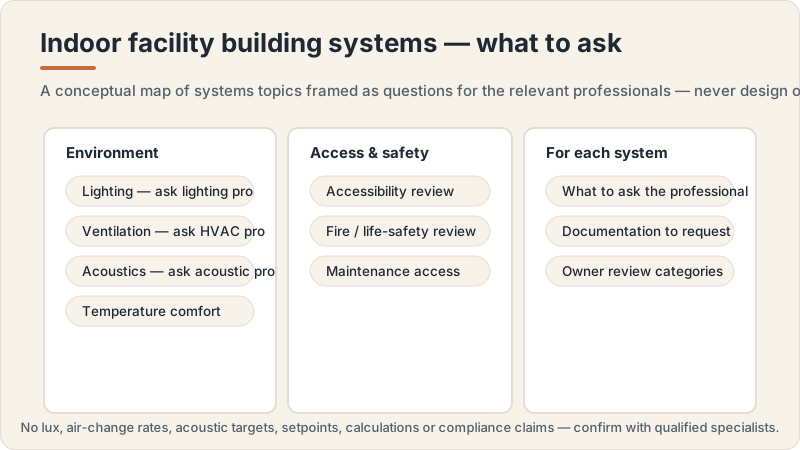
Indoor facility building-systems questions concept
Conceptual editorial diagram — not a construction drawing, specification, to-scale plan or proof of a real project. It is not engineering, structural, fire/life-safety, crowd-safety or accessibility-compliance guidance. Capacities, dimensions, standards, requirements and costs vary by facility type, audience, site, use case and governing body, and are confirmed with qualified professionals, relevant authorities and governing bodies. Build Design Hub does not design, build, inspect, certify, recommend or match anyone.
What this guide helps you prepare
This guide helps you prepare the questions, briefing notes and documentation requests that make a lighting conversation productive. Indoor sports facilities host varied activities across the same floor, and each may carry different expectations that only a qualified professional can interpret against the relevant governing bodies. Rather than deciding anything about lighting yourself, the goal here is to arrive at those conversations able to describe your intended uses, your constraints and your open questions clearly, so professionals can advise within their scope.
The material stays deliberately at the level of preparation. It does not tell you what light levels, uniformity, glare control or product choices your facility needs, because those depend on factors that vary by location, facility type, use case, governing body, owner, site, authority, professional team and project scope. Instead it helps you capture what you know, flag what you do not, and structure how you will ask. Every technical answer belongs to the professionals and authorities you engage, and this guide is not a substitute for their input.
- List the intended sports and activities so professionals understand the range of uses your lighting conversation must cover
- Record whether competitive play, broadcast, streaming or spectator use is intended, and note these as questions for governing bodies
- Note flexible or multi-purpose use, since a single space may host several activities with different considerations
- Capture site facts you can observe, such as room shapes and existing fixtures, without interpreting what they require
- Separate what is a confirmed brief item from what is an open question needing professional input
- Gather any existing drawings, prior reports or governing-body correspondence to share with professionals
Understanding your lighting brief and the professionals involved
A useful lighting brief for an indoor sports facility describes intent, not solutions. It sets out the activities you plan to host, who will use the space and when, whether competitive or televised use is anticipated, and any operational goals such as ease of maintenance or flexible zoning between courts. It also records constraints you already know, such as an existing structure, a heritage consideration or a shared community timetable. The brief is a communication tool: it gives lighting professionals the context they need to advise, and it gives you a stable reference when comparing what different professionals propose.
Several kinds of professionals may contribute, and their roles differ by project. A lighting designer or electrical engineer may address the lighting scheme; an architect may coordinate it with the building; a governing body may set expectations for a given sport; and an installer or contractor delivers the work. This guide does not tell you which professionals your project needs or how their scopes divide, because that varies by project scope, site and authority. It helps you ask each professional to define their own role, deliverables and limits, so responsibilities are clear and nothing important falls between them.
- Ask each professional to describe their scope, deliverables and what falls outside their responsibility
- Ask which governing bodies or authorities they will confirm expectations with, and which are yours to approach
- Ask how the lighting scope coordinates with structure, ventilation, acoustics and other building systems
- Record which decisions are professional determinations versus owner preferences, and keep the distinction clear
- Ask what information they need from you before they can advise, and gather it in advance
- Confirm in writing who is responsible for confirming any sport-specific or authority requirements
Documentation to request and organise
Documentation is where a lighting conversation becomes durable and comparable. Rather than relying on verbal assurances, ask professionals to describe, in writing, what they will produce, what standards or governing-body sources they are working to, and what they are explicitly not covering. Requesting the list of deliverables early lets you compare professionals on a like-for-like basis and gives you a record you can revisit at handover. This guide does not define what any document should contain or conclude; it helps you ask for the right documents and keep them organised for the people who will operate and maintain the facility later.
Think across the whole project life when you request documentation, not just the design stage. Ask what will exist at briefing, what will be handed over on completion, and what the facility team will need for ongoing operation, maintenance and future replacement. Ask professionals to state any assumptions their documents rely on, so future readers understand the context. Because requirements and appropriate documentation vary by location, facility type, governing body, authority and project scope, treat every documentation request as a question to confirm with the relevant professionals rather than a fixed list you can finalise alone.
- Request a written scope statement listing what each professional will and will not deliver
- Ask which governing-body or authority sources any advice is based on, without asking this guide to interpret them
- Request a documented list of assumptions behind any professional advice or scheme
- Ask what operation and maintenance documentation will be handed over, and in what format
- Request records that a facility manager would need for future maintenance or replacement decisions
- Ask how documentation will be kept current if the intended use of the space changes later
Planning questions before speaking with professionals
Before you approach lighting professionals, work through the questions you can answer internally so your brief is as clear as possible. These are not technical questions; they are about intent, use and constraint. Clarifying who will use the space, for what, and how flexibly, helps professionals advise efficiently and helps you avoid paying for guesswork about your own priorities. Writing these answers down also surfaces disagreements among stakeholders early, while they are still cheap to resolve, rather than after a scheme is underway.
Equally important is separating what you know from what you must ask. It is tempting to assume a light level, a fixture type or a compliance outcome, but those assumptions can quietly steer a project in the wrong direction. Instead, mark every technical or requirement question as one to confirm with qualified professionals and governing bodies. The aim of this stage is a clean brief and a clear list of open questions, not a set of answers you have decided for yourself.
- Which sports, training and non-sport activities do you intend the space to host, now and foreseeably?
- Is competitive, televised, streamed or spectator use anticipated, and which body governs each activity?
- Who are the stakeholders whose priorities must be reconciled before the brief is finalised?
- What existing constraints do you already know, such as structure, heritage, shared use or operating hours?
- Which items are confirmed brief decisions, and which are open questions for professionals to answer?
- Have you gathered existing drawings, reports and correspondence to share, without interpreting them yourself?
Questions for qualified professionals
When you speak with lighting professionals, keep your questions focused on their scope, their sources and their deliverables rather than pressing for numbers you would then treat as fixed. Ask how they establish what a given activity needs, which governing bodies or authorities they confirm expectations with, and how they handle a space used for several activities. Ask them to explain trade-offs in plain language and to note where a decision depends on information you have not yet provided. Good professionals will welcome clear questions and will be explicit about the limits of their advice.
Use these conversations to test coordination and continuity as well as the lighting itself. Ask how the lighting scope interacts with other building systems, how the work will be verified as part of the wider project, and what the facility will need to operate and maintain it over time. Because everything specific varies by location, facility type, use case, governing body, owner, site, authority, professional team and project scope, treat professional answers as authoritative for your project and this guide as preparation only. Confirm anything involving requirements, standards or suitability directly with those professionals and the relevant governing bodies.
- How do you determine what each intended activity needs, and which governing bodies do you confirm that with?
- How do you approach a multi-purpose space where different activities may have different considerations?
- What documentation will you produce, and what does it explicitly not cover?
- How does the lighting scope coordinate with structure, ventilation, acoustics and other systems?
- What information do you need from us before you can advise, and what assumptions will you record?
- What will the facility team need to operate, maintain and later replace elements of the lighting?
What this does not replace
This is an educational planning resource only. It is not an indoor sports facility construction manual and not structural or architectural design, HVAC/ventilation, lighting or acoustic engineering, fire or life-safety, or accessibility-compliance advice, and it is not permit, zoning, inspection, certification, legal, tax, insurance or procurement advice. It does not design, build, engineer, specify, size, certify, inspect or approve anything, gives no capacities, dimensions, clearances, lux, air-change rates, acoustic or temperature thresholds, revenue, ROI or costs, and offers no warranty interpretation or estimate. Requirements, standards, capacities and costs vary by location, facility type, use case, governing body, owner, site, authority, professional team and project scope, and are confirmed with qualified professionals, relevant authorities and governing bodies.
Build Design Hub does not design, build, engineer, inspect, certify, recommend, rank, verify, introduce, broker or match suppliers, contractors, consultants or professionals, and HELPERG LLC is publisher/operator only. Use this resource to prepare your own thinking and briefs, then have the qualified professionals you engage directly — architects, structural and building-services engineers, lighting, acoustic, accessibility and fire/life-safety specialists, and legal or procurement advisors where appropriate — review your project. Decisions about design, engineering, systems, safety, accessibility, compliance, capacity, procurement and cost must rest on those professionals, the relevant authorities and the governing bodies for your sport and location.
- Not an indoor sports facility construction manual and not structural or architectural design
- Not HVAC/ventilation, lighting or acoustic engineering, fire/life-safety or accessibility-compliance advice
- Not permit/zoning, inspection, certification, warranty-interpretation, legal, tax, insurance or procurement advice
- Not a supplier, contractor, consultant or professional recommendation, ranking, directory or matching service
- Not an estimate and gives no capacity, dimension, system-performance, revenue, ROI or cost figures — requirements and costs vary
- Qualified professional review is required before any indoor sports facility project decision
Indoor sports facility lighting preparation worksheet
- 1Record the full list of sports, training and non-sport activities the space is intended to host
- 2Note whether competitive, televised, streamed or spectator use is anticipated, and which body governs each
- 3Document any multi-purpose or flexible-use expectations across the same floor area
- 4Gather existing drawings, prior reports and governing-body correspondence to share with professionals
- 5List the stakeholders whose priorities must be reconciled before finalising the brief
- 6Capture known site constraints you can observe, without interpreting what they require
- 7Separate confirmed brief items from open questions needing professional input
- 8Prepare a request for each professional to state their scope and what falls outside it
- 9Prepare a request for the list of documents each professional will deliver and when
- 10Note which governing bodies or authorities you must approach and which the professional will
- 11Record which decisions are professional determinations rather than owner preferences
- 12Prepare questions about how the lighting scope coordinates with other building systems
- 13List the operation, maintenance and handover documents to request for the facility team
- 14Keep every requirement, standard or number as a question to confirm with professionals and governing bodies
Common mistakes to avoid
- Stating a light level, fixture type or uniformity figure as fixed instead of a question for professionals
- Assuming a single lighting approach suits every activity in a multi-purpose space
- Treating a lighting or compliance decision as the owner's to make rather than a professional's
- Deciding competitive or broadcast expectations internally instead of confirming with governing bodies
- Skipping written scope and documentation requests in favour of verbal assurances
- Overlooking operation, maintenance and handover documentation until the project is nearly finished
- Interpreting existing drawings or prior reports without qualified professional review
- Assuming requirements are the same as another facility rather than confirming for your own site and use
When to involve a professional
- When any decision depends on a light level, standard, threshold or requirement, involve a qualified lighting professional
- When competitive, televised or spectator use is anticipated, confirm expectations with the relevant governing bodies
- When the space is multi-purpose and different activities may have different considerations, seek professional advice
- When lighting must coordinate with structure, ventilation, acoustics or other systems, involve the appropriate professionals
- When existing drawings, fixtures or prior reports need interpretation, have them reviewed by qualified professionals
- When documentation, assumptions or compliance outcomes are unclear, ask professionals and authorities to confirm them
Frequently asked questions
Questions readers ask about this topic
Does this guide tell me what light levels or lighting my indoor sports facility needs?
No. It contains no lux levels, calculations, design layouts, product specifications or performance thresholds, and it makes no such statements as fact. Those depend on your location, facility type, use case, governing body, owner, site, authority, professional team and project scope, and must be confirmed with qualified professionals and the relevant governing bodies. This guide only helps you prepare questions and documentation requests.
Does Build Design Hub design, build, inspect or recommend suppliers for my project?
No. Build Design Hub, operated by HELPERG LLC, is an educational publisher. It does not design, build, engineer, inspect, certify or interpret compliance, does not design lighting, HVAC or acoustic systems, and does not recommend, rank, verify or match suppliers, contractors or professionals. It provides no capacities, dimensions, costs or requirements. Engage your own qualified professionals for all of that.
How should I use the questions in this guide?
Use them to build a clear brief and a list of open questions before you speak with professionals, and to structure documentation requests so you can compare responses consistently. Treat every answer a professional gives as authoritative for your project, and confirm anything involving requirements, standards or suitability with those professionals and governing bodies.
Can I skip governing bodies if the facility is only for casual or community use?
That is not a decision to make from this guide. Whether and which governing bodies or authorities apply depends on your activities, location and intended use, and should be confirmed with qualified professionals and the relevant bodies. Recording your intended uses and asking that question early keeps your options clear.
Keep reading