
Who this guide is for
- Owners and developers scoping an indoor sports hall, gym or multi-purpose training facility who need to prepare informed questions.
- Sports clubs and community organisations planning a new indoor space or an upgrade to an existing one.
- Schools and education bodies preparing a brief for an indoor sports hall or activity space.
- Municipalities and public-sector project teams organising stakeholder discussions around building systems.
- Facility managers preparing for handover, operations and lifecycle conversations about ventilation.
- Project teams and coordinators assembling documentation to compare professional advice and quotes.
Planning diagram
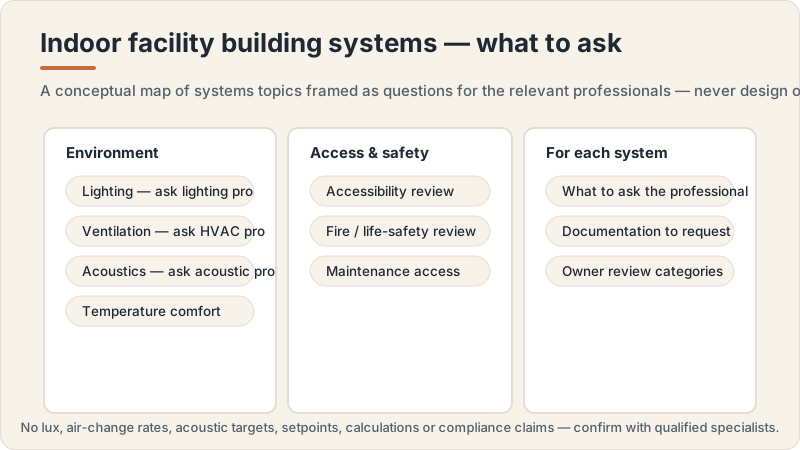
Indoor facility building-systems questions concept
Conceptual editorial diagram — not a construction drawing, specification, to-scale plan or proof of a real project. It is not engineering, structural, fire/life-safety, crowd-safety or accessibility-compliance guidance. Capacities, dimensions, standards, requirements and costs vary by facility type, audience, site, use case and governing body, and are confirmed with qualified professionals, relevant authorities and governing bodies. Build Design Hub does not design, build, inspect, certify, recommend or match anyone.
What this guide helps you prepare
This guide helps you arrive at conversations with ventilation and HVAC professionals with a clearer picture of your facility, its intended uses and the questions worth raising early. Indoor sports spaces are used differently from ordinary buildings: activity levels, occupancy patterns, spectator presence, moisture from showers and changing areas, and equipment can all influence how the space is used and maintained over time. Understanding the shape of your project, rather than the technical solution, is what a non-specialist can responsibly prepare. This guide helps you describe your intended use so professionals can advise on the appropriate approach.
It also helps you plan the documentation trail. Ventilation decisions made verbally or informally are hard to review, hand over or maintain. By preparing a list of documents to request and a structure for recording answers, you make it easier for your team, future facility managers and any incoming professionals to understand what was decided and why. This guide stays firmly at the level of preparation and questions; it does not tell you what the ventilation approach should be, and any specifics remain matters for qualified professionals to determine against your site and applicable requirements.
- Describe intended activities, occupancy patterns and hours of use so professionals can advise appropriately.
- Note the presence of changing rooms, showers or wet areas that may raise moisture questions for professionals.
- List spaces that differ in use (main hall, gym, ancillary rooms, spectator areas) as separate discussion points.
- Prepare a folder structure for recording professional advice, drawings and correspondence.
- Identify who on your team will own ventilation questions through design, handover and operations.
- Gather any existing building information if this is a conversion or upgrade, to share with professionals.
Understanding ventilation as one part of the whole facility
Ventilation does not sit in isolation. In an indoor sports facility it interacts with the building envelope, the intended activities, the layout of changing and support rooms, cleaning and maintenance routines, energy considerations and how the space is operated day to day. A useful early step for a project team is to map where ventilation touches other decisions, so that questions can be raised at the right time rather than after other choices have hardened. This mapping is descriptive preparation, not design; the way these elements should be resolved is a matter for qualified professionals working together.
Different areas of a facility often have very different characteristics. A main activity hall, a fitness gym, changing and shower areas, storage, offices and any spectator space each carry their own considerations, and professionals may treat them differently. Rather than assuming a single approach applies everywhere, prepare to describe each area and its intended use so professionals can advise on what is appropriate. Avoid drawing your own conclusions about how any space should be handled; requirements vary by location, facility type, use case, governing body, owner, site, authority, professional team and project scope, and confirmation rests with qualified professionals and relevant authorities.
- Map how ventilation questions intersect with layout, changing rooms, storage and operations.
- Distinguish the main hall from gym, wet areas, offices and any spectator zones in your notes.
- Note where activities may change over time, and flag this as a discussion point for professionals.
- Record any constraints you already know about the site or existing structure to share, not to interpret.
- Identify which stakeholders (coaches, cleaners, facility staff) can describe real-world use patterns.
- Keep a running list of assumptions to explicitly check with professionals rather than treat as settled.
Documentation and records to request and keep
A large part of preparing responsibly is planning what to ask professionals to provide in writing. Well-organised documentation supports review, handover, operations and future work, and it protects everyone by making decisions traceable. As a non-specialist you cannot judge the technical content, but you can request that key documents exist, are shared and are stored in a way your team and future facility managers can find. The point is to build a record, not to interpret or approve engineering content yourself.
Think about documentation across the whole lifecycle: what is produced during design discussions, what accompanies any installed systems, and what supports ongoing operation and maintenance. Ask professionals what documentation they consider standard for a project like yours, and record their answer rather than assuming. Requirements for what must be documented vary by location, facility type, governing body, authority and project scope; confirm with qualified professionals and the relevant authorities. Keep copies organised and version-controlled so the trail stays coherent from planning through to handover.
- Ask which drawings, schedules and specifications professionals will produce and when.
- Request operation and maintenance documentation planning for handover, and ask what it should contain.
- Ask what commissioning or verification records a project like yours would typically involve, and who holds them.
- Request that assumptions and decisions be recorded in writing, not left verbal.
- Ask which documents future facility managers will need for ongoing operation and lifecycle planning.
- Keep a version-controlled, clearly named store of all correspondence, drawings and reports.
Planning questions before speaking with professionals
Before you engage ventilation or HVAC professionals, it helps to organise what you already know and what you are unsure about. These are questions for your own team to work through internally, focused on describing the project rather than solving it. Clarity on intended use, stakeholders, existing conditions and how the facility will be operated gives professionals better information to work from and reduces the risk of missed considerations later. None of this involves reaching technical conclusions; it is about preparing a fuller, clearer brief.
Work through these prompts with the people who will use, clean, operate and fund the facility, since each sees the building differently. Capture answers in writing so they can be shared with professionals and revisited. Where you find you are guessing at something technical, mark it clearly as a question to raise rather than an answer to supply. This keeps the boundary clean between what a project team can prepare and what qualified professionals must determine.
- What activities, occupancy levels and hours of use do we intend to support in each space?
- Which stakeholders should be consulted, and who owns ventilation decisions internally?
- What do we already know about the site or existing building that professionals should see?
- How do we expect the facility to be cleaned, operated and maintained day to day?
- What future changes in use might we want professionals to consider now?
- Where are we currently assuming something we should instead be asking a professional to confirm?
Questions for qualified professionals
When you meet ventilation and HVAC professionals, the goal is to understand their approach, the requirements they will work to, and the documentation you can expect, not to prescribe a solution. Bring your prepared description of the facility and let professionals advise. Frame everything as a question, and record their answers. Because requirements vary by location, facility type, use case, governing body, owner, site, authority, professional team and project scope, ask professionals to identify which requirements and authorities apply to your specific project rather than assuming any figure or standard.
Use these questions to open a structured conversation and to compare advice consistently if you speak with more than one professional. Ask about scope boundaries, what falls to other disciplines, what they need from you, and how their work will be documented and reviewed. Keep your own role to organising the discussion and recording it; confirmation of any technical detail, requirement or approach rests with the qualified professionals and the relevant authorities and governing bodies.
- Which requirements, authorities and governing bodies apply to ventilation for our specific facility and uses?
- How do you approach spaces that differ in use, such as the main hall, gym and wet areas?
- What information do you need from us to advise properly, and what should we prepare?
- Which parts of this fall to other disciplines, and how do you coordinate with them?
- What documentation will you produce, and what should we retain for operations and handover?
- How will your work be reviewed or verified, and by whom, before we rely on it?
What this does not replace
This is an educational planning resource only. It is not an indoor sports facility construction manual and not structural or architectural design, HVAC/ventilation, lighting or acoustic engineering, fire or life-safety, or accessibility-compliance advice, and it is not permit, zoning, inspection, certification, legal, tax, insurance or procurement advice. It does not design, build, engineer, specify, size, certify, inspect or approve anything, gives no capacities, dimensions, clearances, lux, air-change rates, acoustic or temperature thresholds, revenue, ROI or costs, and offers no warranty interpretation or estimate. Requirements, standards, capacities and costs vary by location, facility type, use case, governing body, owner, site, authority, professional team and project scope, and are confirmed with qualified professionals, relevant authorities and governing bodies.
Build Design Hub does not design, build, engineer, inspect, certify, recommend, rank, verify, introduce, broker or match suppliers, contractors, consultants or professionals, and HELPERG LLC is publisher/operator only. Use this resource to prepare your own thinking and briefs, then have the qualified professionals you engage directly — architects, structural and building-services engineers, lighting, acoustic, accessibility and fire/life-safety specialists, and legal or procurement advisors where appropriate — review your project. Decisions about design, engineering, systems, safety, accessibility, compliance, capacity, procurement and cost must rest on those professionals, the relevant authorities and the governing bodies for your sport and location.
- Not an indoor sports facility construction manual and not structural or architectural design
- Not HVAC/ventilation, lighting or acoustic engineering, fire/life-safety or accessibility-compliance advice
- Not permit/zoning, inspection, certification, warranty-interpretation, legal, tax, insurance or procurement advice
- Not a supplier, contractor, consultant or professional recommendation, ranking, directory or matching service
- Not an estimate and gives no capacity, dimension, system-performance, revenue, ROI or cost figures — requirements and costs vary
- Qualified professional review is required before any indoor sports facility project decision
Ventilation preparation worksheet: what to record, ask and gather
- 1Record the intended activities, occupancy patterns and hours of use for each space in the facility.
- 2List every distinct area (main hall, gym, changing rooms, showers, storage, offices, spectator zones) as a separate line.
- 3Note the presence of any wet areas, showers or moisture-generating spaces as discussion points for professionals.
- 4Gather existing building information, drawings or site details if this is a conversion or upgrade, to share.
- 5Identify and name the internal owner of ventilation questions through design, handover and operations.
- 6List the stakeholders (coaches, cleaners, facility staff, funders) to consult and what each can describe.
- 7Write down every assumption you are currently making, marked clearly as items to confirm with professionals.
- 8Prepare a list of documentation to request from professionals, including what they consider standard for your project.
- 9Ask professionals to identify which requirements, authorities and governing bodies apply to your facility.
- 10Ask which parts of the work fall to other disciplines and how coordination will happen.
- 11Request that decisions and assumptions be recorded in writing rather than left verbal.
- 12Ask what operation, maintenance and handover documentation should be produced and who will hold it.
- 13Set up a version-controlled, clearly named store for all drawings, reports and correspondence.
- 14Note how professional advice will be reviewed or verified before your team relies on it.
Common mistakes to avoid
- Stating an air-change rate, temperature, capacity or dimension as a fixed fact instead of a question for professionals.
- Assuming a single ventilation approach applies to the whole facility rather than describing each area's use.
- Treating a ventilation or system decision as the owner's to make, when it belongs to qualified professionals.
- Skipping professional review and relying on informal or verbal advice without written records.
- Assuming requirements are the same as another facility's without confirming with authorities and governing bodies.
- Under-scoping wet areas, changing rooms and moisture considerations by leaving them out of the brief.
- Failing to plan for operation, maintenance and handover documentation until it is too late to request it.
- Guessing at technical details to fill gaps in the brief instead of flagging them as questions to confirm.
When to involve a professional
- Before any ventilation or HVAC approach is decided, involve qualified professionals to advise for your specific site and uses.
- When a space involves moisture, showers or changing areas, so professionals can consider it in context.
- When you are unsure which requirements, authorities or governing bodies apply to your facility.
- When existing building or site conditions may affect options, so professionals can assess rather than assume.
- Before handover, to confirm operation and maintenance documentation is appropriate for facility managers.
- Whenever a decision would otherwise be made on a project team's assumption rather than professional advice.
Frequently asked questions
Questions readers ask about this topic
Does Build Design Hub design the ventilation or HVAC system for my facility?
No. Build Design Hub does not design, build, engineer, inspect, certify or verify anything, and it does not design HVAC, ventilation, lighting or acoustic systems. It does not recommend, rank, match or introduce suppliers, contractors or professionals. This guide is educational project-preparation material only. It provides no air-change rates, sizing, calculations, capacities, dimensions, costs or requirements. Any technical detail must be determined and confirmed by qualified professionals for your specific project.
Can this guide tell me what air-change rate or temperature my sports hall needs?
No. This guide contains no air-change rates, setpoints, thresholds or performance figures, because those depend entirely on your specific facility and applicable requirements. Requirements vary by location, facility type, use case, governing body, owner, site, authority, professional team and project scope. Ask qualified ventilation and HVAC professionals, along with the relevant authorities and governing bodies, to identify and confirm what applies to your project.
What can I actually prepare myself before speaking with professionals?
You can prepare a clear description of your facility and its intended uses, a list of stakeholders, any existing site information, a record of your assumptions marked for confirmation, and a list of documentation to request. These are organisational tasks that make professional conversations more productive. They do not involve reaching technical conclusions, which remain the responsibility of qualified professionals.
How should I handle documentation and handover for ventilation?
Ask professionals what documentation they consider standard for a project like yours, and request that decisions, drawings and operation and maintenance information be provided in writing. Keep everything in an organised, version-controlled store so future facility managers can use it. What must be documented varies by location, authority and project scope, so confirm the specifics with qualified professionals and the relevant authorities.
Keep reading