
Who this guide is for
- Owners and developers commissioning or converting an indoor sports facility who want maintenance access considered early
- Clubs and sports organisations planning a new hall, gym or training space and thinking about long-term upkeep
- Schools and education estates teams responsible for sports halls and their support rooms
- Municipalities and public-sector project teams preparing briefs for multi-purpose indoor facilities
- Facility managers and operations staff who will live with servicing access decisions after handover
- Project managers and client-side advisors coordinating design and operational-readiness conversations
Planning diagram
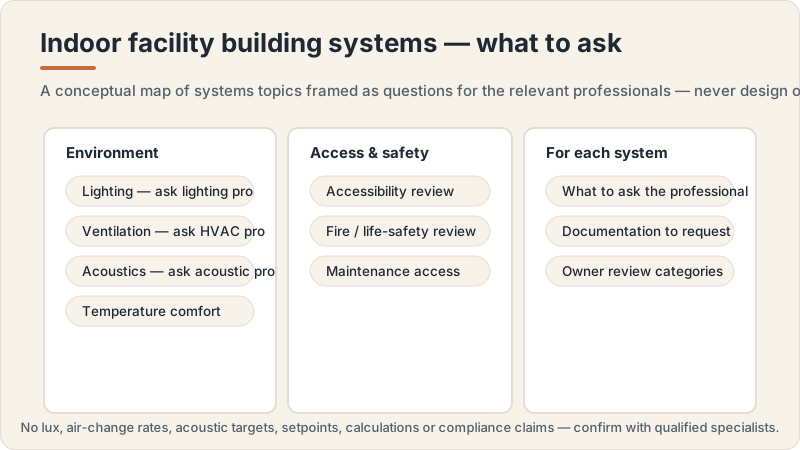
Indoor facility building-systems questions concept
Conceptual editorial diagram — not a construction drawing, specification, to-scale plan or proof of a real project. It is not engineering, structural, fire/life-safety, crowd-safety or accessibility-compliance guidance. Capacities, dimensions, standards, requirements and costs vary by facility type, audience, site, use case and governing body, and are confirmed with qualified professionals, relevant authorities and governing bodies. Build Design Hub does not design, build, inspect, certify, recommend or match anyone.
What this guide helps you prepare
This guide helps you prepare the maintenance-access conversation with your designers and facilities advisors before decisions are locked in. It focuses on how high-level and concealed systems in an indoor sports facility might be reached for inspection, cleaning, adjustment, repair and eventual replacement. It helps you assemble the questions, the documentation requests and the operational context a professional needs, rather than telling you how access should be arranged or how any equipment should be serviced.
You can use it to write a maintenance-access section of your project brief, to prompt stakeholder discussions between owners and future operators, and to structure quote-comparison so that servicing access is treated consistently across proposals. It does not replace design, engineering, inspection or operational judgement. Every consideration below is a prompt to raise with qualified professionals and relevant authorities, not a specification, a requirement or a decision you should make on your own.
- A brief that names each high-level or concealed system you expect will need periodic servicing
- A record of who will operate and maintain the facility after handover, so their needs inform the conversation
- A list of documentation you intend to request from designers about servicing access
- A structure for comparing how different proposals address reaching and servicing systems
- A set of open questions to bring to design and facilities professionals rather than answers to assume
- Notes on where owner preferences end and professional or authority decisions begin
Systems and high-level areas that raise access questions
Indoor sports facilities concentrate several systems in places that are hard to reach: lighting and its controls above the playing area, ventilation and heating equipment in roof voids or plant rooms, sound and scoreboard systems, roof-level fittings, and services running behind wall linings or above suspended ceilings in changing and support rooms. Sports-specific fittings such as netting, dividing curtains, retractable seating, mounted goals and basketball backstops also need periodic attention. Naming these systems early helps your designers understand what will need to be reached, without you specifying how that reaching should be done.
The point of listing these areas is to prompt a professional conversation about servicing over the building's life, not to decide access arrangements yourself. Whether a given system is best reached from below, from a roof space, from a plant room or by some other means is a design question shaped by the building, the equipment chosen, the operators' capabilities and the applicable rules. Your role in preparation is to make sure nothing that will need servicing is overlooked in the brief, and to ask how each item is expected to be reached and by whom.
- List high-level lighting, controls and any fittings mounted above the playing or training area
- Note ventilation, heating and cooling equipment and where it is expected to sit
- Record sports fittings that move or need adjustment, such as curtains, nets, seating and mounted equipment
- Identify concealed services above ceilings or behind linings in changing and support rooms
- Capture roof-level and external elements that may need periodic inspection or cleaning
- Ask designers to map each listed item to how and by whom it is expected to be serviced
Turning access thinking into brief and documentation requests
Once you have listed the systems, the useful preparation is deciding what to ask for in writing. A designer can describe, in documentation, how each system is intended to be reached, what routine and less-frequent servicing is anticipated, and which tasks are expected to fall to in-house staff versus specialist contractors. Requesting this early means maintenance access is discussed while the design can still adapt, rather than surfacing as a problem after handover. This guide does not tell you what the answers should be; it helps you ask for them clearly and consistently.
Documentation requests also give you a fair basis for comparing proposals. If every designer or contractor you speak with responds to the same access questions, you can see how each has thought about servicing over the facility's life. Keep the requests framed as questions and information needs, not as instructions or specifications. The professionals you engage are responsible for how access is actually designed and how any work is carried out safely and in line with applicable rules.
- Ask for a written description of how each listed system is intended to be reached for servicing
- Request that anticipated routine and less-frequent maintenance be identified, without assuming figures
- Ask which tasks are expected to be in-house versus specialist, so operators can plan
- Request that access-related documentation be handed over at completion for the operations team
- Use the same access questions across proposals so responses can be compared fairly
- Confirm which access-related decisions rest with professionals and authorities, not the owner
Planning questions before speaking with professionals
Before your first detailed design conversation, it helps to organise what you already know and what you are unsure about. Who will operate and maintain the facility? What in-house capability will they have, and where might specialist contractors be needed? Which systems concern you most because they sit high up, move, or are hidden? Working through these questions internally means you arrive with context that lets professionals give more relevant guidance, rather than expecting them to guess your operating situation.
These are preparation questions to answer among your own stakeholders, not technical decisions. Avoid fixing any dimensions, clearances, servicing intervals, staffing levels or costs at this stage; those depend on the design, the equipment, the operators and the applicable rules, and they are for qualified professionals and relevant authorities to determine. The goal is clarity about your context and priorities, so the professional conversation is productive.
- Who will own, operate and maintain the facility, and what maintenance capability will they have?
- Which systems and high-level areas most concern us in terms of being reached and serviced?
- What information about servicing access do we want handed over at completion?
- How will we compare proposals on how they address maintenance access?
- Which questions are ours to answer, and which must be confirmed with professionals or authorities?
- Have we avoided assuming any figures, intervals or costs that a professional should determine?
Questions for qualified professionals
When you meet designers, architects, building-services engineers and facilities advisors, use focused questions about how each system will be reached and serviced, and what documentation you will receive. Ask them to explain, for each high-level or concealed item, how servicing is anticipated, who is expected to carry it out, and what the operations team will need to know at handover. Keep the discussion at the level of what to ask and what to request, and let the professionals own the technical and safety-related decisions.
Take notes on where answers depend on other decisions still to be made, such as equipment selection or the final layout, and on where confirmation from a relevant authority or governing body is needed. Requirements and responsibilities vary by location, facility type, use case, governing body, owner, site, authority, professional team and project scope, so treat every professional response as guidance to confirm rather than a fixed rule. This keeps you well informed without stepping into design, engineering or compliance judgements that are not yours to make.
- How is each high-level or concealed system intended to be reached for inspection and servicing?
- Which servicing tasks are expected to be in-house, and which need specialist contractors?
- What access-related documentation will be provided to the operations team at handover?
- Which access matters must be confirmed with a relevant authority or governing body?
- How might equipment or layout choices still in progress change the access approach?
- What responsibilities for safe access and servicing rest with the design and operations teams rather than the owner?
What this does not replace
This is an educational planning resource only. It is not an indoor sports facility construction manual and not structural or architectural design, HVAC/ventilation, lighting or acoustic engineering, fire or life-safety, or accessibility-compliance advice, and it is not permit, zoning, inspection, certification, legal, tax, insurance or procurement advice. It does not design, build, engineer, specify, size, certify, inspect or approve anything, gives no capacities, dimensions, clearances, lux, air-change rates, acoustic or temperature thresholds, revenue, ROI or costs, and offers no warranty interpretation or estimate. Requirements, standards, capacities and costs vary by location, facility type, use case, governing body, owner, site, authority, professional team and project scope, and are confirmed with qualified professionals, relevant authorities and governing bodies.
Build Design Hub does not design, build, engineer, inspect, certify, recommend, rank, verify, introduce, broker or match suppliers, contractors, consultants or professionals, and HELPERG LLC is publisher/operator only. Use this resource to prepare your own thinking and briefs, then have the qualified professionals you engage directly — architects, structural and building-services engineers, lighting, acoustic, accessibility and fire/life-safety specialists, and legal or procurement advisors where appropriate — review your project. Decisions about design, engineering, systems, safety, accessibility, compliance, capacity, procurement and cost must rest on those professionals, the relevant authorities and the governing bodies for your sport and location.
- Not an indoor sports facility construction manual and not structural or architectural design
- Not HVAC/ventilation, lighting or acoustic engineering, fire/life-safety or accessibility-compliance advice
- Not permit/zoning, inspection, certification, warranty-interpretation, legal, tax, insurance or procurement advice
- Not a supplier, contractor, consultant or professional recommendation, ranking, directory or matching service
- Not an estimate and gives no capacity, dimension, system-performance, revenue, ROI or cost figures — requirements and costs vary
- Qualified professional review is required before any indoor sports facility project decision
Maintenance-access preparation register
- 1Record each high-level system above the playing or training area you expect will need servicing
- 2List ventilation, heating and cooling equipment locations as understood, to raise with professionals
- 3Note sports fittings that move or need adjustment, such as curtains, nets, seating and mounted goals
- 4Capture concealed services above ceilings or behind linings in changing and support rooms
- 5Identify roof-level and external elements that may need periodic inspection or cleaning
- 6Record who will operate and maintain the facility after handover
- 7Note the in-house maintenance capability you expect the operator to have
- 8Gather the access-related documentation you intend to request from designers
- 9Write the questions about how each system will be reached and by whom
- 10Draft a consistent set of access questions to use across every proposal
- 11Mark which decisions are owner preferences and which belong to professionals or authorities
- 12List the systems whose servicing you most want clarified before design is fixed
- 13Record where answers depend on equipment or layout choices still to be made
- 14Note any points that need confirmation with a relevant authority or governing body
Common mistakes to avoid
- Stating a clearance, height, walkway width or servicing interval as a fixed fact instead of confirming it with professionals
- Assuming a maintenance-access arrangement is required without checking it against the design, equipment and applicable rules
- Treating how a system will be reached as an owner decision rather than a professional design question
- Leaving the future operator out of the conversation, so servicing access is designed without their input
- Forgetting moving sports fittings such as curtains, nets and retractable seating when listing systems that need servicing
- Skipping any request for access-related documentation to be handed over at completion
- Assuming figures for staffing, frequency or cost that depend on decisions a professional should make
- Comparing proposals informally instead of asking every designer the same access questions
When to involve a professional
- When you need to understand how any high-level or concealed system will actually be reached and serviced
- When servicing access could be affected by structural, roof or ceiling decisions
- When building-services equipment locations influence how ventilation, heating or lighting is maintained
- When moving sports fittings or mounted equipment raise questions about periodic adjustment and servicing
- When you are unsure whether an access matter must be confirmed with a relevant authority or governing body
- When responsibility for safe access and servicing needs to be clearly assigned across the design and operations teams
Frequently asked questions
Questions readers ask about this topic
Does Build Design Hub design the access provisions or specify how our equipment should be serviced?
No. Build Design Hub is an educational resource. It does not design, build, engineer, inspect, certify, or specify access provisions, and it does not design HVAC, lighting or acoustic systems. It also does not recommend, rank, verify or match suppliers, contractors or professionals, and it gives no dimensions, clearances, capacities, intervals, costs or requirements. This guide only helps you prepare questions to raise with qualified professionals, who are responsible for how access and servicing are actually designed and carried out.
Can this guide tell us what maintenance access our facility needs?
No. Access-related requirements vary by location, facility type, use case, governing body, owner, site, authority, professional team and project scope. This guide helps you list the systems worth discussing and frame questions to confirm with qualified professionals and relevant authorities. It does not state what your facility requires or provide any working-at-height or safe-access instructions.
How should we decide who reaches and services each system?
That is a question for your design and facilities professionals, informed by your operating context. Preparation on your side means recording who will run the facility and what capability they have, then asking professionals how each system is intended to be reached and whether tasks are in-house or specialist. This guide does not make those decisions or state staffing, frequency or cost.
When should we bring in a qualified professional for maintenance access?
Bring one in early, before design decisions are fixed, so servicing access can be considered while it can still influence the design. Involve professionals whenever access depends on structure, building services, moving sports fittings, or confirmation from an authority or governing body. This guide is preparation material to help those conversations, not a substitute for professional judgement.
Keep reading