
Who this guide is for
- Owners and operators planning a new or refurbished indoor sports hall, gym or multi-purpose training space
- School, college and municipality project leads preparing a brief for a sports hall or shared community space
- Sports clubs scoping an indoor court, studio or training facility before engaging professionals
- Developers and project teams assembling a design brief and consultant scope for an indoor sports build
- Facility managers preparing operational and use-pattern information to share with an acoustic specialist
- Anyone comparing acoustic consultant or supplier proposals who wants a like-for-like question structure
Planning diagram
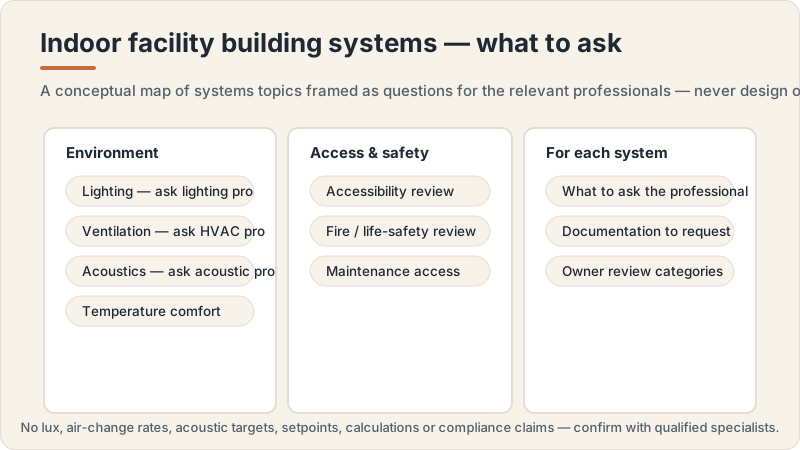
Indoor facility building-systems questions concept
Conceptual editorial diagram — not a construction drawing, specification, to-scale plan or proof of a real project. It is not engineering, structural, fire/life-safety, crowd-safety or accessibility-compliance guidance. Capacities, dimensions, standards, requirements and costs vary by facility type, audience, site, use case and governing body, and are confirmed with qualified professionals, relevant authorities and governing bodies. Build Design Hub does not design, build, inspect, certify, recommend or match anyone.
What this guide helps you prepare
This guide helps you get ready for a productive conversation with an acoustic specialist about an indoor sports facility. Sound behaviour inside a sports hall or gym is often raised because of hard floors, tall volumes, concurrent activities and adjacent rooms such as changing areas, offices, viewing galleries or neighbouring classrooms. Rather than trying to solve any of that yourself, the purpose here is to help you describe your facility, its intended uses and the people around it clearly enough that a qualified specialist can advise you properly. Good preparation usually shortens professional conversations and helps you compare proposals fairly.
It is important to be explicit about what this guide is not. It does not provide reverberation figures, noise limits, sound-insulation ratings, material specifications, panel layouts, or any acoustic calculation, and it does not tell you whether a space will be compliant. Those are matters for acoustic engineering by qualified professionals, informed by the governing bodies, authorities and standards that apply to your specific project. Treat every prompt below as something to raise and confirm, never as an instruction or a fixed answer.
- A plain description of the facility type: single hall, multi-court space, gym, studio, or a mix, and how activities may overlap
- A list of activities and user groups you expect, including any concurrent uses and quieter uses in the same building
- Notes on adjacencies you already know about: changing rooms, offices, teaching spaces, residential neighbours or shared walls
- The questions you want answered by a specialist, written down before the meeting so nothing is forgotten
- A record of which documents and reports you intend to request, so proposals can be compared on the same basis
- An explicit note that targets, ratings and any design decisions are for the acoustic specialist, not for you to set
How acoustics tends to surface across an indoor sports facility
In an indoor sports facility, sound is rarely a single question. Owners often describe several different concerns that only a specialist can properly separate and assess: how loud and lively the main hall feels during use, whether speech and whistles can be understood during coaching or events, how much activity noise travels to quieter rooms such as offices or classrooms, and how much sound reaches neighbours outside the building. Multi-purpose and school spaces add complexity because the same room may host a match, an assembly, an exam or a community event in the same week, and those uses can pull in different directions. Listing these situations plainly, without trying to rank or resolve them, gives your specialist the raw material they need.
There are also spaces around the main activity area that frequently come up, including changing and shower rooms, plant and equipment rooms, spectator or viewing areas, entrance lobbies and any teaching or meeting rooms. Each has its own relationship to the sports space, and the way they interact is exactly the kind of thing a qualified acoustic specialist assesses. Your job in preparation is to notice and describe these relationships, not to judge whether any of them are acceptable. Requirements and expectations vary by location, facility type, use case, governing body, owner, site, authority, professional team and project scope; confirm with qualified professionals.
- Note where you expect speech clarity to matter, such as coaching, announcements, teaching or events, so the specialist can consider it
- Describe rooms that need to stay quieter and where they sit relative to the main activity space
- Identify neighbours and boundaries the specialist may need to consider, without assuming any outcome
- Flag concurrent-use scenarios where different activities share the building at the same time
- List support spaces (changing, plant, viewing, lobby) and note which sit next to or above quieter areas
- Capture any past experiences or complaints from existing facilities as context, clearly labelled as observations not conclusions
Documentation and reporting to request from an acoustic specialist
A large part of preparing well is knowing what to ask for in writing. When you engage an acoustic specialist, you can ask them to describe their intended scope, their methodology, the assumptions they are working from, and what deliverables you will receive and when. Requesting these in a consistent format across proposals lets you compare consultants on a like-for-like basis rather than on price alone. You are not evaluating the technical correctness of their work — that is their professional responsibility — but you can make sure the scope, deliverables and limitations are clearly stated and that your intended uses have been captured accurately.
It also helps to clarify how acoustic work connects to the rest of the project. Ask how the specialist expects to coordinate with the architect, structural, mechanical and electrical teams, and how their advice is intended to be reflected in drawings, specifications and any tender documents. Ask what they need from you and by when, and how change requests or design revisions are handled. Keep a simple register of every document requested and received so nothing is assumed. Remember that any figures, ratings or recommendations in these documents come from the specialist under their own assumptions and scope, and should be interpreted only by qualified professionals.
- Ask for a written scope of services describing exactly what the acoustic work covers and what it excludes
- Request a plain-language explanation of the specialist's methodology, assumptions and any stated limitations
- Ask what deliverables you will receive (reports, drawings, schedules, correspondence) and at which project stages
- Request confirmation of how their advice will be coordinated with the architect and other engineering disciplines
- Ask what information, drawings and access they need from you, and when, to avoid delays
- Keep a document register recording each item requested, received and outstanding, with dates
Planning questions before speaking with professionals
Before you contact any acoustic specialist, it is worth working through a set of internal questions so that your brief is clear and consistent. These questions are about your own project — what the facility is for, who uses it, what matters to your stakeholders and how the space fits into the building and its surroundings. Answering them among your own team first means the specialist spends their time advising rather than extracting basic facts, and it reduces the risk of leaving something important out of the brief. None of these questions require you to decide anything technical.
As you work through them, resist the temptation to pre-judge outcomes or to assume that a particular material, layout or approach is needed. Those decisions belong to qualified professionals working from the specifics of your project. Your goal is to arrive at the conversation with a clear description of the facility, its uses and its context, plus an honest list of the concerns your stakeholders have raised. Requirements vary by location, facility type, use case, governing body, owner, site, authority, professional team and project scope; confirm with qualified professionals.
- What are all the intended activities and user groups, now and reasonably foreseeable in future?
- Which uses might happen at the same time, and where in the building are quieter uses located?
- What have stakeholders — coaches, teachers, staff, neighbours — said they are concerned about?
- What do we already know about the site, adjacencies, boundaries and any existing structure?
- What documents (drawings, site information, use schedules) can we prepare to hand over?
- Have we written down our questions and clearly separated observations from any assumptions?
Questions for qualified professionals
When you meet an acoustic specialist and the wider project team, having a prepared list of questions keeps the conversation focused and helps you understand their advice and its boundaries. The questions below are prompts to open a dialogue, not a script that produces answers on its own. Ask them to explain their reasoning in plain language, to be explicit about assumptions and limitations, and to tell you what could change their advice as the design develops. It is entirely reasonable to ask a professional to clarify anything you do not understand.
Use the answers to inform your planning, coordination and quote comparison — not to substitute for professional judgement. Acoustic advice interacts with structural, mechanical, electrical, fire, accessibility and other disciplines, and only qualified professionals can weigh those together for your specific facility. If different specialists give differing views, that is a normal reason to seek clarification rather than to pick an answer yourself. Confirm all requirements, ratings and design decisions with the relevant qualified professionals, authorities and governing bodies.
- What is included and excluded in your acoustic scope for a facility like ours, and why?
- What information do you need from us, and how do your assumptions affect your advice?
- How will your recommendations be reflected in drawings, specifications and any tender documents?
- How do you coordinate with the architect and the structural, mechanical and electrical teams?
- What relevant standards, authorities or governing bodies apply, and who confirms compliance?
- What could change your advice as the design, uses or budget evolve, and how are revisions handled?
What this does not replace
This is an educational planning resource only. It is not an indoor sports facility construction manual and not structural or architectural design, HVAC/ventilation, lighting or acoustic engineering, fire or life-safety, or accessibility-compliance advice, and it is not permit, zoning, inspection, certification, legal, tax, insurance or procurement advice. It does not design, build, engineer, specify, size, certify, inspect or approve anything, gives no capacities, dimensions, clearances, lux, air-change rates, acoustic or temperature thresholds, revenue, ROI or costs, and offers no warranty interpretation or estimate. Requirements, standards, capacities and costs vary by location, facility type, use case, governing body, owner, site, authority, professional team and project scope, and are confirmed with qualified professionals, relevant authorities and governing bodies.
Build Design Hub does not design, build, engineer, inspect, certify, recommend, rank, verify, introduce, broker or match suppliers, contractors, consultants or professionals, and HELPERG LLC is publisher/operator only. Use this resource to prepare your own thinking and briefs, then have the qualified professionals you engage directly — architects, structural and building-services engineers, lighting, acoustic, accessibility and fire/life-safety specialists, and legal or procurement advisors where appropriate — review your project. Decisions about design, engineering, systems, safety, accessibility, compliance, capacity, procurement and cost must rest on those professionals, the relevant authorities and the governing bodies for your sport and location.
- Not an indoor sports facility construction manual and not structural or architectural design
- Not HVAC/ventilation, lighting or acoustic engineering, fire/life-safety or accessibility-compliance advice
- Not permit/zoning, inspection, certification, warranty-interpretation, legal, tax, insurance or procurement advice
- Not a supplier, contractor, consultant or professional recommendation, ranking, directory or matching service
- Not an estimate and gives no capacity, dimension, system-performance, revenue, ROI or cost figures — requirements and costs vary
- Qualified professional review is required before any indoor sports facility project decision
Indoor sports facility acoustics preparation worksheet
- 1Record the facility type and layout in plain terms (hall, courts, gym, studio, multi-purpose) as you currently understand it
- 2List every intended activity and user group, including quieter uses that share the building
- 3Note which activities may run concurrently and where they sit relative to each other
- 4Map known adjacencies: changing rooms, offices, teaching or meeting spaces, viewing areas, plant rooms, neighbours
- 5Capture stakeholder concerns about sound, clearly labelled as observations rather than conclusions
- 6Gather site information, existing drawings and any structural context you already hold, to hand over
- 7Write down the specific questions you want an acoustic specialist to answer
- 8Prepare a request for a written scope of services describing coverage, exclusions and limitations
- 9Prepare a request for the specialist's methodology, assumptions and list of deliverables by stage
- 10Ask how acoustic advice will be coordinated with the architect and other engineering disciplines
- 11Start a document register listing items requested, received and outstanding, with dates
- 12List the standards, authorities and governing bodies you will ask professionals to confirm apply
- 13Note explicitly that all targets, ratings, materials and design decisions belong to qualified professionals
- 14Record how you will compare consultant and supplier proposals on a like-for-like basis
Common mistakes to avoid
- Stating a reverberation figure, noise limit or sound-insulation rating as if it were fixed, rather than a matter for a specialist to determine
- Assuming a particular acoustic material, panel layout or product is needed before any professional has assessed the space
- Treating an acoustic decision as the owner's to make, when it is properly a qualified professional's responsibility informed by the applicable standards
- Skipping acoustic input entirely, or leaving it until surfaces and layouts are already fixed and harder to revisit
- Describing only the main hall and forgetting quieter adjacent rooms, neighbours or concurrent-use scenarios
- Assuming requirements from another facility, region or governing body automatically apply to this project
- Comparing consultant proposals on price alone without checking that scope, deliverables and assumptions match
- Interpreting figures or recommendations in an acoustic report yourself instead of asking the specialist to explain them
When to involve a professional
- When you are ready to define an acoustic scope or brief, involve a qualified acoustic specialist rather than setting targets yourself
- When your facility has multiple or concurrent uses, quieter adjacent rooms, or nearby neighbours that raise sound questions
- When acoustic advice needs to be coordinated with structural, mechanical, electrical, fire or accessibility disciplines
- When any standard, authority or governing-body requirement might apply and needs professional confirmation for your specific project
- When you receive an acoustic report and need its figures, ratings or recommendations interpreted by the specialist who produced it
- When design changes, new uses, or budget shifts might affect acoustic advice already given
Frequently asked questions
Questions readers ask about this topic
Does Build Design Hub design acoustics, run calculations, or tell me what targets to use?
No. Build Design Hub is an educational publisher. It does not design, build, engineer, inspect, certify, recommend, rank or match specialists, contractors or products, and it does not design acoustic, HVAC or lighting systems. This guide gives no reverberation figures, noise limits, ratings, dimensions, capacities, costs or requirements. Any such matters are for qualified acoustic specialists and other professionals to determine for your specific facility.
What can I actually do with this guide before I hire anyone?
Use it to prepare. You can describe your facility and its intended uses, list the concerns your stakeholders have raised, note adjacencies and neighbours, write down the questions you want to ask, and decide which documents to request. That preparation helps you have a clearer conversation with an acoustic specialist and compare proposals on a like-for-like basis. It does not replace their professional advice.
How do I know which acoustic requirements apply to my sports facility?
You do not confirm that yourself. Requirements vary by location, facility type, use case, governing body, owner, site, authority, professional team and project scope. A qualified acoustic specialist and the relevant authorities and governing bodies are the appropriate sources. This guide only helps you prepare the questions to ask them.
Can I compare acoustic consultants using the questions here?
You can use the questions and document requests to structure a like-for-like comparison of scope, deliverables, methodology and coordination. That helps you understand what each proposal covers. It is not a way to judge technical correctness or to rank or endorse any consultant, which this guide does not do.
Keep reading