
Who this guide is for
- Facility owners who want a clear temperature and comfort brief to hand to HVAC and building-services professionals
- Clubs and committees describing how playing, training and spectator spaces will be used before design conversations begin
- Schools and colleges coordinating comfort expectations for a sports hall across staff, pupils, governors and budgets
- Municipalities and developers preparing an indoor-facility brief that captures owner-side comfort intentions
- Project teams and sponsors assembling the questions a building-services professional will need answered
- Facility managers and operators mapping how existing or planned spaces are used across seasons and activities
Planning diagram
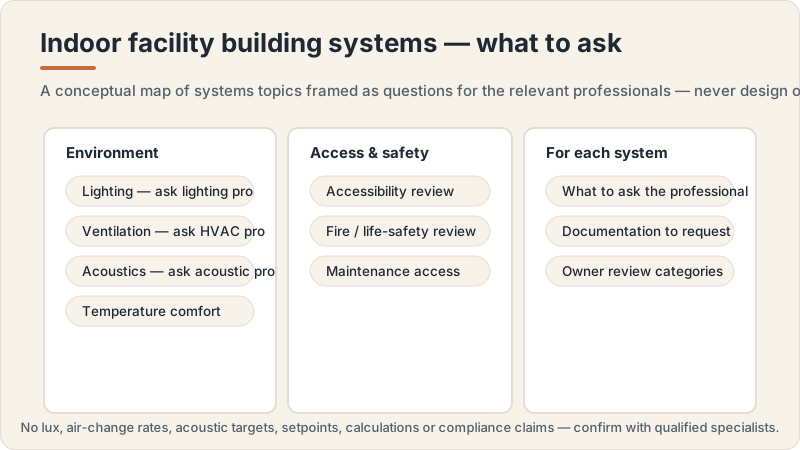
Indoor facility building-systems questions concept
Conceptual editorial diagram — not a construction drawing, specification, to-scale plan or proof of a real project. It is not engineering, structural, fire/life-safety, crowd-safety or accessibility-compliance guidance. Capacities, dimensions, standards, requirements and costs vary by facility type, audience, site, use case and governing body, and are confirmed with qualified professionals, relevant authorities and governing bodies. Build Design Hub does not design, build, inspect, certify, recommend or match anyone.
What this guide helps you prepare
This guide helps you prepare the owner-side temperature and comfort questions for an indoor sports facility: a structured description of how each space will be used, who occupies it and how, and the questions you want a qualified HVAC or building-services professional to answer. It is meant for the planning window, when you are shaping a brief and deciding what to ask, and when getting those questions right makes later design conversations far clearer. The output is an organised brief and question set you can develop over time, not a comfort specification, a system design or any statement about what a space should be.
Preparing these questions does not resolve any thermal, ventilation, energy or comfort matter, and it produces no setpoints, targets or calculations. It frames those areas so the right professional can address them, and it captures what each one tells you in writing. Temperatures, thresholds, air movement, humidity, capacities and any applicable requirements are deliberately left as questions here, because they vary by location, facility type, use case, activity, occupancy pattern, season, governing body, owner, site, authority, professional team and project scope, and must be confirmed with qualified professionals. Separating what you have confirmed from what is still open is what makes the brief usable.
- A structured description of each space and how it will be used, for professionals to design against
- A view of which comfort questions are yours to describe and which are for a professional to resolve
- A record of who occupies each space and how their comfort expectations may differ
- A set of temperature and comfort questions framed as prompts, with no setpoints or targets stated
- A log of which comfort items are confirmed in writing and which remain open assumptions
- A brief you can share with HVAC and building-services professionals and keep current as the project develops
How different spaces and users experience comfort in an indoor facility
Thermal comfort in an indoor sports facility is rarely a single number for the whole building, because the spaces and the people in them differ so widely. A main hall or court in active use is experienced very differently by players working hard, by coaches and officials standing or moving less, and by spectators sitting still along the side. Changing rooms, showers, corridors, reception, storage, offices, plant areas and any fitness or training rooms each carry their own comfort character, and the same space can feel different first thing in the morning, during a packed evening session, or during a quiet weekend. Describing these differences at a planning level, rather than deciding how to handle them, gives a professional a clear starting point. What each space should actually be, and how any difference is addressed, is theirs to determine for your specific facility.
It helps to think of comfort as a set of factors that professionals weigh together rather than temperature alone. Air movement, humidity, how quickly a space warms up or cools down, how it feels near large glazed areas or entrances, and how it copes with a sudden influx of people all contribute to how comfortable a room feels. Activities differ too: a high-intensity court session, a gentle exercise class, a school assembly held in the hall, and a spectator event each place different demands on the same space. Your role at this stage is to describe these uses and occupancy patterns honestly and note where you expect tensions, not to prescribe how they are balanced. Any judgement about comfort factors, trade-offs or requirements belongs with a qualified building-services professional and, where relevant, the governing body for your sport.
- Describe each space (main hall or court, changing and shower rooms, corridors, reception, offices, storage, plant, fitness or training rooms) and how it is used
- Note how active players, coaches, officials, spectators and staff each experience the same space differently
- Record occupancy patterns: quiet periods, packed sessions, events, seasonal peaks and how quickly they change
- List the activities each space hosts, from high-intensity play to gentle classes, assemblies or spectator events
- Flag comfort factors you have questions about (air movement, humidity, glazing, entrances) without judging them yourself
- Capture where you expect comfort tensions between different users or activities, as questions for a professional
Comfort factors to raise, not resolve, with building professionals
Beyond how spaces are used, it helps to prepare the comfort factors you want a professional to consider, framed as topics rather than answers. Owners often have practical observations worth surfacing: rooms that feel stuffy when full, cold near doors or glazing, slow to warm or slow to cool, uneven from one end to another, or uncomfortable after showers and heavy use. Capturing these as described experiences, alongside how the facility will be operated across a day and a year, gives a building-services professional real context to design against. You are not diagnosing a cause or proposing a fix; you are describing what you and your users have noticed or anticipate, so the professional can investigate and advise. Any conclusion about ventilation, heating, humidity control or system choice is theirs to reach.
It also helps to prepare questions about how comfort interacts with the rest of the project, because temperature rarely sits in isolation. How a space is used, how it is operated and staffed, how energy and running costs are thought about, how the building envelope and glazing behave, and how comfort relates to any ventilation, air-quality, condensation or maintenance considerations are all connected. At a planning level you can note these connections and record them as questions, without drawing links or conclusions yourself. The purpose is to make sure nothing that affects comfort is quietly left out of the brief, and to hand the professional an honest picture of priorities, constraints and open questions rather than a set of assumed requirements.
- Record described comfort observations (stuffiness, cold spots, uneven warmth, slow response, post-shower conditions) as experiences, not diagnoses
- Note how the facility is operated across a day and a year, so a professional understands the real usage context
- List questions about how comfort relates to the building envelope, glazing, entrances and orientation, without concluding anything
- Capture how comfort connects to ventilation, air quality, humidity, condensation and maintenance, as topics for a professional
- Prepare questions about how comfort priorities interact with energy use and running cost, framed for professional advice
- Flag any space where comfort, activity and occupancy seem to conflict, as an open question rather than a resolved trade-off
Planning questions before speaking with professionals
Before you bring in HVAC or building-services professionals, it is worth getting your own description of the facility and its comfort priorities into shape so those conversations are focused. Work through what you already know about each space, how it will be used, who occupies it, how occupancy changes across a day and a season, and where you or your users have noticed or anticipate comfort issues. The clearer you are about how the facility is used and what matters to you, the easier it is for a professional to advise accurately, and the less likely a comfort priority is to be missed until it becomes a complaint.
Use the questions below to organise your own thinking first. They are prompts to help you assemble a brief and identify gaps, not a substitute for professional input and certainly not a way to reach comfort conclusions yourself. As you answer them, write down which items you can describe with confidence, which are assumptions, and which you do not yet know. That honest record is what turns a blank brief into a structured description a professional can design against.
- How is each space used, and how do the comfort needs of players, spectators, coaches and staff differ?
- How does occupancy change across a typical day, week and season, and where are the peaks?
- Which spaces have I or my users found uncomfortable, and how would I describe that experience?
- Which comfort factors am I unsure about and want a professional to consider rather than deciding myself?
- How might comfort priorities interact with energy use, running costs, glazing or the building envelope?
- Which comfort expectations am I treating as assumptions that a qualified professional needs to confirm?
Questions for qualified professionals
When you move into conversations with HVAC, mechanical or building-services professionals, a prepared list of questions helps you understand what they will consider and confirm for your specific facility, rather than expecting this guide to supply answers it cannot. The questions below are framed to surface how a professional approaches comfort for each space, what information they need from you, and what documentation they will produce, so your brief is developed on their input rather than on assumptions. Ask each professional to be specific about what falls within their scope, what they need you to describe, and what they will provide, and record those answers in writing so the brief can be compared, followed up and kept current.
Remember that this guide does not design HVAC, ventilation or any building system, does not set temperatures, thresholds or targets, and does not tell you what any space should be. The questions are there to help you have better-informed conversations. Anything a professional tells you about comfort factors, temperatures, air movement, humidity, capacities, requirements or trade-offs is theirs to determine and confirm for your specific facility, spaces, activities, occupancy, climate and use, and should be documented in the brief as such, alongside any input from the relevant authorities and the governing body for your sport.
- How will you approach thermal comfort for each of our spaces given how they are used and occupied?
- What information about activities, occupancy and operation do you need from us to advise accurately?
- Which comfort factors (air movement, humidity, response, glazing, entrances) will you consider for our facility?
- How do you weigh comfort against energy use, running cost and the building envelope for a facility like ours?
- What documentation, drawings or specifications will you produce, and how will comfort intentions be recorded?
- What falls outside your scope, and which other professionals, authorities or governing bodies should we involve?
What this does not replace
This is an educational planning resource only. It is not an indoor sports facility construction manual and not structural or architectural design, HVAC/ventilation, lighting or acoustic engineering, fire or life-safety, or accessibility-compliance advice, and it is not permit, zoning, inspection, certification, legal, tax, insurance or procurement advice. It does not design, build, engineer, specify, size, certify, inspect or approve anything, gives no capacities, dimensions, clearances, lux, air-change rates, acoustic or temperature thresholds, revenue, ROI or costs, and offers no warranty interpretation or estimate. Requirements, standards, capacities and costs vary by location, facility type, use case, governing body, owner, site, authority, professional team and project scope, and are confirmed with qualified professionals, relevant authorities and governing bodies.
Build Design Hub does not design, build, engineer, inspect, certify, recommend, rank, verify, introduce, broker or match suppliers, contractors, consultants or professionals, and HELPERG LLC is publisher/operator only. Use this resource to prepare your own thinking and briefs, then have the qualified professionals you engage directly — architects, structural and building-services engineers, lighting, acoustic, accessibility and fire/life-safety specialists, and legal or procurement advisors where appropriate — review your project. Decisions about design, engineering, systems, safety, accessibility, compliance, capacity, procurement and cost must rest on those professionals, the relevant authorities and the governing bodies for your sport and location.
- Not an indoor sports facility construction manual and not structural or architectural design
- Not HVAC/ventilation, lighting or acoustic engineering, fire/life-safety or accessibility-compliance advice
- Not permit/zoning, inspection, certification, warranty-interpretation, legal, tax, insurance or procurement advice
- Not a supplier, contractor, consultant or professional recommendation, ranking, directory or matching service
- Not an estimate and gives no capacity, dimension, system-performance, revenue, ROI or cost figures — requirements and costs vary
- Qualified professional review is required before any indoor sports facility project decision
Indoor facility temperature and comfort brief worksheet
- 1List every space (main hall or court, changing and shower rooms, corridors, reception, offices, storage, plant, fitness or training rooms) the brief should cover
- 2Describe how each space is used and by whom, separating active players, coaches, officials, spectators and staff
- 3Record occupancy patterns for each space across a day, week and season, noting peaks and quiet periods
- 4List the activities each space hosts, from high-intensity play to classes, assemblies and spectator events
- 5Capture described comfort observations (stuffiness, cold spots, uneven warmth, slow response, post-shower conditions) as experiences, not diagnoses
- 6Note questions about how comfort relates to glazing, entrances, orientation and the building envelope, without concluding anything
- 7Record how comfort connects to ventilation, air quality, humidity, condensation and maintenance, as topics for a professional
- 8List questions about how comfort priorities interact with energy use and running cost, framed for professional advice
- 9Flag each space where comfort, activity and occupancy seem to conflict, as an open question rather than a resolved trade-off
- 10Note which comfort expectations are your descriptions and which need a qualified professional to confirm
- 11Record which authorities or governing bodies may set conditions the brief should reflect, as items to confirm
- 12Prepare the list of questions you want each building-services professional to answer for your facility
- 13Mark which brief items are confirmed in writing by a professional and which remain open assumptions
- 14Assemble the description and question set into a single comfort brief you can share and keep current
Common mistakes to avoid
- Writing a target temperature, setpoint or threshold into the brief as fact instead of leaving it for a professional to determine
- Assuming one comfort level suits players, spectators and staff rather than describing how each experiences a space
- Treating a comfort decision as the owner's to make when it belongs with a qualified building-services professional
- Diagnosing a cause for a cold spot or stuffiness instead of describing the experience and letting a professional investigate
- Assuming a requirement or air-change figure applies rather than confirming it for your facility, activity and use
- Leaving occupancy patterns, activities or seasonal peaks out of the brief, so a professional designs against an incomplete picture
- Recording professional advice from memory instead of capturing it in writing in the brief
- Skipping qualified professional review because the space looks similar to another facility
When to involve a professional
- When any comfort question needs a temperature, threshold, air-change rate or capacity determined for a specific space
- When comfort interacts with ventilation, air quality, humidity or condensation and needs a system-level judgement
- When comfort must be balanced against energy use, running cost or the building envelope for your facility
- When a space serves very different users or activities and the trade-offs need professional resolution
- When a governing body, authority, insurer or standard may set conditions the brief must reflect
- When an existing facility shows comfort problems whose cause and remedy need professional investigation
Frequently asked questions
Questions readers ask about this topic
Does this guide tell me what temperature my sports hall or gym should be?
No. This is an educational planning guide that helps you prepare comfort questions for a professional. It gives no temperatures, setpoints, thresholds, air-change rates, humidity targets or calculations, because comfort expectations and any applicable requirements vary by location, facility type, use case, activity, occupancy pattern, season, governing body, owner, site, authority, professional team and project scope. What any space should be is for a qualified HVAC or building-services professional to determine for your specific facility.
Does Build Design Hub design HVAC, ventilation or comfort systems, or recommend suppliers and contractors?
No. Build Design Hub does not design, build, engineer, inspect or certify anything, does not design HVAC, ventilation, lighting or acoustic systems, and does not recommend, rank, verify, introduce, broker or match any supplier, contractor or professional. It also gives no capacities, dimensions, setpoints, costs or requirements. Those are confirmed directly with qualified professionals and the relevant authorities for your specific facility. This guide only helps you prepare and structure your own comfort brief and questions.
Can I treat the comfort observations I record here as a diagnosis of a problem?
No. The worksheet helps you describe what you and your users have noticed or anticipate, such as a stuffy hall or cold entrance, as experiences to hand to a professional. It does not diagnose a cause or propose a fix. What is behind a comfort issue, and how it should be addressed, is for a qualified building-services professional to investigate and advise on for your specific spaces, systems and use.
How do I use this guide if I already have comfort complaints in an existing facility?
Use it to organise a clear description of the spaces, how they are used, and the comfort experiences your users report, then take that to a qualified professional. This guide helps you prepare that description and the questions to ask; it does not identify the cause, judge whether a system is adequate, or tell you what to change. Those conclusions rest with the professional you engage directly.
Keep reading