
Who this guide is for
- Facility owners and developers preparing an indoor sports venue for its first period of operation
- Sports clubs and community organisations planning to run booking, staffing and day-to-day operations of a hall or gym
- Schools and academic institutions readying a new or refurbished sports hall for student, staff and community use
- Municipalities and public-body project teams coordinating opening approvals and operational handover
- Facility and operations managers assembling staffing plans, processes and handover documentation
- Project teams and coordinators sequencing pre-opening tasks and stakeholder conversations
Planning diagram
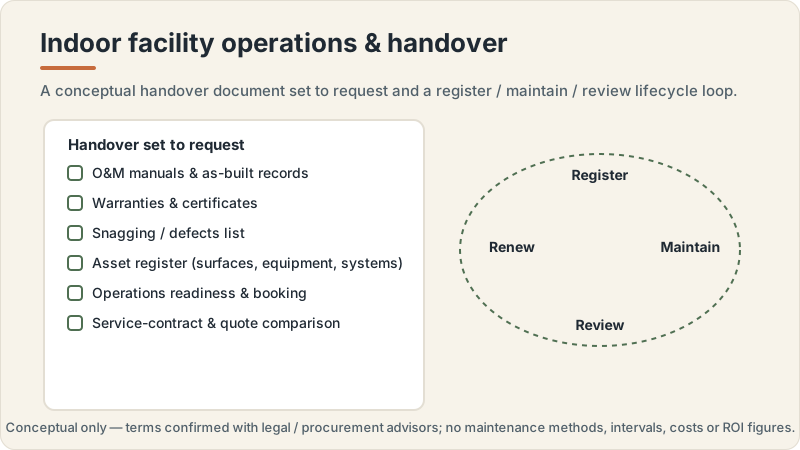
Indoor facility operations and handover concept
Conceptual editorial diagram — not a construction drawing, specification, to-scale plan or proof of a real project. It is not engineering, structural, fire/life-safety, crowd-safety or accessibility-compliance guidance. Capacities, dimensions, standards, requirements and costs vary by facility type, audience, site, use case and governing body, and are confirmed with qualified professionals, relevant authorities and governing bodies. Build Design Hub does not design, build, inspect, certify, recommend or match anyone.
What this guide helps you prepare
This guide helps you build a clear picture of what operations readiness means for your specific indoor facility so that you can walk into conversations with qualified professionals, governing bodies and relevant authorities already organised. It is designed to help you draft a readiness brief, list open questions, and gather the documents and roles you will need to confirm before the facility opens to users. The goal is preparation quality: knowing what to ask, what to record, and who to route each decision to, rather than attempting to answer operational or approval questions yourself.
Operations readiness is a coordination exercise more than a technical one. It brings together staffing plans, day-to-day processes, booking arrangements, handover materials from the project delivery team, and the permits or approvals that various parties may need to confirm. This guide keeps you at the level of framing and structuring those elements. It does not tell you what any requirement is, whether a facility is compliant, or when it is safe to open; those determinations belong to qualified professionals and the appropriate authorities for your location, facility type and use case.
- Draft a plain-language readiness brief describing your facility type, intended uses and the parties involved
- List the operational roles you expect to need and note where responsibilities are still unassigned
- Assemble the handover documents you expect to receive from the project delivery team and note gaps
- Record which permits, approvals or sign-offs need to be confirmed, and with which party, before opening
- Prepare a structured question list to bring to qualified professionals, governing bodies and authorities
- Note assumptions you are making about processes and booking so a professional can review them
Framing staffing, processes and booking readiness
Staffing and process readiness is about mapping the roles, responsibilities and routines a facility needs to function once it opens, and identifying which of those still need to be defined or confirmed. At the preparation stage you are describing the shape of the operation: who covers reception and supervision, how a typical day is expected to run, how changing and support rooms are managed, how equipment is issued and stored, and how incidents and issues would be reported and escalated. Keep these as descriptions and open questions to review with the relevant operational and professional advisors rather than as fixed operating procedures, because appropriate arrangements vary by facility type, use case, governing body, owner and local authority.
Booking readiness sits alongside staffing because how a space is scheduled shapes how it is staffed and supervised. Preparation here means describing the intended user groups, the kinds of sessions or hire arrangements you anticipate, and how bookings, cancellations, access and conflicts might be handled, so that a qualified operational adviser can help you turn descriptions into workable processes. Avoid assuming usage levels, occupancy, session capacities or turnaround times as fixed numbers; these depend on the facility, its intended uses, governing-body guidance and professional input, and should be confirmed rather than assumed. Document your assumptions clearly so they can be tested.
- List the operational roles and shifts you anticipate and note which are confirmed versus still open
- Describe how a typical operating day and week are expected to run, as a draft for professional review
- Note how changing rooms, support spaces, equipment and access would be managed and by whom
- Record the user groups and booking or hire arrangements you anticipate, without assuming usage levels
- Prepare questions about incident reporting, escalation and record-keeping to route to the right adviser
- Flag every capacity, occupancy or turnaround assumption as something to confirm, not to fix yourself
Handover documentation and approvals to confirm
A large part of operations readiness is receiving, organising and understanding the handover materials produced during project delivery, and knowing which permits or approvals still need confirming before the facility opens. At the preparation stage you are building a register of the documents you expect, such as operating and maintenance information, asset and equipment records, warranties, contact details for the professionals involved, and any as-built or system documentation. This guide helps you list what to request and track what is outstanding; it does not interpret those documents, judge whether they are complete, or determine what any warranty, certificate or approval means. Interpretation and sufficiency are matters for qualified professionals and the issuing parties.
Permits and approvals are among the most location-specific parts of readiness, and this guide does not treat any of them as certain. The permits, licences, registrations and approvals that apply to an indoor sports facility depend entirely on location, facility type, use case, governing body, owner, site, authority and project scope. Rather than assuming what applies, prepare a list of the parties who might need to confirm something, and route the questions to them. Confirm with the relevant authorities and qualified professionals which approvals are needed, who is responsible for obtaining or verifying each, and what evidence should be on file before the facility begins operating.
- Build a register of expected handover documents and mark which have been received and which are outstanding
- List operating, maintenance, asset and equipment records you plan to request from the delivery team
- Note which approvals, permits or sign-offs need confirming, with which party, and who is responsible
- Record where documentation appears incomplete so a qualified professional can assess sufficiency
- Prepare questions about warranties, contacts and ongoing obligations rather than interpreting them yourself
- Keep a single log of open items with an owner and a note of who will confirm each one
Planning questions before speaking with professionals
Before you approach qualified professionals, governing bodies or authorities, it helps to organise your own thinking so those conversations are efficient and specific. The questions in this section are ones to work through internally with your project team: they help you clarify your facility type, intended uses, the parties involved, and where your knowledge has gaps. Answering them does not resolve any operational or approval question; it simply produces a clearer brief and a sharper list of what you need others to confirm. Treat every answer as provisional until a qualified professional or the relevant authority has reviewed it.
Working through these questions also helps you avoid presenting assumptions as decisions. Many operations-readiness topics look like owner decisions but are actually shaped by governing-body guidance, professional input and local authority requirements. Identifying which is which before you meet anyone means you can ask better questions and avoid committing to arrangements that later need to change. Record what you do not yet know as openly as what you do; the unknowns are what the professional conversations are for.
- What type of facility and intended uses are we preparing for, and who are the parties involved?
- Which operational roles, processes and booking arrangements do we understand, and which are still unclear?
- What handover documents do we expect, and which are already in hand versus outstanding?
- Which approvals or permits do we suspect apply, and which party is best placed to confirm each?
- What assumptions about usage, capacity or process are we making that must be tested by a professional?
- Where are our biggest gaps in knowledge, and who is the right person or authority to close each one?
Questions for qualified professionals
This section is about the questions you take outward, to the qualified professionals, governing bodies and relevant authorities who can give you binding answers. Because requirements vary by location, facility type, use case, governing body, owner, site, authority, professional team and project scope, the value of this stage lies in asking clearly and recording the responses carefully. Ask each professional to confirm what falls within their remit, what documentation they can provide, and what they recommend you confirm elsewhere. Keep your questions open rather than leading, so you receive their determination rather than a confirmation of your assumptions.
When you gather answers, note who gave each one, what documentation supports it, and what remains to be confirmed by another party. This turns a series of conversations into a coherent readiness record you can act on. Nothing in this guide substitutes for those professional determinations; it only helps you reach them in an organised way. If any answer touches on safety, certification, compliance, approvals or interpretation of documents, treat the professional's or authority's response as the authoritative one and record it as such.
- Which operational, permit or approval requirements apply to a facility of our type, use case and location?
- Who is responsible for obtaining, verifying or confirming each approval, and what evidence should be on file?
- What handover documentation should we expect, and how do you assess whether it is complete?
- Which of our staffing, process and booking assumptions need to change based on your review?
- What ongoing obligations, records or reviews should we plan for after opening, in your view?
- What should we confirm with another professional, governing body or authority beyond your remit?
What this does not replace
This is an educational planning resource only. It is not an indoor sports facility construction manual and not structural or architectural design, HVAC/ventilation, lighting or acoustic engineering, fire or life-safety, or accessibility-compliance advice, and it is not permit, zoning, inspection, certification, legal, tax, insurance or procurement advice. It does not design, build, engineer, specify, size, certify, inspect or approve anything, gives no capacities, dimensions, clearances, lux, air-change rates, acoustic or temperature thresholds, revenue, ROI or costs, and offers no warranty interpretation or estimate. Requirements, standards, capacities and costs vary by location, facility type, use case, governing body, owner, site, authority, professional team and project scope, and are confirmed with qualified professionals, relevant authorities and governing bodies.
Build Design Hub does not design, build, engineer, inspect, certify, recommend, rank, verify, introduce, broker or match suppliers, contractors, consultants or professionals, and HELPERG LLC is publisher/operator only. Use this resource to prepare your own thinking and briefs, then have the qualified professionals you engage directly — architects, structural and building-services engineers, lighting, acoustic, accessibility and fire/life-safety specialists, and legal or procurement advisors where appropriate — review your project. Decisions about design, engineering, systems, safety, accessibility, compliance, capacity, procurement and cost must rest on those professionals, the relevant authorities and the governing bodies for your sport and location.
- Not an indoor sports facility construction manual and not structural or architectural design
- Not HVAC/ventilation, lighting or acoustic engineering, fire/life-safety or accessibility-compliance advice
- Not permit/zoning, inspection, certification, warranty-interpretation, legal, tax, insurance or procurement advice
- Not a supplier, contractor, consultant or professional recommendation, ranking, directory or matching service
- Not an estimate and gives no capacity, dimension, system-performance, revenue, ROI or cost figures — requirements and costs vary
- Qualified professional review is required before any indoor sports facility project decision
Operations-readiness preparation register
- 1Record the facility type, intended uses and all parties involved in a short readiness brief
- 2List every operational role you anticipate and mark it as confirmed or still open
- 3Describe the expected typical operating day and week as a draft for professional review
- 4Note how changing rooms, support spaces, equipment and access would be managed and by whom
- 5Record the anticipated user groups and booking or hire arrangements without assuming usage levels
- 6Log every capacity, occupancy or turnaround figure as an assumption to confirm, never as a fixed fact
- 7Build a register of expected handover documents and mark received versus outstanding items
- 8List operating, maintenance, asset, equipment and warranty records to request from the delivery team
- 9Note which permits, approvals or sign-offs need confirming, with which party, and who is responsible
- 10Record where documentation appears incomplete for a qualified professional to assess
- 11Prepare a structured question list for professionals, governing bodies and authorities
- 12Note your knowledge gaps and the right person or authority to close each one
- 13Keep a single open-items log with an owner and a confirmation source for each entry
- 14Date the register and note that all entries remain provisional until professionally confirmed
Common mistakes to avoid
- Stating a capacity, occupancy or turnaround figure as fixed instead of confirming it with a professional or governing body
- Assuming which permits or approvals apply rather than confirming them with the relevant authorities
- Treating an operational or system decision as the owner's when it should be shaped by professional and governing-body input
- Interpreting handover documents, warranties or certificates yourself instead of routing them to a qualified professional
- Skipping professional and authority review because the building looks finished and ready
- Presenting internal assumptions about staffing or booking as settled decisions before they have been tested
- Assuming usage levels or demand without confirming intended uses and governing-body guidance
- Failing to record who is responsible for obtaining or confirming each approval before opening
When to involve a professional
- Involve qualified professionals and the relevant authorities to confirm which permits, approvals or sign-offs apply before opening
- Involve a qualified professional to assess whether handover documentation is complete and sufficient
- Involve the appropriate parties to interpret any warranty, certificate, approval or compliance document
- Involve a qualified operational adviser when turning draft staffing, process or booking descriptions into workable arrangements
- Involve professionals whenever a question touches safety, certification, accessibility or life-safety matters
- Involve governing bodies and authorities to confirm any requirement, obligation or ongoing record you are unsure about
Frequently asked questions
Questions readers ask about this topic
Does Build Design Hub design, build, engineer, inspect or certify indoor sports facilities?
No. Build Design Hub is an educational resource only. It does not design, build, engineer, inspect or certify facilities, does not design HVAC, ventilation, lighting or acoustic systems, and does not recommend, rank, verify or match suppliers, contractors, consultants or professionals. It does not provide capacities, dimensions, setpoints, costs or requirements. This guide only helps you prepare questions and documents to take to qualified professionals and the relevant authorities.
Can this guide tell me which permits and approvals my facility needs before opening?
No. Permits, licences and approvals depend entirely on location, facility type, use case, governing body, owner, site, authority and project scope. This guide helps you build a list of parties to ask and questions to raise, but you must confirm what actually applies with the relevant authorities and qualified professionals.
Does completing the readiness register mean my facility is ready or safe to open?
No. The register is a preparation aid to help you organise staffing, process, booking and documentation questions. It does not determine readiness, compliance or safety. Whether a facility is ready to open is a matter for qualified professionals and the appropriate authorities to confirm.
How should I handle staffing and booking capacity numbers during planning?
Treat any capacity, occupancy, session or turnaround figure as an assumption to confirm, not as a fact. Appropriate numbers depend on the facility, its intended uses, governing-body guidance and professional input. Record your assumptions clearly and route them to a qualified adviser for review.
Keep reading