
Who this guide is for
- Owners and boards weighing several quotes for an indoor sports hall, gym or multi-purpose space
- Sports clubs and community organisations preparing to review responses side by side
- Schools and education bodies coordinating a hall, court or training-space project
- Municipal and public-sector teams organising a structured, transparent comparison exercise
- Developers and project managers assembling a like-for-like quote-comparison matrix
- Facility managers documenting scope, exclusions and assumptions before professional review
Planning diagram
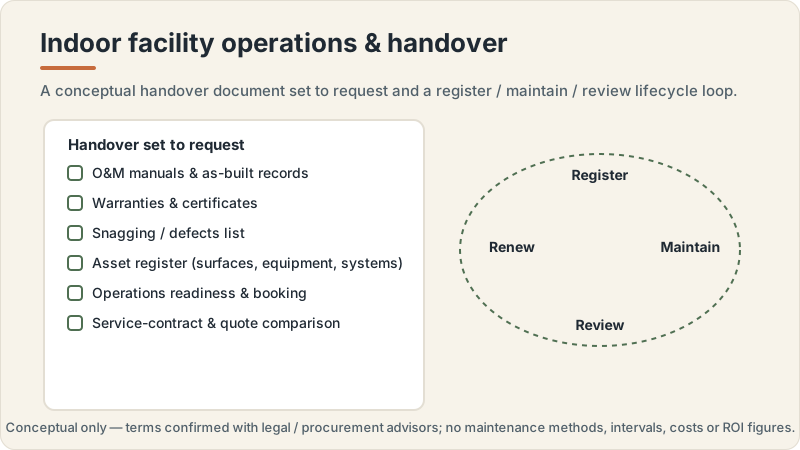
Indoor facility operations and handover concept
Conceptual editorial diagram — not a construction drawing, specification, to-scale plan or proof of a real project. It is not engineering, structural, fire/life-safety, crowd-safety or accessibility-compliance guidance. Capacities, dimensions, standards, requirements and costs vary by facility type, audience, site, use case and governing body, and are confirmed with qualified professionals, relevant authorities and governing bodies. Build Design Hub does not design, build, inspect, certify, recommend or match anyone.
What this guide helps you prepare
This guide helps you prepare a neutral comparison structure so that quotes for an indoor sports facility can be read consistently rather than one at a time in isolation. The core idea is a matrix: scope items, exclusions and assumptions become rows, and each quote becomes an anonymous column labelled Quote A, Quote B and so on. Reading across a row shows where responses agree, diverge or stay silent, which is far more useful for preparing questions than comparing headline figures. The aim is preparation for a conversation with qualified professionals, not a decision.
It also helps you gather the descriptive material that makes such a matrix possible: what each quote says it includes, what it explicitly leaves out, and what it silently assumes about the site, the building, the intended activities and the support spaces. This guide does not tell you which quote is better, does not assign scores and does not interpret prices, value or fairness. It is a way of organising information so that gaps become visible and can be routed to the right professional, authority or governing body for confirmation.
- Set up columns as unnamed quotes (Quote A, Quote B) to keep comparison neutral and price-free
- List scope items as rows so each quote can be read across the same line
- Record exclusions as their own rows rather than assuming they match
- Capture stated assumptions about site, building and intended use as separate rows
- Note where a quote is silent on a row, which is itself a finding to raise
- Keep the matrix descriptive, avoiding any value, ranking or recommendation language
Building the like-for-like comparison matrix
A like-for-like matrix starts by agreeing a single, shared list of scope rows drawn from your project brief, not from any one quote. Typical row groupings for an indoor facility might include the playing or activity space, the floor system, wall and ceiling treatments, changing and support rooms, storage, building-services provisions, and the professional inputs a quote may or may not cover. Because responses phrase these differently, the preparation work is normalising language: mapping each quote's wording onto your shared rows so that a like item sits on a like line. Where a quote bundles several of your rows into one item, record that as a note rather than forcing a split.
Once rows are fixed, each quote becomes a column and every cell records what that quote states for that row: included, excluded, assumed, unclear or silent. Resist the urge to fill silence with guesses. An empty cell is a genuine finding that becomes a question for the responder or a qualified professional. Keep any technical descriptors, such as references to floor type, services provisions or room counts, exactly as written by the quote; do not standardise them into requirements, and do not treat any figure a quote mentions as a fact until confirmed. The matrix records what was said, not what is correct.
- Draw scope rows from your own brief before reading any single quote's structure
- Map each quote's wording onto your shared rows and note where items are bundled together
- Use consistent cell labels such as included, excluded, assumed, unclear or silent
- Preserve each quote's original descriptors verbatim instead of rewriting them as requirements
- Flag any cell where a quote references a dimension, capacity or figure for professional confirmation
- Add a notes row per column for wording that does not map cleanly onto your rows
Reading exclusions, assumptions and silences across quotes
Exclusions and assumptions are where quotes most often differ, and where a like-for-like matrix earns its value. One response may explicitly exclude ground preparation, changing-room fit-out or certain building-services connections, while another simply does not mention them, leaving you to discover the gap later. By giving exclusions and assumptions their own labelled rows, you can read across all columns and see, for a single item, which quotes name it, which exclude it and which are silent. This turns a vague sense that responses 'differ' into a specific list of items to confirm with the responders and with qualified professionals.
Assumptions deserve equal attention because they shape what a quote covers without stating it as scope. A quote may assume a particular site condition, an existing building element, a level of access, or a set of activities the space will host. None of these should be accepted as established; each is a question. Recording assumptions as rows lets you ask every responder the same question and lets a qualified professional review whether an assumption is reasonable for your site, use case and governing body. The matrix does not judge whether an assumption is right or wrong; it makes the assumption visible so the right person can review it.
- Give exclusions their own rows so a silent quote can be distinguished from an excluding one
- List each stated assumption about site, building, access or intended activities as a row
- Compare the same exclusion across all columns before drawing any conclusion
- Record who should confirm each assumption: the responder, a professional, or an authority
- Watch for scope that appears in one column but is absent from every other
- Keep exclusion and assumption cells factual, avoiding any judgement of reasonableness
Planning questions before speaking with professionals
Before involving qualified professionals, use the matrix to clarify your own project position so that questions are precise. If you cannot yet describe the intended activities, the support spaces you need, or the parts of the building already in place, the matrix will have empty rows that make comparison unreliable. Preparing answers to these internal questions first means that when you do speak with a professional, you can point to specific rows and cells rather than describing the situation from memory. This preparation is about organising what you know and identifying what you do not, not about reaching technical conclusions.
It also helps to decide, before any professional conversation, which differences matter most to your project and which are minor wording variations. A structured pass over the matrix lets you group findings into questions for the responders, questions for a professional and items that may need an authority or governing body. This keeps later conversations focused and avoids treating a comparison exercise as if it were a technical assessment, which it is not. Any figure, provision or condition a quote mentions remains unconfirmed until a qualified professional reviews it for your specific site and use case.
- Have you written a single shared scope list independent of any one quote?
- Can you describe the intended activities and support spaces the facility must serve?
- Do you know which parts of the building or site already exist versus are proposed?
- Which matrix rows are still empty because your own brief has not settled them?
- Have you separated wording differences from genuine scope differences across columns?
- Which findings are questions for responders, and which need a qualified professional?
Questions for qualified professionals
When you take the matrix to qualified professionals, frame every technical row as a question rather than a statement. Ask what documentation each quote's scope implies, what a given exclusion might mean for your project, and whether an assumption a quote has made is appropriate for your site, facility type, use case and governing body. Professionals can advise on matters this guide deliberately avoids, such as building systems, floor and surface considerations, support spaces, and how a scope description relates to the reviews, permissions and confirmations relevant to your location. This guide provides no requirements, dimensions or thresholds; those belong entirely to the professionals and authorities involved.
Use the comparison to request the same clarification consistently across responders and to ask a professional which gaps carry the most importance for your specific project. Because requirements vary by location, facility type, use case, governing body, owner, site, authority, professional team and project scope, the matrix cannot tell you what is compliant, adequate or complete; only appropriately qualified people can. Keep the record of what each quote stated so that when a professional advises, you can trace their guidance back to the exact row and column it concerns, and update your questions rather than your conclusions.
- What documentation should each quote's stated scope be able to produce or reference?
- Which exclusions in the matrix could most affect this project, and why?
- Are the assumptions a quote has made appropriate for this site, use case and governing body?
- What reviews, permissions or confirmations are relevant before relying on any scope description?
- Which building-systems questions (floor, services, support rooms) need a professional's input?
- How should silent or unclear cells be resolved before any comparison is considered complete?
What this does not replace
This is an educational planning resource only. It is not an indoor sports facility construction manual and not structural or architectural design, HVAC/ventilation, lighting or acoustic engineering, fire or life-safety, or accessibility-compliance advice, and it is not permit, zoning, inspection, certification, legal, tax, insurance or procurement advice. It does not design, build, engineer, specify, size, certify, inspect or approve anything, gives no capacities, dimensions, clearances, lux, air-change rates, acoustic or temperature thresholds, revenue, ROI or costs, and offers no warranty interpretation or estimate. Requirements, standards, capacities and costs vary by location, facility type, use case, governing body, owner, site, authority, professional team and project scope, and are confirmed with qualified professionals, relevant authorities and governing bodies.
Build Design Hub does not design, build, engineer, inspect, certify, recommend, rank, verify, introduce, broker or match suppliers, contractors, consultants or professionals, and HELPERG LLC is publisher/operator only. Use this resource to prepare your own thinking and briefs, then have the qualified professionals you engage directly — architects, structural and building-services engineers, lighting, acoustic, accessibility and fire/life-safety specialists, and legal or procurement advisors where appropriate — review your project. Decisions about design, engineering, systems, safety, accessibility, compliance, capacity, procurement and cost must rest on those professionals, the relevant authorities and the governing bodies for your sport and location.
- Not an indoor sports facility construction manual and not structural or architectural design
- Not HVAC/ventilation, lighting or acoustic engineering, fire/life-safety or accessibility-compliance advice
- Not permit/zoning, inspection, certification, warranty-interpretation, legal, tax, insurance or procurement advice
- Not a supplier, contractor, consultant or professional recommendation, ranking, directory or matching service
- Not an estimate and gives no capacity, dimension, system-performance, revenue, ROI or cost figures — requirements and costs vary
- Qualified professional review is required before any indoor sports facility project decision
Indoor facility quote comparison matrix worksheet
- 1Write a single shared scope list from your own brief before reading any quote's structure
- 2Set up one anonymous column per quote (Quote A, Quote B) with no price fields
- 3Convert your scope list into matrix rows grouped by activity space, floor, walls and ceiling, support rooms, storage and services
- 4Map each quote's wording onto your shared rows and note where items are bundled
- 5Record each cell as included, excluded, assumed, unclear or silent
- 6Add a dedicated row set for exclusions so silent quotes are not confused with excluding ones
- 7Add a dedicated row set for stated assumptions about site, building, access and intended activities
- 8Preserve each quote's original technical descriptors verbatim without rewriting them as requirements
- 9Flag every cell where a quote references a dimension, capacity, provision or figure for professional confirmation
- 10List empty and unclear cells as open questions rather than filling them with guesses
- 11Group findings into questions for responders, questions for a professional, and items for an authority or governing body
- 12Note which qualified professional or authority should confirm each flagged row
- 13Keep a change log so professional advice can be traced back to the exact row and column
- 14Record who owns the matrix and when it was last updated for the project team
Common mistakes to avoid
- Stating a dimension, capacity, clearance or provision from a quote as if it were a confirmed requirement
- Assuming that a quote silent on an item includes it, rather than treating silence as an open question
- Comparing headline figures instead of comparing scope, exclusions and assumptions row by row
- Rewriting each quote's wording into standard terms and losing the differences that mattered
- Treating a system or building-services decision as the owner's to make rather than a qualified professional's
- Skipping professional review because the matrix looked complete on its own
- Building rows from one quote's structure instead of from an independent project brief
- Reading a neutral comparison as a ranking, value judgement or recommendation
When to involve a professional
- When a quote references dimensions, capacities, provisions or figures that need confirmation for your site
- When exclusions or assumptions could materially change what the facility can host or support
- When building-systems items (floor, ventilation, lighting, acoustics, support rooms) appear in any quote's scope
- When reviews, permissions or confirmations relevant to your location may apply to the described scope
- When responses differ so much that like-for-like mapping is unclear without expert interpretation
- Before treating any comparison finding as a basis for a decision or commitment
Frequently asked questions
Questions readers ask about this topic
Does this guide tell me which quote is best or offer a recommendation?
No. This guide only helps you structure a like-for-like comparison of scope, exclusions and assumptions. It does not compare prices, judge fairness or value, rank responses or recommend any option. Any decision belongs to you with input from qualified professionals.
Does Build Design Hub design, build, inspect or match me with suppliers or contractors?
No. Build Design Hub does not design, build, engineer, inspect, certify, recommend, rank, verify, introduce or match suppliers, contractors or consultants. It does not design HVAC, lighting or acoustic systems and provides no capacities, dimensions, costs or requirements. It offers educational preparation material only; confirm everything with qualified professionals.
Can I use the technical details a quote mentions as facts for my project?
Treat them as unconfirmed. Record what each quote states verbatim, but do not treat any dimension, capacity, provision or figure as correct until a qualified professional reviews it for your specific site, facility type, use case and governing body. Requirements vary and must be confirmed with the relevant professionals and authorities.
How should I handle a quote that is silent on an item other quotes mention?
Record it as silent rather than assuming it is included or excluded. A silent cell is a genuine finding and becomes a question for that responder or a qualified professional. The matrix records what was said, not what should be there.
Keep reading