
Who this guide is for
- Clubs and community sports organisations considering a modest grandstand or spectator facility
- Municipalities and local authorities scoping a small public venue or upgrade
- Schools, colleges and universities planning seating alongside existing playing fields
- Developers and landowners exploring a smaller mixed-use or seasonal venue
- Project teams and facility managers assembling a brief before engaging professionals
- Owners preparing for early feasibility, stakeholder and quote-comparison conversations
Planning diagram
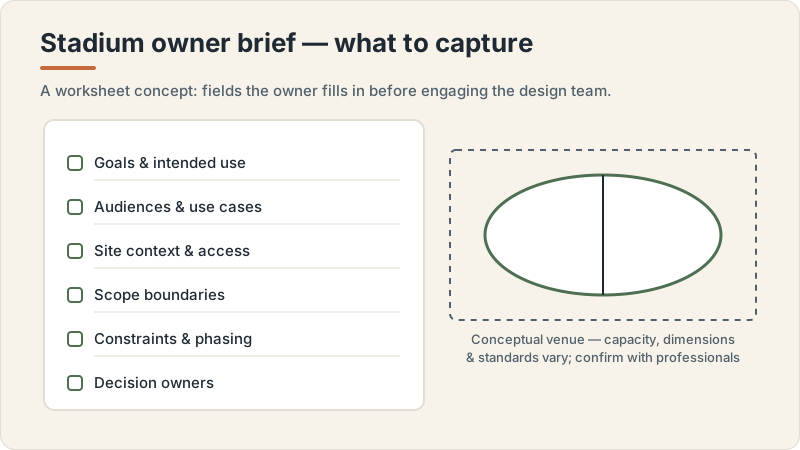
Stadium owner brief worksheet concept
Conceptual editorial diagram — not a construction drawing, specification, to-scale plan or proof of a real project. It is not engineering, structural, fire/life-safety, crowd-safety or accessibility-compliance guidance. Capacities, dimensions, standards, requirements and costs vary by facility type, audience, site, use case and governing body, and are confirmed with qualified professionals, relevant authorities and governing bodies. Build Design Hub does not design, build, inspect, certify, recommend or match anyone.
What this guide helps you prepare
This guide helps you assemble a clear project brief for a smaller stadium or grandstand and organise the questions you will take to qualified professionals. It supports you in writing down your intended uses, describing your site and constraints in plain language, recording the stakeholders who need a say, and framing the unknowns you expect a professional team to help resolve. The aim is a document that a feasibility adviser, architect, engineer, planner or contractor could read and quickly understand what you are trying to achieve and what you have not yet decided.
It does not tell you how to build, sequence, engineer or lay out a venue, and it does not set any capacity, dimension, load, sightline, lighting, gradient, cost or timeline figure. Those belong to qualified professionals and the relevant authorities and governing bodies, and they vary by location, facility type, use case, governing body, owner, site, authority, professional team and project scope. Treat this guide as a preparation tool that helps you ask better questions, compare responses on a consistent basis, and avoid arriving at professional conversations with gaps that slow everything down.
- Write your project purpose in one or two plain sentences before adding detail
- Separate what you have decided from what you expect professionals to advise on
- List the events and uses you want the facility to support, without fixing numbers
- Note the site, access and neighbours in descriptive terms, not measurements
- Capture who must be consulted, informed or asked to approve at each stage
- Record open questions as questions, so professionals can answer them directly
How preparation differs at a modest scale
A smaller stadium or grandstand often shares a site with existing activity: a school field, a community pitch, a park or a club ground already in use. That changes what your brief needs to foreground. Rather than a blank site and a large dedicated project organisation, you are more likely to be describing how a modest spectator facility fits alongside things that already happen, who currently manages the land, and how a project would coexist with day-to-day operations. Preparation at this scale benefits from being explicit about the existing context, the seasonal calendar, and the people who wear more than one hat, because a single volunteer or officer may cover roles that a larger venue would split across a team.
The emphasis also shifts toward flexibility and lifecycle. A modest facility may need to serve several uses, be operated by a small team or volunteers, and be maintained on a limited ongoing footing. Your brief can capture these realities without pretending to solve them: describe the mix of uses you hope for, the operating and maintenance capacity you realistically have, and the appetite for phasing versus doing everything at once. None of this is a substitute for professional advice on what is feasible or permissible; it simply gives the professionals you engage an honest picture of the constraints they are designing and advising within, which requirements confirm with qualified professionals and relevant authorities.
- Describe existing site activity and who currently manages or programmes it
- Note whether the facility must share space, access or services with other users
- Record the realistic operating and maintenance capacity, including volunteer roles
- Capture your appetite for phasing versus a single stage, as a discussion point
- List seasonal or event-calendar constraints that could affect any works window
- Flag where a small team means one person holds several project responsibilities
What to capture in a small-venue brief
A useful small-venue brief records intent and context rather than specifications. Start with the outcomes you care about: what the facility should let people do, who it serves, and how success would look to your stakeholders. Then describe the site and its surroundings in plain language, the way you would explain them to someone visiting for the first time, including access, neighbours, existing structures and anything about the ground or setting you already know or suspect. Add the practical realities of ownership and operation, such as who holds the land, who would run events, and how the facility would be looked after over time. Keep decisions and assumptions visibly separate so that no assumption quietly hardens into a fixed requirement.
Just as important is capturing what you do not know. A strong brief names its open questions rather than papering over them, and it points those questions at the right kind of professional or authority. It also records the constraints you cannot change, such as neighbouring uses, existing commitments or a fixed operating season, so that advisers work within reality from the outset. Avoid writing any number as a fact, whether that is capacity, dimensions, sightlines, lighting, gradients, loads, costs or timelines; instead note that these are to be confirmed with qualified professionals, relevant authorities and governing bodies, which vary by location, facility type, use case, governing body, owner, site, authority, professional team and project scope.
- State intended uses and the outcomes that matter to your stakeholders
- Describe the site, access, neighbours and existing structures in plain language
- Record ownership, who would operate events, and who maintains the facility
- Keep decisions, assumptions and open questions in clearly separate lists
- Note fixed constraints such as neighbouring uses or a set operating season
- Mark every figure as to-be-confirmed with qualified professionals and authorities
Planning questions before speaking with professionals
Before you engage a feasibility adviser, architect, engineer, planner or contractor, work through the questions you can answer yourselves as an owner or client group. These are not technical questions; they are about intent, governance, capacity and constraints. Answering them first makes your brief coherent and helps professionals spend their time on advice rather than on extracting basics from you. It also surfaces internal disagreements early, while they are cheap to resolve, rather than after a professional team has begun scoping around an assumption that not everyone shared.
Treat this stage as internal alignment. Where you cannot agree, record the disagreement as an open question for later; where you are guessing, label it a guess. The goal is a brief that honestly reflects what your side has settled and what it has not, so that the professionals and authorities you approach can respond to something clear. Nothing you decide here fixes a requirement; requirements vary by location, facility type, use case, governing body, owner, site, authority, professional team and project scope, and remain for qualified professionals and the relevant authorities and governing bodies to confirm.
- What is the single main purpose of this facility, in plain words?
- Who decides, who is consulted, and who must formally approve at each stage?
- What can we realistically operate and maintain once the project is complete?
- Which constraints are genuinely fixed, and which are preferences we could relax?
- What have we assumed that we have not yet checked with anyone qualified?
- How will we compare professional responses on a consistent, like-for-like basis?
Questions for qualified professionals
Once your brief is drafted, it becomes the basis for structured conversations with the professionals and authorities relevant to your project. The questions below are prompts to help you learn what applies to your specific situation, not a list of requirements. A qualified professional can tell you which specialists a project like yours typically involves, what a feasibility or scoping stage might examine, and where the relevant authorities and governing bodies fit in. Bring your open questions with you and ask each professional to explain what falls inside and outside their scope, so you understand who owns which decision.
Use these conversations to confirm rather than to assume. Ask how requirements, approvals and standards apply to your location, facility type and intended use, and record the answers against the open questions in your brief. Because Build Design Hub does not design, engineer, inspect, certify or recommend, and gives no capacities, dimensions, costs or timelines, everything here points back to qualified professionals, relevant authorities and governing bodies, who confirm what actually applies, which varies by location, facility type, use case, governing body, owner, site, authority, professional team and project scope.
- Which professionals and specialists does a project of this type typically involve?
- What would a feasibility or early scoping stage examine for our site and uses?
- How do requirements, approvals and any governing-body considerations apply to us?
- What information do you need from our brief to advise accurately, and what is missing?
- Where are the boundaries of your scope, and who owns the decisions outside it?
- How should we structure requests so we can compare responses on a like-for-like basis?
What this does not replace
This is an educational planning resource only. It is not a stadium construction manual and not structural, architectural, seating or stand engineering, crowd-safety, crowd-flow, evacuation, fire or life-safety, or accessibility-compliance advice, and it is not permit, zoning, inspection, certification, legal, tax, insurance or procurement advice. It does not design, build, engineer, specify, certify, inspect or approve anything, gives no capacities, dimensions, loads, revenue, ROI or costs, and offers no warranty interpretation or estimate. Requirements, standards, capacities and costs vary by location, facility type, use case, governing body, owner, site, authority, professional team and project scope, and are confirmed with qualified professionals, relevant authorities and governing bodies.
Build Design Hub does not design, build, engineer, inspect, certify, recommend, rank, verify, introduce, broker or match suppliers, contractors, consultants or professionals, and HELPERG LLC is publisher/operator only. Use this resource to prepare your own thinking and briefs, then have qualified professionals you engage directly review your project. Decisions about design, engineering, structure, crowd safety, fire and life safety, accessibility, compliance, capacity, procurement and cost must rest on those professionals, the relevant authorities and the governing bodies for your sport and location.
- Not a stadium construction manual and not structural, architectural or seating/stand engineering
- Not crowd-safety, crowd-flow, evacuation, fire/life-safety or accessibility-compliance advice
- Not permit/zoning, inspection, certification, warranty-interpretation, legal, tax, insurance or procurement advice
- Not a supplier, contractor, consultant or professional recommendation, ranking, directory or matching service
- Not an estimate and gives no capacity, dimension, revenue, ROI or cost figures — requirements and costs vary
- Qualified professional review is required before any stadium project decision
Small stadium and grandstand brief preparation worksheet
- 1Write a one- or two-sentence statement of the facility's main purpose
- 2List the events, activities and uses you hope the facility will support
- 3Record who owns or controls the land and any existing commitments on it
- 4Describe the site, access routes and neighbouring uses in plain language
- 5Note existing structures, activity or programming that a project must coexist with
- 6Gather the names and roles of everyone who must be consulted, informed or approve
- 7Capture your realistic operating and maintenance capacity, including volunteers
- 8Record seasonal or calendar constraints that could affect any works window
- 9Separate confirmed decisions from assumptions and label each accordingly
- 10List your open questions and note which professional or authority each is for
- 11Mark every capacity, dimension, cost, timeline or standard as to-be-confirmed
- 12Note your appetite for phasing versus a single stage as a discussion point
- 13Draft a consistent structure for comparing professional and supplier responses
- 14Keep a version-dated record so the brief stays current as answers come in
Common mistakes to avoid
- Writing a capacity, dimension or sightline figure into the brief as if it were fixed, rather than a question for qualified professionals
- Assuming requirements, approvals or standards from another venue apply to your site without confirming with the relevant authorities
- Treating cost or timeline guesses as commitments before any feasibility or scoping advice
- Skipping professional review because the project feels small enough to reason through informally
- Leaving stakeholders and approval steps out of the brief until late, then discovering disagreements after scoping has begun
- Blurring decisions, assumptions and open questions together so guesses quietly harden into requirements
- Ignoring how a shared or in-use site constrains the project by drafting the brief as if the site were blank
- Underestimating ongoing operating and maintenance capacity, so the facility becomes hard to run after completion
When to involve a professional
- When you move from an internal brief toward feasibility, scoping or any decision with real consequences
- When questions of capacity, dimensions, sightlines, lighting, loads, gradients or spectator safety arise, which are for qualified professionals
- When approvals, permits, zoning, codes or governing-body considerations may apply and need confirmation with the relevant authorities
- When the site is shared, in active use, or has neighbours whose interests could affect the project
- When accessibility, life-safety or inspection questions surface, since these require qualified professional advice and are outside this guide
- When comparing supplier or contractor responses in a way that could commit you, so a professional can help you interpret them
Frequently asked questions
Questions readers ask about this topic
Does Build Design Hub design, build, engineer or inspect a small stadium or grandstand?
No. Build Design Hub is an educational resource only. It does not design, build, engineer, inspect, certify, recommend, rank, verify, introduce, broker or match any suppliers, contractors, consultants or professionals, and it gives no capacities, dimensions, costs, timelines or requirements. It helps you prepare a brief and questions; qualified professionals and the relevant authorities and governing bodies provide the actual advice, which varies by location, facility type, use case, governing body, owner, site, authority, professional team and project scope.
How is preparing a brief for a small venue different from a large one?
The rigour is similar but the emphasis shifts. Smaller projects often share an in-use site, run on a small or volunteer team, and need flexibility across several uses. The brief benefits from foregrounding existing context, realistic operating and maintenance capacity, and open questions, so the professionals you engage understand the real constraints. It does not change the need for qualified professional advice on anything technical.
Can this guide tell me how many people my grandstand can hold, or what it will cost?
No. This guide never states capacities, dimensions, costs, timelines or standards, because those are determined by qualified professionals and the relevant authorities and governing bodies and vary by location, facility type, use case, governing body, owner, site, authority, professional team and project scope. Record such items in your brief as questions to confirm, not as figures.
When should I stop preparing internally and involve a professional?
As soon as your questions become technical, involve approvals or safety, or lead toward decisions with real consequences. Use your internal brief to reach that point efficiently, then bring your open questions to qualified professionals and the relevant authorities so they can confirm what applies to your specific project.
Keep reading