
Who this guide is for
- Facility owners preparing to engage an accessibility specialist for an operating venue
- Operators and facility managers organising records before an accessibility review
- Schools, colleges and universities reviewing how sports facilities serve their communities
- Sports clubs and community organisations planning an accessibility conversation
- Municipalities and public bodies preparing governance documentation for civic facilities
- Developers handing a facility to an operating team who will arrange specialist review
Planning diagram
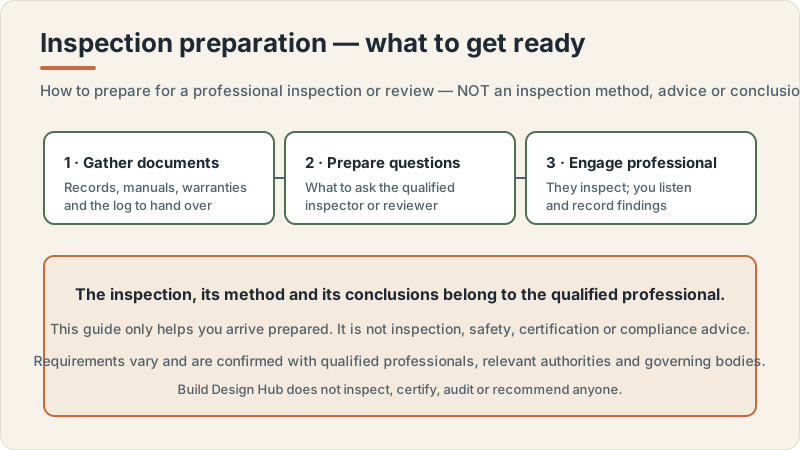
Inspection preparation workflow concept
Conceptual editorial diagram — not a construction drawing, specification, to-scale plan or proof of a real project. It is not engineering, structural, fire/life-safety, crowd-safety or accessibility-compliance guidance. Capacities, dimensions, standards, requirements and costs vary by facility type, audience, site, use case and governing body, and are confirmed with qualified professionals, relevant authorities and governing bodies. Build Design Hub does not design, build, inspect, certify, recommend or match anyone.
What this guide helps you prepare
This guide helps you assemble the raw material an owner or operator needs before engaging a qualified accessibility specialist for a facility already in use: a clear description of who uses the venue and how, the operational and handover documents a specialist may want to see, a record of feedback and observations gathered to date, and a structured list of questions. These are preparation artefacts you create and organise, not judgements you make about whether your facility is accessible. The clearer and more complete they are, the more focused and productive the specialist's review will be, and the easier it becomes to act on their findings.
It is equally important to be clear about what this guide does not do. It does not state what accessibility provisions your facility requires, whether any feature meets a standard, what should be added or altered, or how any change should be carried out. Those determinations belong to qualified accessibility specialists and the relevant authorities and governing bodies, and they vary by location, facility type, audience, use intensity and use case. Your task at this stage is to prepare good records and good questions, not to supply answers that belong to professionals who can review your venue directly.
- Write a plain description of who uses the facility, how often, and for what activities
- Note the user groups and event types the venue serves, including spectators and staff, not only players
- Gather operational, handover and warranty documents a specialist may ask to review
- Record feedback, observations and questions raised by users, staff or visitors over time
- Capture open questions you cannot answer yourself and intend to route to a specialist
- Make assumptions explicit so a specialist can test them rather than have them carried forward unchecked
Organising your facility records before a review
A specialist reviewing an operating facility works best with an accurate picture of the venue as it actually functions, so the preparation worth doing is mostly about organising what already exists. That includes the handover and as-built documentation from when the facility was delivered, any operations and maintenance manuals, drawings or plans that show layout and circulation, and records of changes made since opening. It also includes the human side: how the facility is used across a typical week and season, which entrances, routes, seating areas, changing and washroom facilities and parking are in regular use, and any temporary arrangements that come and go with events. Assembling these into one organised place saves review time and reduces the chance that an important detail is missed.
Gathering records is a documentation task, not an assessment. You are not deciding what any record means for accessibility, scoring features, or comparing your venue against a standard; you are making sure a specialist has what they need to do that work properly. If documents are incomplete or missing, note that too, because a gap in records is itself useful information for a specialist and for your own planning. Keep the focus on completeness and accuracy, and leave interpretation to the professional you engage and the authorities and governing bodies with jurisdiction over your facility.
- Which handover, as-built and operations documents exist, and where are they held?
- Do you have current layout or circulation drawings, and do they reflect changes made since opening?
- What temporary or event-time arrangements affect how the venue is entered and moved through?
- Which user-facing areas, such as entrances, routes, seating, changing rooms, washrooms and parking, are in regular use?
- What changes, additions or alterations have been made since the facility opened, and are they documented?
- Where are records incomplete or missing, so the gaps can be flagged to a specialist rather than overlooked?
Building a feedback and observation log for the conversation
Much of the most valuable input for an accessibility review comes from the people who use a facility day to day, and capturing that input in an organised log gives a specialist a head start. Over time, owners and operators hear comments, requests and questions from players, spectators, staff, parents, officials and visitors about how the venue works for them. Recording these as observations, without trying to judge their significance or resolve them yourself, creates a picture of real-world use that drawings alone cannot show. The same applies to patterns staff notice, recurring questions at the front desk, or arrangements that are routinely improvised around events.
A feedback log is a preparation tool, not a verdict. Logging an observation does not mean a feature is or is not adequate, and nothing in such a log should be treated as a finding, a requirement or a confirmation that anything meets or fails a standard. The point is to bring concrete, specific material to a specialist so the review is grounded in how the facility is actually experienced. Keep entries factual and dated, route anything that suggests an immediate concern to the appropriate professionals straight away, and let the specialist and relevant authorities determine what the observations mean for your facility.
- Record specific comments and requests from users, dated and attributed to a general group rather than named individuals where appropriate
- Note recurring questions staff field about getting into, around or out of the venue
- Capture event-time or seasonal arrangements that are improvised rather than designed-in
- Log observations as factual notes, not as conclusions about adequacy or compliance
- Flag anything suggesting an immediate concern for prompt routing to appropriate professionals
- Keep the log organised so a specialist can scan themes quickly rather than read scattered notes
Planning questions before speaking with professionals
Before you engage an accessibility specialist, it pays to work through what you already know and what you still need to learn. Organising your usage picture, your records and your feedback log first means the specialist conversation starts on firmer ground and stays focused on substance. Be candid about the assumptions you are carrying, such as believing a particular route or facility works well for everyone, so those assumptions can be tested by someone qualified rather than quietly accepted. This preparation also makes it easier to scope the engagement clearly and to act on whatever the specialist recommends.
These questions are prompts to clarify your own thinking, not a checklist that confirms anything about your facility. None of them should be answered with a requirement, a standard or a verdict at this stage. Anything touching what provisions apply, whether features are adequate, or what must change is something to confirm with qualified accessibility specialists and the relevant authorities and governing bodies for your facility, all of which vary by location, facility type, audience, use intensity and use case.
- Can you describe in plain terms who uses the facility and how, across a typical week and season?
- Have you gathered the handover, operations and change records a specialist is likely to request?
- Have you assembled a feedback and observation log from users, staff and visitors?
- Have you written down the assumptions and open questions you want a specialist to examine?
- Have you defined the scope and purpose of the review you are seeking, without pre-judging its outcome?
- Have you noted which authorities or governing bodies may need to be involved, without assuming their answers?
Questions for qualified professionals
When you reach the point of engaging an accessibility specialist, the most valuable thing you can bring is good questions framed against an organised record of how your facility is used. The questions below are examples of what owners and operators commonly need a specialist to address; they are deliberately open, because the answers depend entirely on your specific facility, location, audience, use case and the authorities and governing bodies with jurisdiction. Asking them helps you understand the scope and nature of a review rather than guessing, and it surfaces uncertainties early so they can be addressed through the proper channels.
Use the responses to inform your planning, not as a substitute for a formal review, advice or approval. This guide does not provide accessibility requirements, findings, standards or recommendations for your facility, and it does not recommend, rank, verify, introduce or match any specialist, supplier or contractor. Confirm everything that matters with the qualified accessibility specialist you engage directly and with the relevant authorities and governing bodies, and keep a record of what you are told so your planning stays accurate as you act on it.
- How would you scope an accessibility review of an operating facility like ours, and what would it cover?
- What documentation and information should we provide so your review is as thorough as possible?
- Which authorities or governing bodies are relevant to this type of facility and use, and how should we engage them?
- How should we interpret and act on the feedback and observations we have gathered from users and staff?
- What process would you advise for prioritising and acting on anything your review identifies?
- What ongoing or periodic review would you suggest as the facility, its use and any requirements evolve?
What this does not replace
This is an educational planning resource only. It is not a maintenance manual and not inspection, certification, engineering, architectural, structural, HVAC, electrical, safety-compliance, fire or life-safety, or accessibility-compliance advice, and it is not legal, tax, insurance or procurement advice. It does not maintain, operate, inspect, certify, audit or specify anything, gives no maintenance intervals or procedures as universal rules, and offers no warranty interpretation, estimate, price, ROI or capacity figure. Maintenance requirements and costs vary by facility type, use intensity, surface, system, climate, season, governing body, warranty terms, supplier documentation, contractor scope and local professional requirements, and are confirmed with qualified professionals, suppliers, contractors, relevant authorities and governing bodies.
Build Design Hub does not operate, maintain, inspect, certify, audit, design, build, recommend, rank, verify, introduce, broker or match suppliers, contractors, maintenance providers or facility managers, and HELPERG LLC is publisher/operator only. Use this resource to prepare your own thinking and records, then have qualified professionals you engage directly review your facility. Decisions about maintenance, inspection, safety, compliance, warranties, procurement and suitability must rest on those professionals, suppliers, the relevant authorities and the governing bodies for your sport and location.
- Not a maintenance manual and not maintenance instructions, intervals or procedures as universal rules
- Not inspection, certification, safety-compliance, fire/life-safety or accessibility-compliance advice
- Not engineering, architectural, warranty-interpretation, legal, tax, insurance or procurement advice
- Not a supplier, contractor, maintenance-provider or facility-manager recommendation, ranking, directory or matching service
- Not an estimate, price or cost figure — maintenance requirements and costs vary
- Qualified professional review is required before any operations or maintenance decision
Accessibility review preparation worksheet (records and questions to organise)
- 1Write a plain description of who uses the facility, how often, and for what activities and events
- 2List the user groups served, including players, spectators, staff, officials and visitors
- 3Gather handover and as-built documentation and note where each item is held
- 4Collect operations and maintenance manuals and any layout or circulation drawings
- 5Record changes, additions and alterations made since the facility opened, with dates where known
- 6Note temporary and event-time arrangements that affect entry, circulation and use
- 7Assemble a dated feedback and observation log from users, staff and visitors
- 8Flag any observation suggesting an immediate concern for prompt routing to appropriate professionals
- 9Identify and record where documentation is incomplete or missing
- 10Write down the assumptions you want a specialist to test rather than confirm yourself
- 11List the open questions you intend to route to a qualified accessibility specialist
- 12Define the purpose and rough scope of the review you are seeking, without pre-judging the outcome
- 13Note the authorities and governing bodies that may be relevant, without assuming their positions
- 14Set up a place to record what the specialist tells you so your planning stays accurate
Common mistakes to avoid
- Treating this guide, or any general source, as confirmation that a facility is or is not accessible, instead of confirming with a qualified specialist
- Assuming that because a facility passed something at handover, nothing about its accessibility needs review now that it is in use
- Reading user feedback as a finished verdict rather than as material to bring to a specialist
- Assuming a warranty, handover sign-off or original documentation covers accessibility questions that arise in operation
- Trying to decide what should change, and how, before a qualified specialist has reviewed the venue
- Skipping professional review because a feature looks fine to staff who do not share the needs of all users
- Treating an interval, provision or arrangement seen elsewhere as a universal rule that applies to your facility
- Engaging a specialist with scattered or incomplete records, so the review spends time on document-gathering instead of substance
When to involve a professional
- When you are ready to understand how your operating facility serves users with a range of needs, engage a qualified accessibility specialist
- When any observation or feedback suggests an immediate concern, route it to appropriate professionals without delay rather than waiting for a scheduled review
- When you are unclear which requirements, authorities or governing bodies apply to your facility type and use case
- When you are planning changes, events or expanded use that may affect how people enter, move through or use the venue
- When records are incomplete or the facility has changed materially since handover and you need a current, qualified picture
- When you need to act on review findings and require professional guidance on scope, sequence and the proper channels
Frequently asked questions
Questions readers ask about this topic
Does Build Design Hub review my facility, tell me if it is accessible, or recommend a specialist?
No. Build Design Hub is an educational publisher and does not maintain, inspect, certify, audit or review any facility, and it does not recommend, rank, verify, introduce or match accessibility specialists, suppliers or contractors. It does not provide accessibility requirements, findings, intervals, costs or standards for your venue. This guide only helps you prepare records and questions; a qualified accessibility specialist you engage directly, together with the relevant authorities, reviews your facility and confirms what applies to it.
Can this guide tell me whether my facility meets accessibility requirements?
No. Whether any facility meets requirements is a determination for qualified accessibility specialists and the authorities and governing bodies with jurisdiction, and requirements vary by location, facility type, audience, use intensity and use case. This guide is preparation material only and makes no compliance statement about your venue. Use it to organise what you have, then have a specialist review your specific facility.
What should I have ready before engaging an accessibility specialist?
An organised description of how the facility is used, the handover and operations documents you hold, drawings that reflect any changes since opening, a dated feedback and observation log from users and staff, and a written list of your assumptions and open questions. Note any gaps in your records as well, since a gap is useful information for a specialist. The specialist will confirm exactly what they need for their review.
We received feedback that suggests a problem. What should we do?
Treat feedback as material to bring to a qualified specialist, not as a conclusion you act on by guessing at fixes. If any observation suggests an immediate concern, route it to appropriate professionals promptly through the proper channels. This guide does not interpret feedback or tell you what to change; that is for the specialist you engage and the relevant authorities.
Keep reading