
Who this guide is for
- Owners and developers preparing to commission a periodic condition review of a sports facility they hold
- Facility and operations managers gathering records and observations before reviewers arrive
- Schools, colleges and universities organising documentation for a review of shared sports assets
- Clubs and committees that want a structured way to prepare for a review and brief qualified reviewers
- Municipalities and parks teams coordinating reviews across multiple courts, pitches or venues
- Owner representatives and project coordinators collecting handover, warranty and defect records ahead of a review
Planning diagram
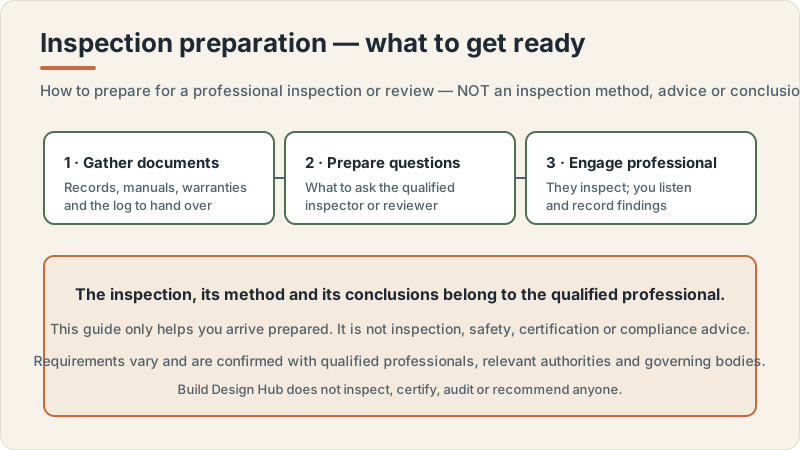
Inspection preparation workflow concept
Conceptual editorial diagram — not a construction drawing, specification, to-scale plan or proof of a real project. It is not engineering, structural, fire/life-safety, crowd-safety or accessibility-compliance guidance. Capacities, dimensions, standards, requirements and costs vary by facility type, audience, site, use case and governing body, and are confirmed with qualified professionals, relevant authorities and governing bodies. Build Design Hub does not design, build, inspect, certify, recommend or match anyone.
What this guide helps you prepare
This guide helps you get ready for a periodic condition review: the kind of review you arrange with qualified reviewers to understand how your sports facility is performing over time. It focuses entirely on preparation. The work it supports is gathering and organising your documents, writing down your own observations in plain language, and assembling the questions you want answered, so that the people you engage arrive to a tidy record rather than a scramble. The aim is clarity and completeness in what you bring, not any judgement about condition, which is for the reviewers to make.
A well-prepared owner makes a review more productive because the reviewer spends less time reconstructing history and more time assessing what matters. This guide deliberately stops short of telling you what good or poor condition looks like, what any finding means, or what should be done next, because those are conclusions for qualified reviewers, suppliers, contractors and the relevant authorities. It keeps every threshold, interval, requirement and cost as a question to confirm, because they vary by facility type, surface, system, use intensity, climate, season, governing body, warranty terms and local professional requirements.
- A single organised place to hold the documents a reviewer is likely to ask for, gathered before they arrive
- A plain-language log of your own observations, clearly labelled as the owner's notes rather than findings
- A list of the questions you want the review to answer, written before the review so you do not forget them
- A clear separation between what you have confirmed in writing and what is still an open question
- A record of which governing body, authority, supplier or contractor relates to each part of the facility
- A note that intervals, thresholds, lifespans and costs are to be confirmed by qualified people, never assumed
Documents and records to gather before a review
Reviews tend to go further when the reviewer can see the facility's history, so a large part of preparation is simply collecting paperwork into one accessible place. Owners commonly assemble the handover pack from construction, any operation and maintenance documentation supplied with surfaces and systems, warranty and guarantee documents, the original specifications or drawings if available, and whatever maintenance, servicing and repair records have built up since opening. Gathering these is an organising task, not an interpretation task: the point is to make the record findable and complete, not to decide what any of it means or whether a warranty covers a particular situation, which is a matter to confirm with the issuer.
Alongside formal documents, it helps to pull together a defect and incident log, supplier and contractor contact details, records of how intensively the facility is used, and any photographs or notes you have kept over time. Keep your own material clearly marked as the owner's record so a reviewer can tell it apart from manufacturer or contractor documentation. Where a document is missing, note that too, because a gap is itself useful information for the review. Resist drawing conclusions from what you gather; the documents support the reviewer's assessment, they do not replace it, and any requirement, interval or coverage they mention should be confirmed rather than assumed.
- Has the handover or construction completion pack been located, and is anything obviously missing from it?
- Are operation and maintenance documents for surfaces, systems and equipment collected and labelled by area?
- Are warranty, guarantee and defect-liability documents gathered, with their issuers and dates noted to confirm later?
- Is there a maintenance, servicing and repair record, and where there is none, has that gap been recorded?
- Are supplier and contractor contacts, plus any usage or booking records, attached so the reviewer can see use intensity?
- Are your own photographs, notes and a defect or incident log included and clearly marked as the owner's record?
Organising your own observations without drawing conclusions
Owners and facility managers see their facility every day, and that informal knowledge is valuable to a reviewer when it is captured honestly. The preparation task is to write down what you have noticed in plain, descriptive language and to separate it firmly from any judgement about severity or cause. A note that says where you have seen something change, when you first noticed it, and how it relates to use is far more useful than a guess about what it means. Labelling everything as the owner's observation, not a finding, keeps the record trustworthy and leaves the assessment where it belongs, with the qualified reviewer.
It also helps to organise observations by area or system, so the review has a logical structure to follow and nothing gets overlooked. Group your notes around the parts of the facility you actually have, describe each plainly, and attach any photographs or dates that support them. Avoid rating anything, ranking areas by concern, or deciding what is urgent, because severity, cause and priority are for the reviewer to determine against requirements that vary by facility type, surface, system, climate and governing body. Your job in preparation is to describe and to ask, not to assess or conclude.
- Have I described each observation in plain terms, with a location and a rough date I first noticed it?
- Am I labelling my notes as the owner's observations rather than as findings, ratings or causes?
- Have I grouped observations by area or system so the review has a clear structure to follow?
- Have I avoided deciding what is urgent or serious, leaving severity and priority to the reviewer?
- Have I attached photographs, usage context or records that help a reviewer understand each note?
- Have I flagged anything I am unsure about as a question for the reviewer rather than answering it myself?
Planning questions before speaking with professionals
Before reviewers arrive, it is worth interrogating your own preparation so you turn up with a clear agenda rather than a loose pile of paper. Ask whether your documents are complete and findable, whether your observations are described well enough for someone else to understand without you narrating them, and whether you have separated what you know in writing from what you are guessing. This self-review tends to surface missing handover documents, unlabelled notes, and points where you have quietly assumed a condition, a coverage or an interval that you are not in a position to judge.
Use these prompts to pressure-test your preparation, not to answer the technical questions yourself. The goal is to make sure the right people are asked the right things and that you can listen and record rather than improvise. Keep every interval, threshold, requirement, coverage and cost as a question, because the answers depend on your specific facility, surface, systems, use and location, and must come from qualified reviewers, suppliers, contractors and the relevant authorities and governing bodies.
- Are my documents complete and organised, and have I noted clearly where something is missing?
- Have I described my observations well enough that a reviewer could understand them without me explaining?
- Which things am I treating as facts that are really questions to confirm with a reviewer, supplier or authority?
- Have I avoided rating condition, deciding causes or judging what a warranty covers anywhere in my notes?
- Which areas, systems or records have I barely covered and should think harder about before the review?
- Do I know which reviewer, supplier, contractor, authority or governing body relates to each part of the facility?
Questions for qualified professionals
Your preparation is also the place to collect the questions you will take to the qualified reviewers you engage. Writing them down as you organise records means you arrive with a focused agenda and can concentrate on listening and recording what you hear. Keep your questions open and let the reviewers provide the assessment, the interpretation and any recommendations; your role is to ask well, capture the answers, and update your records and open questions accordingly rather than to reach conclusions yourself.
Tailor these prompts to your own facility and add to them as new uncertainties surface while you prepare. Questions about intervals, thresholds, lifespans, coverage, standards and cost belong here as questions, not as figures to assume, because the answers depend on your specific facility type, surface, systems, use intensity, climate, season, warranty terms and local requirements, all of which must be confirmed with qualified professionals, suppliers, contractors and the relevant authorities and governing bodies.
- What documents and records would you expect to see for a review of a facility like mine, and what is missing from what I have gathered?
- Which of my observations need formal assessment before any impression I have formed can be relied on?
- How should I interpret my warranty and defect documents, and who confirms what each one actually covers?
- What review scope and frequency would suit a facility of this type, use intensity, surface and climate?
- Which suppliers, contractors, specialists or authorities should be involved in reviewing which parts of the facility?
- What records and documentation would you recommend I keep between reviews so future reviews start from a clearer history?
What this does not replace
This is an educational planning resource only. It is not a maintenance manual and not inspection, certification, engineering, architectural, structural, HVAC, electrical, safety-compliance, fire or life-safety, or accessibility-compliance advice, and it is not legal, tax, insurance or procurement advice. It does not maintain, operate, inspect, certify, audit or specify anything, gives no maintenance intervals or procedures as universal rules, and offers no warranty interpretation, estimate, price, ROI or capacity figure. Maintenance requirements and costs vary by facility type, use intensity, surface, system, climate, season, governing body, warranty terms, supplier documentation, contractor scope and local professional requirements, and are confirmed with qualified professionals, suppliers, contractors, relevant authorities and governing bodies.
Build Design Hub does not operate, maintain, inspect, certify, audit, design, build, recommend, rank, verify, introduce, broker or match suppliers, contractors, maintenance providers or facility managers, and HELPERG LLC is publisher/operator only. Use this resource to prepare your own thinking and records, then have qualified professionals you engage directly review your facility. Decisions about maintenance, inspection, safety, compliance, warranties, procurement and suitability must rest on those professionals, suppliers, the relevant authorities and the governing bodies for your sport and location.
- Not a maintenance manual and not maintenance instructions, intervals or procedures as universal rules
- Not inspection, certification, safety-compliance, fire/life-safety or accessibility-compliance advice
- Not engineering, architectural, warranty-interpretation, legal, tax, insurance or procurement advice
- Not a supplier, contractor, maintenance-provider or facility-manager recommendation, ranking, directory or matching service
- Not an estimate, price or cost figure — maintenance requirements and costs vary
- Qualified professional review is required before any operations or maintenance decision
Condition review preparation worksheet
- 1Gather the handover or construction completion pack into one place and note anything obviously missing
- 2Collect operation and maintenance documents for surfaces, systems and equipment, labelled by area
- 3Assemble warranty, guarantee and defect-liability documents and note their issuers and dates to confirm later
- 4Pull together any maintenance, servicing and repair records, and record where no record exists
- 5Attach supplier and contractor contacts so the reviewer can reach the right parties
- 6Add usage, booking or occupancy records that show how intensively the facility is used
- 7Write your own observations in plain language, labelled as the owner's notes rather than findings
- 8Group observations and documents by area or system so the review has a clear structure
- 9Attach photographs and dates that support your observations without rating their severity
- 10Note which governing body, authority, supplier or contractor relates to each part of the facility
- 11Mark every interval, threshold, lifespan, coverage and cost as something to confirm, not assume
- 12List the open questions you want qualified reviewers to answer during the review
- 13Record any gaps in documentation as useful information rather than guessing what they mean
- 14Decide who will hold and update this record so future reviews start from a clearer history
Common mistakes to avoid
- Treating a maintenance interval or lifespan you have read somewhere as a universal rule rather than a question to confirm with qualified people
- Assuming a warranty or guarantee covers a particular situation instead of asking the issuer to confirm what it actually covers
- Rating condition, deciding causes or ranking areas by concern when those judgements belong to the qualified reviewer
- Arriving with scattered or incomplete documents, so the reviewer spends the review reconstructing history
- Mixing the owner's observations with manufacturer or contractor documentation so the two become hard to tell apart
- Hiding or ignoring missing records rather than flagging the gaps, which are themselves useful to a review
- Logging thresholds, capacities, standards or costs as facts instead of as questions for qualified professionals and authorities
- Assuming preparation replaces the review itself, or that the review replaces ongoing professional advice between reviews
When to involve a professional
- When you need anyone to assess the actual condition of a surface, system, structure or piece of equipment
- When you need an observation interpreted, a cause identified, or a severity or priority determined
- When warranty, guarantee or defect-liability coverage is unclear and must be confirmed by the issuer
- When intervals, thresholds, lifespans or standards must be judged against requirements that vary by facility, surface and governing body
- When a review may touch safety, accessibility, structural, electrical or compliance matters that require qualified specialists and authorities
- When you are deciding what scope, frequency or specialists a review of your facility type should involve
Frequently asked questions
Questions readers ask about this topic
Does Build Design Hub review, inspect, certify or assess the condition of my facility, or recommend reviewers, suppliers or contractors?
No. Build Design Hub is an educational resource and does not review, inspect, assess, certify, audit or sign off the condition of any facility, and it does not design, build, maintain, verify, rank, recommend, broker or match reviewers, suppliers, contractors or facility managers. It gives no intervals, thresholds, lifespans, coverage, requirements or costs as facts. Those depend on your specific facility and on rules that vary by facility type, surface, system, use intensity, climate, season, governing body and warranty terms, and must be confirmed with qualified professionals and the relevant authorities. HELPERG LLC is the publisher and operator of this resource only.
Is this guide a condition assessment method or a way to judge how good or bad my facility is?
No. This guide is preparation only. It does not assess condition, interpret what any observation means, identify causes, rate severity or reach any conclusion about your facility. Its purpose is to help you gather documents and organise your own questions before a periodic review. The assessment itself, and any conclusions or recommendations, are for qualified reviewers and the relevant authorities and governing bodies, against requirements that vary by facility and location.
How do I know what condition my facility is in, or how serious something I have noticed is?
This guide cannot tell you that, and it deliberately avoids doing so. Keep your observations plain and labelled as the owner's notes, and take them to qualified reviewers, who assess condition and severity against requirements that vary by facility type, surface, system, climate and governing body. Treat any impression you have formed as a question to confirm, not a finding to act on.
How often should a condition review happen?
That depends on your facility, so confirm a sensible scope and frequency with the qualified reviewers, suppliers and authorities you engage. Frequency varies by facility type, surface, system, use intensity, climate, season, warranty terms and governing body, and this guide gives no interval as a fact. The aim of preparation is to make whatever review you arrange more useful, not to set how often it should occur.
Keep reading