
Who this guide is for
- Facility owners planning a seasonal, temporary or extended closure and a later reopening of a sports site
- Operators and facility managers organising handover, documentation and readiness records around a shutdown
- Schools and education estates teams scheduling sports-facility downtime around terms and holidays
- Sports clubs and community organisations preparing off-season or between-let closures
- Municipalities and public-sector estates teams coordinating closure governance across multiple sites
- Developers and asset owners preparing closure and reopening considerations as part of lifecycle planning
Planning diagram
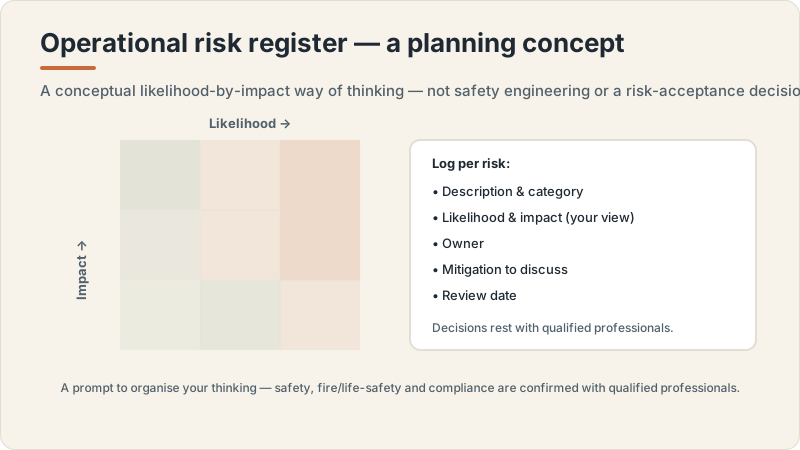
Operational risk register concept
Conceptual editorial diagram — not a construction drawing, specification, to-scale plan or proof of a real project. It is not engineering, structural, fire/life-safety, crowd-safety or accessibility-compliance guidance. Capacities, dimensions, standards, requirements and costs vary by facility type, audience, site, use case and governing body, and are confirmed with qualified professionals, relevant authorities and governing bodies. Build Design Hub does not design, build, inspect, certify, recommend or match anyone.
What this guide helps you prepare
This guide helps you assemble the planning groundwork for a facility closure and a later reopening: the questions to raise, the people and roles to involve, and the documents and records to gather before either event. It treats a closure not as a single switch but as a sequence of decisions, each of which has an owner, a paper trail and a set of professionals who may need to confirm it. By organising those decisions in advance, you reduce the chance that something important is assumed rather than checked, or carried in someone's memory rather than written down.
It is deliberately a preparation tool, not an operating manual. It will not tell you what to do to a surface, a system or a piece of equipment, and it will not state how often anything should happen, what it should cost or how long it should last. Those answers depend on your facility type, use intensity, surface, systems, climate, season, governing body, warranty terms, supplier documentation, contractor scope and local professional requirements, and they are confirmed with the qualified professionals, suppliers, contractors and authorities responsible for them. Your job at the planning stage is to know which questions to ask, who to ask and which records to have ready.
- A structured way to think about closure and reopening as separate but linked planning exercises, each with its own owner
- Prompts for the handover documents, manuals and records you may want to request and store before a closure
- Question sets to take into conversations with suppliers, contractors, facility managers and relevant authorities
- A starting point for a risk register and a defect or snag log you maintain on the owner side
- A framework for capturing decisions in writing so reopening does not depend on individual recollection
- Clarity on what must be confirmed by qualified professionals rather than assumed from a guide
Framing closure as a governed event: scope, ownership and records
A closure is easier to manage when it is treated as a defined event with a scope, a responsible owner and a record, rather than an informal pause. Before anything is paused or stood down, it helps to write down what "closed" actually means for your facility: which areas, surfaces, systems and services are affected, for how long, and who is accountable for each. Different stakeholders may have different assumptions about what stays live during a closure, so capturing the intended scope and circulating it for confirmation is a planning task in its own right. This is documentation and governance preparation, not an instruction on how to shut anything down.
Equally important is deciding, in advance, what evidence the closure should leave behind. Consider what condition information, readings, photographs, meter records, access logs and outstanding-defect notes you want captured at the point of closure so that the reopening team starts from a known baseline rather than guessing. The specifics of what to record, and who is competent to record or verify it, are matters to confirm with the relevant professionals, suppliers and contractors for your systems. The planning value here is in agreeing the questions and the record structure beforehand, so the right information exists when you need it.
- What does "closed" mean for this facility, area by area and system by system, and who confirms that definition
- Who is the single accountable owner for the closure, and which decisions sit with suppliers, contractors or authorities
- What baseline condition records, readings and photographs do stakeholders want captured at the point of closure
- Which access, key, alarm and permission arrangements change during closure, and who needs to be informed
- What outstanding defects, warranty matters or open contractor items should be logged before the site is paused
- How and where will all of this be stored so the reopening team can retrieve it without relying on memory
Preparing the reopening: readiness questions and the people to involve
Reopening a facility is its own planning exercise and benefits from being prepared well before the intended date rather than treated as the reverse of closure. A useful starting point is a list of the things you would want confirmed before a facility returns to use, expressed as questions for the people who can answer them: which systems and surfaces need professional attention before reuse, which warranties or supplier confirmations apply, which permissions or sign-offs others require, and who is responsible for each. This guide does not provide a recommissioning method or tell you what is required to reopen; those are determined with the qualified professionals, suppliers, contractors and authorities for your facility.
It also helps to think early about sequence and lead time at a planning level only: some confirmations, supplier visits or professional reviews may need to be arranged in advance, and identifying who to contact and what to ask is something you can prepare without making any operational decision yourself. Build the reopening as a set of questions and a stakeholder map rather than a checklist of actions to perform, and use it to organise conversations. The substance of any review, test, inspection or certification, and whether it is needed at all, is for the relevant professionals to define and carry out.
- What would you want confirmed, and by whom, before this facility returns to use after a closure
- Which suppliers, contractors, facility managers or authorities may need to be involved in reopening, and how early
- What documentation, warranties or supplier confirmations might be relevant to reuse, and where they are held
- Which sign-offs or permissions sit with other parties, and what lead time those parties say they need
- How will reopening decisions be recorded so there is a clear account of who confirmed what
- What planning questions remain open, and which qualified professional is best placed to resolve each one
Planning questions before speaking with professionals
Before you contact suppliers, contractors, facility managers or authorities, it helps to organise your own side first so that those conversations are efficient and the right questions get asked. Gather what you already hold about the facility, its systems and its history, identify the gaps, and decide what you most need confirmed. Working through these prompts internally tends to surface the assumptions worth testing and the documents worth requesting, and it gives each professional a clear, well-framed question rather than an open-ended one.
These prompts are for your own preparation and do not call for any judgement about maintenance, safety, inspection or compliance. Treat them as a way to assemble context and define questions, not as a basis for acting on the facility yourself. Where a prompt touches on something technical, the point is to identify who should confirm it, not to reach a conclusion. Anything that affects the facility itself should be confirmed with the appropriate qualified professional before it is relied upon.
- What records, manuals, handover packs and warranty documents do we already hold, and what is missing
- What do we know about the facility's systems, surfaces and history, and what is only assumed
- What are our objectives for this closure and reopening, and what constraints, dates or budgets frame them
- Which decisions are genuinely ours to make and which belong to suppliers, contractors or authorities
- What open defects, complaints or unresolved items should be on the table before any conversation
- What is the single most important thing we need each professional to confirm, and why
Questions for qualified professionals
When you do speak with qualified professionals, suppliers, contractors, facility managers or relevant authorities, prepared questions help you understand what applies to your specific facility rather than relying on general assumptions. Because requirements vary so widely, the most useful questions ask each party to set out what is relevant to your situation, what they are responsible for, what they need from you and what they would expect to confirm before a closure or a reopening. Capturing their answers in writing, against named responsibilities, strengthens your records and your risk register.
The questions below are prompts to adapt, not a script, and the answers belong to the professionals you engage. Maintenance, inspection, certification, safety, compliance and engineering matters are theirs to define and carry out; this guide does not. Where answers differ between parties, that difference is itself useful planning information to record and resolve before you commit to a date.
- Given our facility type, use and systems, what do you consider relevant to a closure and reopening of this scope
- What are you responsible for, what falls outside your scope, and who covers the gaps you have identified
- What documentation, records or confirmations do you need from us, and at what point in the timeline
- What would you expect to be confirmed before this facility is paused, and again before it returns to use
- How do warranty terms, supplier documentation or governing-body requirements affect what we are planning
- What lead times, dependencies or sequencing should we plan around, and who else should we be talking to
What this does not replace
This is an educational planning resource only. It is not a maintenance manual and not inspection, certification, engineering, architectural, structural, HVAC, electrical, safety-compliance, fire or life-safety, or accessibility-compliance advice, and it is not legal, tax, insurance or procurement advice. It does not maintain, operate, inspect, certify, audit or specify anything, gives no maintenance intervals or procedures as universal rules, and offers no warranty interpretation, estimate, price, ROI or capacity figure. Maintenance requirements and costs vary by facility type, use intensity, surface, system, climate, season, governing body, warranty terms, supplier documentation, contractor scope and local professional requirements, and are confirmed with qualified professionals, suppliers, contractors, relevant authorities and governing bodies.
Build Design Hub does not operate, maintain, inspect, certify, audit, design, build, recommend, rank, verify, introduce, broker or match suppliers, contractors, maintenance providers or facility managers, and HELPERG LLC is publisher/operator only. Use this resource to prepare your own thinking and records, then have qualified professionals you engage directly review your facility. Decisions about maintenance, inspection, safety, compliance, warranties, procurement and suitability must rest on those professionals, suppliers, the relevant authorities and the governing bodies for your sport and location.
- Not a maintenance manual and not maintenance instructions, intervals or procedures as universal rules
- Not inspection, certification, safety-compliance, fire/life-safety or accessibility-compliance advice
- Not engineering, architectural, warranty-interpretation, legal, tax, insurance or procurement advice
- Not a supplier, contractor, maintenance-provider or facility-manager recommendation, ranking, directory or matching service
- Not an estimate, price or cost figure — maintenance requirements and costs vary
- Qualified professional review is required before any operations or maintenance decision
Closure and reopening preparation register (record, request and organise)
- 1Record what "closed" means for each area, surface, system and service, and note who confirms that definition
- 2Name the single accountable owner for the closure and for the reopening, and list the decisions that sit with others
- 3List the suppliers, contractors, facility managers and authorities who may need to be involved, with contact details
- 4Gather existing handover packs, manuals, as-built records and supplier documentation, and note what is missing
- 5Compile warranty and guarantee documents and record the questions you want each provider to confirm
- 6Start a defect, snag and outstanding-item log for matters open at the point of closure
- 7Record the baseline condition information, readings, photographs and meter notes stakeholders want captured at closure
- 8Document the access, key, alarm and permission changes that apply during closure and who must be informed
- 9Draft the list of things you would want confirmed, and by whom, before the facility returns to use
- 10Note the lead times, sign-offs and dependencies each external party says they need ahead of reopening
- 11Build a risk register capturing closure and reopening risks, owners and the professional who confirms each item
- 12Decide where all documents and decisions are stored so the reopening team can retrieve them without relying on memory
- 13List the open planning questions and assign each to the qualified professional best placed to answer it
- 14Record decisions and confirmations in writing, against named responsibilities and dates, as they are made
Common mistakes to avoid
- Treating an interval, frequency or lifespan mentioned anywhere as a universal rule rather than something a qualified provider confirms for your facility
- Assuming a warranty automatically covers closure-related matters without confirming the terms with the provider
- Handling a closure informally, with no defined scope, owner or record, so reopening depends on individual memory
- Planning the reopening only as the closure date approaches, leaving no lead time for supplier visits or professional review
- Assuming reopening is simply the reverse of closure, rather than its own exercise with its own confirmations
- Failing to capture baseline condition records at closure, so the reopening team starts without a known starting point
- Skipping professional review and acting on general guidance for facility-specific decisions
- Not recording who is responsible for each decision, so gaps between supplier, contractor and owner go unnoticed
When to involve a professional
- When a closure or reopening involves systems, surfaces or equipment whose condition you cannot confirm yourself
- When warranty, guarantee or supplier-documentation terms need to be interpreted for your specific situation
- When any sign-off, certification, inspection or permission may be required by a contractor, authority or governing body
- When responsibilities are unclear or appear to fall between suppliers, contractors, facility managers and the owner
- When an extended or major closure, or a change of use on reopening, introduces risks beyond routine seasonal downtime
- When stakeholders give conflicting answers and you need a qualified professional to resolve the question for your facility
Frequently asked questions
Questions readers ask about this topic
Does Build Design Hub close, reopen, maintain, inspect or certify facilities, or recommend providers to do so?
No. Build Design Hub is an educational publisher and does not operate, maintain, inspect, certify, audit or manage facilities, and does not recommend, rank, verify, introduce or match suppliers, contractors, maintenance providers or facility managers. This guide offers planning prompts only. It gives no costs, intervals or requirements, and any work on or decision about a facility should be confirmed with qualified professionals, suppliers, contractors and the relevant authorities.
Will this guide tell me how often to maintain my facility or what reopening it requires?
No. It contains no maintenance intervals, procedures, schedules or reopening requirements, because these vary by facility type, use intensity, surface, system, climate, season, governing body, warranty terms, supplier documentation, contractor scope and local professional requirements. The guide helps you prepare the questions to confirm those points with the qualified professionals responsible for your facility.
How should I use this guide before a closure or reopening?
Use it to organise your own planning: to assemble documents and records, draft questions for suppliers, contractors, facility managers and authorities, and structure a risk register and defect log. It is a preparation tool to help you arrive at professional conversations organised and informed, not a substitute for advice on your specific facility.
Who should be involved in closure and reopening planning?
That depends on your facility and its systems, and is something to confirm rather than assume. Depending on the situation it may include facility managers, suppliers, contractors, relevant authorities and governing bodies, alongside the owner or operator. The guide helps you map who may need to be involved and what to ask each of them; the parties themselves confirm their scope and responsibilities.
Keep reading