
Who this guide is for
- Owners and boards who want incident records that support governance and review
- Facility managers and operators planning how a log will be kept day to day
- Schools and colleges preparing operations documentation for a sports facility
- Clubs and community organisations setting up record-keeping for a venue
- Municipalities and public bodies organising consistent records across facilities
- Developers and project sponsors preparing handover documentation requests
Planning diagram
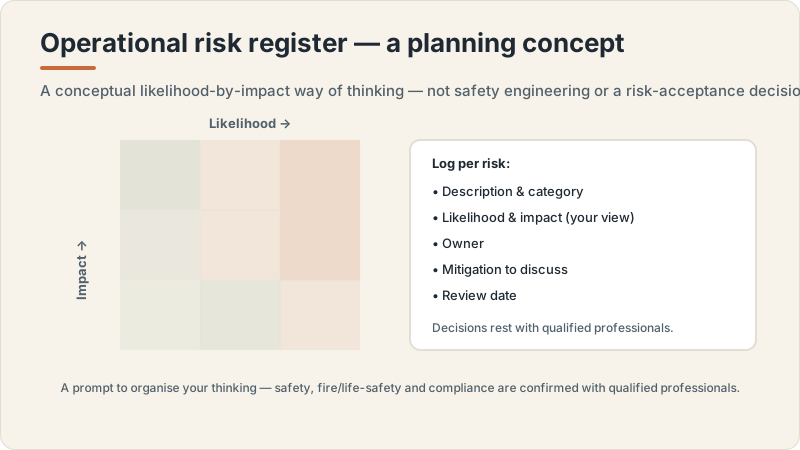
Operational risk register concept
Conceptual editorial diagram — not a construction drawing, specification, to-scale plan or proof of a real project. It is not engineering, structural, fire/life-safety, crowd-safety or accessibility-compliance guidance. Capacities, dimensions, standards, requirements and costs vary by facility type, audience, site, use case and governing body, and are confirmed with qualified professionals, relevant authorities and governing bodies. Build Design Hub does not design, build, inspect, certify, recommend or match anyone.
What this guide helps you prepare
This guide helps you prepare the structure of an incident log and the thinking around it, not the response to any incident itself. The most valuable early decision is to define what your log is actually for: a record that supports later review and governance, that helps you spot patterns over time, and that gives you an accurate account of what was recorded and when. Being clear about that purpose shapes every other choice, from which fields you capture to how long records are kept and who is allowed to see them. A log designed as an afterthought tends to capture too little of what matters and too much that simply adds noise.
It also helps you organise the surrounding questions so that the people who should advise you do so at the right time. An incident log sits close to insurance, legal duties, governing-body expectations and data-protection considerations, all of which vary and none of which this guide can answer for you. By preparing a clear definition of scope, a draft set of fields and a list of open questions, you make it far easier for qualified professionals and the relevant authorities to tell you what applies to your facility, what your obligations are, and where your draft needs to change before it is used.
- A plain-language statement of what your incident log is for and who relies on it
- A draft list of the fields and categories you think the log should capture
- A note of how the log will sit alongside insurance, legal and governing-body considerations
- A record of open questions to confirm with qualified professionals and authorities
- A view of who will own, complete, review and store the log
- A framework for keeping the log consistent across people and over time
Choosing the fields an incident log should capture
The usefulness of a log depends heavily on which fields it captures, because consistent fields are what let you review records later without guessing. As a planning exercise, it helps to think in categories rather than wording: identifying information such as a unique reference and the date and time recorded; location within the facility; a factual description of what was recorded; who recorded it and their role; and any follow-up actions noted, who was assigned them and their status. The aim at this stage is to decide what categories of information matter for your review and governance needs, not to draft response procedures or instructions for handling any event.
It is worth treating field design as something to confirm rather than to finalise alone. The fields that are appropriate for a school differ from those for a stadium, a community club or a municipal venue, and what an insurer, governing body or data-protection regime expects can shape both what you should capture and what you should be careful not to capture. Personal information in particular deserves early professional input, because how it is collected, stored and retained is governed by rules that vary by jurisdiction. Use this section to draft your candidate fields and the reasons for each, then have qualified advisers confirm what belongs in the log and what does not.
- A unique reference and the date and time the entry was recorded
- Location within the facility, described consistently across entries
- A factual description field, kept free of interpretation or blame
- Who recorded the entry and their role or relationship to the facility
- Category or type fields that let similar records be grouped for review
- Follow-up fields: actions noted, owner assigned, and current status
Organising and reviewing the log over time
How a log is organised determines whether it is actually usable months or years later. Early planning questions include where the log lives, whether it is digital or paper or both, how entries are kept in a fixed order, and how you prevent records from being altered or lost without a trace. Consistency is the quiet ingredient here: if every person who completes the log uses the same fields, the same categories and the same level of detail, then later review becomes a matter of reading records rather than reconstructing them. A short written note explaining how the log is meant to be completed often does more for quality than the template itself.
Records matter most at the point of review, which is the reason for keeping them in the first place. A well-structured log lets you look back across a season or a year, see whether certain locations or categories recur, and bring an accurate, dated account to governance discussions, insurers, auditors or your board. This guide does not tell you how often to review, how long to retain records, or what conclusions to draw, because those depend on your obligations and advisers. What it helps you prepare is a log organised so that whatever review you and your professionals decide on can actually be carried out.
- Where the log is stored, who can access it, and how access is controlled
- How entries are kept in order and protected from undetected changes
- A short written guide on how the log should be completed, for consistency
- How the log will support periodic review without prescribing a frequency
- Who is responsible for reviewing entries and raising patterns for discussion
- How records will be made available to professionals, insurers or auditors if needed
Planning questions before speaking with professionals
Before you involve insurers, legal advisers, your governing body or data-protection specialists, it helps to work through a set of clarity questions with your own team. These are not technical or legal questions; they are framing questions that make your draft log stronger and your professional conversations more productive. The clearer you are about what the log is for, what you intend to capture and where your uncertainties lie, the more focused the advice you receive will be. Many record-keeping problems trace back to a vague purpose rather than a difficult template.
Use this stage to separate what you are confident about from what you genuinely need confirmed. It is entirely reasonable to arrive at a professional conversation saying that you have drafted candidate fields but do not yet know what your obligations are around personal data, retention or governing-body expectations. Preparing that position deliberately, with a draft and a record of open questions, tends to produce clearer guidance than presenting a finished log and asking only whether it is acceptable.
- What is this log for, and who will rely on the records it holds?
- Which fields are we confident about, and which are we unsure we should capture?
- What personal information might the log involve, and who must advise on that?
- What constraints might our insurer or governing body place on our records?
- Who in our organisation should own, complete and review the log?
- What do we not yet know about retention, access and our obligations?
Questions for qualified professionals
Once you engage insurers, legal advisers, data-protection specialists or your governing body, your prepared questions help you understand their guidance rather than simply receive it. The most valuable questions are about obligations, scope and risk: what you are expected to record and for how long, what you should be careful not to capture, how personal information must be handled, and where the genuine uncertainties lie for a facility like yours. Because expectations vary by jurisdiction, facility type, use case, insurer and governing body, expect advisers to frame answers around your specific situation rather than as universal rules.
Keep questions about legal duties, data protection, insurance and governing-body requirements firmly with the relevant professionals and authorities. This guide does not provide those answers, and you should be cautious of any source that states retention periods, mandatory fields or reporting obligations as universal facts without knowing your circumstances. Your role is to ask clearly, record what you are told, and make sure the different strands of advice are coordinated so your log satisfies one obligation without quietly breaching another.
- What are we expected to record, and what should we avoid capturing?
- How must personal information in the log be collected, stored and retained?
- How long should records be kept, and on what basis is that decided?
- What does our insurer or governing body expect from our record-keeping?
- Who should be able to access the log, and what controls do you advise?
- What are the main record-keeping risks you would flag for a facility like ours?
What this does not replace
This is an educational planning resource only. It is not a maintenance manual and not inspection, certification, engineering, architectural, structural, HVAC, electrical, safety-compliance, fire or life-safety, or accessibility-compliance advice, and it is not legal, tax, insurance or procurement advice. It does not maintain, operate, inspect, certify, audit or specify anything, gives no maintenance intervals or procedures as universal rules, and offers no warranty interpretation, estimate, price, ROI or capacity figure. Maintenance requirements and costs vary by facility type, use intensity, surface, system, climate, season, governing body, warranty terms, supplier documentation, contractor scope and local professional requirements, and are confirmed with qualified professionals, suppliers, contractors, relevant authorities and governing bodies.
Build Design Hub does not operate, maintain, inspect, certify, audit, design, build, recommend, rank, verify, introduce, broker or match suppliers, contractors, maintenance providers or facility managers, and HELPERG LLC is publisher/operator only. Use this resource to prepare your own thinking and records, then have qualified professionals you engage directly review your facility. Decisions about maintenance, inspection, safety, compliance, warranties, procurement and suitability must rest on those professionals, suppliers, the relevant authorities and the governing bodies for your sport and location.
- Not a maintenance manual and not maintenance instructions, intervals or procedures as universal rules
- Not inspection, certification, safety-compliance, fire/life-safety or accessibility-compliance advice
- Not engineering, architectural, warranty-interpretation, legal, tax, insurance or procurement advice
- Not a supplier, contractor, maintenance-provider or facility-manager recommendation, ranking, directory or matching service
- Not an estimate, price or cost figure — maintenance requirements and costs vary
- Qualified professional review is required before any operations or maintenance decision
Incident log planning worksheet
- 1Have you written a plain-language statement of what your incident log is for?
- 2Have you noted who relies on the records and how they will be used in review?
- 3Have you drafted the categories of information you think the log should capture?
- 4Have you included identifying fields such as a unique reference, date and time?
- 5Have you included a factual description field kept free of interpretation or blame?
- 6Have you included fields for who recorded the entry and their role?
- 7Have you included follow-up fields for actions, owners and status?
- 8Have you decided where the log will be stored and who can access it?
- 9Have you written a short guide on how the log should be completed consistently?
- 10Have you flagged any personal information for professional and data-protection review?
- 11Have you listed open questions on retention, obligations and access for advisers?
- 12Have you identified who owns, completes and reviews the log day to day?
- 13Have you noted how the log will support periodic review without setting a frequency?
- 14Have you recorded what your insurer, governing body and authorities still need to confirm?
Common mistakes to avoid
- Designing the log around responding to incidents rather than recording them for review
- Treating a sample set of fields as a universal or required template for every facility
- Capturing personal information without confirming data-protection obligations first
- Assuming an insurer or governing body has no expectations about your records
- Letting each person complete the log differently so later review becomes guesswork
- Storing records in a way that allows undetected changes or easy loss
- Deciding retention periods or reporting duties yourself instead of confirming them
- Skipping professional review and assuming a draft log is automatically acceptable
When to involve a professional
- When the log will hold personal information and data-protection advice is needed
- When you need to confirm legal duties or reporting obligations for your jurisdiction
- When an insurer or governing body may set expectations for your records
- When retention periods and access controls have to be decided on a sound basis
- When the log will be relied on in audits, governance or any formal review
- When you are unsure which fields to capture or deliberately leave out
Frequently asked questions
Questions readers ask about this topic
What does this guide actually help me do?
It helps you prepare the framework for an incident log: deciding what the log is for, drafting the categories of information it might capture, thinking about how records are organised and stored, and preparing questions for the professionals and authorities you engage. It is an educational planning resource about structure and record-keeping, not a response guide.
Does Build Design Hub maintain, inspect, certify or manage incident logs, or recommend providers?
No. Build Design Hub is an educational resource and does not maintain, inspect, certify, audit, operate or manage facilities or their records, and it does not recommend, rank, verify, introduce, broker or match suppliers, contractors, facility managers or any other providers. HELPERG LLC is the publisher and operator only. It gives no costs, retention periods, required fields or obligations as facts; those vary and must be confirmed with qualified professionals, your insurer, your governing body and the relevant authorities.
Will this guide tell me how to respond to an incident or give first-aid steps?
No. This guide is strictly about the framework of an incident log and deliberately gives no incident-response, emergency, first-aid or safety instructions. How you respond to any actual event is a matter for your own trained people, your written procedures, and the relevant authorities and qualified professionals.
How long should we keep incident records, and which fields are mandatory?
This guide does not state retention periods or mandatory fields, because those depend on your jurisdiction, facility type, insurer, governing body and data-protection obligations. The fields and categories described here are planning prompts to discuss, not requirements. Confirm what you must keep, for how long, and what you should capture with qualified legal, data-protection and insurance advisers and the relevant authorities.
Keep reading