
Who this guide is for
- Facility owners building owner-side governance documentation before or after handover
- Operators and facility managers who want a structured way to track operational risks across a venue
- Schools and colleges preparing risk-review materials for sports halls, pitches and courts
- Sports clubs and community organisations setting up volunteer-friendly operational oversight
- Municipalities and developers coordinating risk reviews across multiple facilities or stakeholders
- Project teams preparing handover and operations-readiness questions for qualified professionals
Planning diagram
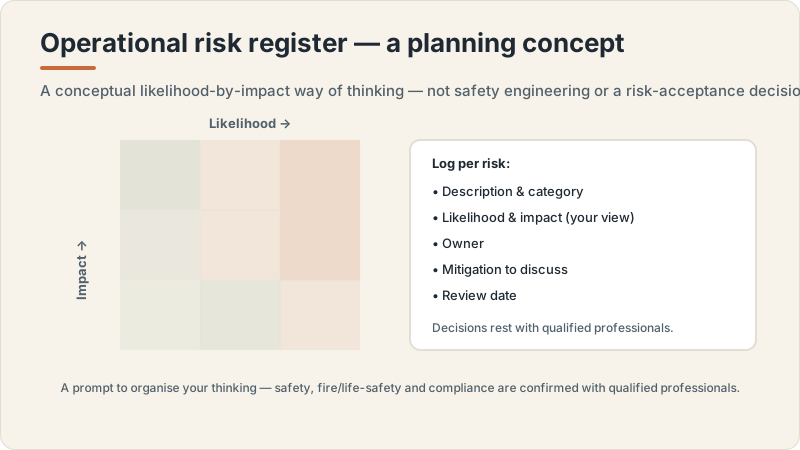
Operational risk register concept
Conceptual editorial diagram — not a construction drawing, specification, to-scale plan or proof of a real project. It is not engineering, structural, fire/life-safety, crowd-safety or accessibility-compliance guidance. Capacities, dimensions, standards, requirements and costs vary by facility type, audience, site, use case and governing body, and are confirmed with qualified professionals, relevant authorities and governing bodies. Build Design Hub does not design, build, inspect, certify, recommend or match anyone.
What this guide helps you prepare
This guide helps you prepare an owner or operator operational risk register: a single, organised place to record the operational things that could disrupt running your sports facility, alongside a consistent way of describing how likely each one is and how much it might matter. The aim is preparation and governance, not action. You are assembling a framework you can take into conversations with facility managers, suppliers, contractors and governing bodies, so those professionals can help you populate, validate and prioritise it. A register written this way becomes a shared reference that survives staff turnover, supports handover, and keeps operational thinking visible to owners who are not on site every day.
It also helps you separate what you can sensibly record yourself from what genuinely needs qualified input. You can log that a risk exists, name an owner for watching it, and note when it should next be reviewed. You cannot, from a template alone, decide whether a risk is acceptable, set a maintenance interval, judge a surface's condition, or interpret a warranty. Those are professional judgements. This guide deliberately stops at the structure and the questions, so that the conclusions are reached with the right people. Treat every category below as a prompt to ask, document and confirm, never as a finding.
- A consistent vocabulary for describing operational risks across your whole facility
- A way to capture who owns watching each risk and when it is next reviewed
- Prompts to take into supplier, contractor and facility-manager conversations
- A handover-friendly document that does not depend on one person's memory
- Clarity on which entries you record yourself versus which need professional input
- A starting point for owner-side governance, not a maintenance or inspection plan
Thinking in likelihood and impact without scoring your facility
A common way to organise a risk register is to think along two axes: how likely an operational disruption is to occur, and how much it would matter if it did. Describing each entry in those terms, even in plain words like lower, moderate or higher, helps you and your professionals talk about relative attention rather than treating every item as equally urgent. The value is in the conversation it structures, not in producing a number that looks authoritative. A likelihood-by-impact view is a thinking aid for prioritising discussion, not a verdict on your facility's safety or condition, and it should never be presented as one.
Because you are not a qualified assessor of your own facility, keep your descriptions provisional and clearly flagged as inputs for review. Two people can reasonably place the same risk differently, and the placement may change once a professional looks at the actual surface, system, climate exposure or usage pattern. Record your initial reasoning so that the professional can challenge or confirm it, and capture the date and the assumptions behind each placement. Avoid converting impressions into apparent certainty: the matrix organises where to focus questions, it does not answer them, and it does not decide what level of risk is acceptable to carry.
- Describe likelihood in relative, plain terms and note the assumptions behind it
- Describe impact in terms of disruption to operations, access or continuity, not severity claims
- Flag every placement as a provisional input awaiting professional review
- Record who placed each entry and on what date, so it can be revisited
- Resist turning words into precise scores that imply false certainty
- Note explicitly that acceptance decisions are made with professionals, not in the register
Categories of operational risk worth logging
Operational risk for a sports facility tends to fall into recognisable categories, and naming them up front helps you build a register that is broad enough to be useful without pretending to be exhaustive. Useful categories to consider include surface and playing-area continuity, building systems and services, equipment availability, environmental and seasonal exposure, supplier and contractor dependency, staffing and competence, scheduling and access, documentation and warranty status, and governance or oversight gaps. You are logging that a category deserves attention and capturing the open questions within it, not diagnosing a problem or prescribing a fix. The categories are organising buckets, and your professionals will help you decide which entries within them actually apply to your facility.
Within each category, write entries as observations and questions rather than instructions. For a surface, you might log uncertainty about who holds the maintenance documentation and what the warranty conditions reference, not a cleaning frequency. For a building system, you might log that handover information is incomplete, not a service procedure. This keeps the register honest about what it is: a map of where attention and professional input are needed. Maintenance requirements vary by facility type, use intensity, surface, system, climate, season, governing body, warranty terms, supplier documentation, contractor scope and local professional requirements, so the register should point to those confirmations rather than substitute for them.
- Surface and playing-area continuity: what documentation and warranty terms exist, held by whom
- Building systems and services: what handover information is complete and what is missing
- Equipment and assets: what inventory, location and supplier records you hold
- Environmental and seasonal exposure: what conditions affect operations and who advises on them
- Supplier, contractor and staffing dependency: where single points of reliance sit
- Documentation, warranty and governance gaps: where ownership of follow-up is unclear
Planning questions before speaking with professionals
Before you bring your draft register to facility managers, suppliers, contractors or governing bodies, it helps to organise your own situation so those conversations are efficient and specific. Work through what you already hold and what you are missing: handover documents, warranty paperwork, supplier contacts, governing-body guidance and any existing operational records. The clearer your inputs, the more usefully a professional can help you populate the owner, mitigation and review columns. These questions are for your own preparation; they are not a substitute for professional assessment, and they should surface gaps rather than lead you to conclusions.
Use this stage to decide who in your organisation should own watching each category, how often you want the register revisited, and what would trigger an out-of-cycle review such as a season change, a new supplier or an incident. Settling governance questions in advance means the professionals you engage can focus on the technical and condition judgements that only they can make. Keep your notes provisional and dated, and be explicit about which entries are assumptions awaiting confirmation versus facts you can evidence with documentation.
- What handover, warranty and operational documents do we currently hold, and what is missing?
- Which categories of operational risk plausibly apply to our facility type and usage?
- Who internally should own watching each category, and how is that recorded?
- What cadence and what triggers should prompt a register review?
- Which entries are our provisional assumptions versus documented facts?
- What governing-body or supplier guidance should we gather before the meeting?
Questions for qualified professionals
When you speak with qualified professionals, facility managers, suppliers, contractors or the relevant governing bodies, your register becomes a structured agenda rather than a list of worries. Ask them to help you confirm which risks genuinely apply, how each should be described, and what mitigation and review approach fits your specific facility, surface, systems, climate and use intensity. Be explicit that you are seeking their professional judgement on condition, intervals, warranty interpretation and acceptability, because those are theirs to make and not yours to assume from a template. Document their answers, who gave them and when, so the register stays a credible owner-side record.
Frame your questions to elicit confirmation and sourcing rather than reassurance. Ask what documentation supports each answer, what varies by season or usage, and what they would want reviewed and by whom over time. Where an answer touches maintenance, inspection, certification, safety, accessibility, warranty, engineering or legal matters, treat it as the professional's domain and record it as their advice, not as a fact you have established. The goal is a register whose every consequential entry can be traced back to a qualified source you can return to.
- Which entries in our draft register actually apply to this facility, and which do not?
- How would you describe the likelihood and impact of each, and on what basis?
- What mitigation and review approach do you advise for our specific surface, systems and usage?
- What documentation supports each answer, and what varies by season, climate or use intensity?
- Who should own ongoing review of each category, and what should trigger a fresh look?
- Which matters here require inspection, certification, warranty, safety or legal advice from a qualified specialist?
What this does not replace
This is an educational planning resource only. It is not a maintenance manual and not inspection, certification, engineering, architectural, structural, HVAC, electrical, safety-compliance, fire or life-safety, or accessibility-compliance advice, and it is not legal, tax, insurance or procurement advice. It does not maintain, operate, inspect, certify, audit or specify anything, gives no maintenance intervals or procedures as universal rules, and offers no warranty interpretation, estimate, price, ROI or capacity figure. Maintenance requirements and costs vary by facility type, use intensity, surface, system, climate, season, governing body, warranty terms, supplier documentation, contractor scope and local professional requirements, and are confirmed with qualified professionals, suppliers, contractors, relevant authorities and governing bodies.
Build Design Hub does not operate, maintain, inspect, certify, audit, design, build, recommend, rank, verify, introduce, broker or match suppliers, contractors, maintenance providers or facility managers, and HELPERG LLC is publisher/operator only. Use this resource to prepare your own thinking and records, then have qualified professionals you engage directly review your facility. Decisions about maintenance, inspection, safety, compliance, warranties, procurement and suitability must rest on those professionals, suppliers, the relevant authorities and the governing bodies for your sport and location.
- Not a maintenance manual and not maintenance instructions, intervals or procedures as universal rules
- Not inspection, certification, safety-compliance, fire/life-safety or accessibility-compliance advice
- Not engineering, architectural, warranty-interpretation, legal, tax, insurance or procurement advice
- Not a supplier, contractor, maintenance-provider or facility-manager recommendation, ranking, directory or matching service
- Not an estimate, price or cost figure — maintenance requirements and costs vary
- Qualified professional review is required before any operations or maintenance decision
Operational risk register preparation worksheet
- 1Record your facility type, primary surfaces, systems and typical use intensity in one place
- 2Gather handover documents and note clearly which are present and which are missing
- 3Collect warranty and defect-log paperwork and list the questions each one raises
- 4List your current suppliers, contractors and facility-management contacts by category
- 5Draft the risk categories you want to track and leave entries open for professional input
- 6For each entry, capture a plain-language likelihood and impact note flagged as provisional
- 7Assign an internal owner for watching each category and record how that is documented
- 8Set the review cadence you want and list the triggers for an out-of-cycle review
- 9Mark each entry as a documented fact or an assumption awaiting confirmation
- 10Note which governing-body or supplier guidance you still need to gather
- 11Prepare a column to record who gave each professional answer and on what date
- 12Keep a running list of entries that explicitly need inspection, certification or legal advice
- 13Date the register and note who compiled it so versions stay traceable
- 14Record what is out of scope for the register so it is not mistaken for a maintenance plan
Common mistakes to avoid
- Treating a likelihood-by-impact placement as a verdict on the facility's safety or condition
- Recording a maintenance interval or frequency in the register as if it were a settled fact
- Assuming a warranty covers a risk without confirming its terms with the supplier or a professional
- Deciding what risk is acceptable from the register alone instead of with qualified professionals
- Letting the register go stale by setting no review cadence or trigger for revisiting it
- Blurring provisional assumptions and documented facts so the register looks more certain than it is
- Logging only physical risks and overlooking documentation, supplier-dependency and governance gaps
- Skipping professional review because the template made the entries look complete
When to involve a professional
- When any entry touches surface, system or equipment condition, intervals or maintenance scope
- When you need to interpret warranty terms, defect logs or handover documentation
- When an entry involves inspection, certification, safety, fire, life-safety or accessibility matters
- When deciding whether a given operational risk is acceptable to carry or how to mitigate it
- When engineering, structural, HVAC, electrical or legal questions arise from a category
- When governing-body requirements or supplier documentation must be confirmed for your facility type
Frequently asked questions
Questions readers ask about this topic
Does Build Design Hub maintain, inspect, certify or assess my facility's risks for me?
No. Build Design Hub is an educational publisher operated by HELPERG LLC. It does not operate, maintain, inspect, certify, audit or assess any facility, and it does not recommend, rank, verify or match suppliers, contractors, maintenance providers or facility managers. It also gives no costs, intervals, lifespans or requirements as facts. This guide only helps you organise your own preparation and questions; the actual judgements are made by qualified professionals you engage directly.
Will a likelihood-by-impact matrix tell me how serious my risks really are?
No. A likelihood-by-impact view is a thinking and prioritisation aid that helps structure conversations, not a measurement of how serious anything actually is. Your placements should be treated as provisional inputs awaiting professional review, because a qualified professional may describe the same risk differently once they consider your specific surface, systems, climate and usage. The register organises where to ask questions; it does not answer them or decide what is acceptable.
Can I use this register to set maintenance schedules for my facility?
No. This guide does not provide maintenance intervals, frequencies, procedures or schedules, and you should not derive them from a risk register. Maintenance requirements vary by facility type, use intensity, surface, system, climate, season, governing body, warranty terms, supplier documentation, contractor scope and local professional requirements. Confirm any maintenance approach with qualified providers and suppliers, and record their advice as theirs rather than treating it as a fact established by the register.
Who should actually decide whether a risk is acceptable?
That decision belongs with qualified professionals, your governing bodies and your own accountable decision-makers, informed by their advice. This guide deliberately stops at structuring and recording risks and does not make acceptance decisions for you. Use the register to bring well-organised questions to those professionals, then document who decided what and on what basis so your owner-side governance stays traceable.
Keep reading