
Who this guide is for
- Facility owners planning a structured yearly look at their sports facility rather than reacting to problems as they arise
- Operators and facility managers who coordinate maintenance, bookings and contractor relationships day to day
- Schools and colleges with sports halls, pitches or courts that sit within wider estate planning cycles
- Sports clubs and community organisations preparing governance documentation and budget conversations for committees or trustees
- Municipalities and public bodies overseeing multiple venues and seeking a consistent review framework
- Developers and project teams handing a completed facility over to an operations team and assembling the records they will rely on
Planning diagram
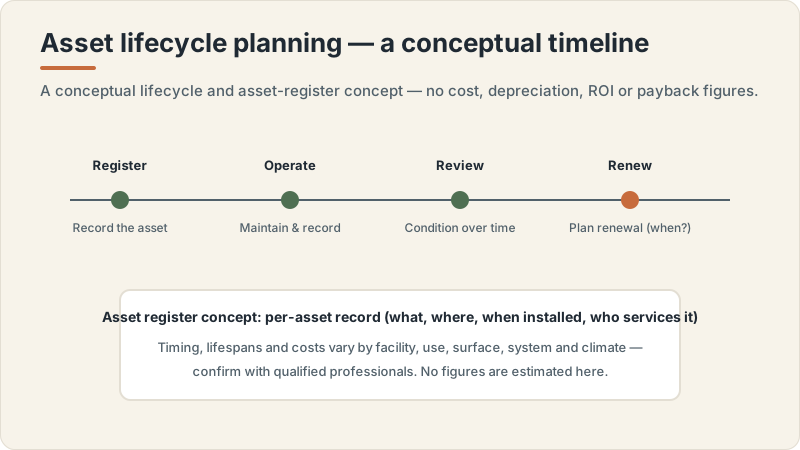
Asset lifecycle planning concept
Conceptual editorial diagram — not a construction drawing, specification, to-scale plan or proof of a real project. It is not engineering, structural, fire/life-safety, crowd-safety or accessibility-compliance guidance. Capacities, dimensions, standards, requirements and costs vary by facility type, audience, site, use case and governing body, and are confirmed with qualified professionals, relevant authorities and governing bodies. Build Design Hub does not design, build, inspect, certify, recommend or match anyone.
What this guide helps you prepare
This guide helps you build the scaffolding for an annual review before you sit down with anyone technical. That means deciding the scope of the review, listing the assets and systems it should cover, locating the documents that describe how each was specified and handed over, and identifying who holds responsibility for what. The aim is to arrive at your review with organised information rather than scattered emails, so that qualified professionals can spend their time advising rather than reconstructing the basics. It also helps you frame the review as a repeatable cycle, so each year builds on the last.
Crucially, this is preparation, not execution. It does not tell you how to maintain a surface, what interval to clean a system on, when something is due for replacement, or whether a defect is a safety issue. Those determinations belong to qualified providers, suppliers, contractors and relevant authorities, and they depend on factors specific to your facility. What this guide offers is a way to structure your questions, your document requests and your records so the people who do make those determinations have what they need.
- Define the review scope: which buildings, surfaces, systems, outdoor areas and equipment are in or out
- Locate handover packs, operation and maintenance documentation, and warranty paperwork for each asset
- Identify who currently holds responsibility for each system and where the gaps or assumptions are
- Frame the review as a recurring cycle so records carry forward year to year
- Separate what you can organise yourself from what requires a qualified professional's judgement
- Decide what outputs you want from the review: an updated register, a budget input, a question list for providers
Building the annual review structure: scope, assets and documentation
A useful annual review starts with an inventory of what you are actually reviewing. Rather than working from memory, many owners build an asset and document register: a single place that lists each surface, structure, mechanical or electrical system, outdoor area and significant piece of equipment, alongside the paperwork that describes it. For each entry you can note whether you hold the original specification, the handover documentation, any supplier maintenance documentation and the warranty or defect-liability terms. Where a document is missing, that gap itself becomes a review item and a question for whoever supplied or installed the asset.
From that inventory you can structure the review around themes that suit your facility, such as playing surfaces, building fabric, services and plant, safety-related documentation, and governance records. The point of the structure is not to reach conclusions yourself but to make sure nothing is silently dropped and that each theme has an owner and a paper trail. Because requirements vary so widely by facility type, surface, climate and governing body, the register should record what each source says and flag anything that needs confirming, rather than asserting a fixed rule. The structure is yours to maintain; the technical judgements within it are for qualified professionals.
- List every surface, structure, system and major equipment item the review will cover
- Record which documents you hold for each: specification, handover pack, supplier documentation, warranty terms
- Note missing or unclear documents and turn each gap into a follow-up question
- Group assets into review themes that fit your facility and assign an owner to each
- Capture what governing-body, warranty or supplier documentation says without treating it as a universal rule
- Carry the register forward each year so changes, additions and decommissioned assets are tracked over time
Who to involve and how to prepare for seasonal and lifecycle conversations
An annual review usually touches more people than just the owner. Depending on your setup, you might involve an operator or facility manager, the contractors or suppliers who installed key systems, providers who hold maintenance documentation, and internal stakeholders such as a committee, finance lead or estates team. Preparing for the review means deciding who needs to be in which conversation, what each person is responsible for, and what you want to ask them. It also means being clear about boundaries: who decides intervals and methods, who interprets warranty terms, and who has authority to confirm whether something meets a relevant requirement. None of those determinations are yours to make from this guide.
Two further dimensions are worth preparing for. The first is seasonality: many facilities review certain areas around changes of season or activity, and preparing means gathering the relevant records ahead of those points rather than scrambling afterwards. The second is lifecycle and risk: an annual review is a natural moment to update a risk register and to capture questions about how long systems might serve, when providers suggest reviewing them, and what documentation governs replacement. All of these are questions to put to qualified professionals and suppliers, not figures to assume. Preparing the questions, the documents and the attendee list is the work this guide supports; answering them is the providers' role.
- Map who is responsible for each system and who should attend each part of the review
- Clarify decision boundaries: who sets intervals and methods, who interprets warranties, who confirms requirements
- Prepare a risk register entry for each significant asset, listing open questions rather than conclusions
- Gather records ahead of seasonal or activity changes so conversations are based on current information
- List lifecycle questions for providers about review timing, documentation and replacement planning
- Confirm what each contractor or supplier expects from you to keep documentation and warranties current
Planning questions before speaking with professionals
Before you contact any provider, contractor or qualified professional, it helps to work through a set of internal planning questions so your own position is clear. These cover what you actually own, what documentation you hold, what you are uncertain about, and what you want the annual review to achieve this year. Answering them yourself first means you can describe your facility accurately and ask targeted questions, rather than asking a professional to start from nothing. It also surfaces assumptions, such as believing a warranty covers something or that a previous interval still applies, that are worth testing rather than carrying forward.
These questions are about organising your thinking and your paperwork, not about reaching technical conclusions. They are deliberately framed so that the answers are within your knowledge as an owner or operator, with anything technical flagged for a professional. Treat the output as the brief you bring into the review: a clear picture of scope, documents, responsibilities and open questions, with every interval, requirement or lifespan marked as something to confirm rather than assert.
- What is the full scope of assets and systems this year's review should cover, and what is deliberately excluded?
- Which handover, operation and maintenance, warranty and supplier documents do I hold, and which are missing?
- Where am I relying on an assumption about a warranty, interval or responsibility that I have not verified?
- Who currently holds each maintenance and operational responsibility, and are any roles unassigned or unclear?
- What changed at the facility this year that the review and risk register should reflect?
- What specific outcomes do I want from the review: an updated register, a budget input, a provider question list?
Questions for qualified professionals
Once your preparation is organised, the next step is to take well-framed questions to the qualified providers, contractors, suppliers and authorities relevant to your facility. The aim of these questions is to obtain the technical judgements and documentation that you cannot and should not determine yourself. Because requirements vary by facility type, use intensity, surface, system, climate, season, governing body, warranty terms, supplier documentation, contractor scope and local professional requirements, these questions ask each professional to confirm what applies to your specific situation rather than to validate a number you have assumed.
Keep a record of the answers, who gave them and what documentation supports them, so the review builds an auditable trail year on year. Where answers differ between sources, or where a question touches certification, safety, structural, electrical, accessibility or warranty matters, treat that as a signal to involve the appropriate qualified professional or authority directly. Build Design Hub cannot answer these questions, confirm any requirement, or connect you with anyone; the conversations belong to you and the professionals you choose to engage.
- What maintenance documentation, scope and responsibilities apply to this surface or system in our specific facility?
- How should we interpret the warranty and defect-liability terms, and what keeps them valid?
- What does the relevant governing body, authority or supplier documentation require us to confirm, and how?
- When do you suggest reviewing this system, and what factors would change that for our use and climate?
- Which matters here require a separate qualified professional, such as for structural, electrical, safety or accessibility questions?
- What records, evidence or documentation should we retain to support future reviews and any compliance obligations?
What this does not replace
This is an educational planning resource only. It is not a maintenance manual and not inspection, certification, engineering, architectural, structural, HVAC, electrical, safety-compliance, fire or life-safety, or accessibility-compliance advice, and it is not legal, tax, insurance or procurement advice. It does not maintain, operate, inspect, certify, audit or specify anything, gives no maintenance intervals or procedures as universal rules, and offers no warranty interpretation, estimate, price, ROI or capacity figure. Maintenance requirements and costs vary by facility type, use intensity, surface, system, climate, season, governing body, warranty terms, supplier documentation, contractor scope and local professional requirements, and are confirmed with qualified professionals, suppliers, contractors, relevant authorities and governing bodies.
Build Design Hub does not operate, maintain, inspect, certify, audit, design, build, recommend, rank, verify, introduce, broker or match suppliers, contractors, maintenance providers or facility managers, and HELPERG LLC is publisher/operator only. Use this resource to prepare your own thinking and records, then have qualified professionals you engage directly review your facility. Decisions about maintenance, inspection, safety, compliance, warranties, procurement and suitability must rest on those professionals, suppliers, the relevant authorities and the governing bodies for your sport and location.
- Not a maintenance manual and not maintenance instructions, intervals or procedures as universal rules
- Not inspection, certification, safety-compliance, fire/life-safety or accessibility-compliance advice
- Not engineering, architectural, warranty-interpretation, legal, tax, insurance or procurement advice
- Not a supplier, contractor, maintenance-provider or facility-manager recommendation, ranking, directory or matching service
- Not an estimate, price or cost figure — maintenance requirements and costs vary
- Qualified professional review is required before any operations or maintenance decision
Annual review preparation register
- 1Record the agreed scope of this year's review, listing assets and areas in scope and out of scope
- 2Compile an asset list covering surfaces, structures, services, plant, outdoor areas and major equipment
- 3Gather handover packs and operation and maintenance documentation for each listed asset
- 4Locate warranty and defect-liability paperwork and note expiry or review dates to confirm with providers
- 5List supplier and contractor maintenance documentation you hold, and flag any you are missing
- 6Map who is responsible for each system, noting unassigned or unclear responsibilities
- 7Build or update a risk register entry per significant asset, recording open questions not conclusions
- 8Note any assumptions about intervals, lifespans or coverage that need confirming with professionals
- 9Record facility changes from the past year that the review should reflect
- 10Prepare a question list for each provider, contractor, supplier or authority you intend to involve
- 11Identify seasonal or activity points around which records should be gathered in advance
- 12List which matters appear to need a separate qualified professional and why
- 13Decide and document the intended outputs of the review and who receives them
- 14Set up a place to log answers, sources and supporting documents so the review carries forward each year
Common mistakes to avoid
- Treating a maintenance interval, lifespan or figure from one source as a universal rule rather than confirming it for your specific facility
- Assuming a warranty covers a particular issue without reading the terms or checking with the provider
- Skipping the involvement of a qualified professional because a task looks routine or self-evident
- Starting the review from memory instead of from an asset and document register, so items are silently dropped
- Leaving responsibilities unassigned or assuming someone else owns a system without confirming it
- Recording your own conclusions about safety, structural or compliance matters instead of routing them to the appropriate professional or authority
- Failing to carry records forward year to year, so each review starts from scratch and trends are lost
- Confusing preparation with execution and trying to decide technical intervals or methods yourself
When to involve a professional
- When a question touches structural, electrical, mechanical, HVAC or building-fabric matters that require qualified engineering or specialist judgement
- When warranty, defect-liability or contract terms need interpreting, which is a matter for legal or the relevant supplier and contractor
- When anything relates to safety, fire and life safety, certification or accessibility, where a qualified professional or authority must confirm requirements
- When sources disagree on intervals, requirements or whether a defect matters, and an authoritative determination is needed
- When you are setting maintenance scope, methods or intervals, which should be defined with qualified providers and suppliers, not assumed
- When the review surfaces a possible defect or condition concern that needs a qualified inspection or assessment you are not equipped to perform
Frequently asked questions
Questions readers ask about this topic
Does Build Design Hub maintain, inspect or certify my facility, or recommend providers?
No. Build Design Hub is an educational publisher operated by HELPERG LLC. It does not maintain, inspect, certify, audit, operate, design or build facilities, and it does not recommend, rank, match, introduce or verify suppliers, contractors, maintenance providers or facility managers. It also does not provide costs, intervals, lifespans or requirements. This guide only helps you organise your own preparation; the technical judgements and any introductions are for you and the qualified professionals you choose to engage.
Will this guide tell me how often to maintain my surfaces or systems?
No. Maintenance requirements vary by facility type, use intensity, surface, system, climate, season, governing body, warranty terms, supplier documentation, contractor scope and local professional requirements. This guide deliberately avoids stating intervals, methods or schedules as facts. It frames them as questions to confirm with qualified providers, suppliers, contractors and relevant authorities who can assess your specific situation.
Who should actually decide what the review concludes?
Technical conclusions about condition, intervals, warranties, safety, certification or replacement belong to qualified professionals, suppliers, contractors and relevant authorities. Your role, and the focus of this guide, is to prepare the scope, documents, responsibilities and questions so those professionals can advise effectively. Treat anything technical as something to confirm rather than to decide from a general guide.
How is an annual review different from day-to-day maintenance?
Day-to-day maintenance is ongoing operational work; an annual review is a periodic, structured step back to look at the whole facility as a system, update records and risk registers, and plan the conversations to have with providers. This guide helps you prepare that review. It does not replace operational maintenance, professional inspection, or advice from the people responsible for those activities.
Keep reading