
Who this guide is for
- Facility owners and developers planning how a sports venue will be looked after across its full life, not just at opening.
- Operators and facility managers building an operations-readiness picture and a maintenance-planning framework to discuss with providers.
- Schools and education estates teams coordinating sports surfaces, courts and grounds within wider campus planning.
- Sports clubs and community organisations preparing governance, handover and renewal questions for committees and providers.
- Municipalities and public-sector estates teams planning long-term stewardship of community sports assets.
- Project teams assembling handover documents, warranty and defect logs and risk registers before involving qualified professionals.
Planning diagram
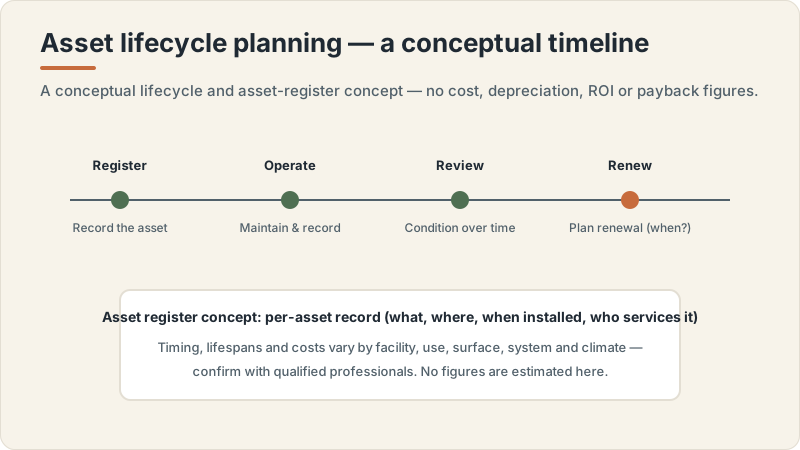
Asset lifecycle planning concept
Conceptual editorial diagram — not a construction drawing, specification, to-scale plan or proof of a real project. It is not engineering, structural, fire/life-safety, crowd-safety or accessibility-compliance guidance. Capacities, dimensions, standards, requirements and costs vary by facility type, audience, site, use case and governing body, and are confirmed with qualified professionals, relevant authorities and governing bodies. Build Design Hub does not design, build, inspect, certify, recommend or match anyone.
What this guide helps you prepare
This guide helps you build the owner-side groundwork for a facility's whole life before you ask anyone qualified to commit to anything. That groundwork is mostly organisational: assembling the handover pack you should expect at commissioning, listing the assets and systems a facility contains, noting which warranty and defect questions still need answers, and writing down the renewal questions you want professionals to address at each stage. None of this involves doing maintenance, deciding intervals or judging condition; it involves getting your facts, documents and open questions into one place so conversations with suppliers, contractors, governing bodies and qualified professionals are productive.
The reason to prepare this way is that lifecycle outcomes are shaped early, by what you record and request, long before any renewal work is contemplated. Requirements, lifespans, capacities and timelines are not fixed facts you can read off a page; they vary by facility type, surface, system, use intensity, climate, season, governing body, warranty terms, supplier documentation, contractor scope and local professional requirements, and they must be confirmed with qualified professionals. Treating this guide as a question-and-record framework, rather than a source of answers, keeps you on the right side of that distinction and makes the eventual professional conversations far more focused.
- A list of the assets, surfaces and systems your facility contains, with whatever documentation you already hold for each.
- The handover, commissioning and as-built records you expect to receive or have received, and the gaps in that pack.
- Warranty terms, defect-log entries and supplier documentation you want to confirm with the relevant parties rather than interpret yourself.
- The renewal and stewardship questions you want qualified professionals and governing bodies to address at each lifecycle stage.
- A governance note on who owns which decision (committee, operator, owner) and how lifecycle questions are escalated and recorded.
- Open uncertainties to flag explicitly, so professionals know what you do not yet know.
Thinking in lifecycle stages and asset renewal questions
It helps to picture a facility's assets moving through broad stages rather than existing in a single fixed state. A useful framing is: commissioning and handover, early operation and defect-resolution, steady operational use, a renewal-consideration stage where condition and suitability questions arise, and an end-of-life or replacement-consideration stage. These labels are a planning vocabulary, not a schedule or a set of dates; when any asset actually moves between stages, and what that means for it, is a matter for qualified professionals, suppliers and governing bodies who know the specific surface, system, climate and use pattern involved. The value of the framing is that it gives you somewhere to file each question and document, so nothing important is left unconsidered.
Within that vocabulary, renewal thinking is mostly about asking better questions rather than reaching conclusions. For each asset you might note which stage you believe it sits in, what records would confirm that, who is responsible for the next decision, and which professional or governing body should be consulted before anything is acted on. Crucially, this guide does not tell you how long anything lasts, when to renew, what condition means, or what work to do; lifespans, conditions, intervals and renewal triggers vary and are defined with qualified professionals, suppliers and contractors. Your job at the planning stage is to capture the question clearly and route it to the right expert, not to answer it yourself.
- Which broad lifecycle stage you understand each asset to be in, and what documentation would confirm or correct that understanding.
- Which renewal or suitability questions you want a qualified professional or governing body to consider, framed as questions rather than decisions.
- Who is accountable for the next lifecycle decision on each asset, and how that decision will be recorded.
- What supplier documentation, warranty terms or as-built information you would need to gather before any renewal conversation.
- How seasonal patterns, use intensity and governing-body expectations might change the questions you ask (to confirm, not assume).
- Where your knowledge ends, so professionals can fill the gaps rather than work around silent assumptions.
Building a maintenance-planning framework and handover record
A maintenance-planning framework, in the owner-preparation sense, is not a maintenance schedule and contains no intervals, frequencies, methods, chemicals or settings. It is a structure for organising who defines maintenance, where the authoritative information lives, and which questions remain open. The authoritative sources are the suppliers, contractors, manufacturers' documentation, warranty terms, governing bodies and qualified professionals attached to your specific assets; your framework simply records which source covers which asset and where the current documentation is held. This keeps you from treating any single figure, interval or instruction as a universal rule, because the framework's whole purpose is to point every operational question back to the party qualified to answer it for your facility.
The handover record is the spine of all of this. A well-organised handover pack request typically covers as-built information, the asset and system inventory, supplier and manufacturer documentation, warranty and guarantee terms, any operation and maintenance documentation the providers supply, and a defect log started during early operation. You are gathering and organising these records and confirming what is missing, not interpreting warranty cover, judging compliance or drawing inspection conclusions, which are matters for the relevant professionals and parties. Where the pack is incomplete, the useful planning output is a clear, itemised list of what to request and from whom, so handover gaps become tracked questions rather than silent risks.
- An index of which supplier, contractor, manufacturer or governing body is the authoritative source for each asset's operational information.
- A handover-pack request list: as-built records, asset inventory, supplier and manufacturer documentation, warranty terms and any operation and maintenance documentation.
- A defect log structure to record observations during early operation for discussion with the responsible provider (not for self-diagnosis).
- Warranty and guarantee questions to confirm with the issuing party rather than interpret in-house.
- A record of where every document is stored and who can access it, so lifecycle questions are not blocked by missing paperwork.
- A tracked list of handover gaps with the party each request should go to.
Planning questions before speaking with professionals
Before you involve suppliers, contractors, governing bodies or qualified professionals, it is worth answering a set of internal questions so the conversation starts from a clear position. These are owner-side questions about your facility, your records, your governance and your uncertainties, not technical questions you should be answering yourself. Working through them tends to reveal where the handover pack is thin, which assets nobody is clearly accountable for, and which lifecycle questions have quietly gone unasked. The output is not a plan of action but a sharper brief for the people who will actually advise you.
Keep these questions framed as preparation. Nothing here asks you to decide an interval, judge a condition, interpret a warranty or conclude anything about compliance or safety; all of that varies by facility type, surface, system, use intensity, climate, season, governing body, warranty terms, supplier documentation, contractor scope and local professional requirements, and belongs with qualified professionals. The point of answering them first is simply that a professional can give you better guidance when you arrive with organised records and explicit questions than when you arrive with a vague sense that something needs looking at.
- Do we have a complete asset and system inventory, and where is each asset's documentation actually stored?
- Which parts of the handover or commissioning pack are missing, and which party should we request them from?
- For each asset, who in our governance structure owns the next lifecycle decision, and how is that recorded?
- Which lifecycle or renewal questions are we currently unsure about, and which professional or governing body should address each one?
- What warranty, guarantee and defect-log questions do we need a provider to confirm rather than have us interpret?
- Have we written down our open uncertainties so professionals can address them directly?
Questions for qualified professionals
When you do speak with qualified professionals, suppliers, contractors and governing bodies, frame your questions to elicit their guidance rather than to confirm a conclusion you have already reached. The questions below are starting points for that conversation; the answers will depend on your specific facility and must come from the appropriate qualified party. Asking who is responsible for defining a given requirement is often as valuable as asking the requirement itself, because it clarifies where authority and accountability sit for the life of the asset.
Remember that this guide cannot and does not answer these questions for you. Maintenance requirements, lifespans, intervals, conditions, capacities, warranty cover and compliance matters vary by facility type, surface, system, use intensity, climate, season, governing body, warranty terms, supplier documentation, contractor scope and local professional requirements, and must be confirmed with qualified professionals. Use the prompts to open a well-organised discussion, then record the guidance you receive against the relevant asset so your lifecycle planning stays current.
- Who is the authoritative source for the operational and maintenance requirements of this specific asset or surface, and how should those be documented?
- What does your guidance say about how this asset's lifecycle stages should be understood for our facility type and use pattern?
- What handover, as-built or supplier documentation should we hold, and what should we request if it is missing?
- How should we interpret and confirm the warranty or guarantee terms for this asset, and who is responsible for that interpretation?
- Which governing bodies, authorities or standards apply to this asset, and who confirms our position against them?
- What records or logs would you want us to keep so that future renewal and stewardship conversations are well informed?
What this does not replace
This is an educational planning resource only. It is not a maintenance manual and not inspection, certification, engineering, architectural, structural, HVAC, electrical, safety-compliance, fire or life-safety, or accessibility-compliance advice, and it is not legal, tax, insurance or procurement advice. It does not maintain, operate, inspect, certify, audit or specify anything, gives no maintenance intervals or procedures as universal rules, and offers no warranty interpretation, estimate, price, ROI or capacity figure. Maintenance requirements and costs vary by facility type, use intensity, surface, system, climate, season, governing body, warranty terms, supplier documentation, contractor scope and local professional requirements, and are confirmed with qualified professionals, suppliers, contractors, relevant authorities and governing bodies.
Build Design Hub does not operate, maintain, inspect, certify, audit, design, build, recommend, rank, verify, introduce, broker or match suppliers, contractors, maintenance providers or facility managers, and HELPERG LLC is publisher/operator only. Use this resource to prepare your own thinking and records, then have qualified professionals you engage directly review your facility. Decisions about maintenance, inspection, safety, compliance, warranties, procurement and suitability must rest on those professionals, suppliers, the relevant authorities and the governing bodies for your sport and location.
- Not a maintenance manual and not maintenance instructions, intervals or procedures as universal rules
- Not inspection, certification, safety-compliance, fire/life-safety or accessibility-compliance advice
- Not engineering, architectural, warranty-interpretation, legal, tax, insurance or procurement advice
- Not a supplier, contractor, maintenance-provider or facility-manager recommendation, ranking, directory or matching service
- Not an estimate, price or cost figure — maintenance requirements and costs vary
- Qualified professional review is required before any operations or maintenance decision
Facility lifecycle planning and handover record worksheet
- 1Compile an inventory of every asset, surface and system in the facility, with a reference for any documentation you already hold.
- 2Record which broad lifecycle stage you understand each asset to be in, noting it as a working assumption to confirm with professionals.
- 3List the handover, commissioning and as-built records you expect, and mark which are received, which are missing and who to request them from.
- 4Gather supplier and manufacturer documentation references for each asset, and note where the originals are stored.
- 5Record the warranty and guarantee terms you hold as questions to confirm with the issuing party, not as interpretations.
- 6Set up a defect-log structure for recording early-operation observations to raise with the responsible provider.
- 7Map who owns the next lifecycle decision for each asset within your governance structure, and how decisions are recorded.
- 8Write down the renewal and suitability questions you want qualified professionals or governing bodies to address per asset.
- 9Note which governing bodies, authorities or standards you believe apply, to confirm with the relevant party.
- 10List your open uncertainties and knowledge gaps explicitly so professionals can address them directly.
- 11Record where every lifecycle document is stored and who can access it.
- 12Prepare a tracked handover-gap list pairing each missing item with the party it should be requested from.
- 13Note seasonal and use-intensity factors you want providers to take into account when they advise (to confirm, not assume).
- 14Keep a place to record the guidance professionals give, filed against the relevant asset, so the plan stays current.
Common mistakes to avoid
- Treating a maintenance interval, lifespan or frequency you read somewhere as a universal rule, instead of confirming what applies to your specific asset with a qualified professional.
- Assuming a warranty or guarantee covers a particular situation without confirming the terms with the issuing party.
- Skipping the handover-pack review, so as-built records, supplier documentation and defect logs are never fully assembled.
- Leaving lifecycle decisions without a clear owner in your governance structure, so renewal questions drift unanswered.
- Reaching condition or renewal conclusions internally rather than routing them to the qualified professionals who can assess them.
- Treating lifecycle stage labels as fixed dates or a schedule rather than as a planning vocabulary to discuss with experts.
- Failing to record open uncertainties, so professionals advise around silent assumptions instead of addressing real gaps.
- Assuming Build Design Hub or any educational guide can supply the requirements, intervals or approvals that only suppliers, contractors, governing bodies and qualified professionals can define.
When to involve a professional
- When you need to define any maintenance requirement, interval, method or condition for a specific asset, surface or system, involve the relevant supplier, contractor or qualified professional.
- When warranty, guarantee or defect-cover questions arise, confirm interpretation with the issuing party rather than deciding in-house.
- When any compliance, safety, accessibility, fire or life-safety, certification or inspection question is in play, involve the appropriate qualified professionals and authorities.
- When an asset appears to be approaching a renewal or replacement decision, consult qualified professionals and governing bodies before acting.
- When governing-body or standards questions affect how an asset is used or maintained, confirm your position with that body or a qualified professional.
- When handover documentation is incomplete or unclear, work with the original suppliers, contractors and qualified professionals to resolve the gaps.
Frequently asked questions
Questions readers ask about this topic
Does Build Design Hub maintain, inspect, certify or manage sports facilities?
No. Build Design Hub, published and operated by HELPERG LLC, is an educational publisher only. It does not operate, maintain, inspect, certify, audit, design, build or manage any facility, and it does not recommend, rank, verify, introduce, broker or match suppliers, contractors, maintenance providers or facility managers. It also provides no costs, prices, intervals, lifespans or requirements. This guide only helps you prepare questions, records and framing to take to qualified professionals.
Can this guide tell me how often to maintain my surface or how long it will last?
No. Maintenance requirements, intervals, frequencies, methods, lifespans, conditions and capacities are not facts this guide can provide. They vary by facility type, surface, system, use intensity, climate, season, governing body, warranty terms, supplier documentation, contractor scope and local professional requirements, and must be confirmed with qualified professionals, suppliers, contractors and the relevant authorities or governing bodies for your specific facility.
What is the practical point of lifecycle planning if I have to confirm everything with professionals anyway?
The point is preparation. By organising your asset inventory, handover records, warranty and defect questions, governance ownership and open uncertainties in advance, you arrive at professional conversations with a clear, focused brief. That tends to make the guidance you receive more relevant and easier to act on, even though the requirements, decisions and approvals themselves always rest with the qualified parties.
Is the lifecycle-stage framing in this guide a schedule I should follow?
No. The stages are a planning vocabulary for organising your thinking and filing your questions, not a schedule, set of dates or instruction to act. When any asset actually moves between stages, and what that means, is for qualified professionals, suppliers and governing bodies who know your specific surface, system, climate and use pattern to determine.
What should I do with the handover gaps I identify using this guide?
Turn them into a tracked list pairing each missing item with the party it should be requested from, such as the original supplier, contractor, manufacturer or qualified professional. This guide helps you identify and organise the gaps; resolving them, and interpreting whatever the records contain, is work for the relevant parties and qualified professionals rather than something to conclude in-house.
Keep reading