
Who this guide is for
- Owners and owner's representatives preparing for long-term renewal decisions on a venue
- Facility managers and operators who need to organise asset records before capital conversations
- Schools, colleges and universities planning ahead for sports-facility renewal
- Clubs and sports organisations whose committees govern long-term facility spending
- Municipalities and public bodies coordinating capital planning across shared facilities
- Developers and project sponsors who want lifecycle thinking captured before handover
Planning diagram
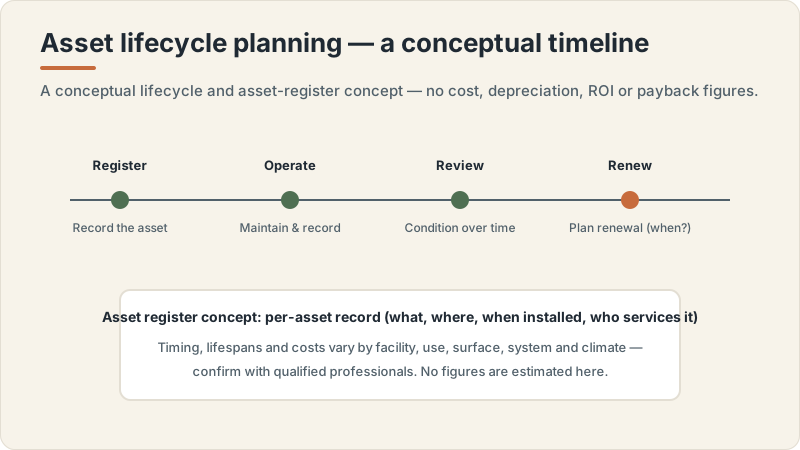
Asset lifecycle planning concept
Conceptual editorial diagram — not a construction drawing, specification, to-scale plan or proof of a real project. It is not engineering, structural, fire/life-safety, crowd-safety or accessibility-compliance guidance. Capacities, dimensions, standards, requirements and costs vary by facility type, audience, site, use case and governing body, and are confirmed with qualified professionals, relevant authorities and governing bodies. Build Design Hub does not design, build, inspect, certify, recommend or match anyone.
What this guide helps you prepare
This guide helps you assemble the raw material an owner needs before any capital-expenditure conversation: a clear inventory of the assets that make up your facility, an honest record of what you do and do not know about each one, and a set of open questions about renewal and replacement timing that you can put to qualified professionals. These are preparation artefacts you create and refine over time, not financial or technical decisions you make alone from a webpage. The clearer they are, the more focused your conversations with suppliers, contractors, surveyors and advisers become, and the easier it is to compare what each one tells you.
It is equally important to be clear about what this guide does not do. It does not tell you what anything should cost, how to budget, what return or payback to expect, or when a surface, roof, system or component should be renewed or replaced. It does not provide lifespans, intervals or condition conclusions. All of those depend on your facility type, use intensity, surface, system, climate, season, governing body, warranty terms and the professionals you engage, and they vary widely. Your job at this stage is to prepare good records and good questions, not to supply answers that belong to qualified professionals, suppliers and contractors.
- List the major assets and systems that make up your facility, grouped in a way that makes sense to you
- Record what you already know about each asset's age, history and supporting documents
- Note where information is missing, so the gaps become questions rather than silent assumptions
- Frame renewal and replacement timing as open questions, not as figures to be assumed
- Capture which decisions feel routine, which feel periodic, and which feel like major events
- Write down the assumptions you are carrying so they can be tested by professionals rather than relied on
Building an asset register to support capex questions
A capital-expenditure conversation is far more productive when it starts from an organised picture of what the facility actually contains. An asset register is simply a written inventory of the components and systems an owner may eventually need to renew or replace: playing surfaces, structures and stands, roofing and cladding, lighting, drainage, mechanical and electrical systems, fencing, court or field furniture, spectator and support spaces, and the documentation that came with each. The point of building it is not to schedule work or assign values yourself, but to give qualified professionals a consistent base to assess and advise against. Keeping the register current, and noting where records are incomplete, turns vague worry about the future into specific, answerable questions.
Alongside each asset, it helps to record what you hold rather than what you assume. Handover documents, warranties, supplier and contractor maintenance documentation, defect logs, and any previous condition reports are the evidence a professional will want to see, and gathering them before a capital conversation saves time and avoids guesswork. Resist the temptation to write down a lifespan, interval or renewal date next to an asset as if it were fixed; instead, record the question and note who would be qualified to answer it. This keeps the register honest and keeps timing where it belongs, with the people who can assess condition for your facility.
- What major assets and systems should appear on the register, and how should they be grouped?
- For each asset, what age, installation and history information do you actually hold?
- Where are the handover documents, warranties and supplier or contractor maintenance records kept?
- Which assets have defect logs or prior condition reports, and which have none?
- Which entries are based on records and which are based on assumption that needs testing?
- Who would be qualified to assess condition and timing for each category of asset?
Framing renewal and replacement timing as questions
Renewal and replacement timing is the heart of capital-expenditure planning, and it is also where the temptation to invent certainty is strongest. It is far safer to frame timing as a question than to carry over a lifespan figure from another facility, a supplier brochure or a general article. Whether a surface, roof, lighting system or piece of equipment is approaching the point where renewal or replacement becomes a serious discussion depends on how it was built, how intensively it is used, the climate and season, how it has been maintained, and the conditions of your specific site. None of that can be read off a page, and this guide deliberately provides no intervals, lifespans or thresholds. What it offers instead is a way to map the questions so the right professionals can answer them.
A useful preparation lens is to think across an asset's whole life rather than as a single replacement event: early life, steady-state use, intensive-use peaks, periods of heavier wear, periodic renewal, and eventual end-of-life replacement each raise different questions. For each asset you can ask which decisions are routine, which are periodic, and which are major capital events that should be planned and discussed separately and well in advance. The aim is to identify which decisions exist and what information a professional would need to advise on them, not to decide the answers yourself. This keeps different surfaces and systems distinct, since they age, wear and recover in very different ways that only qualified specialists can assess for your facility.
- For each major asset, when should a renewal-or-replacement conversation first begin, as a question for professionals?
- Which assets behave as routine upkeep, which as periodic renewal, and which as major capital events?
- What information would a professional need to advise on timing for a given asset?
- How might use intensity, climate and season change when renewal becomes a discussion, in the professional's view?
- Which warranty terms or supplier documentation are relevant to timing, and what do they actually say?
- Where renewal and replacement are alternatives, what questions should be put to professionals to compare them?
Planning questions before speaking with professionals
Before you engage surveyors, suppliers, contractors or advisers, it pays to organise what you already know and what you still need to learn. Working through your own questions first means the professional conversations start further along and stay focused on substance. Capture your asset register, your supporting documents, your open questions and your assumptions in writing, and be candid about what you are guessing rather than knowing. This preparation also makes it far easier to compare what different professionals tell you, because everyone is responding to the same clearly stated picture of your facility.
These questions are prompts to clarify your own thinking, not a checklist to satisfy or a substitute for professional assessment. None of them should be answered with a fixed figure, lifespan, interval or cost at this stage. Anything touching timing, condition, cost, budget, warranty interpretation, safety, compliance or governing-body rules is something to confirm with qualified professionals, suppliers, contractors and the relevant authorities, all of which vary by facility type, use intensity, surface, system, climate, season and governing body.
- Have you built an asset register and noted where records are missing?
- Have you gathered handover documents, warranties, maintenance documentation and any prior reports?
- Have you framed renewal and replacement timing as questions rather than assumed figures?
- Have you separated routine, periodic and major capital decisions in your own thinking?
- Have you written down the assumptions you are carrying so professionals can test them?
- Have you identified who is qualified to assess each category of asset for your facility?
Questions for qualified professionals
When you reach the point of engaging professionals, suppliers or contractors, the most valuable thing you can bring is good questions framed against an organised asset register. The questions below are examples of what owners commonly need professionals to confirm; they are deliberately open, because the answers depend entirely on your specific facility, surfaces, systems, use intensity, climate and the conditions on site. Asking them helps you understand what your facility genuinely faces over time rather than guessing, and it surfaces major renewal and replacement discussions early, while there is still room to plan.
Use the responses to inform your planning, not as a substitute for formal assessment, advice or budgeting. This guide provides no costs, budgets, ROI, lifespans, intervals, condition conclusions or warranty interpretations, and Build Design Hub does not maintain, inspect, certify, audit or value any facility, nor does it recommend, rank, verify, introduce, broker or match any supplier, contractor, surveyor or facility manager. Confirm everything that matters with the qualified professionals you select, and keep a written record of what each tells you so your register and your questions stay accurate as time passes.
- For each major asset, when in your assessment should renewal or replacement first be planned, and what drives that?
- What condition information would you need to assess the timing of renewal for this surface or system?
- How do use intensity, climate and season affect the renewal outlook for a facility like ours?
- What do our warranty terms and supplier documentation actually cover, and what falls outside them?
- Which renewal decisions should be planned and budgeted as separate major capital events?
- What information should we keep recording now so future capital conversations are better informed?
What this does not replace
This is an educational planning resource only. It is not a maintenance manual and not inspection, certification, engineering, architectural, structural, HVAC, electrical, safety-compliance, fire or life-safety, or accessibility-compliance advice, and it is not legal, tax, insurance or procurement advice. It does not maintain, operate, inspect, certify, audit or specify anything, gives no maintenance intervals or procedures as universal rules, and offers no warranty interpretation, estimate, price, ROI or capacity figure. Maintenance requirements and costs vary by facility type, use intensity, surface, system, climate, season, governing body, warranty terms, supplier documentation, contractor scope and local professional requirements, and are confirmed with qualified professionals, suppliers, contractors, relevant authorities and governing bodies.
Build Design Hub does not operate, maintain, inspect, certify, audit, design, build, recommend, rank, verify, introduce, broker or match suppliers, contractors, maintenance providers or facility managers, and HELPERG LLC is publisher/operator only. Use this resource to prepare your own thinking and records, then have qualified professionals you engage directly review your facility. Decisions about maintenance, inspection, safety, compliance, warranties, procurement and suitability must rest on those professionals, suppliers, the relevant authorities and the governing bodies for your sport and location.
- Not a maintenance manual and not maintenance instructions, intervals or procedures as universal rules
- Not inspection, certification, safety-compliance, fire/life-safety or accessibility-compliance advice
- Not engineering, architectural, warranty-interpretation, legal, tax, insurance or procurement advice
- Not a supplier, contractor, maintenance-provider or facility-manager recommendation, ranking, directory or matching service
- Not an estimate, price or cost figure — maintenance requirements and costs vary
- Qualified professional review is required before any operations or maintenance decision
Sports-facility capex preparation register
- 1List the major assets and systems that make up the facility, grouped in a way that makes sense to you
- 2For each asset, record the age, installation and history information you actually hold
- 3Note where age or history information is missing, and mark it as a question to resolve
- 4Gather handover documents and store them where capital conversations can reference them
- 5Collect the warranty terms and documentation associated with each relevant asset
- 6Assemble supplier and contractor maintenance documentation you currently hold
- 7Record which assets have defect logs or prior condition reports, and which have none
- 8Mark each timing entry as a question for professionals rather than an assumed date
- 9Separate decisions that feel routine, periodic and major-capital in your own notes
- 10Identify who would be qualified to assess condition and timing for each asset category
- 11Write down the assumptions you are carrying so they can be tested rather than relied upon
- 12Note which warranty or supplier terms appear relevant to renewal timing, to confirm later
- 13Record open questions to put to qualified professionals, suppliers and contractors
- 14Decide who owns and keeps the register current as new information arrives
Common mistakes to avoid
- Carrying over a lifespan or renewal interval from another facility, a brochure or an article as if it applied to yours
- Writing a cost, budget or payback figure into the plan before any qualified professional has assessed condition
- Treating a warranty as proof that something is covered without confirming what the terms actually say
- Building the register from memory and assumption instead of gathering the documents that exist
- Treating renewal as a single surprise event rather than a major decision planned well in advance
- Skipping professional assessment and deciding timing yourself from general information online
- Letting the register go stale, so capital conversations start from outdated or missing records
- Assuming a supplier's or contractor's general statement is a commitment without confirming scope in writing
When to involve a professional
- Involve qualified professionals before fixing any timing, cost or budget figure, since condition and timing must be assessed for your facility
- Engage suppliers or contractors to confirm what their maintenance documentation and warranty terms actually cover
- Bring in a qualified surveyor or specialist to assess condition when an asset may be approaching renewal or replacement
- Consult the relevant governing body or authority where renewal could touch their rules, safety or compliance
- Involve financial, legal or procurement professionals before committing to any capital programme or contract
- Route every question about lifespans, intervals, condition, cost or warranty interpretation to qualified professionals, not this guide
Frequently asked questions
Questions readers ask about this topic
Does this guide tell me when to renew or replace a surface, system or component?
No. This guide is educational and provides no lifespans, intervals, dates or condition conclusions. Renewal and replacement timing depends on your facility type, use intensity, surface, system, climate, season, governing body and warranty terms, and must be assessed and confirmed by qualified professionals for your facility.
Will Build Design Hub estimate costs, set a budget or recommend providers?
No. Build Design Hub does not provide costs, budgets, ROI or payback figures, and it does not maintain, inspect, certify, audit or value any facility. It does not recommend, rank, verify, introduce, broker or match any supplier, contractor, surveyor or facility manager. This guide only helps you prepare your own records and questions for qualified professionals you select.
What should I prepare before a capital-planning conversation?
Build an asset register, gather your handover documents, warranties, maintenance documentation and any prior reports, frame renewal and replacement timing as questions, and write down your assumptions. Arriving organised makes professional input more focused and lets you compare what different professionals tell you on a consistent basis.
Can I use a warranty to decide what is covered when something needs renewal?
Treat the warranty as a document to confirm, not interpret yourself. This guide does not interpret warranty terms. What a warranty covers, and how it relates to renewal timing, should be confirmed with the supplier or contractor who issued it and, where needed, a qualified professional.
Keep reading