
Who this guide is for
- Facility owners preparing for handover who want a clear list of records to request and keep
- Operators and facility managers who will rely on as-built information in day-to-day running
- Schools and colleges taking on a new or refurbished sports facility and its paperwork
- Clubs and community organisations setting up record-keeping for a court, pitch or building
- Municipalities and public bodies organising governance and document retention for shared assets
- Developers handing a completed facility over to an owner or operating entity
Planning diagram
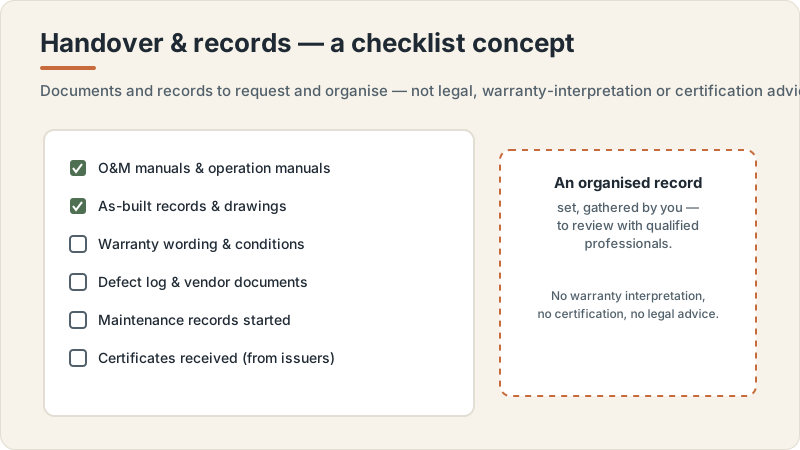
Handover and records checklist concept
Conceptual editorial diagram — not a construction drawing, specification, to-scale plan or proof of a real project. It is not engineering, structural, fire/life-safety, crowd-safety or accessibility-compliance guidance. Capacities, dimensions, standards, requirements and costs vary by facility type, audience, site, use case and governing body, and are confirmed with qualified professionals, relevant authorities and governing bodies. Build Design Hub does not design, build, inspect, certify, recommend or match anyone.
What this guide helps you prepare
This guide helps you prepare to collect and organise the as-built records for a sports facility, so that the people who eventually operate, maintain or advise on it have the information they need close at hand. As-built records are simply the documents that reflect what was actually built and installed: final drawings showing any changes from the original design, the product and material information for surfaces and systems, the warranty and guarantee paperwork, the operation and maintenance documentation provided by suppliers and contractors, and a record of who supplied or installed each element. Preparing a list of what to request, and a place to keep it, is owner-side groundwork that you can do without interpreting any of the technical content.
The work this guide supports is organisational rather than technical. You are deciding what to ask for, when to ask for it, who is responsible for handing it over, and how it will be stored, named and kept up to date. You are not assessing whether a drawing is correct, whether a warranty covers a given situation, or what a maintenance document instructs you to do; those are matters for the qualified professionals, suppliers and contractors involved. Treat everything below as prompts for your own preparation and for conversations with those professionals, not as facts, requirements or instructions about your specific facility.
- Identify the categories of as-built record a facility like yours may generate, as questions to confirm
- Decide who on the project is responsible for assembling and handing over each category
- Plan where and how records will be stored, named and access-controlled
- Note which records you want before handover and which may follow afterwards
- List the questions you will ask suppliers, contractors and professionals about completeness
- Confirm with qualified professionals what documentation your facility type and systems should include
What as-built records to request and who holds them
A useful first step is to think in categories rather than individual files, because different parties hold different parts of the picture. The design and construction team may hold final as-built drawings and any documentation of changes made during the work. Suppliers of surfaces, equipment and systems may hold product data, material information, warranty terms and the operation and maintenance documentation for what they provided. Installers and contractors may hold their own records of what was fitted and where. Building services such as lighting, drainage, heating or ventilation each tend to come with their own packages from whoever supplied and installed them. Listing these categories, and noting which party is the likely source for each, turns a vague handover into a concrete request list you can work through.
What belongs in each category, and whether a given record even exists, varies a great deal and is not something to assume. The right list for your facility depends on its type, its surfaces and systems, the scope each contractor held, and the documentation each supplier provides, all of which differ from project to project. Rather than treating any example list as definitive, use it as a starting point for a conversation: ask the project team and each supplier and contractor what they will provide, in what form, and by when. Keep your own register of what has been requested, what has arrived and what is still outstanding, so nothing quietly falls through the gaps between parties.
- Final as-built drawings and any documentation of changes made during construction
- Product, material and system information for surfaces, equipment and installed elements
- Warranty, guarantee and defect-liability paperwork with the party responsible named
- Operation and maintenance documentation provided by suppliers and contractors
- Supplier and contractor contact details mapped to each element they provided
- A register tracking what was requested, what arrived and what remains outstanding
Organising, storing and keeping records usable over time
Collecting records is only half the task; they also have to be stored in a way that someone can actually use months or years later. That means deciding on a consistent structure before documents start arriving: how folders are organised, how files are named, where both digital and any physical copies live, who can access them, and how access is handled when staff or operators change. A simple, agreed naming and folder convention applied from the start tends to save far more effort than trying to impose order on a pile of mixed files afterwards. It also helps to record basic information about each document as it comes in, such as what element it relates to, who provided it and when it was received, so the collection stays navigable as it grows.
Records also age. Surfaces are resurfaced, equipment is replaced, systems are altered, and each change can make part of the original documentation out of date. Planning from the outset for how records will be updated, who is responsible for keeping them current, and how superseded versions are retained rather than simply overwritten, helps the archive stay trustworthy. None of this requires you to interpret the technical content; it is document management. Where a question arises about whether a record is complete, accurate or current enough for a particular purpose, that is a matter to put to the qualified professionals, suppliers or contractors concerned, not to resolve from the filing structure alone.
- Agree a folder structure and file-naming convention before documents start arriving
- Decide where digital and any physical records are stored and who can access them
- Capture basic metadata for each record: element, source and date received
- Plan how access is transferred when operators, managers or staff change
- Decide how updates are made and how superseded versions are retained, not overwritten
- Confirm retention expectations with qualified professionals and relevant authorities, as these vary
Planning questions before speaking with professionals
Before you contact the project team, suppliers or contractors, it helps to organise what you already know and what you still need to settle. Working through your own questions first means the conversations start further along and stay focused, and it makes it far easier to tell whether a handover package is arriving as you expected. Capture the categories of record you intend to request, the party you think holds each, the format and timing you would prefer, and the open questions you have about completeness and updating. Being explicit about your assumptions lets them be tested rather than quietly carried forward.
These prompts are for clarifying your own preparation, not a list to be answered with fixed rules. None of them should be resolved with an assumed requirement, interval, retention period or standard at this stage. Anything touching what documentation is required, how long it must be kept, what a warranty covers, or what maintenance a record implies is something to confirm with qualified professionals, suppliers, contractors and the relevant authorities, all of which vary by facility type, system, location and use case.
- Have you listed the categories of as-built record you intend to request?
- Have you mapped each category to the party most likely to hold it?
- Have you decided what format and timing you would prefer for each handover item?
- Have you planned how records will be named, stored and access-controlled?
- Have you written down your open questions about completeness and future updates?
- Have you noted what you are assuming about retention, without treating it as settled?
Questions for qualified professionals
When you reach the point of speaking with the project team, suppliers, contractors and any advisers, the most useful thing you can bring is a clear set of questions framed against your own request list. The questions below are examples of what owners and operators often need others to confirm; they are deliberately open, because the answers depend on your facility, its systems, the scope each party held and the documentation each provides. Asking them helps you understand what your handover package should realistically contain and surfaces missing or unclear records early, while they are still straightforward to chase.
Use the responses to inform your record-keeping plan, not as a substitute for professional advice or for the documentation itself. This guide does not provide requirements, retention periods, intervals or standards, and it does not maintain, inspect, certify, recommend, rank, verify, introduce or match any supplier or contractor. Confirm what matters with the qualified professionals, suppliers, contractors and authorities relevant to your facility, and keep a record of what you are told so your understanding of the package stays accurate as the project develops.
- What as-built records will you provide for the elements within your scope, and in what form?
- Which warranty, guarantee and defect-liability documents apply, and who holds responsibility under each?
- What operation and maintenance documentation accompanies the surfaces and systems you installed?
- Are there records that will only be available after handover, and how will those be transferred?
- What documentation would you expect a facility of this type to retain, and for how long?
- Who should we contact about each element if a question arises once the facility is in use?
What this does not replace
This is an educational planning resource only. It is not a maintenance manual and not inspection, certification, engineering, architectural, structural, HVAC, electrical, safety-compliance, fire or life-safety, or accessibility-compliance advice, and it is not legal, tax, insurance or procurement advice. It does not maintain, operate, inspect, certify, audit or specify anything, gives no maintenance intervals or procedures as universal rules, and offers no warranty interpretation, estimate, price, ROI or capacity figure. Maintenance requirements and costs vary by facility type, use intensity, surface, system, climate, season, governing body, warranty terms, supplier documentation, contractor scope and local professional requirements, and are confirmed with qualified professionals, suppliers, contractors, relevant authorities and governing bodies.
Build Design Hub does not operate, maintain, inspect, certify, audit, design, build, recommend, rank, verify, introduce, broker or match suppliers, contractors, maintenance providers or facility managers, and HELPERG LLC is publisher/operator only. Use this resource to prepare your own thinking and records, then have qualified professionals you engage directly review your facility. Decisions about maintenance, inspection, safety, compliance, warranties, procurement and suitability must rest on those professionals, suppliers, the relevant authorities and the governing bodies for your sport and location.
- Not a maintenance manual and not maintenance instructions, intervals or procedures as universal rules
- Not inspection, certification, safety-compliance, fire/life-safety or accessibility-compliance advice
- Not engineering, architectural, warranty-interpretation, legal, tax, insurance or procurement advice
- Not a supplier, contractor, maintenance-provider or facility-manager recommendation, ranking, directory or matching service
- Not an estimate, price or cost figure — maintenance requirements and costs vary
- Qualified professional review is required before any operations or maintenance decision
As-built records request and storage register
- 1Record the facility's elements and systems, noting which may have their own documentation package
- 2List the categories of as-built record you intend to request for each element
- 3Map each category to the party most likely to hold or produce it
- 4Note for each item the preferred format, the responsible party and the expected timing
- 5Record which items you want before handover and which may follow afterwards
- 6Log the warranty, guarantee and defect-liability paperwork to request, with the responsible party named
- 7Capture the supplier and contractor contact details tied to each element they provided
- 8Decide and write down the folder structure and file-naming convention to be used
- 9Note where digital and any physical records will be stored and who may access them
- 10Record basic details for each document received: element, source and date
- 11Track the status of every requested item as outstanding, received or queried
- 12Note open questions about completeness and accuracy to raise with the relevant party
- 13Plan how records will be updated and how superseded versions will be retained
- 14List the points you need qualified professionals, suppliers or contractors to confirm
Common mistakes to avoid
- Treating an example record list as a definitive requirement, rather than confirming what applies with the project team, suppliers and contractors
- Assuming a warranty covers a particular situation instead of asking the responsible party to confirm its terms
- Leaving record-gathering until after handover, when the people who hold documents are harder to reach
- Skipping a naming and folder convention, then struggling to find records when they are needed
- Assuming a retention period or documentation requirement as fact rather than confirming it with qualified professionals and authorities
- Overwriting documents when something changes, instead of retaining superseded versions alongside updates
- Relying on one person's memory or inbox rather than an agreed, access-controlled store
- Trying to judge from the filing alone whether a record is complete or accurate, instead of asking the professionals who produced it
When to involve a professional
- When you are unsure what as-built documentation your facility type and systems should include, ask the qualified professionals on the project
- When warranty, guarantee or defect-liability terms need interpreting, raise them with the responsible supplier, contractor or a legal adviser
- When a maintenance or operation document needs to be acted on, work with the qualified provider, supplier or contractor who issued it
- When questions of retention, compliance or required documentation arise, confirm them with qualified professionals and the relevant authorities
- When a record appears incomplete, inconsistent or out of date, ask the party who produced it rather than drawing your own conclusions
- When governance or record-handling for a public or shared facility is involved, involve the appropriate advisers for your organisation
Frequently asked questions
Questions readers ask about this topic
What are as-built records for a sports facility?
As-built records are the documents that describe a facility as it was actually delivered: final drawings reflecting any changes from the original design, product and material information for surfaces and systems, warranty and guarantee paperwork, the operation and maintenance documentation from suppliers and contractors, and the contacts behind each element. What a particular facility should have varies by its type, surfaces, systems and the scope each party held; confirm what applies to yours with qualified professionals, suppliers and contractors.
Does Build Design Hub gather, store, maintain or check these records for me?
No. Build Design Hub is an educational publisher and does not maintain, inspect, certify or audit facilities, does not store or verify any records, and does not recommend, rank, introduce or match suppliers, contractors or providers. It also gives no costs, intervals, retention periods or requirements. This guide helps you prepare your own request list, storage plan and questions; gathering, interpreting and acting on the actual records is for you and the qualified professionals, suppliers and contractors you engage directly.
When should I start asking for as-built records?
Many owners find it easier to plan the request list early and agree who hands over what before handover, since the people who hold documents are most reachable while the project is fresh. Some records may only be available after handover. The right timing for your project depends on the scope each party held and the documentation they provide, so confirm a sequence with the project team, suppliers and contractors rather than assuming one.
How should as-built records be stored?
This guide does not prescribe a storage method, because suitable arrangements vary by organisation, facility and any retention expectations that apply. As a planning matter, it helps to agree a consistent folder and naming structure, decide where digital and physical copies live, control who can access them, and plan how updates and superseded versions are handled. Confirm any retention or compliance expectations with qualified professionals and the relevant authorities.
Keep reading