
Who this guide is for
- Facility owners preparing to take over a newly built or renovated sports facility and wanting an organised document request
- School and college estates teams responsible for sports halls, courts, pitches or pools after construction completes
- Sports club committees and volunteer operators inheriting a facility and needing a records baseline
- Municipal and parks-department staff coordinating handover of publicly funded sports infrastructure
- Developers and project sponsors assembling a handover pack to pass to an operating entity
- Facility managers and operations leads building an operations-readiness and maintenance-planning framework
Planning diagram
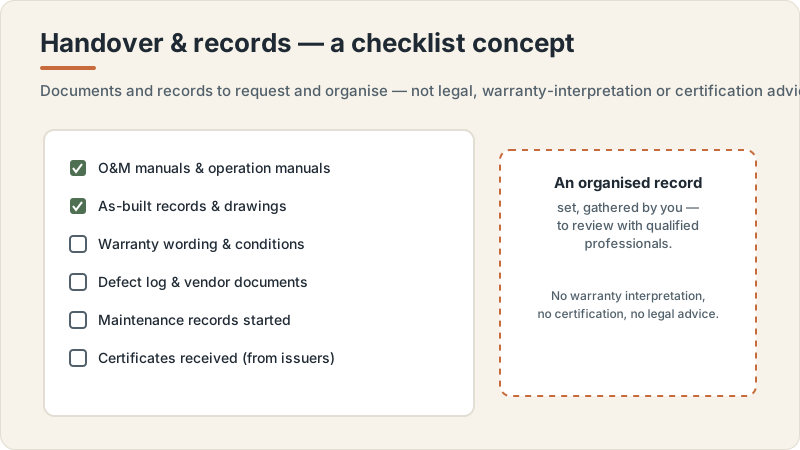
Handover and records checklist concept
Conceptual editorial diagram — not a construction drawing, specification, to-scale plan or proof of a real project. It is not engineering, structural, fire/life-safety, crowd-safety or accessibility-compliance guidance. Capacities, dimensions, standards, requirements and costs vary by facility type, audience, site, use case and governing body, and are confirmed with qualified professionals, relevant authorities and governing bodies. Build Design Hub does not design, build, inspect, certify, recommend or match anyone.
What this guide helps you prepare
This guide helps you prepare a clear, written request for the documents that typically accompany a sports-facility handover, so the operating team starts with a complete records baseline rather than gaps discovered months later. The aim is preparation and organisation: knowing what categories of document to ask about, how to record what you receive, and which questions to raise with the parties responsible for producing each item. It is a framework for getting ready, not a description of how to maintain, inspect or accept anything.
Use it to draft an operations-readiness checklist, to structure conversations with your project team, suppliers, contractors and governing bodies, and to capture open items in a register you can track to closure. Because what is appropriate for one facility differs from another, treat every category below as a prompt to confirm scope, format and responsibility with qualified professionals rather than as a fixed list of requirements. The point is to ask better questions earlier, not to assume what your specific project should deliver.
- A document request list you can share with your project team and contractors before handover
- A register to record what was received, in what format, and what remains outstanding
- Prompts for clarifying who is responsible for producing and updating each document
- A way to capture open questions about warranty terms and defect logging to confirm with the right parties
- A structure for organising handover records so the operating team can find them later
- Preparation notes for seasonal review and lifecycle-planning conversations with professionals
Categories of handover documents to ask about
Handover packs for sports facilities often span several document families, and it helps to think in categories so you can ask about each one deliberately. Operations and maintenance manuals describe systems and equipment as supplied; as-built drawings and models record what was actually constructed; warranty and guarantee documents set out what the various parties have undertaken; and certificates, test records and commissioning data capture the state of systems at completion. Rather than assuming any of these will arrive, prepare a written request that names each category and asks the responsible party to confirm what applies to your facility.
Sports facilities add their own layers because surfaces, courts, sports flooring, pitch systems, line markings, equipment, lighting and any aquatic or specialist plant may each carry separate documentation from different suppliers. Some items may reference governing-body or manufacturer documentation that lives outside the main contract pack. Your job at the preparation stage is to ask which documents exist, who holds them, what format they come in, and how they relate to one another, then record the answers. What is required, how coverage works, and what any certificate means are all questions to confirm with qualified professionals and the issuing parties, not conclusions to draw from this guide.
- Which operations and maintenance manuals exist, and for which systems, surfaces and equipment
- Whether as-built drawings, models or surveys are being provided, and in what format
- Which warranty, guarantee and defect-liability documents apply, and who issued each one
- What certificates, test records and commissioning data are part of the pack, and who to confirm their meaning with
- Whether sport-specific surfaces, courts or equipment carry separate supplier documentation
- Which spare-parts lists, supplier contacts and product references accompany installed items
Organising records and tracking open items
Receiving documents is only half of handover preparation; organising them so the operating team can use them is the other half. Prepare a simple structure for naming, storing and indexing what arrives, and decide early where the master copies will live and who can access them. A handover register that lists each expected document, its source, its format, the date received and its current status turns a pile of files into something the operating team can rely on. This is record-keeping preparation, not a maintenance or compliance activity.
Some items will be outstanding at handover, and that is normal, which is why a tracked list of open items matters more than a single moment of completeness. For each gap, note what is missing, who is responsible, and what question needs answering before it can be closed. Keep warranty terms, defect-log entries and any items flagged for professional follow-up clearly separated so they are not lost. When you reach the limits of what you can confirm yourself, route those items to qualified professionals, the issuing suppliers or your project team rather than interpreting them in-house.
- A naming and storage convention agreed before documents start arriving
- A master register listing expected documents, source, format, date received and status
- A separate, tracked list of outstanding items with named owners and next steps
- A place to log defects and open questions to raise with the responsible parties
- Notes on which documents may need periodic updating and who owns that update
- A clear marker for items that require professional review before they are considered settled
Planning questions before speaking with professionals
Before you contact suppliers, contractors, governing bodies or qualified professionals, it helps to organise your own thinking so the conversations are productive. Clarify internally what your facility includes, who will operate it, what records you already hold, and where you are uncertain. Writing down assumptions you are making, especially about what a warranty might cover or what a certificate might mean, lets you turn each one into an explicit question rather than a quiet risk. These preparation questions are for your own readiness; the answers come from the relevant parties, not from this guide.
It also helps to map responsibilities before the discussion. Knowing which party produced which document, who is expected to update it, and who to contact for each system means you arrive with specific questions instead of general ones. Treat any interval, lifespan, capacity or coverage figure that appears in conversation as something to confirm with the qualified party, because these vary by facility type, use intensity, surface, system, climate, season, governing body, warranty terms, supplier documentation, contractor scope and local professional requirements.
- What does our facility actually include, and which surfaces, systems and equipment need documentation?
- Which documents do we already hold, and where are the gaps in our current records?
- What assumptions are we making about warranty coverage that we should turn into explicit questions?
- Who produced each document, and who is responsible for keeping it current after handover?
- What contact points do we have for each supplier, contractor and system, and are they confirmed in writing?
- Which open items do we need a qualified professional to review before we rely on them?
Questions for qualified professionals
When you move from internal preparation to speaking with qualified professionals, suppliers, contractors and governing bodies, frame your requests as questions about your specific facility rather than as assumptions to be confirmed. The goal is to understand what documents should exist, what each one means, how warranties and defect periods are intended to work, and who is responsible for what, in terms grounded in your project rather than general expectations. Keep a record of who answered each question and when, so the operating team has traceable sources.
Be especially careful with anything involving coverage, certification, intervals, capacities or compliance, because these are matters for the relevant qualified parties and authorities, not for interpretation from a general guide. If a document is unclear, ask the issuing party to explain it rather than assuming its effect. Build Design Hub does not provide these answers, does not interpret warranties or certificates, and does not recommend or verify the providers you speak with; the questions below are prompts to help you have an informed conversation with the right professionals.
- Which handover documents should our specific facility and its systems include, in your view?
- What does this warranty or guarantee cover, what are its conditions, and who do we contact to make a claim?
- What does this certificate or test record represent, and who is the appropriate authority to confirm its standing?
- Who is responsible for updating as-built records or manuals if changes are made after handover?
- What documentation should accompany our sport-specific surfaces, courts, lighting or specialist plant?
- Which items here would you recommend a qualified professional, supplier or authority review before we rely on them?
What this does not replace
This is an educational planning resource only. It is not a maintenance manual and not inspection, certification, engineering, architectural, structural, HVAC, electrical, safety-compliance, fire or life-safety, or accessibility-compliance advice, and it is not legal, tax, insurance or procurement advice. It does not maintain, operate, inspect, certify, audit or specify anything, gives no maintenance intervals or procedures as universal rules, and offers no warranty interpretation, estimate, price, ROI or capacity figure. Maintenance requirements and costs vary by facility type, use intensity, surface, system, climate, season, governing body, warranty terms, supplier documentation, contractor scope and local professional requirements, and are confirmed with qualified professionals, suppliers, contractors, relevant authorities and governing bodies.
Build Design Hub does not operate, maintain, inspect, certify, audit, design, build, recommend, rank, verify, introduce, broker or match suppliers, contractors, maintenance providers or facility managers, and HELPERG LLC is publisher/operator only. Use this resource to prepare your own thinking and records, then have qualified professionals you engage directly review your facility. Decisions about maintenance, inspection, safety, compliance, warranties, procurement and suitability must rest on those professionals, suppliers, the relevant authorities and the governing bodies for your sport and location.
- Not a maintenance manual and not maintenance instructions, intervals or procedures as universal rules
- Not inspection, certification, safety-compliance, fire/life-safety or accessibility-compliance advice
- Not engineering, architectural, warranty-interpretation, legal, tax, insurance or procurement advice
- Not a supplier, contractor, maintenance-provider or facility-manager recommendation, ranking, directory or matching service
- Not an estimate, price or cost figure — maintenance requirements and costs vary
- Qualified professional review is required before any operations or maintenance decision
Handover document request and tracking register
- 1Record the full scope of your facility: surfaces, courts, systems, equipment and any specialist or aquatic plant
- 2List the operations and maintenance manuals you are requesting and the party responsible for each
- 3Note whether as-built drawings, models or surveys are being provided and in what format
- 4Capture each warranty and guarantee document expected, its issuing party and where the original is held
- 5Log the certificates, test records and commissioning data being provided and who to confirm their meaning with
- 6Gather supplier and contractor contact details for each installed system, surface and item of equipment
- 7Record any spare-parts lists, product references and supplier documentation accompanying installed items
- 8Note sport-specific surface, court, line-marking or equipment documents that may come from separate suppliers
- 9Set up a master register with document name, source, format, date received and current status
- 10Maintain a separate tracked list of outstanding items with named owners and next steps
- 11Keep a defect and open-question log to raise with the responsible parties
- 12Flag every item that needs qualified-professional or issuing-party review before it is relied upon
- 13Agree a naming, storage and access convention so the operating team can locate records later
- 14Mark which documents may need periodic updating and confirm who owns that update going forward
Common mistakes to avoid
- Assuming a document category will be delivered automatically instead of requesting it in writing before handover
- Treating an interval, lifespan or capacity mentioned in a manual as a universal rule rather than something to confirm with the supplier or a qualified professional
- Assuming a warranty covers a particular item or situation without asking the issuing party to confirm its terms and conditions
- Interpreting a certificate or test record in-house instead of confirming its meaning with the relevant authority or professional
- Storing handover documents without a register, so the operating team cannot tell what was received or what is missing
- Closing handover as complete without a tracked list of outstanding items and their owners
- Failing to record who is responsible for updating as-built records and manuals after later changes
- Skipping qualified-professional review of items that affect operations because they appeared straightforward on paper
When to involve a professional
- When you are unsure what documents your specific facility, surfaces or systems should include at handover
- When the terms, conditions or coverage of any warranty, guarantee or defect-liability document are unclear
- When you need to understand what a certificate, test record or commissioning document represents
- When responsibility for producing, updating or holding a document is undefined or disputed
- When sport-specific surfaces, courts, lighting or specialist plant carry documentation you cannot interpret
- When any item in your register affects operations, maintenance planning or compliance and you need authoritative confirmation
Frequently asked questions
Questions readers ask about this topic
Does Build Design Hub maintain, inspect or certify our facility, or interpret our warranties and certificates?
No. Build Design Hub is an educational resource only. It does not operate, maintain, inspect, certify, audit, design or build facilities, and it does not interpret warranties, certificates or test records. It also does not recommend, rank, verify or match suppliers, contractors, maintenance providers or facility managers, and it provides no costs, intervals, capacities or requirements. Those answers come from qualified professionals and the issuing parties for your specific facility.
Which handover documents are required for our sports facility?
This guide cannot state requirements as facts, because what applies varies by facility type, use intensity, surface, system, climate, season, governing body, warranty terms, supplier documentation, contractor scope and local professional requirements. Use the categories here to prepare your request, then confirm what your specific facility should include with qualified professionals, your project team, suppliers and the relevant governing bodies and authorities.
Can this guide tell us whether our warranty covers a particular surface or system?
No. Warranty interpretation is outside the scope of this educational guide. Whether a warranty covers a specific item, and under what conditions, is a question for the party that issued the warranty and, where appropriate, a qualified professional. Prepare your questions using this guide, but confirm coverage directly with the responsible parties.
Is this guide a checklist for accepting or signing off the project?
No. This is a preparation guide for organising and requesting handover documents. It does not describe a legal acceptance, sign-off or approval process and is not a substitute for advice from qualified professionals, legal advisors or your project team on how to handle acceptance for your specific project.
Keep reading