
Who this guide is for
- Owners and committees who will hold the records for a newly built or refurbished sports facility
- Facility and operations managers who will rely on manuals and contacts long after the project closes
- Schools and clubs that need an organised, accountable document set for the people who run the site
- Municipalities and public-sector teams assembling records for transparency and continuity
- Developers and project sponsors preparing what to request from vendors and suppliers before handover
- Project coordinators building a single register of documentation received and still outstanding
Planning diagram
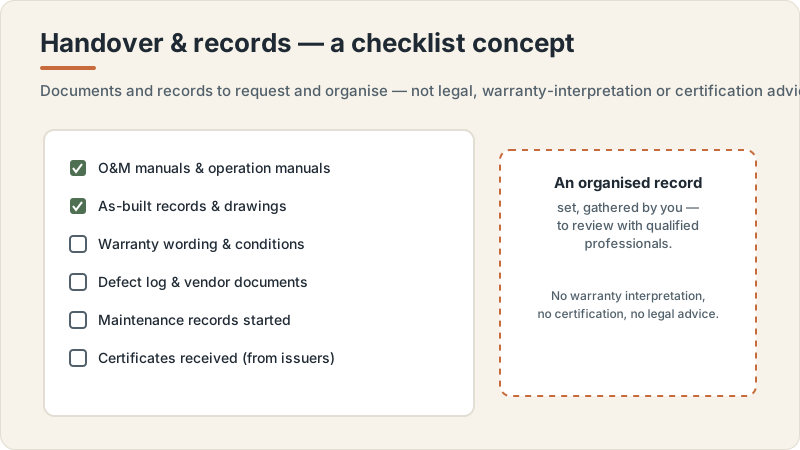
Handover and records checklist concept
Conceptual editorial diagram — not a construction drawing, specification, to-scale plan or proof of a real project. It is not engineering, structural, fire/life-safety, crowd-safety or accessibility-compliance guidance. Capacities, dimensions, standards, requirements and costs vary by facility type, audience, site, use case and governing body, and are confirmed with qualified professionals, relevant authorities and governing bodies. Build Design Hub does not design, build, inspect, certify, recommend or match anyone.
What this guide helps you prepare
This guide helps you assemble an organised request list of the documentation worth gathering from vendors and suppliers, and a way to track what you have received against what is still outstanding. A sports facility brings together many separate contributions — surfaces, drainage elements, lighting, fencing, seating, equipment, mechanical and electrical systems, and the works that join them — and each vendor typically holds product data sheets, warranty paperwork, operating and maintenance manuals, and named contacts. The work here is preparation: knowing what to ask each vendor for, capturing it in one place, and keeping the record auditable so qualified professionals can review it properly.
It does not tell you which documents are mandatory, what any data sheet, manual or warranty should say, or whether the set you receive is complete and acceptable. Those judgements depend on the specifics of your project and belong to qualified professionals, the suppliers themselves, and any relevant authority or governing body. What this guide offers is a structure for the request — a way to make sure nothing you may rely on later is quietly missing, and that every promised document can be checked off against an actual file rather than a recollection.
- A consolidated request list covering data sheets, warranties, manuals and contacts for each vendor
- A way to record which vendor supplied which component, system or work package
- A received-versus-outstanding view so gaps are visible before the project closes
- Prompts to capture the named contact and support route for each supplier
- A structure that lets qualified professionals review the documentation efficiently
The four document families to request from each vendor
A practical way to build a vendor documentation request is to think in four families and ask each supplier for the relevant items in each. Product and technical data sheets describe what was actually supplied — the model, specification, references and any accompanying technical information the vendor provides. Warranty and guarantee documents set out, in the vendor's own wording, what they say they stand behind and for how long. Operating and maintenance manuals are the instructions a vendor issues for their own product or system. Contact and support information records who to reach for spares, claims, queries or technical help. Treat these as categories to request, not as a checklist you are entitled to judge — what each family should contain varies by product, supplier and governing body, and is confirmed with the vendor and qualified professionals.
As you build the request, list each component, system or work package alongside the vendor responsible and the documents you expect in each family. This makes it visible where a single element involves more than one vendor — a surface supplier and an installing contractor, for example, may each hold different paperwork — and where a family of documents appears to be missing entirely. Keep the list factual: name the item, name the vendor, note the documents requested and received, and leave interpretation of adequacy to the people qualified to give it.
- Which product or technical data sheets describe exactly what each vendor supplied?
- Which warranty or guarantee documents has each vendor provided in writing, and who issues them?
- Which operating and maintenance manuals does each vendor publish for their own product or system?
- Who is the named contact for spares, claims, technical queries and support for each item?
- Where a single element involves several vendors, who holds which documents?
- Are there components or systems where a whole family of documents appears to be missing?
Recording, versioning and storing what arrives
Collecting documents is only half the task; keeping an organised, retrievable record is what makes them useful years later. For each item received, it helps to note the vendor, the document type, the version or revision and reference, the date provided, and the format — whether digital, physical, or both. A register that pairs every requested document with a clear received-or-outstanding status turns a scattered pile of emails and folders into something a facility manager, a board, or a qualified professional can navigate. You are not assessing whether each document is technically sufficient; you are ensuring it exists in a form that can be stored, found and reviewed.
It also helps to decide, early, who owns the record after handover and where it will live, so the file does not fragment as people move on. Note any conditions a vendor states alongside a document — for instance, expectations they attach to a warranty — without interpreting them, and flag those for confirmation. A tidy, complete and version-controlled file is what allows the right professionals to advise you and what your operations team will depend on long after the project is closed out. Where a document refers to maintenance, treat it as a vendor's own published material to be confirmed with qualified providers, not as instructions to follow as universal rules.
- Record the vendor, document type, version, reference and date for every item received
- Pair each requested document with a clear received-or-outstanding status
- Note the format of each record — digital, physical, or both — and where the master copy lives
- Capture any conditions a vendor states alongside a document, without interpreting them
- Name a single owner for the documentation record after handover
- Flag anything ambiguous, undated or unwritten for qualified professionals to review
Planning questions before speaking with professionals
Before you go back to vendors or sit down with advisors, settling some internal questions makes your requests clearer and your records more consistent. Decide who on your side owns the documentation register, what you will ask every vendor for so responses are comparable, how documents will be stored and shared, and which stakeholders — a board, a council, a school governing body — need to see the final set. Agreeing this early means each vendor is asked for the same families of documents in the same way, which makes the collection far easier to track and review.
It also helps to think about your own context: how the facility will be used, who will operate it, and which records that team will lean on most. These factors shape what you prioritise requesting, but they are not technical, legal or compliance conclusions to draw alone. Use this internal preparation to frame and prioritise your document requests, and carry anything uncertain — especially anything touching warranties, maintenance obligations or compliance — forward to qualified professionals rather than resolving it yourself.
- Who on our side owns the vendor documentation register and keeps it current?
- What set of documents are we asking every vendor to provide, so the records are comparable?
- How will we store, version and retrieve these documents over the facility's life?
- Which records will our operations team rely on most, and have we prioritised requesting them?
- Which stakeholders or authorities need to see the final documentation, and in what form?
- Which questions about warranties, maintenance or compliance must be carried to professionals?
Questions for qualified professionals
When you meet qualified professionals — which may include the relevant suppliers and contractors, a legal or contract advisor, and the architect, engineer or other technical advisors you have engaged — your prepared register helps them give focused input. Because what documentation is appropriate, complete or required varies by location, facility type, system and governing body, the people to confirm whether your set looks complete, whether anything important is missing, and how the documents connect to operations are these professionals, not this guide. Bring your vendor list and document register so the review is grounded in the actual paperwork rather than recollection.
Frame your questions to surface gaps, responsibilities and follow-ups rather than to seek a verdict you then act on alone. Ask which documents a given professional should review, what additional records or wording is worth requesting from a vendor, and how the manuals and warranties connect to your maintenance and operations planning. Record their answers alongside the documents so the register remains a single, trustworthy source for whoever manages the facility in the years ahead.
- Does our collected documentation set look complete, and what appears to be missing?
- Which of these vendor documents should a legal or contract advisor review?
- What additional data sheets, manuals or records is it reasonable to request from each vendor?
- How do these manuals and warranties connect to our maintenance and operations planning?
- Which records should we retain long-term, and which can be archived or superseded?
- Who should we contact, and how, if a component or system later needs vendor support?
What this does not replace
This is an educational planning resource only. It is not a maintenance manual and not inspection, certification, engineering, architectural, structural, HVAC, electrical, safety-compliance, fire or life-safety, or accessibility-compliance advice, and it is not legal, tax, insurance or procurement advice. It does not maintain, operate, inspect, certify, audit or specify anything, gives no maintenance intervals or procedures as universal rules, and offers no warranty interpretation, estimate, price, ROI or capacity figure. Maintenance requirements and costs vary by facility type, use intensity, surface, system, climate, season, governing body, warranty terms, supplier documentation, contractor scope and local professional requirements, and are confirmed with qualified professionals, suppliers, contractors, relevant authorities and governing bodies.
Build Design Hub does not operate, maintain, inspect, certify, audit, design, build, recommend, rank, verify, introduce, broker or match suppliers, contractors, maintenance providers or facility managers, and HELPERG LLC is publisher/operator only. Use this resource to prepare your own thinking and records, then have qualified professionals you engage directly review your facility. Decisions about maintenance, inspection, safety, compliance, warranties, procurement and suitability must rest on those professionals, suppliers, the relevant authorities and the governing bodies for your sport and location.
- Not a maintenance manual and not maintenance instructions, intervals or procedures as universal rules
- Not inspection, certification, safety-compliance, fire/life-safety or accessibility-compliance advice
- Not engineering, architectural, warranty-interpretation, legal, tax, insurance or procurement advice
- Not a supplier, contractor, maintenance-provider or facility-manager recommendation, ranking, directory or matching service
- Not an estimate, price or cost figure — maintenance requirements and costs vary
- Qualified professional review is required before any operations or maintenance decision
Vendor documentation request and tracking register
- 1List every component, system and work package, and name the vendor or supplier responsible for each
- 2For each vendor, request the relevant product and technical data sheets describing what was supplied
- 3Request the written warranty or guarantee documents each vendor provides, and note who issues them
- 4Request the operating and maintenance manuals each vendor publishes for their own product or system
- 5Capture the named contact, support route and any reference numbers for spares, claims and queries
- 6Record, for each requested document, a clear received-or-outstanding status
- 7Note the version, revision, reference and date for every document received
- 8Record the format of each record — digital, physical, or both — and where the master copy is stored
- 9Identify vendors or items where a whole family of documents appears to be missing
- 10Log any conditions a vendor attaches to a document, without interpreting them
- 11Flag items that were promised verbally but have not yet arrived in writing
- 12List the questions and gaps to carry to qualified professionals
- 13Note which stakeholders or authorities need to see the final documentation set
- 14Confirm who owns the documentation register after handover and where it will live
Common mistakes to avoid
- Asking only for warranties and overlooking data sheets, manuals or the contact details you will need later
- Accepting verbal assurances that documents 'will follow' without recording them as outstanding
- Treating a manual's published guidance as a universal maintenance rule rather than vendor material to confirm with qualified providers
- Assuming one vendor's documentation covers an element that actually involves several parties
- Storing documents across scattered emails and folders so no single, complete register exists at handover
- Interpreting a warranty or condition internally instead of routing it to qualified professionals
- Failing to capture a named contact, so no one knows who to call when a component later needs support
- Closing the project without naming an owner for the documentation register going forward
When to involve a professional
- When you need to know whether your collected documentation set is complete for your facility and context
- When any warranty, guarantee or contractual wording in a vendor document needs to be interpreted
- When a manual or data sheet describes maintenance or conditions that should be confirmed with a qualified provider
- When a component or system appears to have no documentation and you need to understand the implications
- When documentation conflicts with what was described verbally and the difference matters
- When stakeholders or authorities require formal assurance that the records meet relevant requirements
Frequently asked questions
Questions readers ask about this topic
Does Build Design Hub maintain, inspect or certify facilities, or recommend and match vendors?
No. Build Design Hub is an educational resource. It does not maintain, inspect, certify, audit, design or build anything, and it does not recommend, rank, verify, introduce, broker or match suppliers, contractors, maintenance providers or facility managers. It also gives no costs, intervals, requirements or standards as facts. This guide only helps you prepare a list of documentation to request from vendors and a way to record what you receive; confirm specifics with the vendors, qualified professionals and the relevant authorities.
What documents should I ask each vendor for?
A useful starting structure is four families: product and technical data sheets, warranty and guarantee documents, operating and maintenance manuals, and contact and support information. This guide helps you build a request list across those families and track what arrives. It does not state which documents are required or what they should contain — that varies by product, supplier, facility type and governing body, and is confirmed with the vendor and qualified professionals.
Can I follow the maintenance instructions in a vendor's manual as the rule for my facility?
This guide does not tell you to. A vendor manual is the supplier's own published material for their product, and how it applies depends on your surface, system, use intensity, climate, warranty terms, contractor scope and local professional requirements, which vary. Maintenance requirements vary by facility type, use intensity, surface, system, climate, season, governing body, warranty terms, supplier documentation, contractor scope and local professional requirements; confirm with qualified professionals and providers rather than treating any document as a universal rule.
Why gather documentation as a register instead of keeping the emails?
A single register that pairs every requested document with a received-or-outstanding status, and notes the version, date and contact, gives you something a facility manager, board or professional can navigate years later. Scattered emails make gaps invisible until something fails. This guide does not assess whether your documents are technically sufficient — only that organising them is a sound preparation step, with adequacy confirmed by qualified professionals.
Keep reading