
Who this guide is for
- Facility owners preparing to compare service or maintenance proposals from different providers
- Operators and facility managers who will live with the day-to-day terms of a service agreement
- Schools and education estates teams coordinating a sports-facility maintenance arrangement
- Clubs and community organisations clarifying who is responsible for what after handover
- Municipalities and developers organising service contracts across one or several sites
- Project sponsors assembling questions for suppliers, contractors and their own legal advisers
Planning diagram
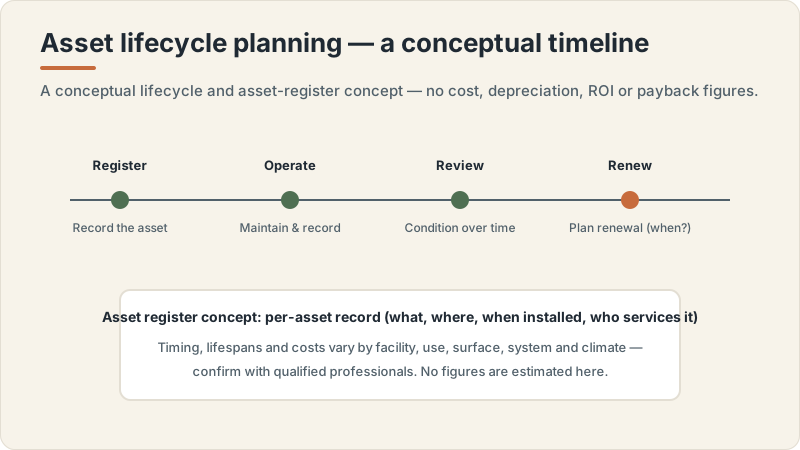
Asset lifecycle planning concept
Conceptual editorial diagram — not a construction drawing, specification, to-scale plan or proof of a real project. It is not engineering, structural, fire/life-safety, crowd-safety or accessibility-compliance guidance. Capacities, dimensions, standards, requirements and costs vary by facility type, audience, site, use case and governing body, and are confirmed with qualified professionals, relevant authorities and governing bodies. Build Design Hub does not design, build, inspect, certify, recommend or match anyone.
What this guide helps you prepare
This guide helps you prepare a structured list of questions about a sports-facility service or maintenance contract before you discuss one with a provider or your own advisers. It focuses on understanding scope, exclusions, responsibilities and key terms as questions to ask, so you can see how each provider describes its commitments in its own words and capture those answers consistently rather than relying on a sales summary or memory.
It does not draft a contract, interpret terms for you, or tell you whether an agreement is fair, sufficient or competitively priced. The purpose is preparation and comparison structure: a way to ask the same questions of everyone, record the responses, and notice where scope and obligations differ so you can raise those points with the provider and with a qualified legal adviser before committing.
- A consistent question set to use across every service or maintenance proposal
- A way to separate what is included from what is excluded or charged extra
- Prompts to surface response expectations, reporting and responsibilities early
- A reminder of which terms to request in writing rather than take on trust
- A structure for capturing answers so you can compare like with like
- A list of points to flag for qualified legal and procurement review
Clarifying scope, exclusions and responsibilities
The single word "service" can cover very different things from one provider to another, so it helps to ask each party to spell out exactly what their agreement does and does not include. Some arrangements describe routine attendance, others reactive call-outs, others a mix; some bundle surfaces, lighting, fencing, drainage and equipment together while others treat each as a separate line or exclude them entirely. Asking who is responsible for which elements, and what falls outside the agreement, helps you avoid assuming cover that was never offered.
Exclusions and assumptions often carry as much weight as the headline scope, so they deserve specific questions rather than a glance. It is worth understanding what triggers an additional charge, what conditions the provider assumes about the facility or its use, and where a boundary sits between their responsibility and yours. Wording varies widely, so the goal is to capture how each provider frames scope and exclusions, then confirm the actual terms with the provider and a qualified professional rather than interpreting the document yourself.
- Which specific surfaces, systems and equipment are inside the agreement, and which are not?
- What does the agreement explicitly exclude, and what would be charged separately?
- Where does the provider's responsibility end and the facility's own responsibility begin?
- What assumptions about use, access, condition or season does the scope rely on?
- How are call-outs or additional visits requested, approved and recorded?
- Who is responsible for parts, consumables and any third-party specialists involved?
Service terms, reporting and exit to clarify
Beyond scope, a service or maintenance contract sets out the working relationship: how the provider attends, how requests are raised, how the facility is kept informed, and what happens when something is not delivered as expected. Asking how response expectations are described, how work and visits are reported back to you, and what records you would receive helps you understand whether the arrangement will give you the visibility you need to run the facility and to keep your own documentation in order.
Term length, renewal, price-review mechanisms and exit arrangements also shape the agreement long after signing, and they are easier to discuss openly before commitment than after. It is reasonable to ask how the contract begins and ends, what notice applies, how any change in scope or charges is handled, and how a handover back to you or to a new provider would work. These are questions to raise with the provider and to confirm with a qualified legal adviser, not terms to settle from a brochure.
- How are response expectations and attendance described, and how are they evidenced?
- What reporting, records or logs would you receive after each visit or request?
- How are changes to scope, frequency or charges proposed and agreed?
- What term, renewal and notice arrangements apply, and how is exit handled?
- What happens to records, access and equipment if the provider changes?
- How are disputes or shortfalls in delivery raised and resolved under the agreement?
Planning questions before speaking with professionals
Before you sit down with a provider or your own advisers, it helps to organise what you already know about the facility and what you need the agreement to cover. Mapping the surfaces, systems and equipment in scope, who currently holds responsibility for each, and which warranty or handover obligations are still live gives you a clearer basis for asking focused questions. It also helps to be honest about what you do not yet know, so those gaps become questions rather than assumptions.
Working through these prompts on your own first means your conversations with suppliers, contractors and legal advisers can be consistent and comparable. The aim is not to reach conclusions yourself but to arrive prepared: with a clear picture of your facility, a consistent question set, and a record of where different providers describe their responsibilities differently, ready for qualified professional review.
- Have you listed the surfaces, systems and equipment you expect a service agreement to address?
- Do you know which warranty or handover obligations are still active and might interact with service terms?
- Have you noted who currently holds responsibility for each element, and where that is unclear?
- Have you separated questions about scope from questions about price, term and exit?
- Have you prepared a consistent question set to use with every provider?
- Have you flagged anything you do not understand for legal or procurement review?
Questions for qualified professionals
Service and maintenance agreements carry legal, financial and operational weight, so several questions are better directed to qualified professionals than answered by reading a document alone. A suitably qualified legal adviser can help you understand obligations and limitations and how the terms interact with your wider contracts and local requirements, while suppliers and contractors can confirm what their scope actually covers for your facility, surfaces and systems.
Use the prompts below to prepare for those conversations. Build Design Hub does not draft, review or interpret service or maintenance contracts, does not give legal, procurement or insurance advice, and does not recommend, rank, verify, introduce or match providers, suppliers or contractors. Those judgements belong with your own qualified advisers and with the providers themselves; this guide only helps you prepare the questions.
- How do these service terms sit alongside our wider contracts, warranties and obligations?
- Which exclusions, conditions or liabilities could affect us in practice?
- Are there local legal, procurement or governing-body requirements that interact with these terms?
- What should be clarified, amended or confirmed in writing before signing?
- How would responsibility be divided if an issue spans the provider, a warranty and our own duties?
- What records or evidence should we keep to support the agreement over its term?
What this does not replace
This is an educational planning resource only. It is not a maintenance manual and not inspection, certification, engineering, architectural, structural, HVAC, electrical, safety-compliance, fire or life-safety, or accessibility-compliance advice, and it is not legal, tax, insurance or procurement advice. It does not maintain, operate, inspect, certify, audit or specify anything, gives no maintenance intervals or procedures as universal rules, and offers no warranty interpretation, estimate, price, ROI or capacity figure. Maintenance requirements and costs vary by facility type, use intensity, surface, system, climate, season, governing body, warranty terms, supplier documentation, contractor scope and local professional requirements, and are confirmed with qualified professionals, suppliers, contractors, relevant authorities and governing bodies.
Build Design Hub does not operate, maintain, inspect, certify, audit, design, build, recommend, rank, verify, introduce, broker or match suppliers, contractors, maintenance providers or facility managers, and HELPERG LLC is publisher/operator only. Use this resource to prepare your own thinking and records, then have qualified professionals you engage directly review your facility. Decisions about maintenance, inspection, safety, compliance, warranties, procurement and suitability must rest on those professionals, suppliers, the relevant authorities and the governing bodies for your sport and location.
- Not a maintenance manual and not maintenance instructions, intervals or procedures as universal rules
- Not inspection, certification, safety-compliance, fire/life-safety or accessibility-compliance advice
- Not engineering, architectural, warranty-interpretation, legal, tax, insurance or procurement advice
- Not a supplier, contractor, maintenance-provider or facility-manager recommendation, ranking, directory or matching service
- Not an estimate, price or cost figure — maintenance requirements and costs vary
- Qualified professional review is required before any operations or maintenance decision
Service contract preparation worksheet
- 1Record the facility type, surfaces, systems and equipment you expect a service agreement to address
- 2List who currently holds responsibility for each element, and mark where this is unclear
- 3Note any live warranty, defect-log or handover obligations that may interact with service terms
- 4Gather the existing handover, manufacturer and supplier documents you already hold
- 5Write down, for each proposal, exactly what the provider says is included in scope
- 6Write down what each provider says is excluded or would be charged separately
- 7Capture how each provider describes response expectations and attendance
- 8Record what reporting, records or logs you would receive after visits or requests
- 9Note the term, renewal, notice and price-review arrangements described in each proposal
- 10Record how changes to scope or charges, and how exit or handover, would be handled
- 11Keep questions about scope separate from questions about price, term and exit
- 12List every point you do not fully understand and mark it for professional review
- 13Note which questions belong with the provider and which belong with a legal or procurement adviser
- 14Keep a dated written record of answers so each proposal can be compared on the same basis
Common mistakes to avoid
- Assuming the word "service" means the same thing across providers instead of asking each to define its scope
- Treating a maintenance frequency mentioned in a proposal as a universal rule rather than something specific to that provider and facility
- Assuming a warranty covers what a service contract does, or that the two automatically align, without confirming
- Relying on a verbal summary or brochure line instead of getting scope and exclusions in writing
- Skipping qualified legal or procurement review before signing because the document looks routine
- Comparing proposals on price alone without separating out scope, exclusions, term and exit
- Overlooking exit, renewal and handover terms until a change of provider is already needed
- Leaving responsibility boundaries between the provider, the facility and any warranties undefined
When to involve a professional
- Before signing any service or maintenance agreement, when a qualified legal adviser should review the terms
- When scope, exclusions or responsibility boundaries are unclear or appear to differ between proposals
- When service terms may interact with live warranties, handover obligations or other contracts
- When procurement rules, governing-body requirements or local regulations may apply to the arrangement
- When term, renewal, price-review or exit provisions could carry significant financial or operational consequences
- When a dispute, shortfall or change of provider raises questions about liability or records
Frequently asked questions
Questions readers ask about this topic
Does Build Design Hub maintain, inspect or certify sports facilities, or recommend service providers?
No. Build Design Hub is an educational publisher and does not maintain, inspect, certify or audit facilities, and it does not recommend, rank, verify, introduce or match providers, suppliers or contractors. It also gives no costs, intervals or requirements as facts. This guide only helps you prepare questions to discuss with providers and with your own qualified advisers. HELPERG LLC is publisher and operator only.
Will this guide tell me what my service contract should include?
No. It does not draft contracts, set terms or tell you what your agreement should contain. Contractual requirements vary by facility type, use, systems, governing body, warranty terms, provider scope and local professional requirements. The guide offers questions to clarify scope, exclusions and terms; what your contract should say is a matter for the provider and a qualified legal adviser.
Can this guide tell me whether a maintenance contract is fair or good value?
No. It does not assess whether any agreement is fair, sufficient or competitively priced, and it contains no figures, durations or estimates. It helps you ask consistent questions and record the answers so you can compare how providers describe their responsibilities, then take those points to qualified professionals who can advise on value and adequacy.
How should I use the questions in this guide?
Treat them as a preparation worksheet. Work through them yourself first, gather the documents and details you already hold, then use the prompts to ask each provider the same questions and capture the answers in writing. Flag anything you do not understand, and confirm scope, exclusions and terms with the relevant providers, authorities and qualified professionals before deciding.
Keep reading