
Who this guide is for
- Facility owners preparing to engage qualified safety professionals for a new or existing venue
- Operators and facility managers structuring an owner-side review and documentation routine
- Schools and education estates teams organising review preparation for sports provision
- Sports clubs and committees clarifying who reviews what and when
- Municipalities and public-estate teams assembling governance and review records
- Developers handing a completed facility to an operating party who will manage ongoing review
Planning diagram
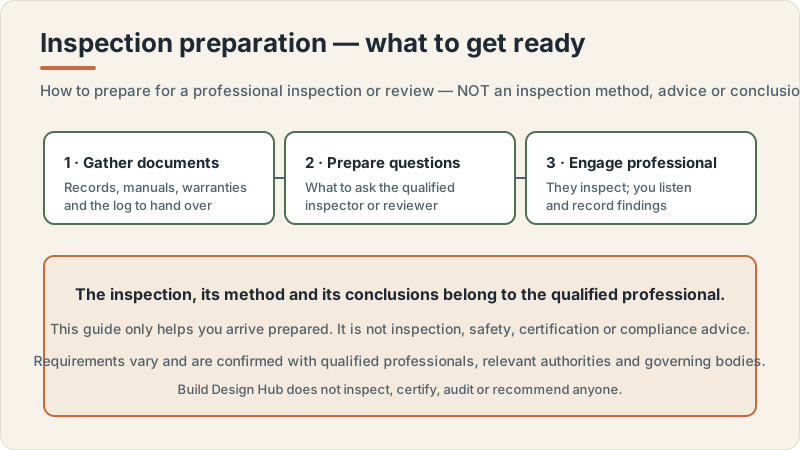
Inspection preparation workflow concept
Conceptual editorial diagram — not a construction drawing, specification, to-scale plan or proof of a real project. It is not engineering, structural, fire/life-safety, crowd-safety or accessibility-compliance guidance. Capacities, dimensions, standards, requirements and costs vary by facility type, audience, site, use case and governing body, and are confirmed with qualified professionals, relevant authorities and governing bodies. Build Design Hub does not design, build, inspect, certify, recommend or match anyone.
What this guide helps you prepare
This guide helps you prepare for a conversation with qualified safety professionals, not to carry out a review yourself. Preparation means assembling the facility's documentation, mapping out who is responsible for what, and writing down the questions you want answered before, during and after a professional review. When you walk into that conversation organised, the professional can spend their time on judgement rather than on chasing basic information, and you are better placed to understand and act on what they tell you. The output of this preparation is a set of records and questions, not a set of conclusions.
Just as importantly, this guide helps you understand why regular review matters as a planning idea, without telling you what any review must contain or how often it should happen. A facility changes over time as it is used, as seasons turn, as equipment ages and as how the space is used evolves. Those changes are exactly why owners build a habit of periodic review with qualified people. What that rhythm should be, and what each review should cover, are questions for the professionals and authorities you engage, who weigh your facility type, use and local requirements.
- Gather handover documents, manuals, warranty terms and supplier documentation in one place before any review
- Map who currently holds responsibility for each element and each record
- Write down the questions you want a qualified professional to help you answer
- Capture the facility's history of use, changes and prior reviews so professionals see context
- Separate what you can organise as an owner from what only a qualified professional should judge
- Note which authorities, governing bodies or suppliers you may need to confirm specific points with
Building an owner-side risk register and review record
A risk register is an owner-side planning document that lists the things you want to keep an eye on and review with professionals, alongside who is responsible and where the supporting records live. It is not a judgement about whether anything is safe, and it is not a substitute for professional review; it is an organising tool that makes review conversations more productive. Each entry might name an element of the facility, the documentation you hold about it, the date of any prior professional review, and an open question to raise. The register's value is that it keeps these threads visible rather than scattered across emails, folders and memories.
Alongside the register, a simple review record helps you track when professional reviews happened, who conducted them, and what follow-up the professional identified as the owner's responsibility to arrange. Recording this does not mean interpreting it; where a professional notes something for follow-up, the follow-up itself is arranged with qualified providers. Keeping the record current also helps at handover, when a new operator or manager needs to understand the facility's history quickly. Build Design Hub does not maintain, audit or review any register for you; this is a framework you keep and run yourself, and the substance is confirmed with qualified professionals.
- List each facility element and the documentation you hold for it
- Record who is responsible for arranging review and follow-up on each item
- Note the date and provider of any prior professional review
- Keep open questions visible so they are raised at the next professional conversation
- Track follow-up items a professional flagged as the owner's responsibility to arrange
- Store the register and review record where a future operator can find them
Why regular review matters and how to plan for it
Facilities are not static. Use intensity rises and falls across a season, weather and climate act on outdoor elements, equipment and surfaces age, and how a space is used can drift away from its original brief as programmes and bookings change. A habit of regular review with qualified people exists precisely because these changes accumulate quietly. As a planning idea, building review into your calendar and governance means the facility is looked at by appropriate professionals on a rhythm that suits it, rather than only when something has already gone wrong. This guide does not set that rhythm; it encourages you to ask the right people what rhythm suits your facility.
Planning for regular review is largely about preparation and coordination rather than the review itself. You can prepare by deciding in advance who will be involved, what documents they will need, and how you will record and act on what they tell you. You can coordinate by aligning review windows with quieter periods and by anticipating seasonal patterns that change what a facility faces. The specifics, including how often review should happen and what each review should examine, vary widely and are confirmed with qualified professionals, suppliers and the relevant authorities or governing bodies for your facility type and location.
- Plan who you will involve and when, before the need becomes urgent
- Anticipate seasonal and usage changes that may prompt a review conversation
- Decide in advance how you will record and act on professional findings
- Align proposed review windows with quieter operating periods
- Confirm an appropriate review rhythm with qualified professionals rather than assuming one
- Revisit the plan after major changes in use, equipment or surrounding works
Planning questions before speaking with professionals
Before you reach out to qualified safety professionals, it helps to answer some questions internally so you arrive organised. These are owner-side questions about documentation, responsibility and history rather than questions that require professional judgement. Working through them clarifies what you already hold, what you are missing, and what you most want a professional to help you understand. It also helps you describe your facility accurately, which lets the professional scope the conversation sensibly. None of this preparation reaches a conclusion about safety; it simply makes the eventual professional conversation more focused and useful.
Treat this preparation as assembling a brief about your own facility. The clearer that brief, the easier it is for a qualified professional to tell you what they would look at, what they would need from you, and which authorities, governing bodies or suppliers you may need to involve as well. If you find gaps while preparing, note them as questions rather than trying to fill them yourself, since the right way to close a gap is often to ask the appropriate professional, supplier or authority.
- What handover documents, manuals and warranty terms do we actually hold, and what is missing?
- Who is currently responsible for each element, and is that written down anywhere?
- What has changed in how the facility is used since it opened or was last reviewed?
- What prior professional reviews have taken place, and where are those records?
- Which suppliers, contractors or governing bodies are connected to specific elements?
- What are the main things we want a qualified professional to help us understand?
Questions for qualified professionals
Once you engage qualified safety professionals, the questions shift from what you hold to what they would examine and advise. These questions are framed to draw out the professional's judgement and to clarify the owner's responsibilities, not to extract fixed rules from this guide. Because requirements vary by facility type, use intensity, surface, system, climate, season, governing body, warranty terms, supplier documentation, contractor scope and local professional requirements, the answers belong with the professional you engage and, where relevant, with the authorities and governing bodies they point you toward.
Asking clearly also helps you understand the boundary of any review: what it covered, what it deliberately did not cover, and what remains the owner's responsibility to arrange or confirm elsewhere. Keep a written note of the answers and any follow-up the professional identifies, and use that note to update your owner-side register and review record. Build Design Hub does not provide these answers, does not recommend or match the professionals who do, and gives no requirements, intervals or costs; those come from the qualified people you engage.
- What would your review cover for a facility of this type and use, and what would it not cover?
- What documentation would you need from us, and in what form?
- How do you suggest we record and act on what you identify?
- What rhythm of review would you consider appropriate for our facility, and why?
- Which authorities, governing bodies or suppliers should we also confirm specific points with?
- What remains our responsibility to arrange or confirm after your review?
What this does not replace
This is an educational planning resource only. It is not a maintenance manual and not inspection, certification, engineering, architectural, structural, HVAC, electrical, safety-compliance, fire or life-safety, or accessibility-compliance advice, and it is not legal, tax, insurance or procurement advice. It does not maintain, operate, inspect, certify, audit or specify anything, gives no maintenance intervals or procedures as universal rules, and offers no warranty interpretation, estimate, price, ROI or capacity figure. Maintenance requirements and costs vary by facility type, use intensity, surface, system, climate, season, governing body, warranty terms, supplier documentation, contractor scope and local professional requirements, and are confirmed with qualified professionals, suppliers, contractors, relevant authorities and governing bodies.
Build Design Hub does not operate, maintain, inspect, certify, audit, design, build, recommend, rank, verify, introduce, broker or match suppliers, contractors, maintenance providers or facility managers, and HELPERG LLC is publisher/operator only. Use this resource to prepare your own thinking and records, then have qualified professionals you engage directly review your facility. Decisions about maintenance, inspection, safety, compliance, warranties, procurement and suitability must rest on those professionals, suppliers, the relevant authorities and the governing bodies for your sport and location.
- Not a maintenance manual and not maintenance instructions, intervals or procedures as universal rules
- Not inspection, certification, safety-compliance, fire/life-safety or accessibility-compliance advice
- Not engineering, architectural, warranty-interpretation, legal, tax, insurance or procurement advice
- Not a supplier, contractor, maintenance-provider or facility-manager recommendation, ranking, directory or matching service
- Not an estimate, price or cost figure — maintenance requirements and costs vary
- Qualified professional review is required before any operations or maintenance decision
Safety review preparation worksheet
- 1Gather all handover documents, operation and maintenance manuals, and warranty terms in one place
- 2List each facility element you want covered in review conversations
- 3Record the supplier, contractor or governing body connected to each element
- 4Note what documentation you hold for each element and what is missing
- 5Write down who is currently responsible for arranging review and follow-up on each item
- 6Capture the facility's history of use, programme changes and prior works
- 7Record the date and provider of any previous professional review
- 8Build an owner-side risk register that keeps open questions visible
- 9Draft the questions you want to answer internally before contacting professionals
- 10Draft the questions you want to raise with qualified professionals
- 11Identify which authorities, governing bodies or suppliers you may need to confirm points with
- 12Decide in advance how you will record and act on professional findings
- 13Note proposed review windows that align with quieter operating periods
- 14Store the register and review record where a future operator can find them
Common mistakes to avoid
- Treating a frequency, interval or lifespan from any source as a universal rule rather than confirming it with qualified professionals for the specific facility
- Assuming a warranty or supplier document covers something without confirming the terms with the supplier or a qualified professional
- Skipping professional review and relying only on owner-side judgement about what is safe
- Confusing an owner-side risk register with a professional review or conclusion
- Waiting until a problem appears instead of planning a review rhythm in advance with qualified people
- Losing the facility's review history at handover because records were never gathered in one place
- Trying to close documentation or knowledge gaps internally instead of asking the appropriate professional, supplier or authority
- Forgetting to ask what a review deliberately did not cover, leaving owner responsibilities unclear
When to involve a professional
- Engage qualified safety professionals when you need any judgement about how a facility should be reviewed, since requirements vary and are not set by this guide
- Involve the relevant authorities or governing bodies when a question touches requirements specific to your facility type, location or sport
- Bring in the original suppliers or contractors when warranty terms, supplier documentation or installed-system specifics need confirming
- Seek qualified professionals after major changes in use, equipment, surrounding works or following any incident
- Involve qualified professionals at handover so a new operator inherits a clear, current picture of review history and responsibilities
- Confirm an appropriate review rhythm and scope with qualified professionals rather than assuming one from any general source
Frequently asked questions
Questions readers ask about this topic
Does Build Design Hub inspect, certify or review my facility, or recommend professionals who do?
No. Build Design Hub is an educational publisher and does not operate, maintain, inspect, certify, audit or review any facility, and does not recommend, rank, verify or match safety professionals, suppliers or contractors. It also gives no costs, intervals or requirements. This guide only helps you prepare your own documents and questions before you engage qualified professionals you choose.
How often should a sports facility be reviewed for safety?
This guide does not state any frequency. How often review should happen, and what it should cover, vary by facility type, use intensity, surface, system, climate, season, governing body and local professional requirements. Confirm an appropriate rhythm with qualified safety professionals and the relevant authorities for your facility.
Is an owner-side risk register the same as a safety review?
No. A risk register is a planning and organising document you keep yourself; it lists what you want to track and which questions to raise. It is not a judgement that anything is safe and does not replace review by qualified professionals. Its purpose is to make professional conversations more focused.
What should I prepare before contacting a safety professional?
Gather handover documents, manuals, warranty terms and supplier documentation, map who is responsible for each element, record the facility's history and any prior reviews, and write down both the questions you can answer internally and the ones you want the professional to help you understand.
Keep reading