
Who this guide is for
- Facility owners preparing to receive handover of a new or refurbished sports facility and wanting a record-keeping framework
- Operators and facility managers who will be the day-to-day point of contact for logging observations after handover
- Schools and colleges with sports halls, pitches or courts who need owner-side documentation discipline
- Sports clubs and community organisations coordinating a defects-liability period with their contractor
- Municipalities and public-sector teams responsible for governance and records on civic sports facilities
- Developers and project sponsors who want their owner-handover pack to include a usable defect-log structure
Planning diagram
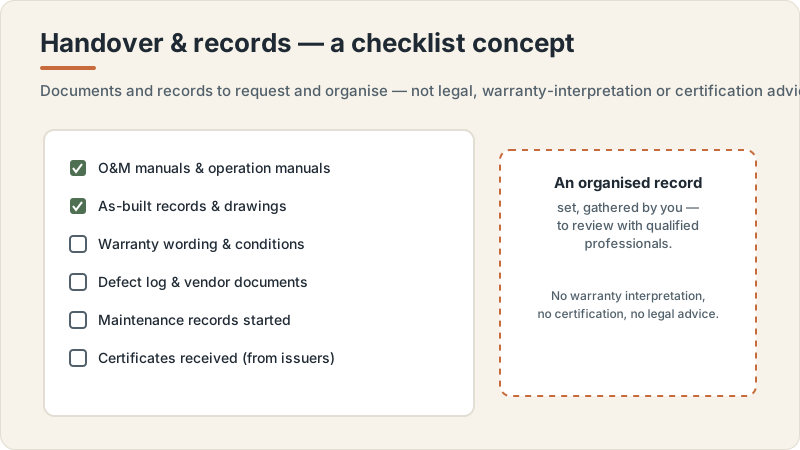
Handover and records checklist concept
Conceptual editorial diagram — not a construction drawing, specification, to-scale plan or proof of a real project. It is not engineering, structural, fire/life-safety, crowd-safety or accessibility-compliance guidance. Capacities, dimensions, standards, requirements and costs vary by facility type, audience, site, use case and governing body, and are confirmed with qualified professionals, relevant authorities and governing bodies. Build Design Hub does not design, build, inspect, certify, recommend or match anyone.
What this guide helps you prepare
This guide helps you prepare the structure of a defect log before and during a defects-liability period, so that observations made after handover are captured in a consistent, organised and reviewable form. It walks through the kinds of information a log can hold, how those fields relate to one another, and how the log can be arranged so that entries are easy to find, group and hand to the people who will actually assess them. The aim is preparation and organisation, not action: it helps you decide what to record and how to file it, not what to do about any individual item.
It deliberately stays away from technical and contractual conclusions. It will not help you judge whether something is a genuine defect, normal wear, a maintenance item or out of scope, and it will not interpret warranty or contract terms. Those judgements depend on your specific agreements, surface, systems, climate, governing body and local requirements, and they belong to qualified professionals and your advisers. A well-structured log makes their review faster and clearer; it does not replace it.
- A consistent set of fields so every entry is recorded the same way regardless of who logs it
- A filing and grouping approach so entries can be sorted by area, system, surface or status
- A clear separation between observation (what was seen) and any later assessment by professionals
- A handover-readiness view: what to request from your contractor or developer to start the log on day one
- Prompts for the questions to raise with qualified professionals rather than answering them yourself
- A governance trail showing who logged what, when, and what supporting documentation accompanies each entry
Core fields a sports-facility defect log can capture
A defect log is most useful when each entry carries the same core information, so the value of a structured log lies in agreeing the fields up front rather than improvising them later. Useful fields typically describe the observation itself (a plain, factual description of what was noticed), where it was seen (a location reference tied to a zone, room, court, pitch or system), and when and by whom it was logged. Supporting fields often include a unique reference number, the facility area or system category, the date raised, photographs or attachments, and a free-text notes field for context. The point of these fields is to capture observations clearly and neutrally, not to label severity, cause or responsibility, which are matters for qualified review.
Beyond the observation, a log can carry tracking fields that record the status of an entry as it moves through review by the appropriate people, dates of correspondence, and references to any documentation supplied by your contractor or supplier. It is important that status and outcome fields record what others have determined rather than your own conclusions: the log notes that an item was reviewed, referred or closed, and by whom, without the log itself deciding the technical or contractual answer. Which categories, systems and surfaces are relevant to your facility, and what status workflow fits your arrangement, vary by project and should be confirmed with qualified professionals and your contractor.
- A unique reference (ID) per entry so items can be cited unambiguously in correspondence
- A factual description field, kept to what was observed rather than a diagnosis or cause
- A location reference linked to a consistent zoning or area map of the facility
- A category or system tag (for example surface, lighting, drainage, fittings) agreed with your team
- Date raised, person who raised it, and date last updated for a clear audit trail
- A status field that records the stage of professional/contractor review, not your own verdict
Organising and maintaining the log so it stays usable
How a log is organised determines whether it stays useful as entries accumulate. Deciding in advance how items will be grouped (by facility area, by system, by date, by status) lets you sort and filter rather than scroll, and a consistent location-referencing scheme tied to a plan or zone map keeps entries findable when several relate to the same space. It also helps to agree a single source of truth: one maintained log rather than scattered emails and notes, with clear rules about who can add entries, who can update status fields, and how supporting files are named and stored alongside it. These are organisational choices you can make as the owner or operator, independent of any technical judgement.
A log also benefits from a light governance layer so that it can be relied upon later. Recording who logged each item, keeping original observations unedited once raised, and preserving the chain of correspondence makes the record trustworthy as a documentation trail. Many owners plan review checkpoints (for example aligning a log review with a seasonal facility review or a scheduled progress meeting) at intervals confirmed with their contractor and professional team rather than fixed by this guide. The log itself does not trigger maintenance or resolve anything; it organises information so that the people responsible for assessment and any action can work from a clear, shared record.
- A grouping scheme decided up front (area, system, status or date) so the log can be sorted and filtered
- A consistent location-referencing convention tied to a facility plan or zone map
- A single maintained log as the source of truth, with clear rules on who adds and who updates entries
- A file-naming and storage approach for photographs, plans and supplier documents linked to each entry
- A practice of preserving original observations unedited, with updates recorded separately for an audit trail
- Planned review checkpoints whose timing and scope you confirm with your contractor and professional team
Planning questions before speaking with professionals
Before you involve your contractor, supplier or professional advisers, it helps to clarify your own starting position so those conversations are productive. That means knowing what your handover and contractual documents say a defects-liability period is, what records you already hold, what the facility areas and systems are that the log should cover, and who on your side will own the log. These are owner-side preparation questions: working through them does not require technical or legal expertise, but it does shape what you ask others. Capturing your assumptions and uncertainties here also flags exactly which points you need a professional to confirm.
It is equally useful to plan how the log will fit your governance and records. Consider where the log will live, who can access it, how it links to your wider handover and operations documentation, and how you will keep it current. Frame anything you are unsure about (timelines, what counts as a defect, what is covered, what the contract requires) as a question to raise rather than an answer to assume, because those points depend on your specific arrangements and on professional and contractual input. This preparation lets you go into discussions with a clear log structure and a clear list of what still needs confirming.
- What do our handover and contract documents actually say about the defects-liability period, and what is still unclear to us?
- Which facility areas, surfaces and systems should the log cover, and how will we reference each one consistently?
- Who on our side owns the log, can add entries, and updates status, and how will we keep it current?
- What records, plans, warranties and supplier documents do we already hold, and what is missing?
- How will the defect log link to our wider handover pack, asset register and operations documentation?
- Which of our assumptions about timelines, coverage and what counts as a defect do we need professionals to confirm?
Questions for qualified professionals
When you do speak with qualified professionals (your contractor, suppliers, project or contract administrator, and your own legal, surveying or engineering advisers as appropriate), the defect log is a tool to support the conversation, not a substitute for their judgement. The questions below are framed so that the professional makes the determination and you record it. They focus on understanding the process, the scope, what documentation you should expect, and how observations move through review, rather than on you reaching technical or contractual conclusions yourself. Direct each question to the appropriate professional for your project.
Remember that what counts as a defect, how a defects-liability period operates, what is and is not covered, and any timelines or obligations vary by contract, facility type, surface, system, climate, governing body, supplier documentation, contractor scope and local professional requirements. This guide cannot state any of these as fact. Use these questions to obtain confirmation from the people qualified and contractually positioned to give it, and record their responses in the log so the trail is clear.
- Who is the correct point of contact for raising and reviewing logged items, and what process should we follow?
- How should we describe and reference an observation so it is clear for your assessment?
- What documentation (plans, warranties, supplier manuals, certificates) should accompany handover and the log?
- How will you confirm whether a logged item is in scope, and how should we record that determination?
- What timelines, checkpoints or notice steps apply to the defects-liability process for this facility?
- Which questions in this log should go to which professional (contractor, supplier, surveyor, legal or contract adviser)?
What this does not replace
This is an educational planning resource only. It is not a maintenance manual and not inspection, certification, engineering, architectural, structural, HVAC, electrical, safety-compliance, fire or life-safety, or accessibility-compliance advice, and it is not legal, tax, insurance or procurement advice. It does not maintain, operate, inspect, certify, audit or specify anything, gives no maintenance intervals or procedures as universal rules, and offers no warranty interpretation, estimate, price, ROI or capacity figure. Maintenance requirements and costs vary by facility type, use intensity, surface, system, climate, season, governing body, warranty terms, supplier documentation, contractor scope and local professional requirements, and are confirmed with qualified professionals, suppliers, contractors, relevant authorities and governing bodies.
Build Design Hub does not operate, maintain, inspect, certify, audit, design, build, recommend, rank, verify, introduce, broker or match suppliers, contractors, maintenance providers or facility managers, and HELPERG LLC is publisher/operator only. Use this resource to prepare your own thinking and records, then have qualified professionals you engage directly review your facility. Decisions about maintenance, inspection, safety, compliance, warranties, procurement and suitability must rest on those professionals, suppliers, the relevant authorities and the governing bodies for your sport and location.
- Not a maintenance manual and not maintenance instructions, intervals or procedures as universal rules
- Not inspection, certification, safety-compliance, fire/life-safety or accessibility-compliance advice
- Not engineering, architectural, warranty-interpretation, legal, tax, insurance or procurement advice
- Not a supplier, contractor, maintenance-provider or facility-manager recommendation, ranking, directory or matching service
- Not an estimate, price or cost figure — maintenance requirements and costs vary
- Qualified professional review is required before any operations or maintenance decision
Defect log preparation worksheet: fields to define and items to gather
- 1Record the source documents (contract, handover pack, warranties) you hold that mention a defects-liability period, noting which are missing
- 2Define a unique reference (ID) format for log entries and confirm everyone will use it
- 3Agree the list of facility areas, surfaces and systems the log will categorise, with input from your team
- 4Establish a consistent location-referencing scheme tied to a facility plan or zone map
- 5Define the observation field rules: factual description only, kept separate from any cause or verdict
- 6Decide which tracking fields you need (date raised, raised by, date updated, status, correspondence references)
- 7Set up an attachments approach for photographs, plans and supplier documents, with a clear file-naming convention
- 8Record who on your side may add entries and who may update status fields
- 9Choose one maintained log as the single source of truth and note where it is stored and who can access it
- 10Note the questions you need professionals to confirm (what counts as a defect, coverage, timelines) as open items
- 11Plan review checkpoints and confirm their timing and scope with your contractor and professional team
- 12Capture how the log links to your wider asset register, handover pack and operations documentation
- 13List which professional each type of question should be directed to (contractor, supplier, surveyor, adviser)
- 14Set a rule that original observations stay unedited once raised, with updates recorded separately for the audit trail
Common mistakes to avoid
- Treating any interval, timeline or coverage you have read about as a universal rule rather than confirming it against your own contract and with professionals
- Assuming a warranty or the defects-liability process covers a given item without having a qualified professional or your adviser confirm it
- Using the log to decide whether something is a defect, its cause, or who is responsible, instead of recording observations for others to assess
- Letting observations live in scattered emails and notes rather than one maintained log, so the record cannot be relied on later
- Skipping a consistent location and reference scheme, so entries about the same area become hard to find and group
- Editing or overwriting original observations once raised, which breaks the audit trail and the record's credibility
- Mixing factual observation with diagnosis or instructions in the same field, blurring what was seen from what someone concluded
- Deferring setup until problems appear, so there is no agreed structure or owner for the log when it is first needed
When to involve a professional
- When you need to know whether a defects-liability period applies, how it operates, or what timelines and obligations exist for your facility
- When deciding whether an observation is a defect, normal wear, a maintenance item or out of scope, which is a determination for qualified professionals
- When interpreting what a warranty, contract or supplier document covers, which should go to your contractor, supplier and legal or contractual adviser
- When defining the technical categories, systems or surface-specific fields the log should track for your particular facility
- When you are unsure who should assess a particular type of item, so the right contractor, supplier, surveyor or engineer is engaged
- When any item touches safety, compliance, certification, or structural, electrical, drainage or surface engineering questions that require a qualified professional
Frequently asked questions
Questions readers ask about this topic
Does Build Design Hub maintain, inspect or certify our facility, or recommend a contractor to handle defects?
No. Build Design Hub is an educational publisher and does not operate, maintain, inspect, certify, audit, design or build facilities, and it does not recommend, rank, verify, introduce or match suppliers, contractors, maintenance providers or facility managers. It also gives no costs, intervals or requirements. This guide only helps you prepare your own defect-log structure and the questions to put to qualified professionals, who carry out any assessment or work.
Will this guide tell us what counts as a defect or whether something is covered?
No. Whether an observation is a defect, normal wear or out of scope, and whether any warranty or contract covers it, are determinations for qualified professionals, your contractor and suppliers, and your own advisers, based on your specific arrangements. The log is for recording observations and tracking how others review them; it does not make those judgements, and this guide cannot state them as fact.
How is a defect log different from a maintenance schedule?
A defect log records and tracks observations raised during a defects-liability period so they can be reviewed by the appropriate people, whereas a maintenance schedule concerns ongoing upkeep activities. This guide covers only the planning and structure of the log. It does not provide maintenance schedules, intervals, procedures or instructions, which vary by facility and are defined with qualified providers and suppliers.
What fields should every entry in our log contain?
A consistent core typically includes a unique reference, a factual observation description, a location reference, the date raised, who raised it, a category or system tag, an attachments field, and a status field that records the stage of professional or contractor review. The exact fields, categories and status workflow that suit your facility should be confirmed with your contractor and professional team, since they vary by project.
Keep reading