
Who this guide is for
- Facility owners assembling handover records and wanting a single place to log every warranty and guarantee
- Operators and facility managers who will hold and act on warranty paperwork after the project completes
- Schools and colleges preparing governance records for a new or refurbished sports facility
- Sports clubs and community organisations organising documents handed over by a contractor or supplier
- Municipalities and public-sector teams needing a traceable register for accountability and handover
- Developers preparing a structured warranty record to pass to a future owner or operator
Planning diagram
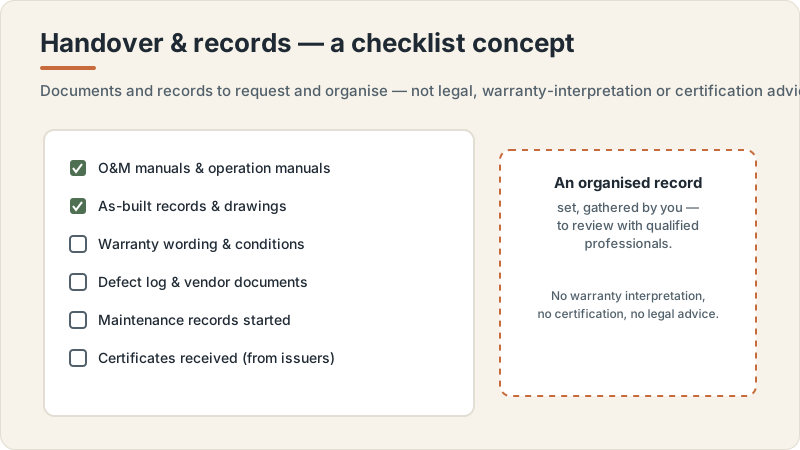
Handover and records checklist concept
Conceptual editorial diagram — not a construction drawing, specification, to-scale plan or proof of a real project. It is not engineering, structural, fire/life-safety, crowd-safety or accessibility-compliance guidance. Capacities, dimensions, standards, requirements and costs vary by facility type, audience, site, use case and governing body, and are confirmed with qualified professionals, relevant authorities and governing bodies. Build Design Hub does not design, build, inspect, certify, recommend or match anyone.
What this guide helps you prepare
This guide helps you set up an organised warranty tracker before, during and after handover, so the warranties attached to your facility are captured in one consistent place rather than scattered across inboxes and filing systems. A sports facility is assembled from many separate components and work packages, and each can carry its own warranty or guarantee from a different party on different terms. The aim is to help you decide what to record for each item, how to keep that record traceable, and which questions to put to the issuing parties and to qualified professionals. It is a preparation framework, not an instruction to maintain, inspect or interpret anything.
The tracker described here is a record-keeping structure, not an assessment. You are cataloguing what exists and what you have been told, not deciding whether coverage is sufficient or what any term means. Recording an item, its stated term, its stated conditions and the party who issued it gives qualified professionals and any legal adviser something concrete to review, and gives your own team a reliable reference. Keep the tracker factual and free of your own interpretation; where something is unclear, the right response is to record a question to confirm rather than to guess at an answer.
- A consolidated list of every component and work package that may carry a separate warranty or guarantee
- A consistent way to record the item, the issuing party, and where the documentation is stored
- Fields to capture stated terms and stated conditions exactly as written, without your own interpretation
- A place to log open questions and who needs to confirm each one
- Prompts to identify gaps where no warranty or guarantee appears to exist
- A structure handover records can plug into, so nothing is lost when responsibility passes to an operator
Structuring the tracker: what to record for each item
A useful tracker usually has one row per warranty or guarantee, with consistent columns so every entry holds the same kind of information. Common fields include the item or component, the work package it sits within, the party who issued the warranty and how to reach them, the stated term or duration, the stated start point, the stated conditions, and a link or reference to the document itself. Recording these as plain facts copied from the paperwork keeps the tracker reliable. The point is not to summarise or paraphrase the wording, which can change its meaning, but to capture what is stated and where the full text lives so it can be read in full when needed.
Beyond the warranty details, it helps to record the practical context around each entry: when the item was installed or accepted, who holds the original document, and any conditions that appear to depend on records you would need to keep. Some warranties reference conditions about how an item is used, serviced or evidenced, and recording that a condition exists, in the issuer's own words, is different from deciding what it requires of you. Treat every condition as something to confirm with the issuing party and qualified professionals rather than a rule you interpret yourself, and note who you still need to ask. A tracker built this way stays a record, not an opinion.
- Item or component, and the work package or contract it belongs to
- Issuing party and contact route for questions or claims
- Stated term or duration, and the stated start point, copied as written
- Stated conditions and any referenced documents, captured verbatim with a link to the full text
- Where the original document is held and who is responsible for keeping it
- Open questions for this item and the party who needs to confirm each one
Organising terms, conditions and the gaps between packages
Once each item has a row, the more revealing work is looking across the whole tracker. Listing components and packages side by side helps you see where coverage might overlap, where it might be split between parties, and where it may be missing entirely. A single element such as a playing surface can involve both a product warranty from a manufacturer and a workmanship guarantee from the installer, held by different parties on different terms. Recording both, and noting the boundary between them, prevents the common situation where each party assumes the other stands behind a shared element. The tracker makes those boundaries visible so they become questions rather than surprises.
Conditions deserve their own attention because they often determine whether a warranty stays meaningful over time. Some warranties reference how an item is used, who services it, or what records are kept, and they may distinguish between manufacturer, contractor and operator responsibilities. Your tracker's job is to record that these conditions exist and where they are stated, not to decide what they oblige you to do or whether you are meeting them. Capturing them in one place lets qualified professionals and any legal adviser review the full picture, and lets you raise specific, well-framed questions with each issuing party instead of relying on memory or assumption.
- Where two parties may each warrant part of the same element, and the boundary between them
- Whether any condition references records, servicing or use that someone would need to track
- Which conditions distinguish manufacturer, contractor and operator responsibilities
- Components or works where no warranty or guarantee appears to be offered
- How the tracker links to handover records, asset lists and the defect or snagging log
- Who holds responsibility for keeping the tracker current after handover
Planning questions before speaking with professionals
Before you involve qualified professionals or a legal adviser, it is worth getting your own house in order so their time is spent on review rather than reconstruction. Walk through your project package by package and ask whether every component that might carry a warranty is represented in the tracker, whether you actually hold each document or only a reference to it, and whether the entries are complete enough that someone unfamiliar with the project could follow them. These internal questions are not about interpreting coverage; they are about whether your record is organised, traceable and ready to be reviewed.
It also helps to be honest about what is uncertain. Note where you are not sure who issued a warranty, where a document is referenced but not in your possession, and where a condition is stated but its meaning is unclear to you. Recording these uncertainties as explicit open questions, rather than leaving them as quiet assumptions, turns the tracker into a working agenda for the conversations ahead. The goal of this stage is a clean, complete record and a clear list of what you still need to confirm with others.
- Is every component and work package that might carry a warranty represented in the tracker?
- Do we hold each original document, or only a reference, and who is the holder?
- Are stated terms and conditions copied as written rather than paraphrased?
- Where are we unsure who issued a warranty or how to contact them?
- Which conditions are stated but unclear to us, and so need confirming with the issuer?
- Does the tracker link cleanly to handover records, the asset list and the defect log?
Questions for qualified professionals
When you involve qualified professionals, suppliers, contractors and any legal adviser, the tracker becomes the shared reference for the discussion. Ask each issuing party to confirm, in writing, the items they stand behind, the stated terms, and the conditions that apply, so your record reflects their words rather than your assumptions. Ask qualified professionals and any legal adviser to review the assembled picture, including the boundaries between packages and any gaps you have flagged. Requirements, durations and conditions vary by location, facility type, audience, site, use case and governing body; treat every answer as specific to your facility, and document who told you what so your record stays traceable.
These conversations are also where responsibility for the tracker itself should be settled. Confirm who will keep it current as items are accepted, replaced or refreshed, who holds the original documents, and what each party expects you to keep on your side. Maintenance and record-keeping obligations vary and are defined with the relevant providers and suppliers, not assumed from a template; confirm the specifics with qualified professionals. The aim is a record that stays reliable over the life of the facility, with clear ownership and a clear route for raising anything that arises.
- Can you confirm in writing the items you warrant, the stated term, and the stated start point?
- What conditions apply to each warranty, and what records or evidence do they reference?
- Where two parties cover parts of the same element, who is responsible for what at the boundary?
- Are there components where no warranty or guarantee applies, and is that expected for this facility type?
- Who should keep the tracker current after handover, and who holds each original document?
- What do you need from us so that a warranty's stated conditions continue to be met?
What this does not replace
This is an educational planning resource only. It is not a maintenance manual and not inspection, certification, engineering, architectural, structural, HVAC, electrical, safety-compliance, fire or life-safety, or accessibility-compliance advice, and it is not legal, tax, insurance or procurement advice. It does not maintain, operate, inspect, certify, audit or specify anything, gives no maintenance intervals or procedures as universal rules, and offers no warranty interpretation, estimate, price, ROI or capacity figure. Maintenance requirements and costs vary by facility type, use intensity, surface, system, climate, season, governing body, warranty terms, supplier documentation, contractor scope and local professional requirements, and are confirmed with qualified professionals, suppliers, contractors, relevant authorities and governing bodies.
Build Design Hub does not operate, maintain, inspect, certify, audit, design, build, recommend, rank, verify, introduce, broker or match suppliers, contractors, maintenance providers or facility managers, and HELPERG LLC is publisher/operator only. Use this resource to prepare your own thinking and records, then have qualified professionals you engage directly review your facility. Decisions about maintenance, inspection, safety, compliance, warranties, procurement and suitability must rest on those professionals, suppliers, the relevant authorities and the governing bodies for your sport and location.
- Not a maintenance manual and not maintenance instructions, intervals or procedures as universal rules
- Not inspection, certification, safety-compliance, fire/life-safety or accessibility-compliance advice
- Not engineering, architectural, warranty-interpretation, legal, tax, insurance or procurement advice
- Not a supplier, contractor, maintenance-provider or facility-manager recommendation, ranking, directory or matching service
- Not an estimate, price or cost figure — maintenance requirements and costs vary
- Qualified professional review is required before any operations or maintenance decision
Warranty tracker preparation worksheet
- 1List every component and work package that may carry a separate warranty or guarantee
- 2Record the issuing party and a contact route for each item
- 3Capture the stated term or duration exactly as written in each document
- 4Record the stated start point for each warranty as the issuer states it
- 5Copy stated conditions verbatim and link to the full document text
- 6Note where each original document is held and who is responsible for keeping it
- 7Flag elements where two parties may each warrant part of the same item, and the boundary between them
- 8Identify components or works where no warranty or guarantee appears to exist
- 9Log any condition that references records, servicing or use someone would need to track
- 10Record an open question for every item where the issuer, term or condition is unclear
- 11Note who needs to confirm each open question and by when
- 12Link each entry to the handover records, asset list and defect or snagging log
- 13Assign ownership of keeping the tracker current after handover
- 14Prepare the assembled tracker for review by qualified professionals and any legal adviser
Common mistakes to avoid
- Treating the tracker as an interpretation exercise and writing down what you think a clause means instead of what it states
- Paraphrasing terms or conditions, which can quietly change their meaning, rather than copying them verbatim
- Assuming a warranty covers something without confirming it in writing with the issuing party
- Recording only a reference to a document rather than securing and storing the original
- Overlooking the boundaries between packages, where each party assumes the other stands behind a shared element
- Leaving conditions unlogged, so record-keeping or servicing expectations are missed entirely
- Failing to assign anyone to keep the tracker current after handover, so it goes stale
- Skipping professional or legal review and relying on the tracker as if it settled coverage
When to involve a professional
- When you are unsure who issued a warranty or what a stated condition is meant to require
- When two or more parties appear to warrant parts of the same element and the boundary is unclear
- When a warranty references records, servicing or evidence and you need to understand what to keep
- When the wording of any term or condition needs to be interpreted, which is a legal rather than record-keeping question
- When you are deciding whether coverage gaps you have flagged are acceptable for your facility type
- When responsibility for the tracker and original documents must be formally assigned at or after handover
Frequently asked questions
Questions readers ask about this topic
Does Build Design Hub maintain, inspect or certify the facility, or recommend warranty providers?
No. Build Design Hub is an educational resource. It does not maintain, inspect, certify, audit or build anything, and it does not recommend, rank, verify, introduce or match suppliers, contractors or providers. It also gives no costs, durations, intervals or requirements. This guide only helps you structure your own record and prepare questions for qualified professionals, suppliers and the relevant authorities.
Will this guide tell me what my warranties cover or whether they are adequate?
No. This guide does not interpret warranties or judge whether coverage is sufficient. It helps you record what each warranty states, the issuing party and the conditions, so that qualified professionals and any legal adviser can review the full picture. What a clause means and whether it is adequate are questions to confirm with those professionals.
What should a warranty tracker actually record for each item?
As a general framework, an entry typically captures the item, the work package it belongs to, the issuing party and contact, the stated term and start point, the stated conditions copied as written, and where the original document is held. The specifics vary by facility type, supplier and document, so confirm what to record and what each term means with the issuing parties and qualified professionals.
When should I involve a professional or legal adviser?
Consider involving them whenever a term or condition needs interpreting, when responsibility for a shared element is unclear, when conditions reference records or servicing you would need to track, or when you are deciding whether a coverage gap matters. The tracker organises the information; professionals review and advise on it.
Keep reading