
Who this guide is for
- Stadium and venue owners weighing whether to expand capacity or footprint and wanting a structured brief before engaging professionals
- Sports clubs and their boards preparing to discuss an expansion with a project team, funders or a governing body
- Municipalities and public bodies that own or lease a stadium and need to organise stakeholder and authority conversations
- Schools, colleges and universities considering enlarging an existing sports venue or grandstand
- Developers and project managers scoping a stadium expansion and assembling questions for structural and crowd-safety specialists
- Facility managers who must keep a venue operating while an expansion is explored and want to capture operational constraints early
Planning diagram
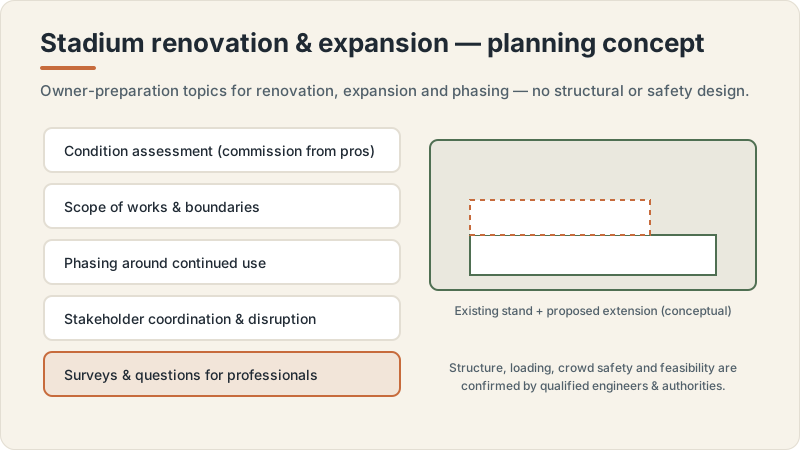
Stadium renovation and expansion concept
Conceptual editorial diagram — not a construction drawing, specification, to-scale plan or proof of a real project. It is not engineering, structural, fire/life-safety, crowd-safety or accessibility-compliance guidance. Capacities, dimensions, standards, requirements and costs vary by facility type, audience, site, use case and governing body, and are confirmed with qualified professionals, relevant authorities and governing bodies. Build Design Hub does not design, build, inspect, certify, recommend or match anyone.
What this guide helps you prepare
This guide helps you turn a rough intention such as add more seats or extend the concourse into a written brief that a professional team can respond to. A good expansion brief records what the venue is used for today, what you want it to do after the work, and the constraints you already know about, such as event dates you cannot move, neighbouring buildings, or parts of the structure you have questions about. It also captures the open questions honestly, so that when you sit down with an engineer, an architect or a crowd-safety specialist, the conversation starts from a shared understanding rather than from guesswork.
Preparation is not design. This guide does not tell you how large the expansion can be, how the existing structure will behave, how many people the venue can hold, or what any authority will require, because all of those depend on your specific site, use case, governing body and the judgement of qualified professionals. What it does is help you assemble the information, questions and stakeholder input that make those later expert conversations faster and better informed. The output you are aiming for is a clear brief and a prioritised question list, not a decision made in advance of professional review.
- Write a plain-language statement of what the expansion is meant to achieve and why now
- Record how the venue is used today and how you expect use to change after any expansion
- List known fixed constraints: event calendar, adjacent land or buildings, access routes, live operations
- Capture the open questions and uncertainties you want qualified professionals to examine
- Note which stakeholders, authorities and governing bodies you believe will need to be involved
- Distinguish what you know for certain from what you are assuming and will need confirmed
Interfacing with the existing structure and venue
An expansion sits alongside, on top of, or against something that is already standing, and the point where new meets old is where much of the risk and complexity lives. As you prepare your brief, it helps to describe the existing venue as fully as you can from records you already hold: original drawings, previous renovation documents, past reports, and any known limitations that have come up in operation. You are not assessing the structure yourself; you are gathering what exists so that qualified structural professionals can decide what investigation, survey or analysis they consider necessary before anything is designed.
Interface thinking also covers the parts of the venue that will keep operating and the services that thread through it. Concourses, entrances, exits, drainage, power, data and the pitch or playing surface all connect the old and new in ways that are easy to overlook in an early brief. Rather than deciding how any of these should be handled, record where you think they interact and flag them as questions. Whether the existing structure can accommodate an expansion, and how the new and existing parts should relate, are matters for qualified structural and design professionals to determine for your specific site and use case.
- Gather existing drawings, prior renovation records and any past reports the owner already holds
- Note where the expansion would physically meet existing stands, roofs, concourses or foundations
- List existing services (power, water, drainage, data) that cross the likely interface, as questions not answers
- Record known constraints on the playing surface, pitch access and existing entrances and exits
- Flag any parts of the structure the owner has questions or concerns about, for professional investigation
- Ask what surveys or investigations a qualified structural professional considers necessary before design begins
Thinking about staged delivery and keeping the venue running
Many stadium expansions are contemplated for a venue that must continue hosting events, which raises the question of whether the work could be organised in stages rather than all at once. Staged delivery thinking, at the brief stage, is not a construction sequence or a programme; it is simply an honest record of what the venue must keep doing during any work, which dates are immovable, and which areas cannot be closed at the same time. Capturing these operational realities early lets your project team and qualified professionals consider how, or whether, delivery can be phased around them.
It also helps to record the operational, access and safety questions that phasing raises without trying to resolve them yourself. If part of the venue stays open while another part is worked on, how spectators, staff, vehicles and deliveries move around the site becomes a live question for qualified crowd-safety and project professionals to examine, together with the relevant authorities and governing bodies. Your job in the brief is to describe the constraints and name the questions clearly. How phasing should actually be planned, whether the venue can safely operate during works, and what any authority will accept are decisions for qualified professionals, not for this guide.
- List the events, seasons or bookings that constrain when work could take place
- Record which areas of the venue cannot be closed, and when, from an operational standpoint
- Note how spectators, staff, vehicles and deliveries currently move, so professionals can assess phasing impacts
- Capture whether partial operation during works is a goal, a constraint, or something to confirm with professionals
- Flag temporary access, egress and operational questions for qualified crowd-safety and project professionals
- Ask which authorities or governing bodies would need to be consulted about operating during any works
Planning questions before speaking with professionals
Before you engage a professional team, it is worth working through a set of internal questions with your own stakeholders so that your brief is coherent and your priorities are clear. These are questions you answer among owners, operators, funders and users, not technical questions with fixed answers. Getting alignment early on what success looks like, what is fixed and what is flexible, and who has authority to decide, prevents an expansion brief from drifting or contradicting itself once professionals begin responding to it.
Use this stage to surface disagreements and unknowns while they are still cheap to resolve. If different stakeholders assume different scopes, capacities or timings, the brief will send mixed signals; naming those differences now is far better than discovering them after professional work has started. Remember that any figure, requirement or limit that comes up in these discussions is provisional and must be confirmed with qualified professionals, relevant authorities and governing bodies, because such things vary by location, facility type, use case, owner, site, authority, professional team and project scope.
- What is the expansion actually trying to achieve, and how will stakeholders judge whether it succeeded?
- What is genuinely fixed (dates, budget envelope, site boundaries) versus open to professional advice?
- Who owns the decision, who funds it, and who must be consulted before commitments are made?
- What do we already have documented about the existing venue, and what is missing?
- What assumptions are we making that we have written down as needing professional confirmation?
- Which stakeholders, users, authorities and governing bodies should see the brief before it is finalised?
Questions for qualified professionals
Once your brief and internal alignment are in place, it becomes the basis for structured conversations with qualified professionals: structural and design specialists, crowd-safety professionals, project managers, and the relevant authorities and governing bodies for your venue. The aim of these conversations is to have experts assess your specific situation and tell you what investigation, feasibility work and approvals they consider necessary. Bringing clear questions, honest constraints and your existing documentation makes those meetings far more productive than arriving with only a vague ambition to expand.
Frame your questions as requests for professional judgement about your site, not as attempts to extract a fixed answer this guide could never responsibly give. Ask what needs to be investigated, what could affect feasibility, and what approvals and consultations apply, and then let qualified professionals and authorities provide the answers for your case. Requirements, limits, capacities, costs and timelines all vary by location, facility type, use case, governing body, owner, site, authority, professional team and project scope, so treat every professional response as specific to your project and confirm it in writing.
- What investigations or surveys of the existing structure do you consider necessary before any design work?
- How would you approach the interface between the existing venue and any expansion, for our specific site?
- What would you need to know to assess whether staged delivery around live events is feasible here?
- Which crowd-safety, operational and egress matters must be examined by suitably qualified specialists?
- Which authorities, permits, approvals and governing-body requirements apply to a project like ours?
- What are the main things that could affect feasibility, scope or programme that we should plan around?
What this does not replace
This is an educational planning resource only. It is not a stadium construction manual and not structural, architectural, seating or stand engineering, crowd-safety, crowd-flow, evacuation, fire or life-safety, or accessibility-compliance advice, and it is not permit, zoning, inspection, certification, legal, tax, insurance or procurement advice. It does not design, build, engineer, specify, certify, inspect or approve anything, gives no capacities, dimensions, loads, revenue, ROI or costs, and offers no warranty interpretation or estimate. Requirements, standards, capacities and costs vary by location, facility type, use case, governing body, owner, site, authority, professional team and project scope, and are confirmed with qualified professionals, relevant authorities and governing bodies.
Build Design Hub does not design, build, engineer, inspect, certify, recommend, rank, verify, introduce, broker or match suppliers, contractors, consultants or professionals, and HELPERG LLC is publisher/operator only. Use this resource to prepare your own thinking and briefs, then have qualified professionals you engage directly review your project. Decisions about design, engineering, structure, crowd safety, fire and life safety, accessibility, compliance, capacity, procurement and cost must rest on those professionals, the relevant authorities and the governing bodies for your sport and location.
- Not a stadium construction manual and not structural, architectural or seating/stand engineering
- Not crowd-safety, crowd-flow, evacuation, fire/life-safety or accessibility-compliance advice
- Not permit/zoning, inspection, certification, warranty-interpretation, legal, tax, insurance or procurement advice
- Not a supplier, contractor, consultant or professional recommendation, ranking, directory or matching service
- Not an estimate and gives no capacity, dimension, revenue, ROI or cost figures — requirements and costs vary
- Qualified professional review is required before any stadium project decision
Stadium expansion brief preparation worksheet
- 1Record the plain-language objective of the expansion (capacity, footprint, function) in the owner's own words
- 2Gather and list every existing document you hold: original drawings, past renovation records, prior reports
- 3Note how the venue is used today and how use is expected to change after any expansion
- 4List the fixed event dates, seasons and bookings that constrain when work could happen
- 5Map where the expansion would physically meet the existing structure, and flag each point as a question
- 6Record existing services (power, water, drainage, data) that may cross the interface, without assuming solutions
- 7Capture operational constraints: which areas must stay open, and when, during any works
- 8Note current movement of spectators, staff, vehicles and deliveries for professionals to assess
- 9Write down every assumption (capacities, timings, requirements) as items needing professional confirmation
- 10List the stakeholders, users, authorities and governing bodies to consult, and who owns the final decision
- 11Prepare the question list for structural, design, crowd-safety and project professionals
- 12Record open uncertainties and known concerns about the existing venue for professional investigation
- 13Assemble a structure for comparing professional or supplier responses on a like-for-like basis
- 14Keep a single register that separates confirmed facts from assumptions awaiting professional review
Common mistakes to avoid
- Stating a target capacity, dimension or footprint in the brief as if it were fixed, before any qualified professional has assessed the site
- Assuming the existing structure can carry an expansion instead of asking what investigation professionals consider necessary
- Treating requirements, codes, approvals or governing-body rules as known, rather than confirming them with the relevant authorities
- Writing a programme or delivery sequence in the brief instead of recording operational constraints and leaving phasing to professionals
- Overlooking how the venue must keep operating during works, so crowd-safety and access questions surface too late
- Skipping stakeholder alignment, so the brief carries contradictory scopes, budgets or timings into professional conversations
- Assuming Build Design Hub or any single source will design, engineer, cost or approve the expansion rather than preparing to engage qualified professionals
- Putting provisional numbers for cost, timeline or revenue into the brief as facts instead of flagging them as assumptions to confirm
When to involve a professional
- Before making any decision about whether the existing structure can support an expansion, involve qualified structural professionals to determine what investigation is needed
- When the expansion would interface with existing stands, roofs, foundations or the playing surface, involve suitably qualified design and structural specialists
- When the venue must keep operating during works, involve qualified crowd-safety and project professionals to examine phasing, access and egress questions
- When permits, approvals, zoning or governing-body requirements come into scope, consult the relevant authorities and governing bodies directly
- As soon as any figure for capacity, cost, load or timeline is needed for a decision, seek confirmation from qualified professionals rather than assuming
- Whenever accessibility, fire, life-safety or crowd-flow matters arise, defer to suitably qualified professionals and the relevant authorities for your specific venue
Frequently asked questions
Questions readers ask about this topic
Does Build Design Hub design, engineer, cost or approve a stadium expansion?
No. Build Design Hub is an educational publisher operated by HELPERG LLC. It does not design, build, engineer, inspect, certify, cost or approve any project, and it does not recommend, rank, verify or match suppliers, contractors, consultants or professionals. It also gives no capacities, dimensions, loads, costs or requirements. This guide only helps you prepare a brief and questions so you can engage qualified professionals, relevant authorities and governing bodies yourself.
Can this guide tell me how much extra capacity my stadium can hold or what it will cost?
No. Capacity, dimensions, loads, costs, timelines and requirements all vary by location, facility type, use case, governing body, owner, site, authority, professional team and project scope, and they can only be established for your specific venue by qualified professionals and the relevant authorities. This guide deliberately contains no such figures and instead helps you frame those topics as questions to confirm with the right experts.
How detailed should my expansion brief be before I speak to professionals?
Detailed enough to be clear, but not so detailed that it makes engineering, safety or design decisions in advance. Aim to record your objective, how the venue is used, known constraints such as event dates and interfaces with the existing structure, your open questions, and the assumptions you need confirmed. Leave the technical answers, feasibility conclusions and approvals to qualified professionals and authorities responding to that brief.
Can I plan the construction stages and keep the venue open during works using this guide?
This guide can only help you record the operational constraints that phasing must work around, such as immovable dates and areas that cannot close. Whether an expansion can be delivered in stages, whether the venue can safely operate during works, and how movement and egress should be handled are matters for qualified crowd-safety and project professionals and the relevant authorities, not for this educational guide.
Keep reading