
Who this guide is for
- Stadium and sports-venue owners weighing a renovation or staged expansion who want to organise their thinking before engaging professionals.
- Clubs and resident tenants who need to understand how phased work might interact with their events, seasons and operations.
- Municipalities, councils and school or university facility teams responsible for a community or campus venue.
- Developers and project sponsors assembling an early brief and stakeholder map for a redevelopment concept.
- Project teams, programme managers and facility managers coordinating internal preparation and stakeholder questions.
- Boards, trustees and finance or governance stakeholders who need a structured list of decision points and open questions to review.
Planning diagram
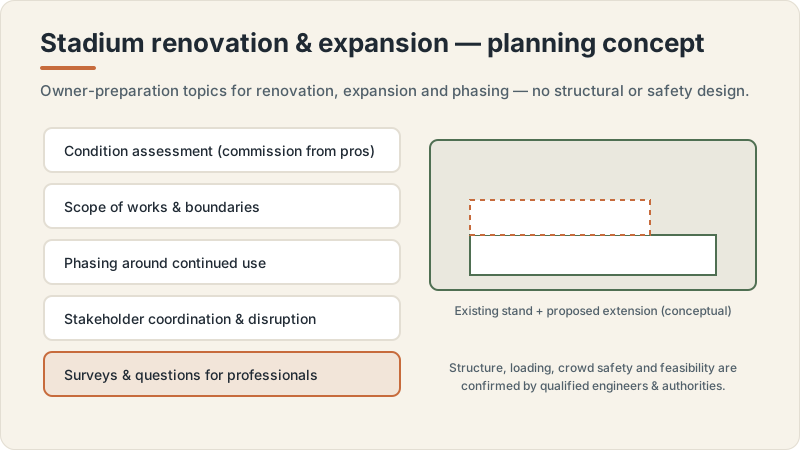
Stadium renovation and expansion concept
Conceptual editorial diagram — not a construction drawing, specification, to-scale plan or proof of a real project. It is not engineering, structural, fire/life-safety, crowd-safety or accessibility-compliance guidance. Capacities, dimensions, standards, requirements and costs vary by facility type, audience, site, use case and governing body, and are confirmed with qualified professionals, relevant authorities and governing bodies. Build Design Hub does not design, build, inspect, certify, recommend or match anyone.
What this guide helps you prepare
This guide helps you assemble the preparation materials that make later conversations with qualified professionals more productive: a written project brief, a stakeholder and tenant map, an inventory of how the venue is used today, a register of open questions, and a structured way to describe the phases and decision points you are considering. It is intended to help you think, not to tell you how to phase or sequence anything. The aim is that when you speak with architects, engineers, planners, safety specialists, governing bodies and relevant authorities, you arrive with organised context rather than assumptions, so their advice can be tailored to your actual situation.
Because a stadium often continues operating while renovation or expansion is discussed, much of the preparation centres on understanding potential disruption, dependencies between stages, and the events that would trigger a review or a go/no-go decision. This guide frames those as questions and considerations to record, never as instructions or standards. Anything touching capacity, dimensions, loads, gradients, lighting levels, safety, accessibility, permits, codes, timelines or cost is out of scope here and must be confirmed with qualified professionals, relevant authorities and governing bodies for your specific location, facility type, use case, owner, site and project scope.
- Write a plain-language project brief describing the venue, its current uses, and what you are exploring — without stating any figures as fixed.
- Assemble a stakeholder and tenant map: who uses the venue, who governs it, and who would be affected during any work.
- Record how the venue operates today across event days, non-event days and off-season, as context for later professional review.
- Capture the questions and uncertainties you want qualified professionals, authorities and governing bodies to confirm.
- List the internal decisions your board, finance or governance stakeholders will need to make and the information they will want.
- Note where you are assuming something — a capacity, a timeline, a requirement — so it can be flagged as an item to verify rather than a fact.
Framing project phases and decision points
Thinking about a stadium project in phases usually starts by describing what the venue does now and what you are hoping to explore, then identifying the natural decision points where you would pause, review information and choose whether and how to continue. A decision point is simply a moment where you expect to need confirmed information — from a professional, an authority or a governing body — before committing to the next stage. Recording these points in advance helps you see which decisions depend on others, and which questions must be answered before a later choice becomes meaningful. This is a thinking and organising exercise, not a method for how phasing should technically be carried out.
It also helps to separate the concept you are exploring from the constraints you do not yet understand. Owners often find it useful to write down the dependencies they suspect exist — for example, how continued event use, tenant commitments or seasonal calendars might interact with any staged work — and to treat every one of those as a question for qualified professionals rather than a settled parameter. Framing phases as a series of decision points, each with its own open questions and its own review of confirmed information, keeps the preparation honest about what is known versus what must still be verified with the relevant professional team and authorities.
- What are the natural decision points at which you would want to pause and review confirmed information before continuing?
- Which decisions appear to depend on other decisions, and what information links them?
- What would you need a qualified professional, authority or governing body to confirm before a given stage could be considered?
- What assumptions about use, calendar or scope are you currently making that should be treated as questions?
- Who needs to be part of each decision point — internally and among tenants, stakeholders and authorities?
- What information would signal that a concept should be revisited, narrowed or paused rather than advanced?
Disruption planning as owner preparation
For an operating venue, one of the most useful preparation tasks is thinking through disruption: how everyday and event-day operations, tenants, staff, the public and the surrounding area could be affected while work is considered, and what questions that raises. This is preparation for conversations, not an operational or safety plan. The goal is to document how the venue functions across different day types, which functions are most sensitive to interruption, and where you would need qualified professionals and relevant authorities to advise on managing any impact. Recording these considerations early gives your professional team and stakeholders a clearer picture of the operational context they are advising within.
Disruption preparation also connects directly to phasing thinking, because the way a project might be staged often reflects the need to keep parts of a venue usable, honour existing commitments, or work around a calendar of events and tenants. None of that should be assumed or designed here; instead, capture the operational realities and constraints as questions to raise. Matters such as crowd movement, safety, accessibility, temporary arrangements and event readiness are specialist areas that belong entirely with qualified professionals, safety specialists, relevant authorities and governing bodies, and this guide only helps you gather the context and questions to bring to them.
- Which venue functions are most sensitive to interruption, and who relies on them across event and non-event days?
- How do tenant commitments, seasons and event calendars shape when disruption would or would not be acceptable?
- What questions about temporary operations, access and communications would you want to raise with qualified professionals and authorities?
- Which stakeholders — tenants, neighbours, staff, the public, authorities — need to be part of disruption conversations, and when?
- What operational information should you document now so professionals can advise within your real context?
- Where might crowd, safety, accessibility or event-readiness questions arise that must be referred to specialists rather than assumed?
Planning questions before speaking with professionals
Before you engage qualified professionals, it helps to have answered the questions that are yours to answer — the ones about your objectives, your constraints, your stakeholders and your appetite for disruption. Clarifying these internally means the professional conversation can focus on their expertise rather than on gathering basic context. Write down what success would look like for this project, what you are certain of, what you are unsure of, and what you are explicitly leaving to professionals and authorities to determine. The clearer this internal picture, the more targeted the later advice can be.
It also helps to be honest, in your preparation notes, about where you have been assuming things. Owners frequently carry unstated assumptions about capacity, timelines, requirements or what a phase involves; the value of this stage is turning each assumption into an explicit question. None of these questions should be resolved by guessing or by treating figures as fixed — they exist precisely so that qualified professionals, relevant authorities and governing bodies can confirm what actually applies to your location, facility type, use case, site and project scope.
- What are we actually trying to achieve, and how would we describe success in plain language?
- What do we know for certain, and what are we currently assuming that should be confirmed?
- Which stakeholders, tenants, authorities and governing bodies must be involved, and at what point?
- What level of disruption could our operations and commitments realistically tolerate, expressed as a question to test with professionals?
- What internal decisions, approvals and governance steps sit behind this project?
- Which topics are we explicitly leaving to qualified professionals rather than deciding ourselves?
Questions for qualified professionals
When you do sit down with qualified professionals — which may include architects, engineers, planners, safety specialists, accessibility specialists, cost consultants, legal advisers and others as appropriate — the strongest position is to bring organised context and a clear list of what you need confirmed. This guide does not tell you what the answers are; it helps you prepare the questions. Treat every question about capacity, dimensions, loads, safety, accessibility, permits, codes, timelines, standards and cost as something to confirm with the appropriate professional, authority or governing body for your specific circumstances, because these vary and cannot be assumed.
Use the professional conversation to test your phasing thinking and disruption preparation against expert judgement, and to understand which specialists, authorities and governing bodies need to be involved and in what order. Ask them to identify the questions you have not thought to ask, the constraints you may have missed, and the points at which their advice would change the shape of your phases or decision points. The purpose of preparation is to make that exchange efficient and grounded in your real situation — not to arrive with answers already assumed.
- What requirements, constraints and approvals apply to a project like this for our location, facility type and use case?
- Which specialists, authorities and governing bodies should be involved, and in what sequence?
- How would you assess the phasing and decision-point thinking we have prepared, and what have we missed?
- What safety, accessibility, crowd, structural and operational considerations must be handled by specialists rather than assumed by us?
- What information should we gather or document before you can advise properly?
- What questions should we be asking that we have not thought to ask?
What this does not replace
This is an educational planning resource only. It is not a stadium construction manual and not structural, architectural, seating or stand engineering, crowd-safety, crowd-flow, evacuation, fire or life-safety, or accessibility-compliance advice, and it is not permit, zoning, inspection, certification, legal, tax, insurance or procurement advice. It does not design, build, engineer, specify, certify, inspect or approve anything, gives no capacities, dimensions, loads, revenue, ROI or costs, and offers no warranty interpretation or estimate. Requirements, standards, capacities and costs vary by location, facility type, use case, governing body, owner, site, authority, professional team and project scope, and are confirmed with qualified professionals, relevant authorities and governing bodies.
Build Design Hub does not design, build, engineer, inspect, certify, recommend, rank, verify, introduce, broker or match suppliers, contractors, consultants or professionals, and HELPERG LLC is publisher/operator only. Use this resource to prepare your own thinking and briefs, then have qualified professionals you engage directly review your project. Decisions about design, engineering, structure, crowd safety, fire and life safety, accessibility, compliance, capacity, procurement and cost must rest on those professionals, the relevant authorities and the governing bodies for your sport and location.
- Not a stadium construction manual and not structural, architectural or seating/stand engineering
- Not crowd-safety, crowd-flow, evacuation, fire/life-safety or accessibility-compliance advice
- Not permit/zoning, inspection, certification, warranty-interpretation, legal, tax, insurance or procurement advice
- Not a supplier, contractor, consultant or professional recommendation, ranking, directory or matching service
- Not an estimate and gives no capacity, dimension, revenue, ROI or cost figures — requirements and costs vary
- Qualified professional review is required before any stadium project decision
Stadium phasing preparation register
- 1Record a plain-language project brief describing the venue, its current uses and what you are exploring.
- 2Map every stakeholder, tenant, governing body and authority that uses, governs or would be affected by the venue.
- 3Document how the venue operates across event days, non-event days and off-season as context for professionals.
- 4List the decision points where you would pause to review confirmed information before continuing.
- 5Note the dependencies you suspect exist between decisions, phrased as questions rather than conclusions.
- 6Capture each assumption you are making about use, calendar, capacity or scope so it can be flagged for verification.
- 7Register the disruption-sensitive functions and who relies on them, without proposing operational solutions.
- 8Record the tenant commitments, seasons and event calendars that shape when disruption would matter.
- 9Assemble the list of questions you need qualified professionals, authorities and governing bodies to confirm.
- 10Note which internal approvals, governance steps and stakeholder sign-offs sit behind the project.
- 11Write down the topics you are explicitly leaving to specialists — safety, accessibility, structural, crowd and event-readiness.
- 12Prepare neutral scope-preparation notes so future professional conversations stay consistent and comparable.
- 13Keep a running log of open questions and uncertainties, updated as professionals and authorities respond.
- 14Identify the information a board or finance stakeholder would want before any decision point.
Common mistakes to avoid
- Treating a capacity, dimension, timeline or requirement as fixed instead of a question to confirm with qualified professionals and governing bodies.
- Assuming what a phase or decision point involves before any professional review has taken place.
- Skipping professional and authority input on safety, accessibility, structural, crowd or event-readiness matters that are outside owner scope.
- Planning around an event calendar or tenant commitments without documenting them as constraints to raise with the professional team.
- Confusing this preparation exercise with a phasing method, construction sequence or operational plan.
- Overlooking stakeholders, tenants or authorities who should be part of decision points from the start.
- Carrying unstated assumptions into professional conversations rather than turning each one into an explicit question.
- Assuming Build Design Hub or any guide can design, engineer, approve, cost or recommend suppliers — it cannot, and none of this replaces professional advice.
When to involve a professional
- When any question touches capacity, dimensions, loads, structure, gradients, lighting or standards — confirm with qualified engineers and specialists.
- When crowd movement, safety, evacuation or event-readiness is involved — involve qualified safety specialists, authorities and governing bodies.
- When accessibility for the public, staff or tenants is in question — involve appropriate accessibility specialists and relevant authorities.
- When permits, codes, zoning, approvals or governing-body requirements may apply — confirm with the relevant authorities and qualified planners.
- When disruption to operating tenants, the public or the surrounding area needs managing — involve qualified professionals and authorities early.
- When legal, tax, insurance, procurement or contractual questions arise — consult the appropriate qualified advisers rather than assuming.
Frequently asked questions
Questions readers ask about this topic
Does Build Design Hub design, build, engineer, inspect or certify stadium work, or recommend suppliers and contractors?
No. Build Design Hub is an educational resource only. It does not design, build, engineer, inspect, certify, recommend, rank, verify, introduce, broker or match any supplier, contractor, consultant or professional, and it provides no capacities, dimensions, costs, timelines or requirements. This guide only helps you organise your thinking and prepare questions to bring to qualified professionals, relevant authorities and governing bodies, who are the ones to advise on your specific project.
Will this guide tell me how to phase or sequence a stadium project?
No. This guide is about preparing to think and to have informed conversations — framing possible project phases, decision points and disruption considerations as questions. It does not provide phasing methods, construction sequencing, or any engineering, design, safety or operational instructions. How a project should actually be phased is a matter for qualified professionals working with your specific site, use case and constraints.
Can I use the figures or timelines discussed with me as fixed once I have a professional's input?
Treat anything a professional confirms as advice specific to your circumstances, and continue to defer to the relevant authorities and governing bodies. This guide states no figures, timelines, capacities, costs or requirements as facts, because they vary by location, facility type, use case, governing body, owner, site, authority, professional team and project scope. Always confirm what applies with qualified professionals.
What should I have ready before contacting professionals?
A written project brief, a stakeholder and tenant map, a record of how the venue operates today, your list of decision points and dependencies, your disruption considerations, and a register of open questions and assumptions to verify. Bringing organised context helps qualified professionals tailor their advice to your real situation rather than gathering basics.
Keep reading