
Who this guide is for
- Owners and owner representatives considering a new or expanded stadium or spectator venue
- Sports clubs and their boards weighing a facility project and needing a shared reference document
- Municipalities, public bodies and school or university estates teams scoping a community or teaching venue
- Developers and investors preparing early-stage documentation before commissioning professional advice
- Project managers and internal project teams assembling a brief to hand to a design team
- Facility managers and operations leads whose day-to-day knowledge should inform intended-use and lifecycle planning
Planning diagram
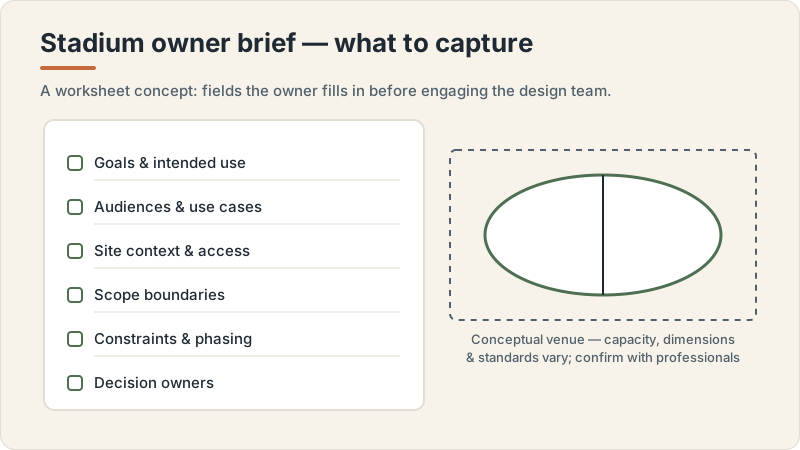
Stadium owner brief worksheet concept
Conceptual editorial diagram — not a construction drawing, specification, to-scale plan or proof of a real project. It is not engineering, structural, fire/life-safety, crowd-safety or accessibility-compliance guidance. Capacities, dimensions, standards, requirements and costs vary by facility type, audience, site, use case and governing body, and are confirmed with qualified professionals, relevant authorities and governing bodies. Build Design Hub does not design, build, inspect, certify, recommend or match anyone.
What this guide helps you prepare
This guide helps you assemble a clear, written owner's project brief before you engage a design team or other professionals. It walks through the elements that most briefs need to address: the goals behind the project, who the venue is intended to serve, the context of the site you are considering, the boundaries of what is and is not in scope, the constraints you already know about, and who inside your organisation owns each decision. The aim is a single reference document that reduces ambiguity and gives every professional you later speak with the same starting picture.
It is a preparation aid, not a design, engineering or construction document. It will not tell you how large a venue should be, how many people it should hold, what it should cost, how long it should take, or which codes and standards apply, because those are matters for qualified professionals, relevant authorities and governing bodies to determine for your specific situation. Instead it helps you record what you know, phrase what you do not know as questions, and organise both so your early conversations are focused and comparable.
- Record the project's purpose in your own words before anyone else frames it for you
- Capture intended uses, audiences and the operating pattern you envisage, marked as assumptions to test
- Note the site context and surrounding conditions you are aware of, without drawing engineering conclusions
- Draw explicit scope boundaries so it is clear what the project does and does not include
- List known constraints and the open questions each one raises for professionals and authorities
- Identify who owns each type of decision and how sign-off will work inside your organisation
Building the goals, intended-use and audience picture
Start the brief by writing down why the project exists and what success would look like in plain language, separate from any solution. Owners often jump to a building; a stronger brief first states the outcomes the venue is meant to support, such as the activities it should host, the experiences different visitors should have, and the role the venue should play for the club, community or institution behind it. Distinguishing goals from proposed solutions keeps the brief useful when professionals later suggest options you had not considered.
Then describe the intended uses and the audiences the venue is meant to serve, treating every figure or assumption as something to confirm rather than fix. Who are the different groups that would use or visit the venue, and what does each need from it? What events or activities do you imagine, and how frequently? Rather than asserting a capacity, an event calendar or a revenue expectation as fact, record these as your current thinking and flag them for qualified professionals and governing bodies to validate against your specific use case and site. This keeps the brief honest and prevents early guesses from hardening into unexamined requirements.
- What outcomes should this project achieve for the owner, users and wider community, stated as goals not solutions?
- Which distinct audiences and user groups will the venue serve, and what does each group need from it?
- What primary and secondary uses do you envisage, and how often would each occur (as assumptions to confirm)?
- Which of your goals are essential versus desirable, and how would you know each has been met?
- What existing information (participation data, current facility use, catchment context) can you gather to inform, not assert, these assumptions?
- Which use, audience or capacity assumptions should be explicitly flagged for professionals and governing bodies to validate?
Framing site context, scope boundaries and constraints
A useful brief describes the site and its context as you currently understand it, while being careful not to reach engineering, planning or compliance conclusions that only qualified professionals and authorities can make. Record what you know about the location, access, neighbouring uses, existing structures, and any prior studies or documents you hold. Note observations rather than verdicts: for example, that a site slopes or that access appears limited, framed as something to raise with professionals, rather than stating what can or cannot be built there. Whether a site is suitable, and what would be involved, is a professional and authority determination.
Equally important is drawing the boundaries of scope. A stadium project can quietly expand to include car parking, landscaping, adjacent facilities, upgrades to existing assets, temporary provisions and operational systems. Writing down what is in scope, what is explicitly out of scope, and what is undecided prevents costly misunderstanding later. Alongside scope, capture the constraints you already know about, such as site ownership status, phasing needs, non-negotiable dates, or existing commitments, and turn each into an open question for the people qualified to assess it. Do not record dimensions, loads, gradients, code or capacity figures as fixed; note the topic and mark it to confirm with qualified professionals and the relevant authorities.
- What do you already know about the site's location, access, neighbours and existing conditions, recorded as observations to verify?
- What documents, surveys or prior studies do you hold, and which gaps would professionals and authorities need to fill?
- What is clearly in scope, clearly out of scope, and still undecided for this project?
- Which adjacent elements (parking, landscaping, existing facilities, operations, temporary provisions) could expand scope if not bounded now?
- What constraints (ownership, phasing, dates, existing commitments) do you know of, and what question does each raise for a professional?
- Which site or scope topics involve requirements, codes or capacities that you should confirm with qualified professionals rather than assume?
Planning questions before speaking with professionals
Before your first meeting with a design team or other advisers, work through the questions you can answer internally so the professionals' time is spent on their expertise rather than on gathering basics you could have supplied. This means reviewing your own goals for internal agreement, confirming who has authority to decide what, and assembling the documents and context already in your possession. Gaps you cannot close internally become the agenda for those early conversations, clearly labelled as open questions rather than presented as settled facts.
It also helps to decide, in advance, how you will capture and compare what you learn. When several professionals or firms describe options, a consistent set of questions and a common structure for recording their answers makes comparison far easier and reduces the risk of comparing unlike things. This is preparation for informed conversations and comparison, not a substitute for professional advice; the answers themselves must come from qualified professionals, relevant authorities and governing bodies.
- Have the owner and key stakeholders agreed on the goals and priorities the brief expresses?
- Who inside your organisation owns each decision, and who must approve the brief before it is shared?
- What information can you gather or organise internally so professionals are not asked to supply the obvious?
- Which questions cannot be answered internally and should therefore lead your first professional conversations?
- How will you record and compare the advice and proposals you receive in a consistent structure?
- What assumptions in the brief must be clearly labelled as unconfirmed when you hand it over?
Questions for qualified professionals
When you engage architects, engineers, planners and other advisers, the brief becomes the basis for structured questions. Use it to ask what requirements, standards and approvals apply to your specific project, what the site context means in practice, what your intended uses imply, and what feasibility work would be needed to test your assumptions. Ask professionals to identify where your brief makes claims that need validation and where it is silent on things that matter. The goal is to convert your written assumptions into professionally assessed information.
Because requirements vary by location, facility type, use case, governing body, owner, site, authority, professional team and project scope, treat every answer as specific to your project rather than a general rule to reuse. Ask who is responsible for confirming code, capacity, safety and accessibility matters, and how those confirmations will be documented, so that responsibility is clear and nothing is assumed. Build Design Hub does not provide these answers, design, engineer, inspect or certify anything; the questions below are prompts to raise with the qualified professionals and authorities you engage.
- Which requirements, standards, codes and approvals apply to a project of this type on this site, and who confirms them?
- What does our intended use and audience picture imply, and which of our assumptions need feasibility or specialist study?
- What does the site context mean for the project, and what surveys or investigations would you recommend commissioning?
- Where does our brief overstate certainty, contain gaps, or make claims that need professional validation?
- Who on the professional team is responsible for capacity, safety, accessibility and compliance matters, and how are those recorded?
- What early-stage work would you propose to test whether our goals and scope are realistic for this site?
What this does not replace
This is an educational planning resource only. It is not a stadium construction manual and not structural, architectural, seating or stand engineering, crowd-safety, crowd-flow, evacuation, fire or life-safety, or accessibility-compliance advice, and it is not permit, zoning, inspection, certification, legal, tax, insurance or procurement advice. It does not design, build, engineer, specify, certify, inspect or approve anything, gives no capacities, dimensions, loads, revenue, ROI or costs, and offers no warranty interpretation or estimate. Requirements, standards, capacities and costs vary by location, facility type, use case, governing body, owner, site, authority, professional team and project scope, and are confirmed with qualified professionals, relevant authorities and governing bodies.
Build Design Hub does not design, build, engineer, inspect, certify, recommend, rank, verify, introduce, broker or match suppliers, contractors, consultants or professionals, and HELPERG LLC is publisher/operator only. Use this resource to prepare your own thinking and briefs, then have qualified professionals you engage directly review your project. Decisions about design, engineering, structure, crowd safety, fire and life safety, accessibility, compliance, capacity, procurement and cost must rest on those professionals, the relevant authorities and the governing bodies for your sport and location.
- Not a stadium construction manual and not structural, architectural or seating/stand engineering
- Not crowd-safety, crowd-flow, evacuation, fire/life-safety or accessibility-compliance advice
- Not permit/zoning, inspection, certification, warranty-interpretation, legal, tax, insurance or procurement advice
- Not a supplier, contractor, consultant or professional recommendation, ranking, directory or matching service
- Not an estimate and gives no capacity, dimension, revenue, ROI or cost figures — requirements and costs vary
- Qualified professional review is required before any stadium project decision
Owner's project brief preparation worksheet
- 1Write a one-paragraph statement of why the project exists, in outcome terms rather than as a proposed building
- 2List the goals in priority order and mark each as essential or desirable
- 3Record the distinct audiences and user groups the venue is intended to serve
- 4Describe the intended primary and secondary uses, marking every frequency or capacity figure as an unconfirmed assumption
- 5Gather the site information, documents, surveys and prior studies you already hold in one place
- 6Note site context observations (access, neighbours, existing conditions) as items to verify, not conclusions
- 7Write an in-scope, out-of-scope and undecided list to bound the project
- 8List known constraints (ownership, phasing, dates, commitments) and the open question each raises
- 9Create a decision-owner register naming who decides and who approves each type of decision
- 10Flag every assumption that requires validation by qualified professionals, authorities or governing bodies
- 11Draft the questions you can answer internally versus those you must take to professionals
- 12Set up a consistent structure for recording and comparing the advice and proposals you receive
- 13Record the internal sign-off status of the brief before it is shared with any professional
- 14Note which requirement, code, capacity or standard topics you will explicitly confirm with professionals rather than assume
Common mistakes to avoid
- Stating a capacity, event calendar or revenue figure as fixed fact instead of an assumption to confirm with professionals and governing bodies
- Assuming code, safety, accessibility or capacity requirements apply without confirming them for your specific site and use case
- Describing a solution (the building) before articulating the goals and outcomes the project should achieve
- Leaving scope boundaries unwritten, so parking, landscaping, operations or adjacent works quietly expand the project
- Drawing engineering or planning conclusions about site suitability that only qualified professionals and authorities can make
- Failing to name who owns each decision, leaving approvals and responsibilities ambiguous when the design team engages
- Treating this guide, or any general information, as a substitute for professional design, engineering, planning or compliance advice
- Handing professionals a brief that mixes confirmed facts with unlabelled assumptions, making early conversations harder to trust
When to involve a professional
- Before treating any capacity, dimension, load, gradient, code or standard as settled, confirm it with the relevant qualified professionals and authorities
- When you need to know whether a site is suitable or what a project would involve, involve architects, engineers and planners rather than concluding from the brief
- When intended uses, audiences or event patterns need to be tested for feasibility, engage professionals to assess them against your site
- When safety, accessibility, fire and life-safety, or crowd-related matters arise, defer entirely to qualified specialists and the responsible authorities
- Before committing to scope, phasing or timelines, have professionals review whether your assumptions are realistic for the project
- When permits, approvals, standards or governing-body requirements are in question, confirm them with the relevant authorities and qualified advisers rather than assuming
Frequently asked questions
Questions readers ask about this topic
Does Build Design Hub design, build, engineer, inspect or certify stadiums, or recommend suppliers and contractors?
No. Build Design Hub is an educational publisher operated by HELPERG LLC. It does not design, build, engineer, inspect, certify, or plan stadiums, and it does not recommend, rank, verify, introduce, broker or match suppliers, contractors, consultants or professionals. It also does not provide capacities, dimensions, costs, timelines, codes or requirements. This guide only helps you prepare a written brief; the substantive work and answers must come from qualified professionals, relevant authorities and governing bodies you engage directly.
Should the brief include a target capacity, budget or completion date?
You can record your current thinking, but you should clearly label any capacity, budget or date as an unconfirmed assumption rather than a fact. Requirements and what is achievable vary by location, facility type, use case, governing body, owner, site, authority, professional team and project scope. Present these figures as questions to validate with qualified professionals and authorities, not as fixed targets, so early guesses do not harden into unexamined requirements.
How detailed should the project brief be before I engage a design team?
Detailed enough to communicate your goals, intended uses, audiences, site context, scope boundaries, known constraints and decision owners, while being honest about what is still unknown. The aim is a clear shared starting point, not a finished specification. Gaps you cannot close internally become the agenda for your early professional conversations, and professionals can help you refine the brief from there.
Can this guide tell me whether my chosen site is suitable for a stadium?
No. Whether a site is suitable, and what a project on it would involve, is a determination for qualified professionals such as architects, engineers and planners, together with the relevant authorities. This guide helps you record what you observe and organise your questions, but it does not and cannot assess site suitability, feasibility or compliance for your project.
Keep reading