
Who this guide is for
- Prospective court owners preparing to approach drainage contractors
- Operators comparing several contractors for the drainage element of a build
- Project managers assembling a question set for drainage conversations
- Owners coordinating drainage with separate base and surface contractors
- Anyone unsure what to ask beyond a headline figure
- Clubs adding a court who want a consistent contractor question set
Planning diagram
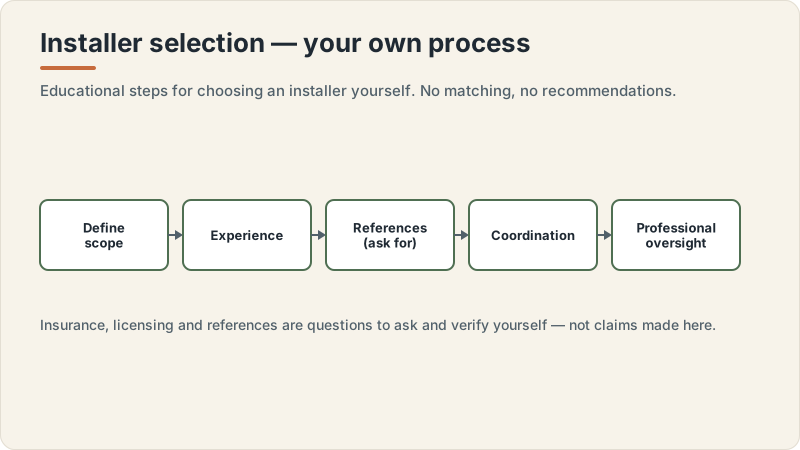
Installer selection process concept
Conceptual editorial diagram — not a construction drawing, specification or to-scale plan. Official court dimensions, standards, drainage, structure and lighting requirements vary by sport, site and location and are confirmed with the relevant federation, supplier and qualified professionals.
What this research helps you prepare
This resource helps you build a structured set of questions to take into conversations with drainage contractors for a sports court project. It is organised around scope clarity, relevant experience, coordination with the base and surface trades, site-specific review, references, insurance and licensing as questions, and handoff documentation, so you cover ground that is easy to skip in early talks.
Everything here stays at a planning and question level. The questions are designed to help you listen for clarity, consistency and a deliberate approach, not to provide drainage engineering answers or to tell you what any contractor should say. Requirements, costs and timelines vary by location, site, scope, access, soil, surface and contractor, so the goal is informed conversation rather than fixed expectations.
Use it to prepare before meetings, to compare contractors on a like-for-like basis, and to record where answers differ so you can follow up with qualified professionals where appropriate.
- A question set covering scope, experience, coordination, references and documentation
- Prompts that help you compare drainage contractors consistently
- A way to notice where answers are vague, assumed or differ
- Framing that keeps cost and timing as drivers to confirm, not figures
Scope clarity and relevant experience
Begin by understanding exactly what a contractor proposes to deliver and where their drainage scope starts and ends. Court drainage interacts with earthworks, the base build-up and the surface above, and contractors divide these responsibilities differently, so ask how they define their part rather than assuming a standard package. Where their scope stops is often where gaps appear later.
Ask about relevant experience as open questions, not as a request for technical specifications or a claim you can verify here. You are listening for whether a contractor has worked on comparable court or sports-surface drainage, how they describe past situations in general terms, and whether they reference confirming requirements with qualified professionals rather than stating fixed certainties.
- What exactly is included in your drainage scope, and what is excluded?
- Where does your drainage work end and the base or surface contractor's begin?
- What experience do you have with drainage for sports courts or similar surfaces?
- How do you approach a site whose soil or conditions are uncertain?
- How do you confirm what the design or specification requires before starting?
- Which decisions do you expect to be made by a qualified designer or engineer?
Coordination with base and surface, and site-specific review
Drainage rarely stands alone. It has to work with the groundwork beneath it and the base and surface above, and the order in which trades work and hand over matters a great deal. Ask how a contractor coordinates with the base and surface trades, what they need in place before they start, and what they leave ready for whoever follows. These are coordination questions, not requests for engineering or construction instructions.
Site conditions drive much of this, so ask how a contractor reviews your specific site rather than relying on a generic approach. Listen for whether they visit, ask about soil, levels, access and existing services, and whether they flag what a qualified professional should confirm. The interface between drainage, base and surface is a common source of disputes, so understanding how a contractor manages it is more useful than any single figure.
- How do you coordinate with the base and surface contractors on sequencing?
- What needs to be in place before you can carry out your work?
- What do you leave ready for the trades that follow you?
- How do you review my specific site, and would you visit before quoting?
- How do you handle uncertainty about soil, levels, access or existing services?
- How are scope changes at the drainage, base and surface interfaces identified and agreed?
What to ask before comparing options
Before you line contractors up against one another, make sure you are comparing like with like. Ask each contractor the same core questions about scope, exclusions, coordination, references, insurance, licensing and documentation, so differences reflect their approach rather than gaps in what you asked. Record answers in a consistent format so you can see where one contractor includes something another leaves out.
Ask about cost and timing as drivers to confirm, not as numbers to lock in. Both vary widely with site conditions, soil, access, scope, weather and how the work coordinates with other trades, so the useful questions are what shapes the schedule and price and what could change them. Put scope, inclusions and exclusions in writing before any comparison feels final.
- Have you asked every contractor the same core questions for a fair comparison?
- Have you clarified what each one includes and explicitly excludes?
- Have you asked what drives the schedule and price, and what could change them?
- Have you asked how each coordinates with the base and surface trades?
- Have you asked each for references you can follow up yourself?
- Have you recorded answers consistently so differences are easy to see?
References, insurance, licensing and handoff documentation
Asking for references, insurance and licensing is a normal part of preparing to engage any contractor, and it belongs in your question set rather than in assumptions. Ask a contractor to provide references you can follow up yourself; this resource cannot supply or vouch for any, and you should speak to those references directly. Treat insurance and licensing as questions to ask and then verify independently with the relevant insurer and authority, not as claims to take at face value.
Handoff documentation is easy to overlook and valuable later. Ask what record a contractor leaves of what was installed, how it was set out, and what the base and surface trades or a maintenance provider would need to know. Clear documentation supports coordination during the build and maintenance afterwards, and a contractor confident in their work usually welcomes the request.
- Can you provide references for comparable work that I can contact myself?
- What insurance do you carry, and how can I verify it independently?
- What licensing or registration applies here, and how do I confirm it with the authority?
- What documentation do you provide of what was installed and how it was set out?
- What would the base, surface or maintenance trades need from your handoff?
- How do you record decisions and changes during the work?
Questions for qualified professionals
Some questions sit better with independent professionals than with a contractor, because they involve judgement, verification or specialist knowledge. Before and during contractor conversations, line up the people who can give you neutral input on drainage design, soil and site conditions, the base and surface, and any regulatory matters, so you are not relying on a single source.
Use the prompts below to plan who to involve and what to ask them. Requirements vary by location and project and must be confirmed with the relevant authority and qualified professionals; this resource cannot state them as fact.
- Designer or drainage engineer: is the proposed drainage approach suitable for my site and intended use?
- Geotechnical or soil specialist: do soil and ground conditions support the planned approach?
- Base and surface specialists: how should drainage be coordinated with the layers above?
- Local authority: what permit, drainage, environmental or discharge requirements apply here?
- Independent reviewer: do the contractor's scope, coordination and documentation hold up under scrutiny?
- Maintenance provider: what information will be needed to keep the drainage performing over time?
What this does not replace
This is an educational project-preparation resource, not an estimate, not a recommendation, not contractor matching, and not a substitute for qualified professional review. It does not provide drainage engineering, design, construction, legal, tax, customs or inspection advice, and it does not tell you which contractor to choose or how to carry out any drainage work.
Requirements and costs vary by location, site, scope, contractor, access, soil, drainage, surface and local conditions, and official requirements must be confirmed with the relevant authorities and qualified professionals. Consult qualified designers, drainage and geotechnical engineers, contractors, the base and surface trades, local authorities and legal or professional advisors where appropriate.
Build Design Hub does not provide contractor matching or professional recommendations, and does not verify, rank, rate or endorse any contractor. HELPERG LLC is the publisher and operator only. Verification and selection of any contractor remain your responsibility.
Drainage contractor questions checklist
- 1Have you asked what is included in the contractor's drainage scope and what is excluded?
- 2Have you asked where their work ends and the base or surface contractor's begins?
- 3Have you asked about relevant experience with court or sports-surface drainage?
- 4Have you asked how they coordinate sequencing with the base and surface trades?
- 5Have you asked how they review your specific site, including a visit?
- 6Have you asked what drives the schedule and price and what could change them?
- 7Have you asked for references you can follow up yourself?
- 8Have you asked about insurance and licensing, and planned to verify both independently?
- 9Have you asked what handoff documentation they provide of what was installed?
- 10Have you asked the same core questions of every contractor for a fair comparison?
- 11Have you planned which questions to take to independent qualified professionals?
- 12Have you planned to verify what you are told independently?
Common mistakes to avoid
- Focusing on a headline figure and skipping questions about scope and exclusions
- Assuming every drainage contractor includes the same work and ends scope in the same place
- Treating coordination with the base and surface as someone else's problem
- Accepting reassurance about site conditions without asking how the site was reviewed
- Taking insurance or licensing as stated rather than verifying both independently
- Asking for references but not actually contacting them yourself
- Overlooking handoff documentation until coordination or maintenance issues appear
- Comparing contractors who were each asked different questions
When to involve a professional
- Drainage design and installation should be carried out and confirmed by qualified professionals in the relevant disciplines.
- A qualified drainage engineer or designer can review whether a contractor's proposed approach suits your site and intended use.
- Geotechnical or soil input may be needed where ground conditions are uncertain and should come from a qualified specialist.
- Coordination between drainage, base and surface should be reviewed so interfaces and handovers are sound.
- Permit, environmental, discharge and other requirements vary by location and must be confirmed with the relevant authority and qualified professionals.
- Build Design Hub does not match, rank, verify or endorse contractors; selection and verification remain your responsibility.
Frequently asked questions
Questions readers ask about this topic
What should I ask a drainage contractor first?
Start with scope: what is included in their drainage work, what is excluded, and where their responsibility ends relative to the base and surface trades. Drainage interacts closely with the layers above and below it, so understanding the boundaries of their scope matters more than any headline figure.
How should I handle questions about cost and timing?
Ask what drives the schedule and price and what could change them, rather than expecting fixed numbers. Both vary by location, site, soil, access, scope, weather and coordination with other trades, so focus on the drivers and confirm specifics in writing with the contractor and qualified professionals.
How should I treat references, insurance and licensing?
Treat them as questions to ask and then verify yourself. Ask the contractor for references you can contact directly, and confirm insurance and licensing independently with the relevant insurer and authority. This resource cannot supply, vouch for or verify any of these on your behalf.
Does this resource recommend or match drainage contractors?
No. It provides questions to frame your own conversations. Build Design Hub does not match, rank, rate, verify or endorse contractors, and HELPERG LLC is the publisher and operator only. Verification and selection remain your responsibility.
Why does coordination with the base and surface matter so much?
Drainage has to work with the groundwork beneath it and the base and surface above, and the interfaces between these trades are a common source of problems and disputes. Asking how a contractor sequences, hands over and documents their part helps you understand how smoothly the wider project will run.
Keep reading