
Who this guide is for
- Court owners preparing to engage a base or groundworks contractor
- Facility managers comparing several contractors for the base stage
- Project leads who want consistent questions before site visits
- Owners coordinating separate contractors across project stages
- Anyone unsure what to ask beyond a headline groundworks price
- Clubs assembling a written record of what each contractor commits to
Planning diagram
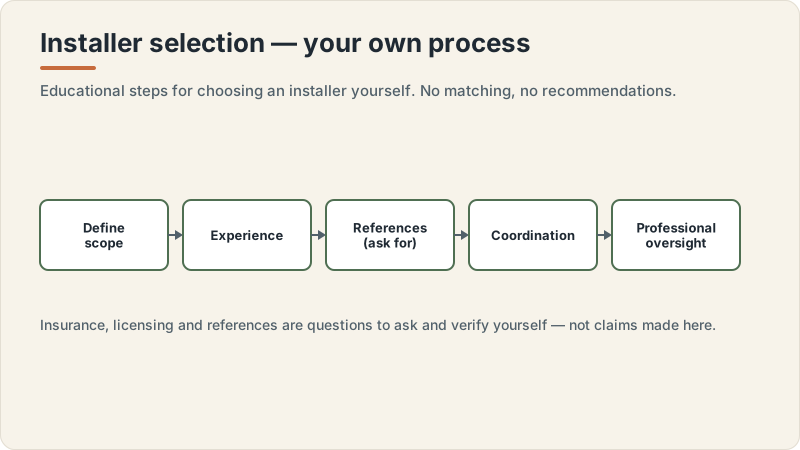
Installer selection process concept
Conceptual editorial diagram — not a construction drawing, specification or to-scale plan. Official court dimensions, standards, drainage, structure and lighting requirements vary by sport, site and location and are confirmed with the relevant federation, supplier and qualified professionals.
What this research helps you prepare
This resource helps you prepare a consistent set of questions for base and groundworks contractors, covering how they understand the scope, how they review your specific site, where their work meets other stages, and what documentation they hand over when their part is complete. It is designed so the same questions can be put to each contractor, giving you a like-for-like basis to compare answers rather than polished proposals.
It does not tell you what your site requires, what groundworks should cost or how long they should take. Those depend on your ground conditions, drainage, access, the surface to be laid later and the contractor, and they vary from project to project. Use the questions to draw out each contractor's approach and to surface differences that a confident pitch can otherwise hide.
- A question framework you can reuse across contractors
- Prompts that separate clear planners from vague ones
- A way to compare scope and coordination consistently
- A written record of what each contractor commits to
Scope clarity and experience questions
Base contractors can interpret a job very differently, from excavation and a prepared sub-base through to drainage connections, edge details and the level and tolerance needed for the surface that follows. Ask each contractor to define exactly what their proposal includes and where it stops, so you are not comparing a narrow scope against a broader one as if they were the same.
Experience with sports court bases is worth exploring, because the levels, falls and drainage a court needs can differ from general groundworks. Ask about the kind of court bases they have prepared before, but treat the answers as background for your own research rather than as a verified record. How they describe past work is something you confirm independently, not something this resource or Build Design Hub vouches for.
- How do you define the base and groundworks scope for this project?
- What is included in your scope, and where does it stop?
- What experience do you have preparing bases for sports courts?
- How do you confirm the levels, falls and tolerances the surface needs?
- What ground conditions or findings could change the scope once work begins?
Site-specific review and coordination questions
A proposal written without seeing your site tells you little. Ask how each contractor reviews your specific ground, drainage and access before committing to an approach, and how they record what they find, so their plan reflects your site rather than a generic template. Ground assessment, drainage behaviour and structural matters are technical questions for qualified professionals; here you are asking how the contractor plans for them and who carries out specialist evaluation, not for procedures or specifications.
Coordination is where split-scope projects often go wrong. The base usually has to be ready, level and accepted before surfacing, fencing, lighting or court kit can follow, so ask how each contractor sequences their work with the stages on either side, who confirms the base is ready to build on, and how problems found later are traced and resolved. Clear answers here reduce the gaps and disputes that appear when separate contractors meet at an interface.
- How will you review our specific site, ground and drainage before work?
- Who carries out any specialist ground or drainage assessment?
- How does your work hand over to the surfacing or court-kit stage?
- Who confirms the base is ready and accepted before the next stage?
- How are issues found at a later stage traced back and resolved?
- How do you record and share what you find on site?
References, insurance and licensing questions
You can ask each contractor for references and examples of comparable base work, then follow those up yourself; this resource does not provide or vouch for any references, and Build Design Hub does not verify, rate or endorse contractors. The point of asking is to give you material to check independently, recognising that the responsibility for verifying any claim rests with you and the professionals you involve.
Insurance, licensing and any registrations are matters to raise as questions and to confirm with the relevant providers and authorities, not claims this resource can make on a contractor's behalf. Ask what cover and credentials a contractor holds, then verify them directly at the source. What is required varies by location and project and should be checked with the appropriate authority and a qualified professional rather than assumed from a proposal.
- Can you provide references for comparable base or groundworks projects?
- What insurance cover do you carry, and can it be confirmed directly?
- What licensing or registrations apply, and how can they be verified?
- Who would be on site, and who supervises the work day to day?
- How can we confirm the credentials you describe with their source?
Handoff documentation and oversight questions
Because the base disappears under later stages, the records a contractor leaves behind matter. Ask what documentation they provide when their work is complete, such as as-built information on levels and drainage connections, evidence of what was done, and sign-off that the base is ready for the next stage. Agreeing this up front means the contractors and professionals who follow can build on a clear record rather than guesswork.
Independent oversight is worth planning for separately from the contractor doing the work. Ask how the base will be reviewed before it is covered, who can inspect or confirm it on your behalf, and how that fits the sequence. Whether such review is appropriate, and who should carry it out, is a judgement for qualified professionals familiar with your project, not something this resource can decide for you.
- What documentation do you provide when the base is complete?
- Will you supply as-built information on levels and drainage?
- How is the base recorded before it is covered by the next stage?
- Who can independently review or confirm the base on our behalf?
- How does any independent oversight fit your sequence and handover?
What to ask before comparing options
Before you compare base or groundworks contractors, make sure each one is responding to the same scope description and the same questions, so you are comparing like with like rather than different interpretations of the work. Where a contractor cannot or will not answer something in writing, record that gap, because it is useful information in its own right.
Keep cost, programme and sequencing as questions rather than fixed figures. Ask what drives them, what could change them and what each contractor is assuming, instead of treating any single number as settled. These vary by site, scope, access, ground conditions, drainage and coordination with other trades, and any figure a contractor gives should be confirmed and reviewed with qualified professionals.
- Is every contractor responding to the same base and groundworks scope, or different assumptions that only look alike?
- What is explicitly included and excluded from each contractor's scope?
- What does each contractor assume about ground conditions, access and what others will provide?
- How does each propose to coordinate with the surface, drainage and enclosure trades?
- What would each need a qualified professional to confirm before the work is finalised?
Questions for qualified professionals
Beyond the base contractor, other qualified professionals can help you judge whether a proposed approach is sound and whether your site is suited to it. A designer, civil or geotechnical engineer or drainage specialist can advise on ground conditions, levels and drainage, while local authorities and the relevant sport's federation or governing body can confirm any applicable requirements for your court and location.
Use these prompts to decide who else to involve and what to confirm independently of any single contractor. Requirements vary by location and project and should be verified with the relevant authority and qualified professionals, not inferred from a proposal alone.
- Is the proposed base approach appropriate for our ground and use?
- What ground or drainage assessment should be carried out, and by whom?
- What levels, falls and tolerances does the chosen surface require?
- What local permissions, notifications or requirements might apply?
- How should we verify a contractor's credentials and track record?
- Who should review and confirm the base before it is covered?
What this does not replace
This resource is educational preparation only. It is not a supplier or contractor recommendation, not contractor matching, not an estimate or quote, and not procurement, legal, tax or customs advice. It does not provide engineering, geotechnical, drainage, design, surveying, inspection or construction advice, and it does not tell you what your site requires or what work should cost or how long it should take.
Costs, timelines and requirements vary by location, ground condition, drainage, access, surface and contractor, and must be confirmed with the relevant professionals and authorities. Consult qualified designers, engineers, drainage and groundworks specialists, local authorities and legal or professional advisors where appropriate, and obtain qualified professional review before making project, engineering, construction or procurement decisions. Build Design Hub does not recommend, rank, rate, verify or introduce suppliers or contractors, and HELPERG LLC is publisher and operator only; verifying and selecting any contractor remain your responsibility.
Base contractor question checklist
- 1Have you asked each contractor to define the base and groundworks scope in writing?
- 2Have you asked about their experience with sports court bases specifically?
- 3Have you asked how they review your particular site, ground and drainage?
- 4Have you asked who carries out any specialist ground or drainage assessment?
- 5Have you asked how their work hands over to the surfacing or court-kit stage?
- 6Have you asked who confirms the base is ready before the next stage begins?
- 7Have you asked for references on comparable base work to follow up yourself?
- 8Have you asked what insurance and licensing apply, to confirm at the source?
- 9Have you asked what documentation and as-built records they hand over?
- 10Have you planned who can independently review the base before it is covered?
- 11Have you identified which other qualified professionals to involve?
- 12Have you recorded each contractor's answers for like-for-like comparison?
Common mistakes to avoid
- Assuming every contractor means the same thing by base or groundworks scope
- Comparing proposals on headline price without checking what each includes
- Accepting a proposal written without a review of your specific site
- Overlooking how the base hands over to surfacing, fencing or court kit
- Treating references, insurance or licensing as confirmed rather than verifying them
- Not agreeing what documentation and as-built records will be handed over
- Letting the base be covered without planning any independent review
- Relying on this resource as verification instead of checking claims yourself
When to involve a professional
- Ground conditions, levels, falls and drainage should be assessed by qualified engineering, geotechnical or drainage professionals familiar with your site.
- Whether a proposed base approach suits your court and intended use is a judgement for qualified professionals, not a fixed answer from a proposal.
- Independent review of the base before it is covered, and who should carry it out, is best decided with qualified professional input.
- Any permissions, notifications or technical requirements vary by location and project and should be confirmed with the relevant authority.
- Insurance, licensing and credentials should be verified directly with the contractor and the relevant providers and authorities.
- Build Design Hub does not rate, rank, recommend, verify or match contractors; selection and verification are your responsibility.
Frequently asked questions
Questions readers ask about this topic
What should I ask a base contractor first?
Ask them to define the scope clearly: what their base and groundworks work includes, where it stops, and how it confirms the levels and drainage the later surface needs. A clear, written scope gives you a fair basis for comparing one contractor with another.
How do I handle coordination between the base and later stages?
Ask how each contractor sequences their work with surfacing, fencing, lighting and court kit, who confirms the base is ready before the next stage, and how problems found later are traced back. Clear answers reduce the gaps that appear where separate contractors meet.
Can Build Design Hub check a contractor's references or insurance for me?
No. This resource gives you questions to ask so you can follow up references, insurance and licensing yourself with the contractor and the relevant authorities. Build Design Hub does not verify, rate, recommend or match contractors, and HELPERG LLC is publisher and operator only.
Will this tell me what the base will cost or how long it takes?
No. Costs and timelines vary by location, ground condition, drainage, access, surface and contractor. This resource points to the drivers and to the contractors and professionals who can confirm specifics for your project, rather than giving any figures.
Why does handoff documentation matter for the base?
Because the base is covered by later stages, records such as as-built levels, drainage connections and sign-off let the contractors and professionals who follow build on a clear record. Agreeing what is handed over up front helps avoid guesswork and disputes later.
Keep reading