
Who this guide is for
- Prospective court owners weighing a turnkey package against a split-scope arrangement and wanting to compare them on responsibility, not just price
- Owners coordinating several suppliers and contractors who need to see where one party's scope ends and the next begins
- People who have experienced or fear scope gaps, finger-pointing or unclear warranty boundaries on a project
- Owners preparing to brief designers, contractors or suppliers and wanting a clear map of who owns what
- Anyone assembling coordination and communication questions before any agreement is signed
Planning diagram
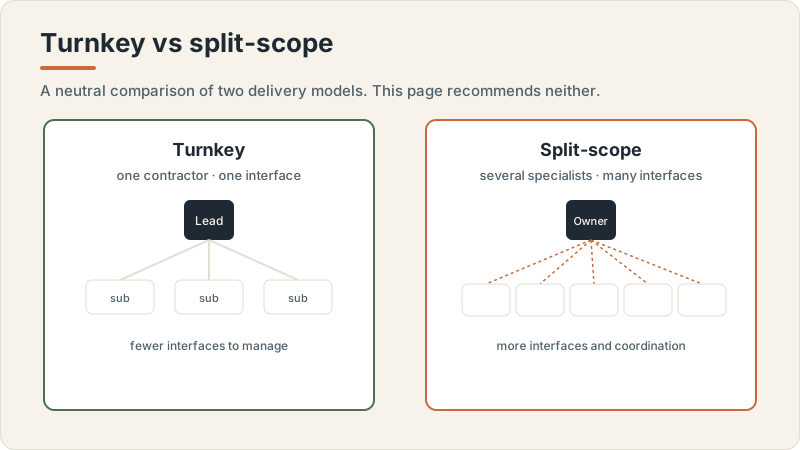
Turnkey vs split-scope concept
Conceptual editorial diagram — not a construction drawing, specification or to-scale plan. Official court dimensions, standards, drainage, structure and lighting requirements vary by sport, site and location and are confirmed with the relevant federation, supplier and qualified professionals.
What this research helps you prepare
This page helps you build a responsibility matrix for your court project: a simple grid that lists every task and deliverable down one side and the parties involved across the top, so you can record who is responsible for each item, who is consulted, and who is merely informed. The aim is clarity about ownership, not a verdict on whether turnkey or split-scope is better.
Working through the matrix helps you surface the interfaces, the points where one party hands over to another, such as where groundworks meet the surface, where the surface meets drainage, or where a supplied kit meets the installer's work. It also helps you notice tasks that nobody has clearly claimed, which are the gaps most likely to cause delay, extra cost or dispute later.
Everything here stays at the planning and question level. It is a method for organising responsibility and coordination, not an allocation of responsibility, not an estimate, and not a substitute for review by the qualified professionals you engage.
- Listing every task and deliverable across the whole project lifecycle
- Recording who is responsible, consulted or informed for each item
- Making interfaces between work packages visible
- Spotting tasks that no party has clearly taken ownership of
Building the matrix and mapping interfaces
A practical way to start is to write the project as a sequence of work packages rather than a single job: site assessment and surveys, design and any permissions, groundworks and base, drainage, the playing surface, lighting, fencing or enclosure, any supplied kit, line marking, testing and handover, and aftercare. Each of these is a row in your matrix.
Across the top, list the parties who might be involved, which could include you as owner, a lead or turnkey contractor, separate trade contractors, suppliers, a designer or engineer, and any third party arranging delivery or logistics. For each row, mark who is responsible for doing the work, who must be consulted, and who simply needs to be kept informed. A turnkey arrangement tends to concentrate responsibility, while a split-scope arrangement spreads it; the matrix lets you see the difference rather than assume it.
Pay particular attention to the interfaces between rows. The boundary between two packages, for example where a supplied surface meets a contractor's base, is where responsibility is easiest to lose. For each interface, note which party owns the join, who checks it, and what happens if the two sides do not align. These are points to confirm in writing with the parties involved, not assumptions to carry forward.
- List the project as work packages, one per row
- List every party who could be involved as columns
- Mark responsible, consulted and informed for each item
- Identify each interface where one package meets another
- Note who owns and checks each interface, not just each task
- Flag any row no party has clearly claimed
Coordination, communication and the documentation trail
A responsibility matrix is only useful if it is matched by a clear way of communicating and recording decisions. As you fill in the grid, think about who coordinates the overall sequence, how parties hand over from one package to the next, and how questions or changes are raised, agreed and recorded. In a split-scope arrangement the owner often carries more of this coordination; in a turnkey arrangement a lead party may carry more of it. Neither is assumed here, and you should confirm who actually holds coordination for your project.
The documentation trail matters as much as the matrix itself. Consider how scope, inclusions, exclusions, assumptions and any changes will be captured in writing, so that the responsibility you have mapped is reflected in the agreements you reach with each party. A verbal understanding of who owns an interface is far weaker than a written one.
Warranty and guarantee boundaries are best treated as a question to ask rather than a feature to assume. Where several parties contribute, ask each one what their warranty covers and excludes, where it begins and ends, and what happens at the interface with another party's work. The aim is to understand how the boundaries fit together for your project, not to rely on an industry norm, since terms vary by supplier, contractor and project.
- Decide who coordinates the overall sequence and handovers
- Agree how questions and changes are raised, agreed and recorded
- Capture scope, inclusions, exclusions and assumptions in writing
- Ask each party where their warranty begins, ends and excludes
- Check how warranty boundaries align at each interface
- Keep the matrix and the written agreements consistent with each other
What to ask before comparing options
Before you compare a turnkey approach with a split-scope approach, it helps to ask the same set of questions of each so the comparison is about responsibility and coordination rather than headline price. The questions below are prompts to put to the parties you are considering; answers will vary by supplier, contractor and project, so treat them as things to confirm rather than assume.
Use these prompts to test where responsibility actually sits under each option, who carries the interfaces, and what coordination falls to you. A clear answer in writing is far more useful than a reassuring one given verbally.
- Who would be responsible for each work package under this arrangement?
- Who owns the interfaces between packages, and who checks them?
- Which tasks, if any, would remain my responsibility as owner?
- Who coordinates the sequence and handovers between parties?
- How are scope, changes and decisions recorded under this option?
- Where does each party's warranty begin, end and exclude, and how do those boundaries meet?
Questions for qualified professionals
Mapping responsibility is partly an organisational task and partly a judgement that benefits from qualified input. The questions below are intended to help you have a more productive conversation with the designers, engineers, contractors and advisors you engage; they are prompts, not a script, and the answers will depend on your specific site, scope and project.
Use them to test whether your matrix reflects how the work really fits together, and to surface any interface, coordination point or boundary that has been assumed rather than confirmed.
- Does my responsibility matrix reflect how this kind of project actually fits together?
- Which interfaces in my matrix carry the most risk if responsibility is unclear?
- What coordination would realistically fall to me under a split-scope arrangement?
- What should I confirm in writing so the responsibilities I have mapped are enforceable?
- What questions should I ask each party about where their warranty and liability boundaries meet?
- What permissions, standards or technical requirements should I confirm with the relevant authority or federation rather than assume from any party?
What this does not replace
This resource is educational and for preparation only. It is not a recommendation of a delivery model, not a recommendation of any supplier or contractor, and not contractor matching. It does not allocate responsibility for you, does not provide an estimate, and is not procurement, legal, tax, customs, engineering, design or construction advice. It will not tell you whether turnkey or split-scope is right for you, what your project should cost, or how long it should take.
Costs, timelines, responsibilities and requirements vary by location, site, scope, surface, base, drainage, lighting, access, supplier and the agreements you reach, and must be confirmed with the relevant parties, authorities and qualified professionals. Consult qualified designers, engineers, contractors, suppliers, local authorities and legal or professional advisors before making any project, procurement, legal, tax, customs, engineering or construction decision.
Build Design Hub does not recommend, rank, verify, introduce or match suppliers or contractors, and does not coordinate, design, build, manage or estimate court projects. HELPERG LLC is the publisher and operator of this resource only; mapping, verifying and agreeing responsibilities for your project remains your responsibility.
Responsibility matrix worksheet
- 1List your project as work packages from site assessment through to aftercare, one per row
- 2List every party who could be involved as a column, including yourself as owner
- 3For each work package, mark who is responsible, who is consulted and who is informed
- 4Identify each interface where one package hands over to another
- 5For every interface, record who owns it, who checks it and what happens if the sides do not align
- 6Highlight any row that no party has clearly claimed as their responsibility
- 7Note who coordinates the overall sequence and the handovers between parties
- 8Record how questions, changes and decisions will be raised, agreed and documented
- 9Write the question to ask each party about where their warranty begins, ends and excludes
- 10Check how warranty and liability boundaries are described to meet at each interface
- 11List the requirements, permissions or standards you must confirm with an authority, federation or professional
- 12Note which responsibilities are still verbal and need confirming in writing before any agreement
Common mistakes to avoid
- Comparing turnkey and split-scope options on price alone instead of on responsibility and coordination
- Mapping tasks but ignoring the interfaces where one party hands over to another
- Leaving tasks unassigned because each party assumes the other will handle them
- Assuming a turnkey arrangement automatically covers every package without confirming inclusions and exclusions
- Relying on a verbal understanding of who owns an interface rather than recording it in writing
- Treating warranty boundaries as a settled norm instead of asking each party where theirs begins and ends
- Overlooking who carries day-to-day coordination, which often falls to the owner in split-scope arrangements
- Letting the matrix and the actual written agreements drift out of step with each other
When to involve a professional
- Involve a qualified designer or engineer to judge whether your responsibility matrix reflects how the work genuinely fits together and where the technical interfaces lie
- Engage contractors or suppliers to confirm in writing which packages and interfaces each will own under the arrangement you are considering
- Seek professional input on which interfaces carry the most risk if responsibility is left unclear
- Ask a legal or professional advisor to review how responsibilities and warranty boundaries are captured before you commit to any agreement
- Consult the relevant local authorities and sport or federation bodies to confirm any permissions, standards or requirements, since these vary by location and project
- Build Design Hub does not allocate responsibility, recommend a delivery model, or match or verify suppliers and contractors; mapping and agreeing responsibilities is your responsibility, ideally with professional support
Frequently asked questions
Questions readers ask about this topic
Does this page tell me whether turnkey or split-scope is better?
No. It gives you a method for mapping responsibility under either arrangement so you can compare them on ownership, interfaces and coordination rather than on price alone. Which delivery model suits your project depends on your site, scope and circumstances, and is something to discuss with the qualified professionals you engage. Build Design Hub does not recommend a delivery model.
What is a responsibility matrix in this context?
It is a simple grid that lists each work package of your project down one side and the parties involved across the top, so you can record who is responsible for each item, who is consulted and who is informed. It makes interfaces and unclaimed tasks visible. This page provides the structure as a worksheet; it does not fill it in or allocate responsibility for you.
How should I handle warranty boundaries between parties?
Treat them as questions to ask rather than norms to assume. Ask each supplier and contractor what their warranty covers and excludes, where it begins and ends, and what happens at the interface with another party's work. Terms vary by supplier, contractor and project, so the aim is to understand how the boundaries fit together for yours, confirmed in writing.
Can Build Design Hub allocate responsibilities or match me with contractors?
No. Build Design Hub is an educational publisher and does not allocate responsibility, coordinate projects, or match, rank, verify or recommend suppliers or contractors. This page is a preparation worksheet only. Confirm and agree responsibilities with the qualified designers, engineers, contractors, suppliers and advisors you choose to engage. HELPERG LLC is publisher and operator only.
Will this tell me what coordination or delivery should cost or how long it takes?
No. This resource contains no figures of any kind. Costs, timelines and responsibilities vary by location, site, scope, surface, drainage, lighting, access, supplier and the agreements you reach. It points to the factors and the parties and professionals who can confirm specifics for your project rather than giving any numbers.
Keep reading