
Who this guide is for
- Prospective padel court owners weighing a turnkey supplier against a split-scope approach
- Operators who want to understand exactly what a single-supplier package includes and excludes
- Anyone unsure where one supplier's responsibility ends and another party's begins
- Project managers mapping interface points and coordination responsibilities
- Clubs adding padel who want a consistent question set for either delivery model
- Owners trying to plan ahead to prevent scope gaps and disputes
Planning diagram
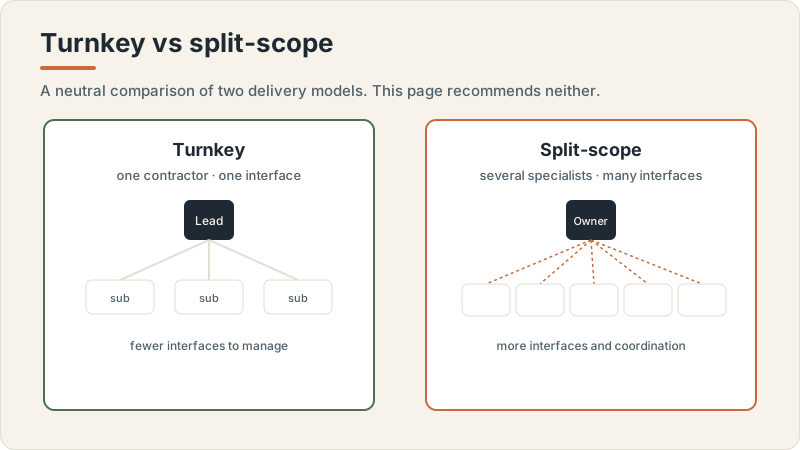
Turnkey vs split-scope concept
Conceptual editorial diagram — not a construction drawing, specification or to-scale plan. Official court dimensions, standards, drainage, structure and lighting requirements vary by sport, site and location and are confirmed with the relevant federation, supplier and qualified professionals.
What this research helps you prepare
This resource helps you build a structured set of questions for a prospective turnkey padel court supplier, focused on one theme: who is responsible for what. It is organised around scope boundaries, the interfaces between bundled and separate work, coordination and communication, warranty wording framed as questions, the documentation trail, and dispute-prevention planning.
Everything stays at a planning and question level. The questions are designed to help you hear how clearly a supplier defines its own scope and how it describes the points where its work meets work done by others. This page does not tell you whether turnkey or split scope is right for your project, because that depends on your site, resources and the specific offers in front of you. Requirements, costs and timelines vary by location, site, scope, access, drainage, lighting, surface, shipping and supplier.
Use it to prepare before meetings, to compare a turnkey offer against a split-scope plan on a like-for-like basis, and to record where answers are vague so you can follow up with qualified professionals.
- A question set mapping turnkey scope boundaries and interfaces
- Prompts for comparing turnkey and split-scope approaches consistently
- A way to surface warranty wording as questions rather than assumptions
- Framing that keeps delivery-model choice with you, not this page
Scope boundaries: what is in and out of a turnkey package
Begin by getting a supplier to draw the edges of its own scope. A padel court combines groundwork and base, drainage, the playing surface, the glass-and-steel enclosure, lighting, fencing and supporting works, and a turnkey offer may bundle all, most or only some of these. The word turnkey means different things to different suppliers, so the useful work is asking exactly which elements sit inside the package and which you would still arrange yourself.
Ask these as questions about responsibility, not as a request for specifications or construction instructions. You are listening for whether a supplier can state plainly where its scope starts and stops, and whether it acknowledges the elements it expects others to handle. Official padel court dimensions and sport requirements vary and should be confirmed with the relevant federation, supplier or qualified designer rather than assumed from any package description.
- Which specific elements does your turnkey package include, and which are excluded?
- Where exactly does your responsibility begin and end on this project?
- What do you assume is already in place or arranged by me before you start?
- Are groundwork, base and drainage inside your scope, or handled separately?
- Are lighting, fencing and enclosure included, or treated as add-ons?
- Which items are commonly assumed to be in a turnkey package but are not in yours?
Interfaces, coordination and communication structure
The points where one party's work meets another's are where scope gaps and delays tend to appear, and they exist under any delivery model. In a turnkey arrangement, the supplier may carry more of these internally; in a split-scope arrangement, you coordinate them. Ask a turnkey supplier how it manages the interfaces inside its own package, and how it handles any handover to or from work outside it, such as utilities, access or site preparation you arrange.
These are coordination and communication questions, not engineering or construction advice. You are trying to understand who holds each interface, how decisions are recorded, who your single point of contact is, and what happens at a handover if something is not as expected. The same questions, asked of separate contractors, help you compare the coordination burden a split-scope approach would place on you.
Clear communication structure is part of what you are evaluating. Ask how the supplier reports progress, how changes are raised and agreed, and how it would coordinate with any party outside its scope, so you can judge how a project would actually run rather than how a proposal reads.
- Who is my single point of contact, and who holds each interface within your scope?
- How do you manage handovers between the elements you bundle together?
- What do you need from me or from outside parties, and by when?
- How are progress, decisions and changes recorded and communicated?
- How would you coordinate with work that sits outside your package?
- What happens at a handover if an earlier element is not as expected?
Warranty boundaries, documentation and dispute prevention
Warranty wording deserves careful, neutral attention under any model, and especially where one supplier covers many elements. Rather than assuming what a turnkey warranty covers, ask where the cover for each element sits, who you would approach if an issue spans the boundary between two elements, and where every term is written down. This page cannot state what is standard, because warranty terms vary between suppliers and there is no universal norm to quote. Ask in the same spirit about the documentation trail: a turnkey arrangement still produces handover records, product information, care instructions and any manufacturer terms that may pass through the supplier.
Most disputes trace back to an unwritten assumption about who was responsible for something. Whether you pursue a turnkey or split-scope approach, planning ahead to close scope gaps is one of the most useful things you can do. Ask how a supplier identifies and agrees changes, how it documents what was agreed, and how it would expect a disagreement about scope to be resolved. These are planning and process questions, not legal advice; you are listening for whether scope, inclusions, exclusions and changes are put in writing as a matter of routine, and whether the boundaries you mapped earlier are reflected in the documentation. Treat warranty and contract terms as wording to read and confirm in writing, ideally with professional advice where the language carries weight.
- Where is the warranty for each element written down, and what does each cover?
- If an issue spans the boundary between two elements, who is responsible?
- How do warranties for items sourced from manufacturers pass to me?
- What handover documentation and care instructions do you provide, and for what?
- How are scope, inclusions, exclusions and changes put in writing?
- How would a disagreement about who is responsible be identified and resolved?
What to ask before comparing options
Before you set a turnkey offer beside a split-scope plan, make sure you are comparing the same ground. Differences in what each model bundles can make a single number or a single proposal look more or less complete than it really is, so the questions below help you normalise the comparison rather than reach a verdict.
Ask each prospective supplier to express its scope in the same terms, so a turnkey package and a set of separate contractor scopes can be lined up element by element. Costs and timelines vary by location, site, scope, supplier, access, drainage, lighting, surface and shipping, so focus on what each model includes, who coordinates it, and where responsibility for each interface sits, not on figures this page cannot provide.
- Have you asked each option to describe scope in the same element-by-element terms?
- Have you mapped which interfaces each model leaves you to coordinate?
- Have you compared inclusions, exclusions and assumptions, not just headline scope?
- Have you noted where warranty responsibility differs between models?
- Have you recorded where answers are vague so you can follow up?
- Have you identified which comparisons need qualified professional input?
Questions for qualified professionals
Some questions belong with independent professionals rather than with a supplier, because they call for judgement, verification or specialist knowledge. Whichever delivery model you lean toward, it helps to line up the people who can give neutral input on site, base, drainage, lighting, enclosure, contract wording and any legal or regulatory matters before and during supplier conversations.
Use the prompts below to plan who to involve and what to ask. Requirements vary by location and project and must be confirmed with the relevant authority, federation and qualified professionals; this resource cannot state them as fact, and it does not provide engineering, design, legal, tax or construction advice.
- Designer or engineer: is a turnkey or split-scope approach better suited to my site and use?
- Site, base and drainage specialists: are the boundaries the supplier describes sound?
- Lighting and enclosure specialists: how should these interface with the package?
- Legal advisor: do the scope, warranty and contract terms hold together across boundaries?
- Local authority and relevant federation: what permit, zoning, noise and sport requirements apply?
- Independent reviewer: do the supplier's interfaces and exclusions stand up to scrutiny?
What this does not replace
This is an educational project-preparation resource, not a supplier or contractor recommendation, not contractor matching, not an estimate, and not procurement, legal, tax or customs advice. It does not provide engineering, architectural, design, inspection or construction advice, and it does not tell you whether to choose a turnkey or split-scope model or which supplier to use.
Requirements and costs vary by location, site, scope, supplier, access, drainage, lighting, surface and shipping, and official sport or federation requirements must be confirmed with the relevant bodies. Consult qualified designers, engineers, contractors, lighting and drainage specialists, local authorities and legal or professional advisors before making project, procurement, contractual or construction decisions.
Build Design Hub does not provide contractor matching or professional recommendations and does not verify, rank, rate or endorse any supplier. HELPERG LLC is the publisher and operator only. Verification and selection of any supplier, and the choice of delivery model, remain your responsibility.
Turnkey padel supplier question checklist
- 1Have you asked which elements the turnkey package includes and excludes?
- 2Have you asked where the supplier's responsibility begins and ends?
- 3Have you mapped each interface and who holds it within the scope?
- 4Have you asked who your single point of contact is for coordination?
- 5Have you asked how progress, changes and decisions are recorded?
- 6Have you asked where the warranty for each element is written down?
- 7Have you asked who is responsible when an issue spans a boundary?
- 8Have you asked what handover documentation you receive, and for what?
- 9Have you asked how scope gaps are identified and disputes prevented?
- 10Have you expressed a split-scope plan in the same terms for comparison?
- 11Have you planned which questions to take to qualified professionals?
- 12Have you planned to verify what you are told independently?
Common mistakes to avoid
- Assuming the word turnkey means the same complete scope from every supplier
- Comparing a turnkey offer with a split-scope plan without normalising what each includes
- Overlooking the interfaces where bundled work meets work you arrange yourself
- Assuming a single warranty covers every element rather than reading each term
- Not identifying who is responsible when an issue spans two elements
- Leaving scope boundaries, exclusions and changes out of the written record
- Choosing a delivery model on price alone without weighing the coordination burden
- Skipping independent professional and legal review of scope and contract wording
When to involve a professional
- A qualified designer or engineer can help you weigh whether a turnkey or split-scope approach suits your site and intended use.
- Specialist site, base, drainage, lighting and enclosure work should be carried out by qualified professionals in each trade, whichever model you choose.
- A legal advisor can review whether scope, warranty and contract terms hold together across the boundaries between elements.
- Official padel court dimensions and sport requirements vary and should be confirmed with the relevant federation, supplier or designer.
- Permit, zoning, noise and accessibility requirements vary by location and must be confirmed with the relevant authority and qualified professionals.
- Build Design Hub does not match, rank, verify or endorse suppliers or recommend a delivery model; selection and verification remain your responsibility.
Frequently asked questions
Questions readers ask about this topic
Does this page say turnkey is better than split scope for a padel court?
No. It provides questions to help you understand what a turnkey package covers so you can compare it with a split-scope plan yourself. The right model depends on your site, resources and the specific offers in front of you, and that decision, with qualified professional input, remains yours.
Why does turnkey scope vary so much between suppliers?
Because the word turnkey has no fixed definition. One supplier may bundle groundwork, surface, enclosure, lighting and fencing, while another covers only some of these. That is why mapping exactly which elements are in and out, and where responsibility ends, matters more than the label itself.
How should I handle warranty questions for a turnkey package?
Ask where the cover for each element is written down, who is responsible if an issue spans a boundary, and how manufacturer terms pass to you. Terms vary between suppliers, so read and confirm the wording in writing, ideally with professional advice where the language carries weight, rather than assuming a standard.
What is an interface, and why ask about it?
An interface is any point where one party's work meets another's, such as where the base hands off to the surface or where bundled work meets utilities you arrange. Scope gaps and delays often appear at these points, so asking who holds each interface helps you see where coordination risk sits under any model.
Does Build Design Hub recommend or match padel court suppliers?
No. It provides questions to frame your own conversations and comparisons. Build Design Hub does not match, rank, rate, verify or endorse suppliers or delivery models, and HELPERG LLC is the publisher and operator only. Verification and selection remain your responsibility.
Keep reading