
Who this guide is for
- Prospective court owners deciding whether to engage one turnkey contractor or several separate specialists
- Operators planning a padel, tennis or multi-sport facility who want to map responsibility boundaries before quoting
- Readers preparing to compare quotes that are structured differently across the two delivery models
- People who want a neutral checklist for interface risk, coordination and documentation, not a verdict on which model is 'best'
- Anyone assembling questions for qualified professionals about scope splits and warranty boundaries
- Owners who want to reduce the chance of disputes by clarifying who is responsible for what, in writing, in advance
Planning diagram
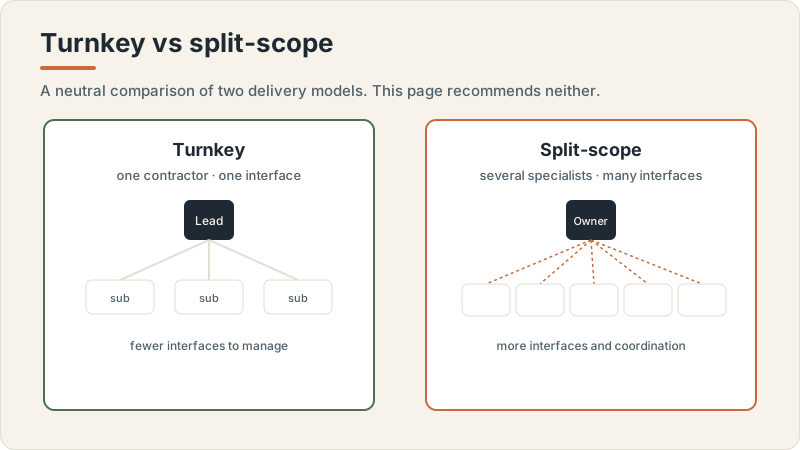
Turnkey vs split-scope concept
Conceptual editorial diagram — not a construction drawing, specification or to-scale plan. Official court dimensions, standards, drainage, structure and lighting requirements vary by sport, site and location and are confirmed with the relevant federation, supplier and qualified professionals.
What this research helps you prepare
This resource helps you prepare a clear, written comparison of two ways to organise a sports court build: a single turnkey contractor responsible for the whole scope, versus several separate specialist contractors each responsible for one part. It does not tell you which to choose. Instead it helps you articulate, for your own project, where responsibility sits, where the interfaces are, and what you would need to coordinate under each model.
The goal is to walk into supplier and contractor conversations already knowing which questions matter to you: who owns the base and drainage interface, who owns the surface, who owns lighting and enclosures, and what happens at the seams between those packages. Mapping this in advance helps you read quotes that are structured very differently and ask consistent questions of everyone you speak to.
- A neutral side-by-side framework for the turnkey and separate-contractor models
- A way to identify the interfaces and seams where responsibility could fall through the gaps
- A set of questions about coordination, communication and documentation to raise yourself
- Prompts for warranty and dispute-prevention conversations, framed as questions rather than claims
Responsibility boundaries and interface risk
The core difference between the two models is who holds responsibility at the boundaries between work packages. A sports court is a sequence of dependent layers: site preparation, base, drainage, the playing surface, line marking, lighting and enclosures or fencing. Each boundary between these is an interface, and interfaces are where ambiguity tends to live. Under a turnkey model, one party typically holds responsibility across those interfaces. Under a separate-contractor model, you may be the party who holds the interfaces together.
Neither arrangement is inherently better; they simply place responsibility differently, and both can work when the boundaries are written down clearly. The risk in either case is the unwritten assumption, where each party believes another is handling drainage falls, surface preparation tolerances, or how the enclosure connects to the surface edge. Your preparation task is to list every interface in your project and note who you would expect to own it under each model, then plan to confirm that ownership in writing.
- List every layer and the interface between each adjoining pair
- For each interface, note who you expect to be responsible under turnkey and under separate contractors
- Flag interfaces where surface, drainage, base or enclosure work physically depend on each other
- Note any interface where you, the owner, would be the coordinating party by default
Coordination, communication and documentation
The two models also differ in how communication flows. With a turnkey contractor, coordination across packages is usually one party's task, and you typically have a single point of contact, though you should confirm how subcontracted work is managed within that arrangement. With separate contractors, coordination may fall to you or to someone you appoint, and information has to pass cleanly between parties who may never meet on site at the same time. Either way, a documented communication structure helps everyone know who decides what.
Documentation is the thread that runs through both models. A clear scope description, an agreed sequence of works, a record of who is responsible for each interface, and a single place where changes are logged all reduce the chance of confusion later. Plan how you will keep a documentation trail regardless of which model you choose, and ask each party how they expect changes, approvals and handover information to be recorded and shared.
- Decide who the coordinating party is under each model and how decisions are communicated
- Plan a single documented scope description and works sequence you can share with everyone
- Ask how changes, approvals and site instructions will be recorded in writing
- Plan how handover documentation, drawings and product information will reach you
Warranty boundaries and dispute prevention as questions
Warranty is one of the most important areas to prepare as questions rather than assumptions, because terms vary widely by supplier, product and contractor and must be confirmed directly. The structural question is the same under both models: if something is not right at an interface, who stands behind it? Under a single turnkey arrangement, responsibility may be more consolidated, but you should still ask exactly what is and is not covered. Under separate contractors, you may be coordinating between several separate warranties, and a fault at a seam could sit between them.
Dispute prevention follows from clarity. Most disputes on construction interfaces trace back to a boundary that was never written down. Your preparation is not to draft legal terms yourself, which is work for qualified professionals, but to identify the questions that surface those boundaries early: what is covered, by whom, for how long, under what conditions, and what the process is if two parties disagree about whose responsibility a problem is. Bring those questions to suppliers, contractors and qualified professionals rather than treating any answer here as settled.
- Ask each party exactly what their warranty covers and, just as importantly, what it does not
- Ask how a problem at an interface between two packages would be handled and by whom
- Note where separate warranties could leave a gap at a seam, and prepare to ask about it
- Treat all warranty and contract terms as matters to confirm in writing with qualified professionals
What to ask before comparing options
Before you line up any quotes or conversations, settle the questions that make the two models comparable on your terms. Quotes structured around a turnkey scope and quotes structured around separate packages can look very different on paper, and you cannot compare them fairly until you know what each is meant to include. Costs and what drives them vary by site, scope, surface, drainage, access, lighting and supplier, so focus on confirming inclusions and responsibilities rather than chasing a single figure.
Use the same baseline scope description for everyone so that the differences you see reflect the delivery model and not a misunderstanding of what you asked for. Asking these questions before comparing keeps the comparison honest and reduces the chance that a missing item only surfaces later.
- What does each model include and exclude against my single baseline scope description?
- Who is responsible for each interface, and is that responsibility stated in writing?
- Who coordinates the sequence of works, and who am I, the owner, expected to coordinate?
- How are changes, delays and on-site decisions documented under each model?
- What warranty applies to each package, and how are interface problems handled?
- What would I need to manage myself under a separate-contractor model that a turnkey arrangement might cover?
Questions for qualified professionals
Some questions are best put to qualified professionals rather than resolved from a web page. This includes anyone you engage for legal, contractual, engineering, design or project-coordination support, as well as the relevant authorities, federations and suppliers for requirements specific to your project. The questions below are framed to help you get useful guidance on the model choice and its interfaces; they are not advice and not a substitute for professional review.
Requirements vary by location and project, so confirm anything that touches permits, codes, sport or federation rules, technical specifications and contract terms directly with the appropriate professional or authority.
- How should responsibility and interface ownership be reflected in any contract or scope document?
- What contractual or coordination risks should I be aware of if I split the scope across separate contractors?
- How might warranty boundaries between separate packages be structured to avoid gaps?
- What documentation should I keep through the project to support clear handover and dispute prevention?
- Which local requirements, codes, federation rules or approvals apply, and who should confirm them?
- Are there project characteristics in my case that make one coordination structure harder to manage than another?
What this does not replace
This page is an educational project-preparation resource and nothing more. It is not a recommendation of the turnkey model or the separate-contractor model, and it is not contractor matching, an introduction service or a directory. It does not rank, rate, verify, endorse or vet any supplier or contractor, and it is not an estimate, a quote or procurement, legal, tax, customs, engineering, design or construction advice.
Requirements and costs vary by location, site and project, and every figure, requirement, warranty term and timeline must be confirmed directly with the relevant authorities, federations, suppliers and qualified professionals. Qualified professional review is required before you make project, contractual, legal, tax, customs, engineering, construction or procurement decisions. Build Design Hub does not recommend, rank, verify or introduce suppliers or contractors, and HELPERG LLC is the publisher and operator only.
Turnkey vs separate contractors comparison worksheet
- 1List every layer of the build and the interface between each adjoining pair
- 2For each interface, write who you expect to be responsible under the turnkey model
- 3For each interface, write who you expect to be responsible under separate contractors
- 4Mark each interface where you, the owner, would be the coordinating party by default
- 5Write a single baseline scope description to share with everyone you speak to
- 6Note, for each model, who coordinates the sequence of works and on-site decisions
- 7Prepare warranty questions for each package, including what is and is not covered
- 8Identify any seam where separate warranties could leave a gap and note a question for it
- 9Plan how changes, approvals and instructions will be recorded in writing under each model
- 10List the handover documents and product information you expect to receive
- 11Write the questions you will put to qualified professionals about contracts and interfaces
- 12Record that all costs, requirements and terms are to be confirmed directly, not assumed
Common mistakes to avoid
- Treating one model as automatically 'better' rather than mapping how each fits your specific project and interfaces
- Comparing a turnkey quote and separate-package quotes without a single baseline scope, so the comparison is not like-for-like
- Leaving interface responsibilities unwritten and assuming someone else will own the seams between packages
- Assuming warranty terms instead of asking each party exactly what is covered and how interface problems are handled
- Underestimating the coordination you would take on yourself under a separate-contractor model
- Failing to keep a documentation trail of scope, sequence, changes and approvals through the project
- Reading any cost, timeline or requirement here as a fixed figure rather than something to confirm directly with suppliers and qualified professionals
When to involve a professional
- Engage qualified professionals before deciding how to structure scope, contracts and responsibility across either model
- Involve a professional to review how interface ownership and warranty boundaries should be reflected in any agreement
- Seek professional guidance on coordination risk if you are considering splitting the scope across separate contractors
- Confirm local permits, codes, federation rules and technical requirements with the relevant authorities and qualified professionals
- Use professional review for any legal, tax, customs, engineering, design or construction question this page deliberately leaves open
- Treat qualified professional input as required, not optional, before any project, contractual or procurement decision
Frequently asked questions
Questions readers ask about this topic
Does this page recommend turnkey or separate contractors?
No. It is a neutral preparation framework that helps you compare both models on your own terms. It does not recommend, rank or endorse either approach, and the right choice depends on your project, which is something to work through with qualified professionals.
What is interface risk in a sports court project?
Interface risk refers to uncertainty at the boundaries between work packages, such as where the base meets drainage or the surface meets the enclosure. It tends to arise when responsibility for a boundary is not written down. Identifying these interfaces early helps you ask who owns each one, in writing.
Can you tell me what a turnkey contract should cover?
No. Contract terms vary by project, supplier and contractor and are matters for qualified professionals. This page helps you prepare questions about inclusions, responsibilities and warranties so you can discuss them with the relevant professionals rather than relying on a fixed template.
How should I compare quotes structured differently across the two models?
Start from a single baseline scope description you share with everyone, then ask each party what their quote includes and excludes against it. That keeps the comparison consistent. Confirm costs, inclusions and responsibilities directly, as they vary by site, scope and supplier.
Does Build Design Hub help me choose a contractor?
No. Build Design Hub does not match, introduce, verify, rank or recommend suppliers or contractors, and HELPERG LLC is the publisher and operator only. This resource is educational preparation to support your own research and your conversations with qualified professionals.
Keep reading