
Who this guide is for
- Prospective court owners weighing a split-scope approach against a single turnkey contractor and wanting to prepare their own questions first
- Operators planning a padel, tennis or multi-sport facility who expect several specialist contractors to be involved
- Anyone trying to map responsibility boundaries and coordination needs before requesting or comparing quotes
- Readers who want a structured worksheet to identify possible scope gaps and interface points to raise with professionals
- People assembling documentation and a communication plan ahead of engaging qualified contractors and advisers
- Owners who want to understand which warranty, coordination and dispute-prevention topics to ask about, not which contractor to choose
Planning diagram
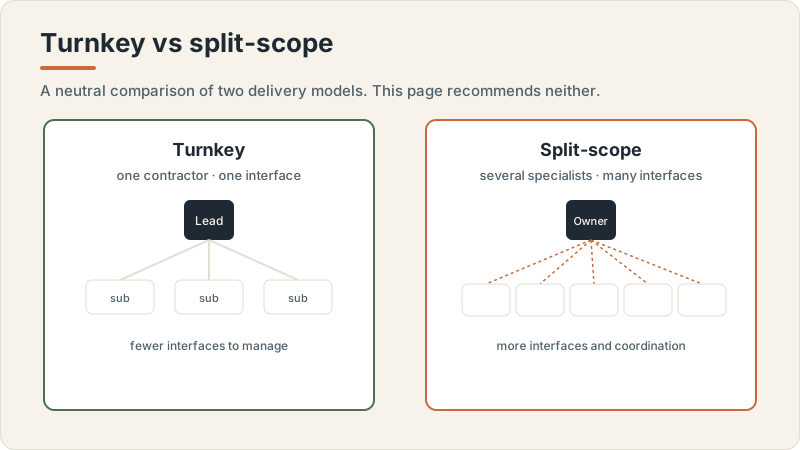
Turnkey vs split-scope concept
Conceptual editorial diagram — not a construction drawing, specification or to-scale plan. Official court dimensions, standards, drainage, structure and lighting requirements vary by sport, site and location and are confirmed with the relevant federation, supplier and qualified professionals.
What this research helps you prepare
This page helps you prepare your own internal picture of how a split-scope project could be organised, so your later conversations with suppliers, contractors and qualified professionals are clearer and more consistent. It is a preparation and research aid, not a recommendation to split or not split your project, and not a procurement, legal, engineering or construction service.
By working through it you can draft a responsibility map, list the interface points where one scope meets another, note the coordination and communication questions you want answered, and assemble the documentation you would need to keep a clear trail. None of this replaces professional review - it simply helps you arrive at that review better organised.
- A draft responsibility map showing which broad parts of the work might sit with which party
- A list of interface points where one contractor's scope is expected to meet another's
- Coordination and sequencing questions to raise with each party and with qualified professionals
- Documentation and communication topics to confirm so decisions and changes are recorded
- Warranty boundary questions to ask - framed as questions, never as assumptions about coverage
Mapping responsibility boundaries
In a split-scope project the most useful early exercise is to write down, in plain language, which broad area of work you expect to belong to which party - for example site preparation, base construction, surfacing, fencing or enclosure, lighting, and drainage. This is your own working draft, not a contract, and the actual boundaries must be confirmed in writing with each contractor and reviewed by qualified professionals.
The goal is to surface the grey areas before they become problems. Where does ground preparation end and base construction begin? Who is responsible for setting out and levels that the next trade relies on? Who confirms that one stage is complete and ready for the next? Writing these questions down now helps you ask them clearly later. Do not assume any boundary is standard; requirements and conventions vary by location, sport and project.
- List the broad work areas you expect and leave space to note who might own each
- Mark every point where two areas meet as a boundary to confirm
- Note who you expect to confirm completion and readiness between stages
- Record any area where ownership is unclear so you can raise it explicitly
- Keep this as a draft for discussion, not as a fixed allocation
Understanding interface and coordination risk
Interfaces are the points where separate scopes physically or sequentially connect - where surfacing meets a base laid by another party, where fencing posts pass through a surface, where drainage and lighting conduits run beneath or around the playing area. These are common places for misunderstandings when more than one contractor is involved, which is why mapping them in advance is helpful preparation.
Coordination risk grows with the number of parties and the dependencies between them. Consider how sequencing works, how site access is shared, what each party needs from the previous one, and how delays or changes in one scope might affect another. These are factors to discuss and confirm with qualified professionals and the contractors themselves; this page does not estimate timelines, costs or likelihoods, all of which vary by site and project.
- Identify each physical interface where one scope meets or sits on another
- Note sequencing dependencies - what must be complete before the next stage
- Consider shared site access, storage and how parties hand over between stages
- List the information each party needs from the one before it (levels, setting out, tolerances)
- Treat all timing, cost and risk questions as items to confirm, never as fixed figures
Communication, documentation and dispute prevention
With several parties involved, a clear communication structure and a documentation trail are topics worth planning for. Think about how instructions, changes and approvals would be recorded, who you would communicate with for each scope, and how information would flow between parties who may never deal with each other directly. These are organisational questions for you and your professional team, not legal advice.
A consistent documentation trail - written briefs, confirmed boundaries, recorded changes and dated approvals - can help everyone stay aligned and can support fair resolution if a disagreement arises about who was responsible for what. How disputes are actually handled is a contractual and legal matter to confirm with qualified professionals; this page only helps you prepare the questions and records, not the terms.
- Decide how you would record instructions, variations and approvals
- Note who your single point of contact is for each scope
- Plan how information passes between parties who do not deal with each other
- Keep dated written records of confirmed boundaries and any changes
- Raise dispute-handling and responsibility-allocation terms with qualified professionals
What to ask before comparing options
Before you compare a split-scope approach with a single turnkey arrangement, or compare different ways of dividing the work, prepare a consistent set of questions so each conversation covers the same ground. Comparing on a like-for-like basis is hard when each party describes their scope differently, so a shared question set helps you spot gaps and overlaps rather than judge who is best.
The questions below are starting points to adapt. They are not a checklist of requirements and they do not assume any particular answer. Use them to understand how each party defines their boundaries, what they expect from others, and what they consider outside their scope - then take anything unresolved to qualified professionals.
- Where does your scope start and end, and what do you assume others will provide?
- What do you need from the previous stage before you can begin, and in what condition?
- How is completion of your scope confirmed, and who signs it off?
- What is explicitly excluded from your scope and would sit with another party?
- How are changes that affect another contractor's work handled and recorded?
- What warranty topics apply to your work, and how would a boundary issue be addressed - as a question to confirm, not an assumed term?
Questions for qualified professionals
Because split-scope coordination touches contracts, sequencing, technical interfaces and risk, there are questions best taken to qualified professionals rather than resolved alone. Use the prompts below to prepare for conversations with the relevant advisers, designers, engineers or other specialists appropriate to your project. This page does not provide that advice and does not tell you which professionals you need - that depends on your project and jurisdiction.
Bring your draft responsibility map, your list of interfaces and your open questions to these conversations. Professionals can help you understand where boundaries should sit, how responsibility and risk are typically allocated in your location, and what documentation supports a clear arrangement - all of which vary and must be confirmed for your specific circumstances.
- Which scope boundaries in my draft map need formal definition, and how?
- How is responsibility and risk allocated between parties in my location and project type?
- What technical interfaces need design or specification input before work is divided?
- What documentation and approval steps would support a clear coordination trail?
- What warranty, liability and dispute-handling matters should be confirmed in writing, and with whom?
- Which professionals, authorities or federations should I consult for my specific project?
What this does not replace
This is an educational project-preparation resource only. It is not a recommendation to use a split-scope or turnkey model, not a supplier or contractor recommendation, not contractor matching or brokerage, and not an estimate of any cost, timeline or outcome. It does not provide procurement, legal, tax, customs, engineering, design, construction or safety advice, and it does not verify, rank, rate or introduce any party.
Requirements vary by location and project, and costs vary by site, scope, supplier, access, drainage, lighting, surface, shipping, local conditions and professional requirements. Confirm all official requirements with the relevant authorities, federations, suppliers and qualified professionals, and consult qualified professionals before making any project, legal, tax, customs, engineering, construction or procurement decision. Build Design Hub does not recommend, rank, verify or introduce suppliers or contractors; HELPERG LLC is the publisher and operator only.
Split-scope coordination research worksheet
- 1Draft a responsibility map listing each broad work area and who you expect might own it
- 2Mark every boundary where two scopes are expected to meet and flag the unclear ones
- 3List each physical interface (surface-to-base, fencing through surface, conduit runs) to confirm
- 4Note the sequencing dependencies and what each stage needs from the previous one
- 5Record how shared site access, storage and stage handovers would work
- 6Write your single point of contact for each scope and how information passes between parties
- 7Decide how instructions, variations and approvals would be documented and dated
- 8Prepare a consistent question set so each party describes scope on a like-for-like basis
- 9List what each party considers excluded from their scope, to spot gaps and overlaps
- 10Note warranty boundary topics to ask about - as questions, never as assumed coverage
- 11Collect the open questions to take to qualified professionals, authorities or federations
- 12Keep all timing, cost and availability items as things to confirm directly, never as figures
Common mistakes to avoid
- Assuming a split-scope or turnkey model is automatically better without confirming what suits your site, scope and local conditions with professionals
- Defining scopes only in conversation and never recording boundaries in writing, leaving interfaces undocumented
- Overlooking the gaps between scopes - the spaces where no party has clearly accepted responsibility
- Assuming warranty coverage spans a boundary issue instead of asking how it would actually be handled and confirming terms in writing
- Treating one contractor's description of their scope as comparable to another's without a shared question set
- Leaving sequencing and handover dependencies unspoken, so one party's delay or change surprises the next
- Trying to fix figures for cost, timing or availability yourself rather than confirming them directly with suppliers and professionals
- Skipping qualified professional review of boundaries, responsibility allocation and contractual terms
When to involve a professional
- Involve qualified professionals to help define where scope boundaries should sit and how completion and handover between stages is confirmed
- Seek professional input on technical interfaces - such as how surfacing meets base, or how drainage, lighting and fencing integrate - before dividing the work
- Consult appropriate advisers on how responsibility, liability and risk are allocated between parties in your location and project type
- Ask qualified professionals what documentation, approvals and contractual terms support a clear coordination trail and fair dispute handling
- Confirm warranty boundaries and any official requirements with the relevant suppliers, authorities, federations and qualified professionals rather than assuming them
- Engage professional review whenever a boundary, interface or responsibility question remains unresolved after your own preparation
Frequently asked questions
Questions readers ask about this topic
Does this page tell me whether to split my project or use one turnkey contractor?
No. It is a neutral preparation resource that helps you map responsibilities, interfaces and questions for either approach. Which model suits your project depends on your site, scope and local conditions, and should be discussed with qualified professionals.
What is an interface in a split-scope court project?
An interface is any point where two separate scopes connect - physically or in sequence - such as where surfacing meets a base laid by another party, or where fencing and conduits pass through the playing area. Mapping these in advance helps you prepare clearer questions.
Can you tell me who is usually responsible for each part of the work?
No. Responsibility boundaries and conventions vary by location, sport and project, and should never be assumed. Use this page to draft your own questions, then confirm the actual boundaries in writing with each contractor and with qualified professionals.
How should warranty boundaries be handled across multiple contractors?
We cannot state how any warranty applies. Treat warranty boundaries as questions to ask each party and to confirm in writing, including how an issue spanning a boundary would be addressed. The terms themselves are a contractual matter for qualified professionals.
Does Build Design Hub help me choose or coordinate contractors?
No. Build Design Hub does not recommend, rank, verify, introduce, match or coordinate any supplier or contractor, and provides no procurement, legal or construction advice. This is an educational worksheet only; HELPERG LLC is the publisher and operator.
Keep reading