
Who this guide is for
- Owners and developers of indoor sports facilities preparing a maintenance and operations plan before or shortly after handover
- Facility managers and operators organising documentation, responsibilities and supplier conversations for a building they run
- Schools and education estates teams planning upkeep of sports halls, gyms and multi-use indoor spaces
- Sports clubs and community organisations taking on responsibility for an indoor venue and its surfaces and equipment
- Municipalities and public-sector estates teams preparing governance and lifecycle planning for civic indoor sports facilities
- Project teams and consultants assembling handover, warranty and defect-management requests on an owner's behalf
Planning diagram
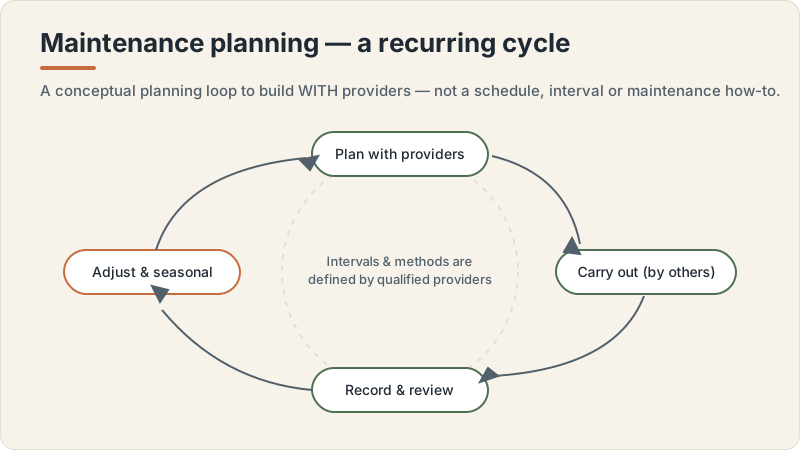
Maintenance planning cycle concept
Conceptual editorial diagram — not a construction drawing, specification, to-scale plan or proof of a real project. It is not engineering, structural, fire/life-safety, crowd-safety or accessibility-compliance guidance. Capacities, dimensions, standards, requirements and costs vary by facility type, audience, site, use case and governing body, and are confirmed with qualified professionals, relevant authorities and governing bodies. Build Design Hub does not design, build, inspect, certify, recommend or match anyone.
What this guide helps you prepare
This guide helps you turn a vague sense that an indoor sports facility needs looking after into an organised set of documents, questions and decisions you can take to qualified professionals. The aim is readiness, not instruction: by the time you finish preparing, you should know which building systems, surfaces and pieces of equipment exist in your facility, who holds the documentation for each, what you still need to request, and where the boundaries of your own knowledge sit. That clarity is what makes a maintenance conversation with a contractor, supplier or facility-management provider efficient rather than guesswork.
It also helps you separate planning from doing. A maintenance plan is an owner-side framework that records assets, responsibilities, warranties, documentation and review points; the actual maintenance work, and the intervals, methods and materials it involves, is defined by the people qualified to do it and varies by facility, surface, system, season and warranty terms. This guide stays firmly on the planning side. It will prompt you to gather and ask, never to perform a task on a surface, system or piece of equipment, and it repeatedly points you back to qualified professionals, suppliers, contractors and the relevant authorities and governing bodies to confirm anything specific.
- A register of the major building systems, sports surfaces and equipment your facility contains, so nothing is forgotten in planning
- A list of handover and documentation gaps to request from your project team, suppliers or previous operator
- Clarity on who is responsible for each asset under your current arrangements, and where responsibility is unclear
- A set of structured questions to bring to qualified professionals rather than assumptions to act on
- An understanding that this guide prepares and organises, but never defines maintenance intervals, methods or materials
Mapping the systems, surfaces and equipment to ask specialists about
Before you can plan maintenance, you need an honest inventory of what is in the building and who answers for it. An indoor sports facility typically brings together a building envelope and structure, mechanical and electrical systems such as heating, ventilation, lighting and water services, the sports surface or surfaces themselves, fixed equipment like goals, hoops, nets, dividers and seating, and loose or movable equipment. Each of these is documented differently and maintained by different specialists under different warranties. The planning task is to list them, note where the documentation lives, and flag the gaps; it is not to decide what should be done to any of them. Anything specific about a system or surface should be confirmed with the supplier, installer or a qualified professional, because requirements vary by facility type, use intensity, surface, system, climate, season, governing body, warranty terms, supplier documentation, contractor scope and local professional requirements.
Treat each asset as a question rather than a job. For a sports surface, the useful planning output is not a cleaning routine but a record of which surface was installed, who supplied and installed it, what supplier documentation and warranty exists, and who you would ask about its upkeep. The same logic applies to ventilation and lighting, to equipment that governing bodies may have expectations about, and to anything safety-related, which belongs with qualified professionals and the relevant authorities rather than with an internal assumption. Building this map gives specialists a clear starting point and lets you see at a glance where you are missing the information needed to plan responsibly.
- Which sports surface or surfaces are installed, who supplied and installed them, and what supplier documentation exists
- Which building systems (ventilation, heating, lighting, water services) serve the sports areas, and who holds their documentation
- What fixed equipment is present (goals, hoops, nets, dividers, seating, scoreboards) and who supplied or installed each item
- Where governing-body or supplier expectations may apply, noted as questions to confirm rather than rules to assume
- Which assets currently have no documentation, warranty record or named responsible party in your files
- Which items you believe are safety-related, to be routed to qualified professionals and relevant authorities rather than handled internally
Building a maintenance-planning framework, register and review rhythm
A maintenance-planning framework is the owner-side structure that holds everything together: an asset register, a record of who is responsible for what, links to warranties and supplier documentation, a defect or issue log, and a calendar of review points where you revisit the plan. None of these contain instructions or intervals. The asset register lists what exists; the responsibility record names who answers for each item; the documentation links point to where the real guidance lives; the defect log captures issues as they arise so patterns become visible; and the review rhythm gives you a predictable moment to involve professionals and update the plan. The intervals, methods and materials that sit behind any actual maintenance are defined by suppliers, contractors and qualified professionals, not by this framework.
A useful review rhythm is built around your own planning needs and the realities of seasonal use, not around any fixed schedule this guide could prescribe. Many operators find it helpful to prepare for periodic reviews, end-of-season or pre-season planning conversations, and warranty-milestone check-ins, but exactly when and how often these happen is something to agree with your providers and governing bodies. The point of the rhythm is governance: a recurring opportunity to ask whether documentation is current, whether responsibilities are still clear, whether defects are being logged and addressed by the right people, and whether anything needs a qualified professional's attention. The framework should make those questions easy to ask, not answer them for you.
- An asset register that records what exists and where its documentation lives, with no intervals or procedures attached
- A responsibility record naming who answers for each system, surface and item under current arrangements
- A defect or issue log to capture problems as they arise, for the right specialist to assess
- Links to warranties, supplier documentation and contractor scope so the real guidance is easy to find
- Planned review points (for example pre-season, end-of-season, warranty milestones) agreed with your providers, not fixed by this guide
- A note on each review of what changed, what is still unclear, and what needs a qualified professional
Planning questions before speaking with professionals
Before you contact a contractor, supplier or facility-management provider, it pays to organise your own position so the conversation starts from facts rather than gaps. Work through what you actually hold: the handover pack, warranty documents, supplier and installer details, equipment lists and any defect history. Note what is missing, what is ambiguous, and what you are assuming without evidence. The questions below are designed to surface those gaps for you internally, so that when you do speak with professionals you can be specific about what you have, what you need, and which decisions are still open. They are preparation prompts, not a script for performing or scheduling any maintenance.
Answering these honestly often reveals that the most urgent task is not maintenance at all but documentation: tracking down a missing warranty, confirming who installed a surface, or clarifying which party is contractually responsible for an item. Resolving those gaps first means the eventual conversation with a qualified professional is about substance rather than basic facts. Remember that anything specific, including requirements, intervals, lifespans, capacities or standards, varies by facility and must be confirmed with the relevant professionals, suppliers, contractors, authorities and governing bodies rather than assumed from this preparation.
- What handover, warranty and supplier documentation do we actually hold, and what is missing or out of date?
- For each major system, surface and item, can we name a single responsible party, or is responsibility unclear?
- Where are we making assumptions about upkeep, intervals or coverage that we cannot evidence from documentation?
- What defects or issues have already been observed, and have they been logged for the right specialist to assess?
- Which questions are about facts we can confirm ourselves, and which genuinely need a qualified professional?
- What governing-body, supplier or authority expectations do we need to ask about rather than guess?
Questions for qualified professionals
Once your own picture is organised, the next step is to prepare the questions you will put to qualified professionals, suppliers, contractors and the relevant authorities and governing bodies. The goal is to learn what your specific facility needs from the people responsible for defining it, not to confirm a routine you have already decided on. Good questions ask providers to explain their scope, their documentation, what their warranties do and do not cover, and how their recommendations relate to your surfaces, systems and use intensity. Keep the questions open: let the professional tell you what applies to your facility rather than leading them toward an answer you have assumed.
Because requirements vary by facility type, use intensity, surface, system, climate, season, governing body, warranty terms, supplier documentation, contractor scope and local professional requirements, treat everything you hear as specific to your context and to the provider's scope. Ask for documentation in writing, ask how their advice would change with heavier or different use, and ask explicitly what falls outside their responsibility so you can see where gaps remain. Build Design Hub does not provide any of these answers, does not maintain, inspect or certify anything, and does not recommend, rank or match providers; these questions are for the qualified professionals you choose to engage.
- What does your scope cover for our specific surfaces, systems and equipment, and what is explicitly excluded?
- How would your recommendations change with our use intensity, season, climate or governing-body context?
- What does the relevant warranty or supplier documentation actually require of the owner, and where can we see it in writing?
- Which items should be assessed by a different specialist, authority or governing body rather than by you?
- What documentation will you provide after any work, and how should we record it in our maintenance plan?
- Where do you see gaps or risks in our current asset register, responsibilities or defect log that we should address?
What this does not replace
This is an educational planning resource only. It is not a maintenance manual and not inspection, certification, engineering, architectural, structural, HVAC, electrical, safety-compliance, fire or life-safety, or accessibility-compliance advice, and it is not legal, tax, insurance or procurement advice. It does not maintain, operate, inspect, certify, audit or specify anything, gives no maintenance intervals or procedures as universal rules, and offers no warranty interpretation, estimate, price, ROI or capacity figure. Maintenance requirements and costs vary by facility type, use intensity, surface, system, climate, season, governing body, warranty terms, supplier documentation, contractor scope and local professional requirements, and are confirmed with qualified professionals, suppliers, contractors, relevant authorities and governing bodies.
Build Design Hub does not operate, maintain, inspect, certify, audit, design, build, recommend, rank, verify, introduce, broker or match suppliers, contractors, maintenance providers or facility managers, and HELPERG LLC is publisher/operator only. Use this resource to prepare your own thinking and records, then have qualified professionals you engage directly review your facility. Decisions about maintenance, inspection, safety, compliance, warranties, procurement and suitability must rest on those professionals, suppliers, the relevant authorities and the governing bodies for your sport and location.
- Not a maintenance manual and not maintenance instructions, intervals or procedures as universal rules
- Not inspection, certification, safety-compliance, fire/life-safety or accessibility-compliance advice
- Not engineering, architectural, warranty-interpretation, legal, tax, insurance or procurement advice
- Not a supplier, contractor, maintenance-provider or facility-manager recommendation, ranking, directory or matching service
- Not an estimate, price or cost figure — maintenance requirements and costs vary
- Qualified professional review is required before any operations or maintenance decision
Indoor sports facility maintenance-planning preparation worksheet
- 1List every major building system serving the sports areas (ventilation, heating, lighting, water services) and where its documentation is held
- 2Record which sports surface or surfaces are installed, with supplier, installer and warranty details
- 3Inventory all fixed equipment (goals, hoops, nets, dividers, seating, scoreboards) and note who supplied or installed each
- 4Inventory loose or movable equipment and note where its documentation lives
- 5Assign a named responsible party to each system, surface and item, and flag anything where responsibility is unclear
- 6Gather the handover pack and list what is missing, incomplete or out of date
- 7Collect all warranty and supplier documents and note expiry or milestone dates to ask about
- 8Start a defect or issue log to capture observed problems for the right specialist to assess
- 9Record any governing-body or supplier expectations as questions to confirm, not as rules to apply
- 10Note which items you believe are safety-related, to route to qualified professionals and relevant authorities
- 11Identify documentation gaps to request from your project team, suppliers or previous operator
- 12Draft the open questions you will bring to qualified professionals, suppliers and contractors
- 13Mark the planned review points (pre-season, end-of-season, warranty milestones) to agree with your providers
- 14List the decisions still open and the professional, authority or governing body who should inform each one
Common mistakes to avoid
- Treating a maintenance interval, frequency or method found online or used elsewhere as a universal rule, rather than confirming what applies to your specific surface, system and use with qualified professionals
- Assuming a warranty covers a particular item or situation without reading the actual warranty terms or asking the supplier in writing
- Skipping professional review and planning upkeep internally for systems, surfaces or safety-related items that belong with specialists and relevant authorities
- Building a maintenance plan with no asset register, so items are forgotten until a problem appears
- Leaving responsibility undefined, so it is unclear who answers for a system, surface or piece of equipment when something goes wrong
- Failing to log defects and issues, which hides patterns and makes it harder for the right specialist to assess them
- Confusing planning with doing, and treating this owner-side framework as if it were a maintenance manual with intervals and procedures
- Assuming governing-body or supplier expectations without confirming them with the body, supplier or a qualified professional
When to involve a professional
- When you are unsure who is responsible for a system, surface or item, or whether a warranty applies to your situation
- Before acting on any assumption about how a sports surface or building system should be maintained, since intervals, methods and materials must be defined by suppliers, installers or qualified professionals
- When an item is or may be safety-related, fire- or life-safety-related, or subject to accessibility considerations, which belong with qualified professionals and the relevant authorities
- When handover or supplier documentation is missing, ambiguous or contradictory and you cannot resolve it from your own records
- Before any seasonal, pre-season or warranty-milestone review where specialist input would change your plan
- When governing-body, certification, or local professional requirements may apply and you need them confirmed by the body or a qualified professional rather than assumed
Frequently asked questions
Questions readers ask about this topic
Does Build Design Hub maintain, inspect or certify my facility, or recommend providers?
No. Build Design Hub is an educational publisher and does not operate, maintain, inspect, certify, audit, design or build any facility, and it does not recommend, rank, verify, introduce or match suppliers, contractors, maintenance providers or facility managers. It also gives no costs, intervals or requirements. This guide only helps you prepare documents and questions; the actual work and any specific guidance come from the qualified professionals, suppliers, contractors and authorities you choose to engage.
Will this guide tell me how often to maintain my sports surface or building systems?
No. It deliberately gives no intervals, frequencies, schedules, chemicals, machinery settings or procedures. Those are defined with qualified providers and suppliers and vary by facility type, use intensity, surface, system, climate, season, governing body, warranty terms, supplier documentation, contractor scope and local professional requirements. The guide helps you organise what you know and what to ask, then points you to the right professionals to confirm anything specific.
What is the difference between a maintenance plan and the maintenance work itself?
A maintenance plan, in this context, is an owner-side planning framework: an asset register, responsibilities, links to warranties and documentation, a defect log and review points. The maintenance work, including how, when and with what it is done, is carried out and defined by qualified professionals, suppliers and contractors. This guide stays on the planning side and never instructs you to perform a task on a surface, system or piece of equipment.
Where do warranty and governing-body questions belong?
With the people who issued them. Warranty interpretation should be confirmed with the supplier or contractor and, where needed, a qualified professional; governing-body or certification expectations should be confirmed with the body itself or a qualified professional. This guide does not interpret warranties, give compliance or certification advice, or state requirements as facts; it only helps you frame those as questions to confirm with the right parties.
Keep reading