
Who this guide is for
- Facility owners and operators who want a maintenance schedule they understand and govern, rather than one they inherit and cannot question
- School, college and university estate teams preparing a maintenance-planning framework across one or several sports facilities and budget cycles
- Sports club committees, trustees and volunteers scoping who is responsible for what before approaching providers
- Municipal and parks managers structuring maintenance programs and records across community sports facilities
- Developers and project sponsors who must understand the maintenance obligations attached to a facility they are delivering or handing over
- Facility and operations managers building a schedule, register and record-keeping system to discuss with suppliers and contractors
Planning diagram
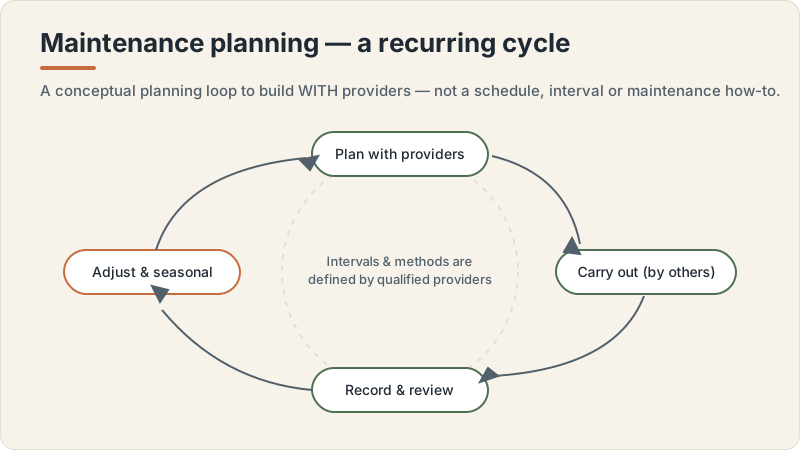
Maintenance planning cycle concept
Conceptual editorial diagram — not a construction drawing, specification, to-scale plan or proof of a real project. It is not engineering, structural, fire/life-safety, crowd-safety or accessibility-compliance guidance. Capacities, dimensions, standards, requirements and costs vary by facility type, audience, site, use case and governing body, and are confirmed with qualified professionals, relevant authorities and governing bodies. Build Design Hub does not design, build, inspect, certify, recommend or match anyone.
What this guide helps you prepare
This guide helps you build the framework and the paperwork that should sit underneath any maintenance schedule, so that when qualified providers and suppliers fill in the technical detail, you can read it, govern it and hold it together over time. The framework separates three distinct things that often get blurred: the categories of task a schedule should cover, the question of who is qualified to define each interval or method within those categories, and the records that prove the schedule is being followed and kept current. Owning that structure is an organisational task you can do; defining the intervals, methods, products and thresholds inside it is not, and this guide never attempts to.
It also helps you treat the schedule as a living governance document rather than a one-time deliverable handed over at practical completion. A maintenance schedule that no one reviews, that does not reflect changing use, and that is not tied to warranty terms or supplier documentation tends to drift out of date quietly until something goes wrong. Preparing means deciding in advance how the schedule will be built with providers, how it will be reviewed and by whom, and how records will be captured, so the document stays useful across seasons and across changes of staff or contractor.
- A plain statement of what the schedule must cover: the surfaces, systems, equipment and spaces in your facility that need ongoing attention
- A list of who defines each part of the schedule (which supplier, contractor, governing body or qualified professional), recorded as a responsibility, not assumed
- The categories of task you expect the schedule to organise, framed as headings to fill with professional input rather than fixed activities
- A note of where warranty terms, supplier documentation and governing-body expectations will need to shape the schedule, to confirm with each source
- A decision on how the schedule will be reviewed, how often that review is discussed with providers, and who signs it off internally
- A first draft of the questions and unknowns you want qualified providers and suppliers to resolve before the schedule is finalised
Categories of task a maintenance schedule can organise
A useful way to prepare is to think of a maintenance schedule as a set of categories to be populated, not a list of jobs you write yourself. Most facilities find it helpful to distinguish broad buckets such as playing surfaces, building fabric and structure, mechanical and electrical systems, plumbing and water, lighting, fencing and barriers, spectator and circulation areas, grounds and landscape, and any specialist equipment. Naming these categories gives a provider or supplier a clear structure to advise against, and gives you a way to check that nothing has been quietly left out of a proposal. The categories are organisational headings; what belongs inside each one, and how often anything is addressed, is for qualified providers, suppliers and the relevant governing bodies to define for your specific facility.
It also helps to recognise that different categories are defined by different people. Surface care may be governed by a supplier's documentation and a governing body's expectations; a building system may be tied to an installer's terms or a manufacturer's documentation; specialist equipment may carry its own provider conditions. Preparing means mapping each category to the source that should define it, so you can ask the right party rather than applying a single generic assumption across everything. Maintenance requirements vary by facility type, use intensity, surface, system, climate, season, governing body, warranty terms, supplier documentation, contractor scope and local professional requirements; confirm with qualified professionals.
- Which categories of asset your facility contains (surfaces, fabric, M&E, plumbing, lighting, fencing, spectator areas, grounds, specialist equipment) that the schedule must address
- For each category, which party is best placed to define its content: a supplier, a contractor, a manufacturer's documentation, a governing body or another qualified professional
- Where a category overlaps several providers, and how you will avoid gaps or duplicated assumptions between them
- Which categories are tied to warranty terms or supplier documentation that you must obtain and read rather than guess at
- How seasonal or use-intensity changes might affect which categories need more attention, framed as a question for providers
- What you currently assume about any category that you should explicitly flag for professional confirmation rather than write into the schedule
Who defines the intervals, and the records that keep the schedule honest
The single most important thing to get right in preparation is that you do not set the intervals; you organise the question of who does. An interval, frequency, method or threshold for any task is something a qualified provider, supplier, manufacturer's documentation or governing body defines for your facility, and it can change with use, climate, warranty conditions and the specifics of your surface or system. Your role is to capture, in your framework, which source defines each interval, what that source actually said, and the conditions attached to it, so that the schedule is traceable back to an authority rather than to a number someone once typed in. Treat any figure you have seen elsewhere as provisional until the responsible party confirms it for you in writing.
Records are what turn a schedule from a wall chart into a governance tool. Preparing means deciding, before work begins, what evidence you will keep: a defect and snag log from handover, a warranty register noting terms and what each warranty does and does not appear to cover (to confirm with the issuer), a record of who is responsible for each category, a log of completed activity supplied by providers, and a review history showing when the schedule was last revisited and by whom. Good records let you ask better questions, support warranty conversations, and hand a successor a facility they can understand. Build Design Hub does not maintain, inspect, certify, audit or verify any of this, and provides no intervals, costs or requirements; this is purely about organising your own evidence.
- For each task category, a record of which party defined the interval or method, exactly what they specified, and the conditions attached
- A warranty register capturing each warranty's terms, duration and apparent scope, with a note to confirm interpretation with the issuer rather than assume coverage
- A defect and snag log carried over from handover, kept open until items are closed and signed off
- A responsibility record showing who owns, performs, oversees and reports on each category of task
- A log of completed maintenance activity, supplied and evidenced by providers, kept against the schedule rather than in scattered emails
- A schedule-review history noting when the schedule was last reviewed with providers, what changed, and who approved it internally
Planning questions before speaking with professionals
Before you contact suppliers, contractors, governing bodies or qualified professionals, work through the questions you can answer yourself, because the clarity of your framework shapes the quality of the advice you receive. These are questions about your facility's use, your stakeholders, your records, your budget posture and your governance, not technical questions about how to maintain anything. Knowing how intensively the facility is really used, who holds responsibility for upkeep, what handover documentation you already possess, and how decisions get approved means a provider can spend their time defining a schedule rather than extracting basic facts from you.
It also helps to be honest about what you do not yet know and where your assumptions are soft. Distinguish what you have decided from what is still open, and resist the urge to write any interval, frequency or method into a draft schedule before a qualified source has confirmed it. The goal of this stage is to hand providers a clear framework with well-marked gaps, not a finished schedule full of guesses they then have to unpick. Every figure, frequency or standard you have in mind should be treated as provisional until the responsible party confirms it for your facility, use, surface, system and governing body.
- How intensively will the facility really be used, across which seasons, and how confident are we in that estimate?
- Which handover documents, warranties, supplier manuals and prior records do we already hold, and what is missing?
- Who is responsible for each category of upkeep today, and where are the boundaries unclear or unassigned?
- Who holds the maintenance budget, who approves changes, and what is our review and sign-off process?
- Which governing-body, league, school or insurer affiliations have expectations we will need to confirm directly?
- What do we currently assume about intervals, coverage or responsibilities that we should flag for professional confirmation rather than write down as fact?
Questions for qualified professionals
When you reach qualified providers, suppliers, governing bodies and relevant authorities, your aim is to convert your prepared framework into a confirmed, traceable schedule for your facility. Ask each party to define the content of the categories they are responsible for, to state the intervals and conditions in terms of your facility rather than generic rules, and to put that in documentation you can keep. Because requirements and recommendations vary by facility type, use intensity, surface, system, climate, season, governing body and warranty terms, ask every professional to confirm what applies to you, to flag where their advice is conditional, and to identify where another specialist should be consulted.
Use these conversations to test your framework, not just to fill it in. Ask providers what they would need from you to advise responsibly, how they would record completed work, what would prompt a change to the schedule, and how warranty terms interact with the maintenance they propose. Where any question touches safety, certification, inspection, compliance, insurance, warranty interpretation or governing-body rules, treat the professional's, supplier's or authority's written confirmation as the authoritative answer, never this guide or any draft schedule you have assembled.
- For each category you are responsible for, what should our schedule cover, and what intervals and conditions apply to our specific facility, surface or system?
- What does your documentation, warranty or governing-body expectation actually require, and how should that be reflected in the schedule and the records we keep?
- What records of completed work will you provide, and in what form, so our log stays evidenced and current?
- What would prompt a change to the schedule, and how should reviews be scheduled and conducted with you over time?
- Which matters here fall to another specialist, a governing body or an authority, and how do we confirm those directly?
- What information, access or records do you need from us to define this part of the schedule responsibly, and who else should we involve?
What this does not replace
This is an educational planning resource only. It is not a maintenance manual and not inspection, certification, engineering, architectural, structural, HVAC, electrical, safety-compliance, fire or life-safety, or accessibility-compliance advice, and it is not legal, tax, insurance or procurement advice. It does not maintain, operate, inspect, certify, audit or specify anything, gives no maintenance intervals or procedures as universal rules, and offers no warranty interpretation, estimate, price, ROI or capacity figure. Maintenance requirements and costs vary by facility type, use intensity, surface, system, climate, season, governing body, warranty terms, supplier documentation, contractor scope and local professional requirements, and are confirmed with qualified professionals, suppliers, contractors, relevant authorities and governing bodies.
Build Design Hub does not operate, maintain, inspect, certify, audit, design, build, recommend, rank, verify, introduce, broker or match suppliers, contractors, maintenance providers or facility managers, and HELPERG LLC is publisher/operator only. Use this resource to prepare your own thinking and records, then have qualified professionals you engage directly review your facility. Decisions about maintenance, inspection, safety, compliance, warranties, procurement and suitability must rest on those professionals, suppliers, the relevant authorities and the governing bodies for your sport and location.
- Not a maintenance manual and not maintenance instructions, intervals or procedures as universal rules
- Not inspection, certification, safety-compliance, fire/life-safety or accessibility-compliance advice
- Not engineering, architectural, warranty-interpretation, legal, tax, insurance or procurement advice
- Not a supplier, contractor, maintenance-provider or facility-manager recommendation, ranking, directory or matching service
- Not an estimate, price or cost figure — maintenance requirements and costs vary
- Qualified professional review is required before any operations or maintenance decision
Maintenance schedule planning and records worksheet
- 1List every asset category your facility contains (surfaces, building fabric, M&E systems, plumbing and water, lighting, fencing, spectator areas, grounds, specialist equipment) that a schedule must address.
- 2For each category, record which party should define its content: a supplier, contractor, manufacturer's documentation, governing body or other qualified professional.
- 3Gather and store all handover documentation, supplier manuals, warranties and any prior maintenance records you can locate.
- 4Build a warranty register noting each warranty's terms, duration and apparent scope, with a flag to confirm interpretation with the issuer rather than assume coverage.
- 5Carry the defect and snag log over from handover and keep it open until each item is closed and signed off.
- 6Write a responsibility record showing who owns, performs, oversees and reports on each category of task.
- 7Estimate the facility's real use intensity and seasonal pattern, noting how confident the estimate is, to share with providers.
- 8Note any governing-body, league, school or insurer affiliations whose expectations you will need to confirm directly.
- 9Create a slot in your framework for each interval or method that records which party defined it, exactly what they specified, and the attached conditions.
- 10Set up a log for completed maintenance activity, to be evidenced by providers, kept against the schedule rather than scattered across emails.
- 11Decide how and how often the schedule will be reviewed with providers, and who signs off changes internally, then start a review history.
- 12Separate what you have decided from what is still open or assumed, and mark every assumed interval, frequency or method for professional confirmation.
- 13Write the specific questions you want each supplier, contractor, governing body or authority to answer before the schedule is finalised.
- 14Note what records, access or information a provider may need from you to define their part of the schedule responsibly.
Common mistakes to avoid
- Treating an interval or frequency found online, in another facility's plan or in a template as a universal rule, instead of having the responsible party confirm it for your facility.
- Writing intervals and methods into a draft schedule yourself before any qualified provider, supplier or governing body has defined them.
- Assuming a warranty covers a given item or failure without reading the terms or confirming interpretation with the issuer.
- Leaving responsibilities undefined between owner, operator, club, volunteers and contractors, so categories of task fall into gaps where each assumes another is responsible.
- Accepting a single provider's proposal as a complete schedule without checking which asset categories it silently leaves out.
- Building the schedule once at handover and never reviewing it, so it drifts out of date as use, staff and contractors change.
- Keeping no records of completed work, warranties or who defined each interval, so the schedule cannot be governed, audited by professionals or handed on.
- Skipping professional review and treating a draft schedule, a template or this guide as authoritative on safety, compliance, certification or governing-body matters.
When to involve a professional
- When any category of the schedule touches player or public safety, certification, inspection, fire or life-safety, accessibility or governing-body rules, involve qualified professionals and the relevant authority before relying on any draft.
- Before finalising intervals, methods or thresholds for any surface, system or equipment, have the responsible supplier, contractor or qualified professional define and confirm them in writing for your facility.
- When you are interpreting a warranty, defect liability or supplier obligation, seek confirmation from the issuer or a qualified adviser rather than assuming coverage.
- When provider proposals diverge, leave categories unaddressed, or you cannot tell why intervals differ, ask a qualified professional to review scope, assumptions and exclusions with you.
- When use intensity changes sharply, a facility is altered or a new system is installed, have providers reassess the schedule rather than adjusting it yourself.
- Whenever you are unsure whether a requirement, interval, lifespan or standard applies to you, confirm it directly with the responsible supplier, qualified professional or governing body.
Frequently asked questions
Questions readers ask about this topic
Does this guide tell me how often to maintain my facility or what each task should involve?
No. It is an educational planning resource that helps you build a maintenance-schedule framework, organise records, and prepare questions. It states no intervals, frequencies, methods, chemicals, settings or procedures. The actual content of any schedule, including how often anything is addressed, is defined with qualified providers, suppliers and governing bodies who can assess your specific facility, surface and systems.
Can Build Design Hub maintain, inspect, certify or recommend a maintenance provider for me?
No. Build Design Hub does not maintain, inspect, certify, audit, verify or operate anything, and it does not recommend, rank, introduce, broker or match suppliers, contractors, maintenance providers or facility managers. It provides no costs, intervals, lifespans or requirements. This guide only helps you organise your own framework and questions so you can approach and compare providers yourself, then take advice from the qualified professionals you engage directly.
Who is supposed to define the intervals in my maintenance schedule?
Not you, and not this guide. Intervals, frequencies, methods and thresholds are defined by the responsible party for each category: a supplier, a contractor, a manufacturer's documentation, or a governing body, and they may be tied to warranty terms. Your job in preparation is to record which source defines each one, what they specified, and the conditions attached, then confirm everything in writing for your facility.
Why does the guide avoid giving intervals, lifespans, costs or standards?
Because those genuinely vary by facility type, use intensity, surface, system, climate, season, governing body, warranty terms, supplier documentation, contractor scope and local professional requirements. Stating them as facts would be misleading. The guide instead frames them as questions to confirm with qualified professionals, suppliers, relevant authorities and governing bodies for your specific situation.
What should I have ready before speaking with providers about a schedule?
A list of your asset categories, the handover documents and warranties you already hold, a realistic use-intensity estimate, a record of who is responsible for each category, your relevant affiliations, a clear note of what is decided versus assumed, and the specific questions you want each provider to answer. The worksheet in this guide is structured to help you assemble exactly that.
Keep reading