
Who this guide is for
- Owners and developers commissioning a new or refurbished sports surface who want to plan for its ongoing care before handover
- Facility managers and operators responsible for day-to-day running who need a structured way to organise maintenance documentation and supplier conversations
- Schools and education estates teams balancing surface upkeep against budgets, term calendars and multiple stakeholders
- Sports clubs and community associations preparing to take on responsibility for a pitch, court or multi-use surface
- Municipalities and parks departments coordinating maintenance planning across several facilities and contracts
- Project sponsors and trustees who need owner-side governance records and clear questions to put to specialists
Planning diagram
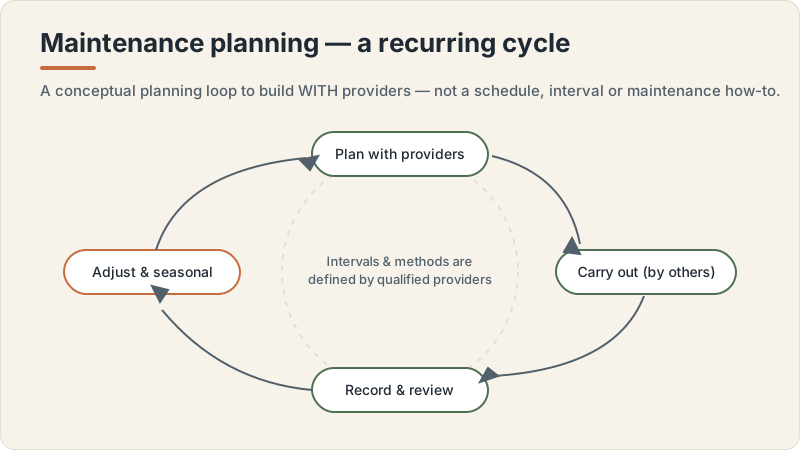
Maintenance planning cycle concept
Conceptual editorial diagram — not a construction drawing, specification, to-scale plan or proof of a real project. It is not engineering, structural, fire/life-safety, crowd-safety or accessibility-compliance guidance. Capacities, dimensions, standards, requirements and costs vary by facility type, audience, site, use case and governing body, and are confirmed with qualified professionals, relevant authorities and governing bodies. Build Design Hub does not design, build, inspect, certify, recommend or match anyone.
What this guide helps you prepare
This guide helps you build the owner-side foundation for surface maintenance conversations: a maintenance-planning framework, a list of handover documents to request, and a set of questions to put to suppliers, specialists and any maintenance provider you engage. The goal is readiness, not execution. Rather than telling you how to care for a surface, it helps you identify what you still need to confirm, who can confirm it, and where the answers should be recorded so they survive staff changes and contract renewals.
It is written for the planning stage and the period around handover, when decisions about responsibility, documentation and warranty are easiest to influence. By preparing structured questions and document requests in advance, you reduce the chance of gaps appearing later, such as missing as-built records, unclear warranty conditions or undocumented assumptions about who maintains what. Everything here is framed as a question to confirm with qualified professionals, because maintenance requirements vary by facility type, use intensity, surface, system, climate, season, governing body, warranty terms, supplier documentation, contractor scope and local professional requirements.
- A maintenance-planning framework you can populate with confirmed details from your own suppliers and specialists
- A list of handover and as-built documents to request and store in one place
- A register of who is responsible for which maintenance tasks, decisions and records
- Questions to surface warranty conditions, defect-reporting routes and documentation expectations
- A structure for seasonal and lifecycle review preparation, without prescribing any schedule
- Prompts to capture assumptions so they can be confirmed rather than carried forward unverified
Building a maintenance-planning framework and handover document request
A useful first step is to separate what you know from what you only assume. A maintenance-planning framework is simply an organised place to record the surface and system installed, the parties involved, the documents you hold, and the open questions you still need answered. It does not contain a schedule or a procedure; it points to where those would be defined with qualified providers. Treating it as a living record, owned on the operator side, helps continuity when contractors change or staff move on, and gives any future specialist a clear starting picture instead of a blank page.
Alongside the framework, prepare a handover document request so the right records are gathered while the people who created them are still available. Many disputes and gaps trace back to missing as-built information, unlabelled drawings or warranty paperwork that no one collected at the time. Ask what documentation exists, who holds it and in what format, then store copies centrally. Whether any document implies a particular maintenance need, interval or limitation is a question for the supplier or specialist who produced it, not something to infer from the document alone.
- Record the specific surface and system type as described by the supplier, without assuming it behaves like another
- Request as-built drawings, product data sheets and any manufacturer documentation provided at handover
- Ask which documents describe maintenance expectations and which are warranty or compliance related, and have the supplier confirm the distinction
- Capture the names and roles of the supplier, installer and any specialist for future reference
- Note where original documents are stored and keep operator-side copies in a central location
- List open questions and assumptions so they can be confirmed with the relevant professional rather than treated as fact
Warranty, defect logging and responsibility questions
Warranty and responsibility are areas where assumptions are costly, so prepare questions rather than conclusions. Owners sometimes assume a warranty covers a broader set of situations than its terms actually describe, or that maintenance responsibilities are obvious when they have never been written down. This guide does not interpret warranty terms; instead it encourages you to ask the supplier or warranty provider to explain, in writing, what the warranty addresses, what conditions attach to it, and how those conditions are intended to be evidenced. The interpretation itself belongs with qualified professionals and the issuing party.
A defect log and a responsibility register are owner-side records that help you ask better questions over time. A defect log is a dated record of issues you observe and report, capturing what was raised, to whom and what response was given, without you drawing engineering or condition conclusions. A responsibility register records who is accountable for each maintenance task, decision and document. Keeping both up to date means that when you do involve a specialist, you can show a clear history rather than reconstructing events from memory.
- Ask the supplier or warranty provider to explain warranty scope, conditions and exclusions in writing
- Confirm how warranty conditions are expected to be evidenced and what records to keep
- Ask who is responsible for raising, recording and resolving defects, and the route for doing so
- Maintain a dated defect log of issues reported and responses received, without recording condition or engineering conclusions
- Build a responsibility register mapping each maintenance task and decision to a named party
- Confirm what counts as a reportable issue and the agreed timeframe and channel for reporting
Planning questions before speaking with professionals
Before you contact a supplier, specialist or maintenance provider, spend time organising your own context so the conversation is efficient and specific. Vague enquiries produce vague answers; a clear picture of your surface, your use patterns and your existing documentation lets professionals give you guidance tailored to your facility. The questions below are for you to answer internally first, so you know what you are asking about and what you already hold. None of them require you to make technical judgements about the surface itself.
Preparing this way also helps you recognise where you genuinely lack information and therefore where professional input is essential. If you cannot describe the surface system, locate the warranty terms or say who is currently responsible for upkeep, those gaps become the first agenda items. Remember that maintenance requirements vary by facility type, use intensity, surface, system, climate, season, governing body, warranty terms, supplier documentation, contractor scope and local professional requirements, so the aim is to gather your facts, not to predetermine the answers.
- What exactly is the surface and system, as described in handover documentation, and where is that recorded?
- How intensively, and for what activities, is the surface used across a typical season?
- Which documents do you already hold, and which are missing or unclear?
- Who is currently responsible for each maintenance task and decision, and is that written down anywhere?
- What governing bodies, leagues or stakeholders have an interest in this surface, and have you confirmed their relevance with them?
- What questions or assumptions remain open that only a qualified professional or supplier can resolve?
Questions for qualified professionals
When you reach the conversation with a supplier, specialist, contractor or maintenance provider, use questions that draw out documentation, scope and responsibility rather than asking this guide to supply answers it cannot. The strongest questions ask the professional to explain, confirm or document something for your specific facility. Because intervals, methods, materials, lifespans and costs depend entirely on your situation and are defined by the people you engage, frame everything as a request to confirm in writing for your surface and system.
Keep a record of the answers alongside your planning framework so future staff and any new provider inherit a documented basis rather than informal recollection. If a professional declines to put something in writing, or if answers conflict between parties, treat that as a signal to seek clarification or a second qualified opinion. The questions below are starting points; adapt them to your facility, and confirm anything material with the relevant supplier, contractor, authority or governing body.
- For our specific surface and system, what maintenance considerations would you document, and can you provide that in writing?
- What does the supplier or manufacturer documentation say about ongoing care, and how should we interpret it for our use intensity and climate?
- What is included and excluded in any proposed maintenance scope, and how are responsibilities divided between us and you?
- What records should we keep to support the warranty, and how should issues be reported and documented?
- Which decisions require a qualified specialist, governing body confirmation or local professional input rather than operator judgement?
- How should we prepare for a seasonal or lifecycle review, and what documentation would you expect us to bring?
What this does not replace
This is an educational planning resource only. It is not a maintenance manual and not inspection, certification, engineering, architectural, structural, HVAC, electrical, safety-compliance, fire or life-safety, or accessibility-compliance advice, and it is not legal, tax, insurance or procurement advice. It does not maintain, operate, inspect, certify, audit or specify anything, gives no maintenance intervals or procedures as universal rules, and offers no warranty interpretation, estimate, price, ROI or capacity figure. Maintenance requirements and costs vary by facility type, use intensity, surface, system, climate, season, governing body, warranty terms, supplier documentation, contractor scope and local professional requirements, and are confirmed with qualified professionals, suppliers, contractors, relevant authorities and governing bodies.
Build Design Hub does not operate, maintain, inspect, certify, audit, design, build, recommend, rank, verify, introduce, broker or match suppliers, contractors, maintenance providers or facility managers, and HELPERG LLC is publisher/operator only. Use this resource to prepare your own thinking and records, then have qualified professionals you engage directly review your facility. Decisions about maintenance, inspection, safety, compliance, warranties, procurement and suitability must rest on those professionals, suppliers, the relevant authorities and the governing bodies for your sport and location.
- Not a maintenance manual and not maintenance instructions, intervals or procedures as universal rules
- Not inspection, certification, safety-compliance, fire/life-safety or accessibility-compliance advice
- Not engineering, architectural, warranty-interpretation, legal, tax, insurance or procurement advice
- Not a supplier, contractor, maintenance-provider or facility-manager recommendation, ranking, directory or matching service
- Not an estimate, price or cost figure — maintenance requirements and costs vary
- Qualified professional review is required before any operations or maintenance decision
Surface maintenance preparation and documentation worksheet
- 1Record the specific surface and system type exactly as described in handover or supplier documentation
- 2Request and store as-built drawings, product data sheets and manufacturer documentation
- 3Gather all warranty paperwork and note who issued it and where the originals are held
- 4List which documents you hold and which are missing, unclear or unconfirmed
- 5Build a responsibility register mapping each maintenance task and decision to a named party
- 6Note the contact details and roles of the supplier, installer and any specialist
- 7Start a dated defect log for issues observed and reported, with responses received
- 8Record current use patterns: activities, frequency and seasons, as you understand them
- 9List the governing bodies, leagues or stakeholders with an interest in the surface
- 10Capture open questions and unconfirmed assumptions for professional follow-up
- 11Prepare written questions about warranty scope, conditions and evidence requirements
- 12Prepare questions about maintenance scope, exclusions and the division of responsibilities
- 13Identify which decisions need a qualified professional, authority or governing body to confirm
- 14Set up a central, operator-side location where all of the above is stored and kept current
Common mistakes to avoid
- Treating a maintenance interval, frequency or method mentioned somewhere as a universal rule, rather than confirming it for your specific surface and system
- Assuming a warranty covers a situation without asking the issuing party to explain its scope, conditions and exclusions in writing
- Skipping the handover document request, then discovering as-built drawings or warranty terms are missing when they are needed
- Leaving maintenance responsibilities undocumented because they seem obvious, so accountability becomes unclear over time
- Inferring a surface's needs from how a different surface or facility behaves, instead of confirming with the supplier or specialist
- Recording condition or engineering conclusions in a defect log when the role of the log is only to capture what was observed and reported
- Carrying assumptions forward as facts rather than flagging them as open questions for a qualified professional
- Postponing professional involvement until a problem escalates, when early questions could have clarified responsibilities and documentation
When to involve a professional
- When you cannot describe the surface or system from the documentation you hold and need a supplier or specialist to confirm it
- When warranty terms, conditions or exclusions are unclear and require interpretation by the issuing party or a qualified adviser
- When proposed maintenance scope, responsibilities or exclusions are ambiguous or conflict between parties
- When a defect or issue has been observed and you are unsure how to report or document it correctly
- When governing-body, league or local requirements may apply and need to be confirmed with the relevant authority
- When you are preparing a seasonal or lifecycle review and want qualified input on what to assess and document
Frequently asked questions
Questions readers ask about this topic
Does Build Design Hub maintain, inspect or certify sports surfaces, or recommend providers?
No. Build Design Hub is an educational publisher only. It does not maintain, inspect, certify, audit, design, build, recommend, rank, verify, broker or match surfaces, systems, suppliers, contractors, maintenance providers or facility managers, and it does not provide costs, intervals or requirements. This guide helps you prepare questions and organise documentation; the answers come from qualified professionals, suppliers, contractors and the relevant authorities for your facility.
Why does this guide avoid giving maintenance intervals, methods or schedules?
Because maintenance requirements vary by facility type, use intensity, surface, system, climate, season, governing body, warranty terms, supplier documentation, contractor scope and local professional requirements. Stating a fixed interval or method as a universal rule would be misleading. Those details are defined with the qualified providers and suppliers responsible for your specific surface, and should be confirmed in writing for your situation.
What should I prepare before contacting a supplier or specialist?
Organise your own context first: record the surface and system as documented, note your use patterns and seasons, list the documents you already hold and those that are missing, and capture who is currently responsible for what. Bring your open questions and assumptions so the professional can address them directly. This makes the conversation more specific and helps you recognise where professional input is essential.
How should I use a defect log without overstepping?
Keep it as a simple, dated record of issues you observe and report: what was raised, to whom, and what response you received. Avoid recording condition, engineering or warranty conclusions, since those are judgements for qualified professionals. A clear, factual log gives any specialist you later involve an accurate history to work from, rather than relying on memory.
Keep reading