
Who this guide is for
- Owners and developers commissioning a new or refurbished sports facility who need to organise handover and operations records
- Facility managers and operators preparing an equipment inventory and maintenance-responsibility framework
- Schools and education estates teams planning governance for shared sports and activity spaces
- Sports clubs and community organisations preparing to take over operation of a venue
- Municipalities and parks departments coordinating maintenance ownership across multiple sites
- Project managers and consultants assembling owner-side handover documentation before occupancy
Planning diagram
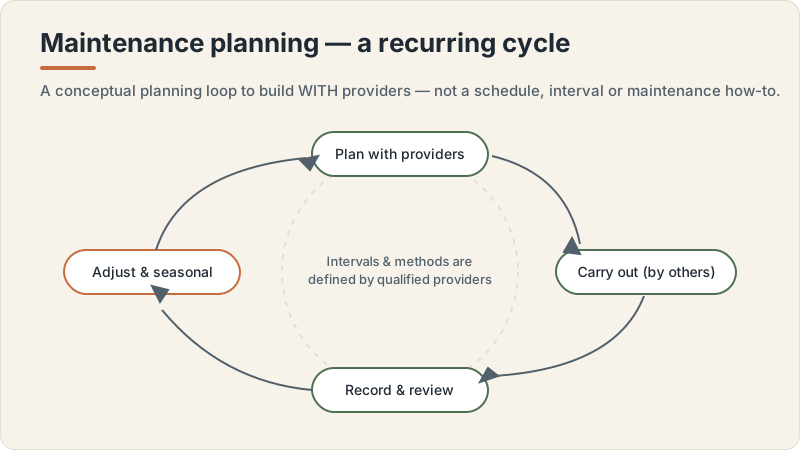
Maintenance planning cycle concept
Conceptual editorial diagram — not a construction drawing, specification, to-scale plan or proof of a real project. It is not engineering, structural, fire/life-safety, crowd-safety or accessibility-compliance guidance. Capacities, dimensions, standards, requirements and costs vary by facility type, audience, site, use case and governing body, and are confirmed with qualified professionals, relevant authorities and governing bodies. Build Design Hub does not design, build, inspect, certify, recommend or match anyone.
What this guide helps you prepare
This guide helps you prepare three connected things before maintenance actually begins: a structured list of the equipment in your facility, a request list for the manufacturer and supplier documentation that should accompany each item, and a set of questions about who is responsible for servicing what. None of these are the maintenance work itself; they are the planning and record-keeping that put you in a position to commission that work knowledgeably. The aim is to replace vague assumptions with documented questions you can put to qualified professionals, suppliers, contractors and the relevant governing bodies.
It is deliberately a preparation tool rather than a manual. It does not tell you how often anything should be serviced, what products or settings to use, or how long any item should last, because those answers depend on your specific facility, its surfaces and systems, how intensively it is used, the climate and season, the warranty terms attached to each item, the documentation each supplier provides, and the scope each contractor agrees. Treat every interval, lifespan, capacity or requirement you encounter as something to confirm in writing with the appropriate professional rather than as a rule you can apply yourself.
- Use it to build an owner-side picture of what equipment exists and what records you hold for each item
- Use it to decide which documents to request at handover rather than chasing them later
- Use it to frame responsibility questions before signing any maintenance or service arrangement
- Treat any number, interval or claim you collect as a question to confirm, never as a fact to act on
- Keep the output as your own planning record that supports conversations with qualified providers
Building an equipment list and the documents to request
A useful starting point is an equipment list that captures, for each item, enough identifying detail to ask good questions later: a plain description, where it is located, the manufacturer and model where known, any serial or asset reference, and the date it was installed or handed over. Sports facilities often combine very different categories of equipment, from fixed and movable goals, nets, posts and dividers, to seating, scoreboards and timing systems, to plant such as ventilation, lighting and water systems, to surface-care machinery and groundskeeping items. Listing them by category and location helps you see gaps and makes it obvious which items you have no paperwork for at all.
Alongside the list, plan which manufacturer and supplier documentation you intend to request for each item. Documents commonly associated with equipment include the operating and owner manuals, installation and commissioning records, parts lists, warranty terms and registration details, and any maintenance documentation the manufacturer provides. Requesting these does not tell you what to do; it gives you the source material that qualified professionals will interpret. Where a document refers to a maintenance interval, a consumable or a setting, record that it exists and treat it as something to confirm with the supplier or a qualified contractor for your specific installation rather than as instruction you act on directly.
- Record description, location, manufacturer, model, serial or asset reference and install/handover date for each item
- Group equipment by category and area so missing items and missing paperwork become visible
- List the documents you want to request per item: manuals, commissioning records, parts lists and warranty terms
- Note where a document exists but is missing, so you can request it before it becomes urgent
- Capture warranty registration details and registration deadlines as questions to confirm with the supplier
- Keep manufacturer maintenance documentation as reference to interpret with professionals, not as instructions to apply
Planning who services each item and how responsibility is recorded
Once you can see your equipment and your documents, the next planning layer is responsibility: for each item or system, who is expected to service it, under what arrangement, and how that is recorded. Responsibility can sit in different places, including the original supplier or installer under a warranty or service arrangement, a separate maintenance contractor, an in-house facilities team, or a governing-body or landlord arrangement. The point of planning here is not to decide the technical work but to make sure every item has a named owner of its servicing and that the basis for that ownership is written down rather than assumed.
This is also where a simple register helps you avoid gaps and overlaps. Record who you understand to be responsible, what the scope of that responsibility is said to be, where the supporting document lives, and what questions remain open. Be cautious about assuming a warranty automatically includes ongoing servicing, or that an installer's involvement continues after handover, or that a governing body's guidance imposes a specific obligation on you; each of these is a question to confirm with the relevant party in writing. Keeping responsibility and its evidence in one place gives you a defensible owner-side record and a clear agenda for conversations with qualified professionals.
- For each item, record who is understood to be responsible for servicing and the basis for that understanding
- Note whether responsibility sits with a supplier, contractor, in-house team or another arrangement, and where the document is
- Flag items with no named owner of servicing as open questions to resolve before issues arise
- Avoid assuming a warranty includes ongoing servicing; record it as a point to confirm in writing
- Capture governing-body or landlord expectations as questions to verify rather than obligations to assume
- Maintain a single responsibility register so gaps, overlaps and unanswered questions stay visible
Planning questions before speaking with professionals
Before you contact suppliers, contractors or qualified professionals, it is worth organising your own questions so the conversation is efficient and so you can tell which answers are missing. Working through your equipment list and document requests usually surfaces a natural set of questions: which items lack documentation, which have no clear servicing owner, which warranties you cannot locate or confirm, and which categories of equipment you understand least. Writing these down as your own internal agenda keeps the eventual professional conversation focused on confirmation and decisions rather than basic discovery.
This internal preparation is also where you decide what you are confident recording as a question versus what you might mistakenly record as a fact. Anything resembling an interval, frequency, lifespan, capacity, cost or standard belongs in the question column, framed as something to confirm with the appropriate party. Maintenance requirements vary by facility type, use intensity, surface, system, climate, season, governing body, warranty terms, supplier documentation, contractor scope and local professional requirements, so your job at this stage is to assemble good questions and a clean record, not to pre-answer them yourself.
- Which equipment items currently have no manual, commissioning record or warranty document on file?
- Which items or systems have no clearly named owner of their servicing?
- What warranty terms exist, and what do they appear to include or exclude that we should confirm?
- Which categories of equipment do we understand least and need a professional to walk us through?
- Which numbers, intervals or claims have we collected that must be confirmed before we rely on them?
- What seasonal or use-intensity factors might a professional need to know about our specific facility?
Questions for qualified professionals
With your list, documents and responsibility register prepared, you can put structured questions to the qualified professionals, suppliers, contractors and governing bodies who are equipped to answer them. The most useful questions confirm scope and responsibility for your specific installation: what servicing each item actually needs, who should carry it out, what the relevant documentation requires, and how warranty terms interact with any servicing arrangement. Asking these as open questions, rather than presenting your own assumptions, gives professionals room to correct misunderstandings before they become costly.
Keep a record of who answered, when, and on what basis, and ask for confirmation in writing where the answer affects responsibility, warranty or budget. Because requirements vary so widely by facility type, surface, system, climate, season, governing body, warranty terms, supplier documentation, contractor scope and local professional requirements, the same question may receive different valid answers for different items, and that is expected. The goal is a documented set of confirmed answers tied to specific equipment, not a single universal rule you apply everywhere.
- For this specific item, what servicing do you consider necessary, and who should carry it out?
- What does the manufacturer documentation require for our installation, and how should we interpret it?
- How do the warranty terms interact with servicing, and what could void or limit cover?
- What scope would a maintenance arrangement for these items typically include and exclude?
- Are there governing-body, surface or system factors specific to our facility we should account for?
- Can you confirm in writing the responsibilities, intervals or requirements that affect our records and budget?
What this does not replace
This is an educational planning resource only. It is not a maintenance manual and not inspection, certification, engineering, architectural, structural, HVAC, electrical, safety-compliance, fire or life-safety, or accessibility-compliance advice, and it is not legal, tax, insurance or procurement advice. It does not maintain, operate, inspect, certify, audit or specify anything, gives no maintenance intervals or procedures as universal rules, and offers no warranty interpretation, estimate, price, ROI or capacity figure. Maintenance requirements and costs vary by facility type, use intensity, surface, system, climate, season, governing body, warranty terms, supplier documentation, contractor scope and local professional requirements, and are confirmed with qualified professionals, suppliers, contractors, relevant authorities and governing bodies.
Build Design Hub does not operate, maintain, inspect, certify, audit, design, build, recommend, rank, verify, introduce, broker or match suppliers, contractors, maintenance providers or facility managers, and HELPERG LLC is publisher/operator only. Use this resource to prepare your own thinking and records, then have qualified professionals you engage directly review your facility. Decisions about maintenance, inspection, safety, compliance, warranties, procurement and suitability must rest on those professionals, suppliers, the relevant authorities and the governing bodies for your sport and location.
- Not a maintenance manual and not maintenance instructions, intervals or procedures as universal rules
- Not inspection, certification, safety-compliance, fire/life-safety or accessibility-compliance advice
- Not engineering, architectural, warranty-interpretation, legal, tax, insurance or procurement advice
- Not a supplier, contractor, maintenance-provider or facility-manager recommendation, ranking, directory or matching service
- Not an estimate, price or cost figure — maintenance requirements and costs vary
- Qualified professional review is required before any operations or maintenance decision
Equipment maintenance planning register: items to record and gather
- 1List every equipment item by category and location with a plain description
- 2Record manufacturer, model, serial or asset reference, and install or handover date for each item
- 3Note which items currently have no documentation on file at all
- 4Request and file operating and owner manuals for each item where available
- 5Request installation and commissioning records from the relevant supplier or installer
- 6Gather parts lists and any manufacturer maintenance documentation as reference material
- 7Record warranty terms, registration details and any registration deadlines to confirm
- 8Assign a named owner of servicing to each item, or flag it as an open question
- 9Record the basis for each servicing responsibility and where the supporting document lives
- 10Maintain a responsibility register that exposes gaps, overlaps and unanswered questions
- 11Log every interval, lifespan, capacity or cost you encounter as a question to confirm, not a fact
- 12Note seasonal, surface, system and use-intensity factors specific to your facility
- 13Prepare a question list for suppliers, contractors and qualified professionals before contacting them
- 14Keep a record of who answered each question, when, and whether it was confirmed in writing
Common mistakes to avoid
- Treating a maintenance interval or frequency found in a document as a universal rule rather than confirming it for your specific installation
- Assuming a warranty automatically includes ongoing servicing rather than checking what it covers and excludes
- Recording an interval, lifespan or capacity as a fact instead of as a question to confirm with the appropriate party
- Leaving items with no named owner of servicing, so responsibility falls through gaps at handover
- Skipping document requests at handover and trying to chase manuals and records much later
- Assuming an installer's involvement continues after handover without confirming any service arrangement
- Treating governing-body guidance as a specific obligation on you without verifying it with the relevant party
- Proceeding without professional review on items or systems you do not fully understand
When to involve a professional
- When an item or system lacks documentation and you cannot tell what servicing it needs or who should provide it
- When warranty terms are unclear or appear to interact with a proposed servicing arrangement
- When responsibility for an item is disputed, overlapping or undefined between supplier, contractor and in-house teams
- When plant, ventilation, lighting, water or electrical systems are involved and require qualified expertise
- When governing-body, surface or system requirements may apply and need authoritative confirmation
- When any decision affects safety, compliance, budget or warranty cover and should be confirmed in writing by a qualified professional
Frequently asked questions
Questions readers ask about this topic
Does Build Design Hub maintain, inspect or certify equipment, or recommend a provider for me?
No. Build Design Hub is an educational resource only. It does not maintain, inspect, service, audit or certify any facility or equipment, and it does not recommend, rank, match, introduce or broker maintenance providers, suppliers or contractors. It also gives no costs, intervals, lifespans, requirements or standards as facts. This guide only helps you organise your own questions and records so you can speak more clearly with the qualified professionals who do that work.
Can this guide tell me how often to service a piece of equipment?
No. It deliberately gives no maintenance intervals, frequencies, chemicals, settings or procedures. Maintenance requirements vary by facility type, use intensity, surface, system, climate, season, governing body, warranty terms, supplier documentation, contractor scope and local professional requirements, so any such detail must be confirmed with the manufacturer, supplier or a qualified contractor for your specific installation.
What should I do with a maintenance interval I find in a manufacturer document?
Record that the document exists and treat the interval as a question to confirm rather than an instruction to apply yourself. Manufacturer documentation is reference material that qualified professionals interpret for your specific equipment and conditions; confirm with the supplier or a qualified contractor before relying on any figure or instruction it contains.
How does this guide help if I am taking over an existing facility?
It helps you build an equipment inventory, identify which documents are missing, and assign a named owner of servicing to each item or flag it as an open question. That gives you an owner-side record and a focused agenda for the qualified professionals, suppliers and contractors who can confirm what is actually required.
Keep reading