
Who this guide is for
- Facility owners preparing to plan upkeep of an outdoor surface, pitch or court before engaging providers
- Operators and facility managers organising handover documents, logs and seasonal review preparation
- Schools and colleges planning governance and record-keeping for outdoor sports grounds they hold
- Clubs and community groups preparing maintenance conversations with suppliers and contractors
- Municipalities and developers building owner-side documentation for outdoor sports assets
- Project sponsors who need an organised maintenance picture before briefing a board or committee
Planning diagram
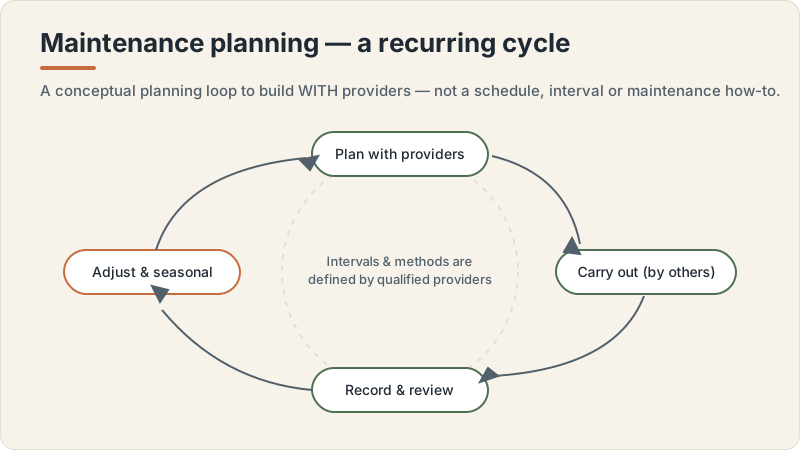
Maintenance planning cycle concept
Conceptual editorial diagram — not a construction drawing, specification, to-scale plan or proof of a real project. It is not engineering, structural, fire/life-safety, crowd-safety or accessibility-compliance guidance. Capacities, dimensions, standards, requirements and costs vary by facility type, audience, site, use case and governing body, and are confirmed with qualified professionals, relevant authorities and governing bodies. Build Design Hub does not design, build, inspect, certify, recommend or match anyone.
What this guide helps you prepare
This guide helps you build the owner-side groundwork for maintaining an outdoor sports facility: the handover documentation to request, the records to keep, the questions to raise and the gaps to take to qualified professionals. It is aimed at the stage before maintenance is defined and carried out, so that when you speak with suppliers, contractors or a facility manager, you arrive with an organised picture of your surface, drainage and weather exposure rather than starting from a blank page. The work here is gathering and questioning, not deciding or doing.
Good maintenance planning at this stage does not try to settle what should be done, how often or with what. It frames those as questions and captures what your own documents and providers actually say, in writing. Maintenance requirements vary by facility type, use intensity, surface, system, climate, season, governing body, warranty terms, supplier documentation, contractor scope and local professional requirements, so this guide deliberately keeps intervals, methods and figures as things to confirm with qualified professionals rather than presenting any of them as fact.
- A list of handover and as-built documents to request and store for your facility
- A defect, warranty and maintenance log structure you can keep over time
- A risk register covering surface, drainage and weather-exposure uncertainties
- A set of questions to bring to suppliers, contractors and any facility manager
- A record separating what your documents state from what still needs confirmation
- A lifecycle and seasonal-review framework to revisit as conditions change
Surfaces, drainage and weather exposure as questions to organise
The three areas that most shape outdoor-facility upkeep planning are the playing surface, the drainage that keeps it usable, and the weather and seasonal exposure that act on both. Rather than treating these as things you must learn to maintain yourself, it helps to treat each as a cluster of questions: what surface and build-up do you actually have, what drainage design sits beneath and around it, and what weather and seasonal patterns does the site experience. Your handover and supplier documentation is the first place to look for answers, and where it is silent, you have a question rather than a fact.
Surface, drainage and weather are also connected, so it is worth recording how providers describe the links between them rather than considering each in isolation. How a surface behaves after rain, how drainage is expected to perform under heavy use, and how seasonal conditions affect both are exactly the kinds of questions to raise with the people who supplied, built or will maintain the facility. Keep any statement about how often something needs attention, what products suit your surface, or what your drainage can handle as a question to confirm with qualified professionals, because these depend on your specific build, climate and warranty terms and are not universal.
- What surface type and build-up your documentation actually records, and what is unstated
- What the drainage design is, and which documents describe how it is expected to perform
- Which weather and seasonal conditions the site experiences and how providers say they affect upkeep
- Where surface, drainage and weather questions overlap and need a joined-up answer
- Which surface or drainage claims in your documents are specific to your build versus generic
- What your supplier or contractor says you should confirm with them rather than assume
Handover, warranty and lifecycle records to assemble
Much of maintenance planning is record-keeping rather than action, and the most useful records usually originate at handover. It is reasonable to ask for as-built drawings, surface and drainage documentation, product and material data sheets, written warranty wording, any maintenance documentation the supplier or contractor provides, and a clear statement of what each party considers their responsibility. Gathering these into one organised place, and noting what is missing, gives you and any professional you later engage something concrete to work from instead of relying on memory or conversation.
Warranty and lifecycle records deserve particular care because they are easy to assume and hard to reconstruct later. Rather than interpreting warranty wording yourself, record exactly what it says and mark anything unclear as a question for the provider and, where appropriate, a qualified professional. The same applies to lifecycle expectations: capture what your documents and suppliers state about how the surface, drainage and structures are expected to behave over time, while treating any specific lifespan, interval or condition claim as something to confirm rather than a fixed fact, since these vary by build, use and conditions.
- As-built drawings and surface, drainage and structural documentation from handover
- Product and material data sheets for the surface, drainage and related components
- Written warranty wording, with unclear points marked as questions rather than interpreted
- A statement of which party is responsible for what, including any maintenance obligations
- A defect log capturing observations, dates and what providers say, without diagnosis
- Lifecycle notes recording stated expectations while flagging intervals and lifespans to confirm
Planning questions before speaking with professionals
Before you contact a supplier, contractor or facility manager, it helps to work through what you already hold and what you still need, so your enquiries are focused and your records support them. This means reviewing your handover and warranty documentation, noting where it is silent or unclear, and writing down the surface, drainage and weather questions that genuinely affect your facility. Preparing this way tends to make later conversations shorter and clearer, and helps you tell the difference between a confident answer and a confirmed one.
It also helps to be honest with yourself about what is unknown. The most useful thing you can bring to a professional is an organised account of what your documents say, what your providers have stated and where you are unsure, so their input can focus where it matters. Keep questions about intervals, methods, products, costs and lifespans as questions, because settling them is the job of qualified professionals working from your specific facility, not of any general guide or assumption.
- Have you gathered your handover, as-built, warranty and supplier documentation in one place?
- Which surface, drainage or weather details are missing, generic or unclear in your records?
- Have you written down the questions that are specific to your facility rather than generic ones?
- Have you separated what your documents and providers state from what you have confirmed?
- Have you logged defects, observations and warranty points without trying to diagnose them?
- Have you identified which open questions a qualified professional, supplier or authority should answer?
Questions for qualified professionals
When you do engage suppliers, contractors, a facility manager or relevant authorities, the goal is to turn your organised records and open questions into answers you can rely on. Useful questions ask what your specific surface and drainage require, what your documentation and warranty actually commit each party to, how weather and seasonal exposure should shape your planning, and what they recommend you confirm independently. Asking for answers in writing keeps your records consistent and gives any future professional something concrete to review.
Treat the answers you receive as input to be recorded and, where they conflict or carry consequences, reviewed by qualified professionals rather than acted on blindly. Questions about maintenance intervals, methods, products, costs, lifespans, certification, compliance and warranty interpretation all sit with the appropriate professionals, suppliers and authorities, because they vary by facility, build, climate, governing body and contract. This guide helps you ask them well; it does not answer them for you.
- What does my specific surface and drainage build require, and what should I confirm with whom?
- What exactly do my warranty and handover documents commit each party to maintaining?
- How should weather and seasonal exposure at this site shape my maintenance planning?
- Which of my recorded claims, intervals or lifespan expectations need independent confirmation?
- Where do providers' answers conflict, and which conflicts need a qualified professional's review?
- What official requirements, governing-body rules or approvals might apply and where do I confirm them?
What this does not replace
This is an educational planning resource only. It is not a maintenance manual and not inspection, certification, engineering, architectural, structural, HVAC, electrical, safety-compliance, fire or life-safety, or accessibility-compliance advice, and it is not legal, tax, insurance or procurement advice. It does not maintain, operate, inspect, certify, audit or specify anything, gives no maintenance intervals or procedures as universal rules, and offers no warranty interpretation, estimate, price, ROI or capacity figure. Maintenance requirements and costs vary by facility type, use intensity, surface, system, climate, season, governing body, warranty terms, supplier documentation, contractor scope and local professional requirements, and are confirmed with qualified professionals, suppliers, contractors, relevant authorities and governing bodies.
Build Design Hub does not operate, maintain, inspect, certify, audit, design, build, recommend, rank, verify, introduce, broker or match suppliers, contractors, maintenance providers or facility managers, and HELPERG LLC is publisher/operator only. Use this resource to prepare your own thinking and records, then have qualified professionals you engage directly review your facility. Decisions about maintenance, inspection, safety, compliance, warranties, procurement and suitability must rest on those professionals, suppliers, the relevant authorities and the governing bodies for your sport and location.
- Not a maintenance manual and not maintenance instructions, intervals or procedures as universal rules
- Not inspection, certification, safety-compliance, fire/life-safety or accessibility-compliance advice
- Not engineering, architectural, warranty-interpretation, legal, tax, insurance or procurement advice
- Not a supplier, contractor, maintenance-provider or facility-manager recommendation, ranking, directory or matching service
- Not an estimate, price or cost figure — maintenance requirements and costs vary
- Qualified professional review is required before any operations or maintenance decision
Outdoor sports facility maintenance planning register
- 1Record your facility type, surface and drainage design as described in your documents
- 2Gather as-built drawings and surface, drainage and structural documentation in one place
- 3Collect product and material data sheets for the surface, drainage and related components
- 4Store written warranty wording and mark any unclear points as questions, not interpretations
- 5Note which party your documents say is responsible for what, including maintenance obligations
- 6List surface, drainage and weather questions that are specific to your facility
- 7Record what providers state drives upkeep, keeping intervals and methods as questions with no figures
- 8Keep a defect and observation log with dates, without diagnosing causes yourself
- 9Capture stated lifecycle expectations while flagging lifespans and intervals to confirm
- 10Maintain a risk register of surface, drainage and weather-exposure uncertainties
- 11Note where documentation is missing, generic or inconsistent across providers
- 12Prepare a structured set of prompts for seasonal reviews and supplier conversations
- 13Mark each claim as confirmed or still to verify with a supplier, authority or professional
- 14Compile your open questions and unconfirmed points for qualified professional review
Common mistakes to avoid
- Treating a maintenance interval or routine you read somewhere as a universal rule for your facility
- Assuming a warranty covers a surface or drainage issue without reading and confirming the wording
- Taking a confident verbal answer as a confirmed, documented fact about your specific build
- Trying to diagnose a surface or drainage problem yourself instead of logging and asking
- Assuming weather and seasonal effects on your site match a generic example rather than confirming
- Skipping handover and as-built documentation and relying on memory or conversation later
- Treating a stated lifespan or condition claim as fixed rather than as something to confirm
- Using your own planning notes as a decision instead of input for qualified professional review
When to involve a professional
- When you need your specific surface and drainage requirements defined rather than assumed
- When warranty wording is unclear or you are unsure what each party is obliged to maintain
- When provider answers conflict and you cannot tell which to rely on
- When a logged defect or drainage concern may have consequences and needs expert assessment
- When official requirements, governing-body rules or approvals may apply and must be confirmed
- When you are ready to turn your records and questions into a maintenance plan or contract
Frequently asked questions
Questions readers ask about this topic
Does this guide tell me how often to maintain my outdoor facility or what to use?
No. It gives no intervals, schedules, products, chemicals, machinery settings or procedures, because these vary by facility type, surface, drainage, use intensity, climate, season, governing body and warranty terms. It helps you organise the questions and records to take to qualified professionals, suppliers and authorities, who define these for your specific facility.
Does Build Design Hub maintain, inspect, certify or recommend providers for my facility?
No. Build Design Hub is an educational publisher and does not maintain, inspect, certify, audit or operate facilities, and it does not recommend, rank, verify, introduce or match suppliers, contractors or facility managers. It also gives no costs, intervals or requirements. This guide only helps you prepare your own records and questions for the qualified professionals you engage directly.
Can I rely on my warranty to cover surface or drainage problems?
Treat warranty coverage as something to read carefully and confirm with the provider, and where needed a qualified professional, rather than assume. This guide does not interpret warranty wording. It helps you record exactly what your documents say and mark unclear points as questions, so the right party can confirm what is and is not covered for your facility.
Is my own planning record enough to manage maintenance without a professional?
No. The record helps you arrive organised, but decisions about what to maintain, how and when should rest on review by qualified professionals, suppliers and any relevant authorities you engage directly. Your notes are input for that review, not a substitute for it, and many questions can only be answered against your specific surface, drainage and conditions.
Keep reading