
Who this guide is for
- Facility owners weighing whether to phase an indoor sports hall renovation or attempt it in one closure
- Clubs and sports organizations that need to keep some activity running during an upgrade
- Schools planning a sports hall or gym refurbishment around term time and existing users
- Municipalities and public-facility managers preparing a brief for a multi-purpose indoor space project
- Developers and project sponsors scoping an indoor court or training-space conversion
- Facility and operations managers who will manage disruption, access and handover during the work
Planning diagram
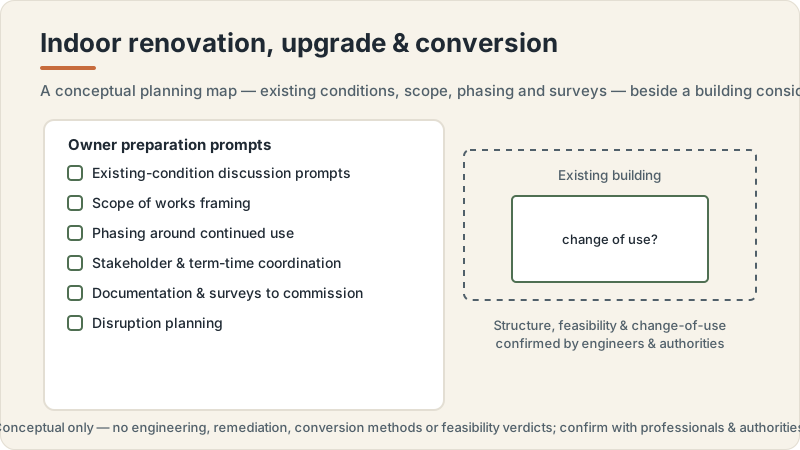
Indoor renovation, upgrade and conversion concept
Conceptual editorial diagram — not a construction drawing, specification, to-scale plan or proof of a real project. It is not engineering, structural, fire/life-safety, crowd-safety or accessibility-compliance guidance. Capacities, dimensions, standards, requirements and costs vary by facility type, audience, site, use case and governing body, and are confirmed with qualified professionals, relevant authorities and governing bodies. Build Design Hub does not design, build, inspect, certify, recommend or match anyone.
What this guide helps you prepare
This guide helps you prepare to discuss project phasing as an owner or sponsor, not to decide it yourself. Phasing an indoor sports facility project touches many overlapping considerations: which parts of the building stay in use, how support spaces like changing and store rooms are affected, how users and neighbors experience disruption, and where the natural decision points fall. Getting your own thinking organized before you engage a professional team helps them understand your priorities, constraints and non-negotiables, and helps you compare the options they present against a clear brief rather than reacting to each proposal in isolation.
It is important to be clear about what this guide does not do. It does not tell you whether phasing is feasible for your building, how a project should be sequenced, or in what order any work should occur, because those are judgments for qualified professionals who have assessed your specific site, structure, systems and scope. Instead, this guide helps you assemble the questions, documents and priorities you will bring into those conversations, so the professional team can advise on a phasing approach that fits your facility, your users and the constraints that apply to your location and use case.
- Clarify why phasing is even on the table for your facility (continued use, funding stages, seasonal access, or something else)
- List the activities and user groups that must, should, or need not continue during the project
- Identify which support spaces (changing, storage, entrance, circulation) are tied to which main spaces
- Note the constraints you already know about (term dates, season, tenancy, events) without assuming they can all be met
- Gather the existing documents and drawings a professional team may ask to see
- Separate your priorities and preferences from decisions that belong to qualified professionals
Understanding phases and decision points as an owner
A useful way to prepare is to think of your project as a series of decision points rather than a single go-ahead. Early on, an owner typically has to decide the overall intent: is this a like-for-like refresh, an upgrade of certain systems or surfaces, a change of use for a space, or a broader conversion? Later decision points may involve confirming scope after a professional assessment, choosing between options a design team presents, and agreeing how the facility will operate at each stage. You do not need to know the technical answers at these points; you need to know what each decision affects, who is accountable for it, and what information you will need in hand to decide well.
Some decisions genuinely belong to the owner, such as budget priorities, which user groups take precedence, acceptable levels of disruption, and how success will be defined. Others only look like owner decisions but are actually professional judgments, such as whether two areas can be worked on at once, whether a space can remain occupied during certain work, or whether a proposed order of work is safe and workable. Preparing to tell these apart, and to ask who owns each decision, keeps you from over-committing to a phasing idea before the people qualified to assess it have weighed in. Whether any particular sequence is feasible or advisable varies by facility type, site, systems, governing body and professional team, and must be confirmed with qualified professionals.
- Map the major decision points you expect, from initial intent through scope confirmation to stage sign-offs
- For each decision, ask whether it is genuinely yours or a professional judgment you are only approving
- Identify what information you would want in front of you before each decision
- Consider how governing-body rules or authority approvals might gate certain decisions (confirm with the relevant bodies)
- Decide how you will document decisions and the reasons behind them for later reference
- Prepare to ask the professional team where owner input is needed and by when
Thinking through disruption and continued operation
Disruption planning is often the reason phasing is considered at all, so it is worth preparing your thinking on it early. Consider how the facility is used across a typical week and year: fixtures, training, lessons, community bookings, quiet periods and peak seasons. Then think about which of these could pause, relocate, or shrink, and which are effectively fixed. The point of this preparation is not to design a phasing plan, but to give the professional team a clear picture of the operational realities they must work around, and to help you understand the trade-offs when they explain what is and is not possible. Assumptions about how long a space can be unavailable, or whether users can share reduced facilities, should be tested with professionals rather than treated as settled.
Continued operation also raises practical questions about access, separation, support spaces and communication that owners are well placed to think about in advance. Where would users enter if the usual entrance is affected? How are changing and toilet facilities handled if part of the building is out of use? Who needs to be told what, and when? These are legitimate owner-side preparations, but any judgment about whether a facility can safely remain partly occupied during work, or whether particular areas can be separated, is a professional one that depends on the site, the scope and applicable requirements. Frame your disruption thinking as questions to raise, not conclusions to impose, and confirm feasibility with qualified professionals and the relevant authorities.
- Describe how the facility is used across a week and a year, including peaks and quiet periods
- Identify which activities could pause, relocate or reduce, and which are effectively fixed
- List the support spaces (changing, toilets, storage, first-aid, reception) tied to each area of use
- Note the communication needs: who must be informed, and through what channels
- Consider temporary access and separation questions to raise (never decide) with professionals
- Prepare to confirm with professionals whether any partial occupation during work is workable for your site
Planning questions before speaking with professionals
Before you engage a design or project team, it helps to work through questions on your own so you arrive with a clearer brief. These are owner-side reflection questions about intent, priorities, constraints and tolerance for disruption. Answering them does not commit you to any approach and does not substitute for professional advice; it simply sharpens the conversation and helps professionals understand what matters most to you. Where a question touches feasibility, requirements or technical judgment, treat your answer as a starting hypothesis to test, not a fixed position.
Working through these prompts also surfaces gaps in what you know, which is valuable in itself. If you cannot answer how a space is used, or which constraints are firm, that tells you what to investigate or gather before the first professional meeting. The goal is to reduce the number of unknowns you are carrying, and to be honest about which of your assumptions still need confirmation from qualified professionals, relevant authorities and governing bodies.
- What is the core intent of this project, in one or two plain sentences?
- Which outcomes would make this project a success, and which would make it a failure, from your perspective?
- What level of disruption is genuinely acceptable to your users, and what is not?
- Which constraints (dates, seasons, events, tenancies) are firm, and which have flexibility to confirm?
- What documents, drawings and records can you already provide about the existing facility?
- Which of your current assumptions do you know still need to be checked with professionals?
Questions for qualified professionals
When you do meet qualified professionals, the value of your preparation shows in the questions you ask and the documentation you request. Rather than asking them to confirm a phasing plan you have already fixed, ask them to assess feasibility, explain trade-offs, and set out where owner decisions are needed. Ask them to be explicit about what they are and are not responsible for, and about which approvals, requirements or governing-body rules apply to your specific facility and location. Any figures, sequences, timelines or requirements they discuss should be documented as their professional position for your project, not treated as general facts.
It also helps to ask for the documentation that will let you make informed decisions and hand the facility over well at the end. Request that assumptions, dependencies and decision points be written down, so you can compare options and understand what each choice affects. Because responsibilities, requirements and feasibility all vary by location, facility type, use case, governing body, owner, site, authority, professional team and project scope, ask each professional to confirm what applies to your project rather than relying on general expectations.
- Which parts of my project are feasible to phase, and what would each option affect operationally?
- Which decisions are mine as owner, and which are professional judgments I would be approving?
- What approvals, governing-body rules or authority requirements apply to a project like this in this location?
- What documentation will you provide at each stage and at handover, and what will you need from me?
- What are the key dependencies and risks in the options you are presenting, in writing?
- What is outside your scope, and which other professionals should I involve and when?
What this does not replace
This is an educational planning resource only. It is not an indoor sports facility construction manual and not structural or architectural design, HVAC/ventilation, lighting or acoustic engineering, fire or life-safety, or accessibility-compliance advice, and it is not permit, zoning, inspection, certification, legal, tax, insurance or procurement advice. It does not design, build, engineer, specify, size, certify, inspect or approve anything, gives no capacities, dimensions, clearances, lux, air-change rates, acoustic or temperature thresholds, revenue, ROI or costs, and offers no warranty interpretation or estimate. Requirements, standards, capacities and costs vary by location, facility type, use case, governing body, owner, site, authority, professional team and project scope, and are confirmed with qualified professionals, relevant authorities and governing bodies.
Build Design Hub does not design, build, engineer, inspect, certify, recommend, rank, verify, introduce, broker or match suppliers, contractors, consultants or professionals, and HELPERG LLC is publisher/operator only. Use this resource to prepare your own thinking and briefs, then have the qualified professionals you engage directly — architects, structural and building-services engineers, lighting, acoustic, accessibility and fire/life-safety specialists, and legal or procurement advisors where appropriate — review your project. Decisions about design, engineering, systems, safety, accessibility, compliance, capacity, procurement and cost must rest on those professionals, the relevant authorities and the governing bodies for your sport and location.
- Not an indoor sports facility construction manual and not structural or architectural design
- Not HVAC/ventilation, lighting or acoustic engineering, fire/life-safety or accessibility-compliance advice
- Not permit/zoning, inspection, certification, warranty-interpretation, legal, tax, insurance or procurement advice
- Not a supplier, contractor, consultant or professional recommendation, ranking, directory or matching service
- Not an estimate and gives no capacity, dimension, system-performance, revenue, ROI or cost figures — requirements and costs vary
- Qualified professional review is required before any indoor sports facility project decision
Indoor sports facility phasing preparation worksheet
- 1Record the core intent of the project (refresh, upgrade, change of use, or conversion) in plain language
- 2Write down why phasing is being considered, and note it as an option to test, not a decision
- 3List every user group and activity that uses the facility across a week and a year
- 4Mark which activities must continue, could relocate or reduce, and could pause
- 5Map each main space to the support spaces (changing, toilets, storage, reception) it depends on
- 6Note all constraints you know of (term dates, season, events, tenancies) and flag which are firm versus flexible to confirm
- 7Gather existing drawings, records, manuals and prior reports the professional team may request
- 8List the major decision points you anticipate and who you think should own each
- 9Separate your genuine owner decisions from judgments that belong to qualified professionals
- 10Record your acceptable and unacceptable levels of disruption for each user group
- 11Draft the communication list: who must be informed, when, and through what channel
- 12Write down every assumption you are making that still needs confirmation from professionals or authorities
- 13Prepare your questions on feasibility, scope boundaries, approvals and handover documentation
- 14Note which governing bodies, authorities or approvals you believe may apply, to verify with the relevant bodies
Common mistakes to avoid
- Deciding on a specific phasing sequence before qualified professionals have assessed whether it is feasible for the site
- Assuming a space can stay occupied during work, when whether that is safe or workable is a professional judgment
- Stating a capacity, dimension, clearance or timeline as fixed instead of confirming it with professionals and governing bodies
- Treating a system or design decision (ventilation, lighting, acoustics, structure) as an owner choice rather than a professional's
- Locking in dates or budgets as firm before scope and feasibility have been professionally reviewed
- Skipping documentation of decisions, assumptions and dependencies, so trade-offs get lost between stages
- Overlooking support spaces (changing, storage, access) and how they connect to the areas being worked on
- Assuming requirements or approvals from another project or location apply, without confirming what applies to this facility
When to involve a professional
- When you need to know whether any phasing or continued-operation approach is feasible for your specific building and scope
- When a decision touches structure, systems, fire, accessibility or safety, which are professional judgments, not owner choices
- When approvals, permits, governing-body rules or authority requirements may apply and need to be confirmed for your location
- When you are unsure who owns a decision or where responsibility for it sits
- When you need formal documentation of scope, assumptions, dependencies or handover requirements
- When existing records are incomplete and the condition or capability of the facility must be professionally assessed
Frequently asked questions
Questions readers ask about this topic
Does Build Design Hub design, build, phase or manage my sports facility project?
No. Build Design Hub is an educational resource only. It does not design, build, engineer, inspect, certify, phase or manage projects; it does not design HVAC, lighting, acoustic, structural or other systems; and it does not recommend, rank, verify, introduce or match suppliers, contractors or professionals. It also gives no capacities, dimensions, costs, timelines or requirements. This guide helps you prepare questions and documents to bring to the qualified professionals who do that work.
Can this guide tell me the right order to carry out the work?
No. This guide deliberately does not describe construction sequencing or phasing methods. Whether phasing is feasible, and in what order any work could occur, are judgments for qualified professionals who have assessed your specific site, systems and scope. Use this guide to prepare to ask them, not to decide sequencing yourself.
How do I know whether a decision is mine or a professional's?
As a general starting point, owners tend to decide priorities, acceptable disruption and success criteria, while professionals assess feasibility, safety, requirements and technical approach. But this varies by project, so a good preparation step is simply to ask each professional which decisions they own, which they need your input on, and which are outside their scope, and to have that written down.
Why does this guide avoid giving figures like capacities, timelines or costs?
Because those depend on many factors specific to your project. Requirements vary by location, facility type, use case, governing body, owner, site, authority, professional team and project scope, and must be confirmed with qualified professionals and the relevant authorities. Any figure stated in general could be wrong for your situation, so this guide frames such things as questions to confirm rather than facts.
Keep reading