
Who this guide is for
- Facility managers responsible for an ageing or heavily used indoor sports hall considering refurbishment
- School, college or university estates teams scoping a sports hall upgrade
- Sports clubs and community associations that own or lease an indoor hall and want to renovate
- Municipalities and public leisure operators preparing a refurbishment brief for procurement
- Developers or owners assessing an existing hall for upgrade rather than demolition
- Project teams and project managers assembling the information a design and survey team will need
Planning diagram
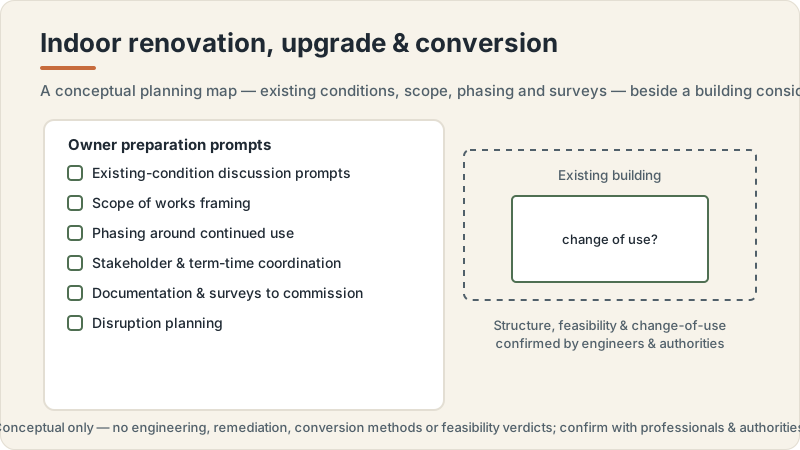
Indoor renovation, upgrade and conversion concept
Conceptual editorial diagram — not a construction drawing, specification, to-scale plan or proof of a real project. It is not engineering, structural, fire/life-safety, crowd-safety or accessibility-compliance guidance. Capacities, dimensions, standards, requirements and costs vary by facility type, audience, site, use case and governing body, and are confirmed with qualified professionals, relevant authorities and governing bodies. Build Design Hub does not design, build, inspect, certify, recommend or match anyone.
What this guide helps you prepare
This guide helps you assemble a renovation brief for an existing indoor sports hall so that the qualified professionals you later engage can understand your building, your goals, and your constraints without starting from a blank page. It focuses on the preparation you can do as an owner or operator: describing current conditions in your own words, framing the scope of what you hope to change, mapping who uses the hall and when, and identifying the surveys and documentation you may need to commission. It deliberately stops short of any design, engineering, remediation, or method advice, because those are decisions for licensed professionals working with your specific site.
Think of the brief as a conversation-starter rather than a specification. A strong brief records what you know, flags what you do not know, and organises your questions so that architects, engineers, surveyors, and other specialists can respond efficiently. Whether a particular condition is acceptable, what any survey will reveal, whether a system can be reused, and how work should be sequenced are all matters to confirm with the relevant qualified professionals and authorities. Requirements vary by location, facility type, use case, governing body, owner, site, authority, professional team, and project scope; confirm with qualified professionals.
- A structured description of the existing hall and its current uses that a professional team can read quickly
- A clear statement of your renovation goals separated from assumptions about how to achieve them
- A running list of unknowns and questions to route to the correct specialist or authority
- A record of which surveys and reports you may need to commission and who might hold existing ones
- A note of stakeholders, operating patterns, and constraints that any phasing discussion must respect
- A framing of decisions that are yours to make versus those that belong to qualified professionals
Framing the existing condition and renovation scope
A renovation brief starts with an honest description of what you have, expressed as observations and questions rather than diagnoses. You can record what users and staff report — surfaces that show wear, areas that feel cold or stuffy, rooms that flood with people at peak times, spaces that are hard to clean, or fittings that frequently need repair — without attempting to explain the cause or prescribe a fix. Note the age of the building and any major works you are aware of, and gather whatever original drawings, as-built records, maintenance logs, warranties, and previous survey reports exist. Where information is missing, say so plainly; a documented gap is more useful to a professional than a guess presented as fact.
Scope framing is about separating the outcomes you want from the technical decisions that deliver them. You might want the hall to feel more welcoming, to accommodate more activities, to reduce running costs, or to serve users more inclusively — these are legitimate owner goals. Translating them into specific interventions to surfaces, building systems, layout, or support rooms is work for qualified professionals, and whether any given change is feasible, necessary, or compatible with the existing structure is theirs to determine. Resist the temptation to write dimensions, capacities, clearances, system parameters, or performance targets into the brief; instead, frame each as a question. Requirements vary by location, facility type, use case, governing body, owner, site, authority, professional team, and project scope; confirm with qualified professionals.
- What do users, coaches, and cleaning or maintenance staff consistently report about the current hall?
- Which original drawings, as-built records, maintenance logs, and past survey reports can you locate?
- Which renovation goals are outcomes (comfort, flexibility, running cost, inclusion) versus assumed solutions?
- Where are you tempted to state a dimension, capacity, or system value — and can you reframe it as a question?
- Which parts of the hall are in scope, which are explicitly out of scope, and where is the boundary uncertain?
- What decisions are yours to make as owner, and which must be confirmed by a qualified professional?
Phasing around continued use and the surveys to commission
Many indoor sports halls cannot simply close for the duration of a renovation, so the brief should describe how the facility is used through the week and season rather than propose a construction sequence. Record fixture calendars, term dates, league commitments, community bookings, exam periods, and any events that cannot move, along with which spaces share access routes, changing rooms, plant, or entrances. This information lets a professional team advise on whether phased or decant approaches are possible for your building; how the work is actually sequenced, isolated, and made safe is a matter for qualified professionals and the relevant authorities, not for the brief to instruct.
The brief should also identify the surveys and reports you may need to commission or supply so that professionals are not working blind. You do not need to interpret survey findings yourself — the value is in commissioning the right specialists and requesting clear documentation. Where existing reports are old, incomplete, or of unknown provenance, note that and ask whether they should be refreshed. What surveys are appropriate, what they will reveal, and what any findings mean for your options are questions for the qualified professionals who carry them out. Requirements vary by location, facility type, use case, governing body, owner, site, authority, professional team, and project scope; confirm with qualified professionals.
- How is the hall used across the week, term, and season, and which commitments genuinely cannot move?
- Which spaces share entrances, changing rooms, circulation, or plant that a phased approach would affect?
- Which existing surveys or reports do you already hold, and how current and complete are they?
- Which specialists might you ask about condition, building systems, or site factors, and what documentation should you request?
- How will you keep users informed and bookings managed while parts of the hall are unavailable?
- What contingency questions should you raise with professionals if a survey uncovers something unexpected?
Planning questions before speaking with professionals
Before your first meeting with an architect, surveyor, or engineer, it helps to organise what you know and what you want so the conversation is productive. These questions are for internal discussion among owners, operators, and stakeholders; they are not technical determinations. Working through them turns vague dissatisfaction with the current hall into a structured brief that a professional can respond to, and surfaces the disagreements or unknowns among your own team that are better resolved early than mid-project.
None of these questions asks you to decide a technical matter or to assume a requirement. Their purpose is to clarify your goals, constraints, decision-makers, and information gaps. When a question touches on condition, systems, safety, accessibility, capacity, or code, the answer is not to guess but to note it as something to confirm with the appropriate qualified professional or authority. Requirements vary by location, facility type, use case, governing body, owner, site, authority, professional team, and project scope; confirm with qualified professionals.
- What are the top three outcomes we want from this renovation, in plain language and priority order?
- Who are our stakeholders — users, staff, governing bodies, funders, neighbours — and how will each be consulted?
- What is our decision-making process, and who signs off scope, budget, and phasing choices?
- What documentation about the existing building do we hold, and what is clearly missing?
- What operating constraints (fixtures, terms, bookings, events) must any approach respect?
- What questions are we unsure how to answer, and which professional or authority should we route each to?
Questions for qualified professionals
When you engage architects, engineers, surveyors, and other specialists, a prepared list of questions helps you understand their scope and the documentation they will provide, without expecting this guide to pre-empt their advice. The aim is to learn what each professional is responsible for, what surveys or assessments they recommend for your specific hall, and how their findings will be recorded and handed over. Ask them to explain the basis of their recommendations and to identify anything outside their remit that another specialist or authority should confirm.
Because every hall, site, and jurisdiction differs, the answers you receive are specific to your project and cannot be substituted with figures or thresholds from any guide. Use these questions to build a documentation trail — reports, drawings, assessments, and clear statements of assumptions — that you can carry through design, procurement, and handover. Requirements vary by location, facility type, use case, governing body, owner, site, authority, professional team, and project scope; confirm with qualified professionals.
- What surveys or condition assessments do you recommend for this existing hall, and why?
- What documentation, drawings, and reports will you provide, and how should we store and reuse them?
- Which aspects of condition, systems, safety, accessibility, or code fall outside your remit and need another specialist or authority?
- How will you advise on whether the hall can remain partly in use, and what does that depend on?
- What assumptions are your recommendations based on, and what would change them?
- What approvals, consents, or governing-body confirmations should we expect to need, and who obtains them?
What this does not replace
This is an educational planning resource only. It is not an indoor sports facility construction manual and not structural or architectural design, HVAC/ventilation, lighting or acoustic engineering, fire or life-safety, or accessibility-compliance advice, and it is not permit, zoning, inspection, certification, legal, tax, insurance or procurement advice. It does not design, build, engineer, specify, size, certify, inspect or approve anything, gives no capacities, dimensions, clearances, lux, air-change rates, acoustic or temperature thresholds, revenue, ROI or costs, and offers no warranty interpretation or estimate. Requirements, standards, capacities and costs vary by location, facility type, use case, governing body, owner, site, authority, professional team and project scope, and are confirmed with qualified professionals, relevant authorities and governing bodies.
Build Design Hub does not design, build, engineer, inspect, certify, recommend, rank, verify, introduce, broker or match suppliers, contractors, consultants or professionals, and HELPERG LLC is publisher/operator only. Use this resource to prepare your own thinking and briefs, then have the qualified professionals you engage directly — architects, structural and building-services engineers, lighting, acoustic, accessibility and fire/life-safety specialists, and legal or procurement advisors where appropriate — review your project. Decisions about design, engineering, systems, safety, accessibility, compliance, capacity, procurement and cost must rest on those professionals, the relevant authorities and the governing bodies for your sport and location.
- Not an indoor sports facility construction manual and not structural or architectural design
- Not HVAC/ventilation, lighting or acoustic engineering, fire/life-safety or accessibility-compliance advice
- Not permit/zoning, inspection, certification, warranty-interpretation, legal, tax, insurance or procurement advice
- Not a supplier, contractor, consultant or professional recommendation, ranking, directory or matching service
- Not an estimate and gives no capacity, dimension, system-performance, revenue, ROI or cost figures — requirements and costs vary
- Qualified professional review is required before any indoor sports facility project decision
Indoor sports hall renovation brief preparation worksheet
- 1Record the building's approximate age and any major works or extensions you are aware of
- 2Gather all available original drawings, as-built records, and past renovation documentation
- 3Collect maintenance logs, warranties, service records, and any previous survey or condition reports
- 4Write down what users, coaches, and cleaning or maintenance staff consistently report about the hall
- 5List the renovation outcomes you want, in priority order, as goals rather than solutions
- 6Mark which spaces are in scope, out of scope, and where the boundary is uncertain
- 7Map how the hall is used across the week, term, and season, noting commitments that cannot move
- 8Note which spaces share entrances, changing rooms, circulation, or plant
- 9Identify stakeholders — users, staff, governing bodies, funders, neighbours — and how each will be consulted
- 10Record your decision-makers and the sign-off process for scope, phasing, and budget
- 11List the surveys, assessments, or specialist reports you may need to commission or supply
- 12Log every point where you are tempted to state a dimension, capacity, or system value, and reframe it as a question
- 13Compile your open questions and route each to the relevant professional, authority, or governing body
- 14Note which existing reports are old, incomplete, or of unknown provenance and may need refreshing
Common mistakes to avoid
- Writing a fixed dimension, capacity, clearance, or run-off into the brief instead of asking a qualified professional to confirm it
- Assuming an existing system, surface, or structure can be reused without commissioning the relevant survey or professional assessment
- Treating a building-system, accessibility, or safety decision as the owner's choice rather than a matter for a licensed professional
- Skipping professional review of the existing condition and relying on staff impressions as if they were diagnoses
- Proposing a construction sequence or phasing plan in the brief rather than describing use patterns and letting professionals advise
- Assuming permit, code, zoning, or governing-body requirements are met without confirming with the relevant authorities
- Presenting missing or unknown information as fact instead of documenting it as a gap to be filled by survey or specialist
When to involve a professional
- When you need to understand the actual condition of surfaces, structure, or building systems — commission the appropriate qualified surveyors and engineers
- When any change touches structure, building systems, fire and life safety, or accessibility — involve the relevant licensed professionals and authorities
- When you are deciding whether the hall can stay partly in use during works — a professional team must advise on feasibility and safe isolation
- When existing surveys or reports are old, incomplete, or of unknown provenance — ask a qualified professional whether they should be refreshed
- When your questions touch permits, codes, zoning, certification, or governing-body approval — confirm with the relevant authorities and governing bodies
- When survey findings are unexpected or your options are unclear — return to the qualified professionals before committing scope or budget
Frequently asked questions
Questions readers ask about this topic
Does Build Design Hub design, build, engineer, inspect, or certify an indoor sports hall renovation?
No. Build Design Hub is an educational resource only. It does not design, build, engineer, inspect, certify, or project-manage any renovation; it does not design HVAC, ventilation, lighting, or acoustic systems; and it does not recommend, rank, verify, introduce, broker, or match suppliers, contractors, or professionals. This guide gives no capacities, dimensions, costs, or requirements. Those all come from the qualified professionals and authorities you engage for your specific project.
Can this guide tell me what surveys my hall needs or what condition it is in?
No. This guide can help you organise the question of surveys and describe what you observe, but it cannot tell you what condition your building is in or which surveys are appropriate. What surveys to commission, what they reveal, and what findings mean are determined by the qualified professionals who carry them out for your specific hall and site.
How should I handle keeping the hall in use during renovation?
Record how the hall is used across the week, term, and season and which commitments cannot move, then share that with your professional team. Whether phased or decant approaches are possible, and how any work is sequenced and made safe, are decisions for qualified professionals and the relevant authorities — not something a brief or this guide should instruct.
Why does this guide avoid giving dimensions, capacities, or system targets?
Because those vary by location, facility type, use case, governing body, owner, site, authority, professional team, and project scope. Presenting any such figure as fact would be misleading. The safe approach is to frame each as a question and confirm it with qualified professionals, relevant authorities, and governing bodies for your specific project.
Keep reading