
Who this guide is for
- Facility managers responsible for an ageing or failing indoor sports surface who need to structure a replacement conversation
- School and college estates teams scoping a sports hall or gymnasium floor renovation
- Sports club committees and volunteer boards preparing a brief before approaching specialists
- Municipal and community-centre officers planning a leisure or multi-purpose hall upgrade
- Developers and project teams coordinating an indoor surface replacement within a wider refurbishment
- Owners and trustees who must compare quotes and understand what documentation to request
Planning diagram
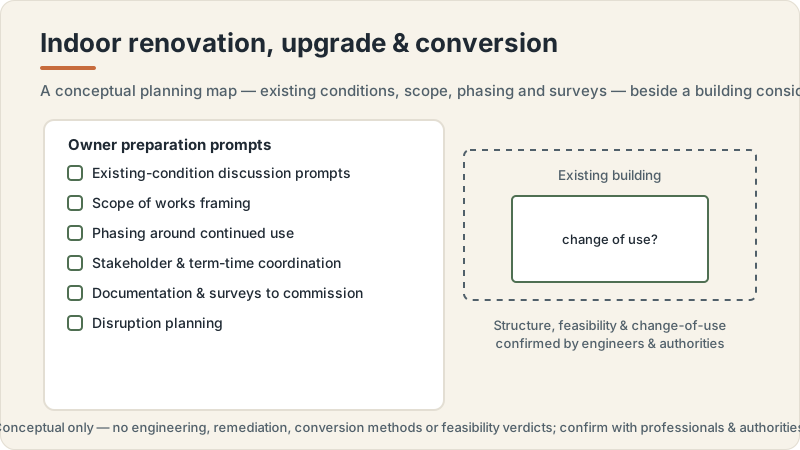
Indoor renovation, upgrade and conversion concept
Conceptual editorial diagram — not a construction drawing, specification, to-scale plan or proof of a real project. It is not engineering, structural, fire/life-safety, crowd-safety or accessibility-compliance guidance. Capacities, dimensions, standards, requirements and costs vary by facility type, audience, site, use case and governing body, and are confirmed with qualified professionals, relevant authorities and governing bodies. Build Design Hub does not design, build, inspect, certify, recommend or match anyone.
What this guide helps you prepare
This guide helps you assemble the information, questions and documents that make a first meeting with a flooring specialist or building professional useful rather than exploratory. Replacing an indoor sports surface is rarely just a cosmetic swap: the decision usually depends on the condition of what is there now, the layers and structure beneath it, how the space is used, and how moisture behaves in the building. By preparing these inputs in advance, you reduce the number of return visits and give professionals a clearer basis for their own assessment. The intent is preparation and organisation, not self-diagnosis.
What this guide deliberately does not do is tell you which surface to choose, how a floor should be built up, what moisture or performance levels are acceptable, or whether your current floor has failed. Those are technical judgements that qualified professionals make against your specific building, use case and any governing-body guidance for your sport. Treat every number, target or requirement as something to confirm with the relevant specialists and authorities. This guide stays at the level of what to observe, record and ask.
- A short written summary of what you currently know about the existing surface and how the space is used
- A folder of documents you already hold: original drawings, previous flooring records, any past reports
- A list of the concerns that prompted you to consider replacement, in plain language
- A clear separation between owner decisions and professional/technical judgements
- A set of questions to bring to a flooring specialist rather than answers you have guessed
- An honest note of what you do not know, so professionals can scope their own assessment
Discussing surface condition without self-diagnosing
When you first raise a replacement, a specialist will want to understand the symptoms you are observing rather than a conclusion you have already reached. Your job in preparation is to describe what you see and experience, not to grade the floor or decide it has failed. Note where the concerns appear, how long they have been present, whether they are spreading, and how they affect use of the space. Photographs of specific areas, taken plainly and dated, are usually more helpful than adjectives. Resist the urge to attribute a cause; the same visible symptom can have very different underlying explanations that only a qualified professional can distinguish.
Frame condition as a discussion, not a verdict. Whether a surface should be repaired, refinished or fully replaced is a professional judgement that depends on the specific floor, its history, its use and any governing-body guidance for your sport. Avoid stating that a surface has reached the end of its life, that a particular fault is structural, or that replacement is the only option, until a professional has assessed it. Requirements and acceptable condition vary by location, facility type, use case, governing body, owner, site, authority, professional team and project scope; confirm these with qualified professionals. Your prepared notes exist to inform that assessment, not to pre-empt it.
- Where exactly do the visible or functional concerns appear, and are they localised or widespread?
- How long have the symptoms been present, and do they appear to be changing over time?
- How is the space actually used, and by whom, on a typical week?
- What plain, dated photographs can you provide of the specific areas of concern?
- What symptoms are you observing, without assuming a cause or grading severity yourself?
- Which observations are facts you can point to, versus assumptions you should flag as uncertain?
Sub-floor and moisture questions for specialists
The layers beneath the visible surface, and how moisture moves through the building, are among the most important topics in a surface-replacement conversation, and among the least suitable for owner self-assessment. What sits under the current floor, how it was constructed, and whether moisture is present or migrating are questions for qualified professionals to investigate and interpret. Your preparation task is to gather whatever history you hold and to list the questions you want the specialist to answer, not to attempt measurements, set thresholds, or conclude that a moisture problem exists or does not. Any figures, limits or acceptable readings are matters for professionals to determine against your specific building.
Approach this section as a request for professional investigation and documentation. Ask what the specialist would need to establish about the sub-floor and moisture behaviour before advising on replacement, what tests or assessments they would recommend, who is qualified to carry them out, and how the findings would be recorded. Be explicit that you are not asking this guide or yourself to judge readings; you are preparing to commission and understand professional assessment. Moisture and sub-floor requirements vary by location, facility type, use case, governing body, owner, site, authority, professional team and project scope; confirm all of them with qualified professionals.
- What records exist about the current sub-floor construction and any previous flooring work?
- What would a specialist need to establish about the sub-floor before advising on replacement?
- What moisture-related assessments would a qualified professional recommend, and who is qualified to carry them out?
- How will any findings about the sub-floor and moisture be documented and shared with you?
- What history of leaks, damp, drainage or previous repairs can you provide to inform the assessment?
- What questions should you ask so that assumptions about moisture are tested by professionals rather than by you?
Planning questions before speaking with professionals
Before you contact a flooring specialist or building professional, it helps to settle the questions only you as the owner can answer, so the technical conversation can focus on technical matters. These are practical, non-technical decisions: who needs to be consulted, how the space is committed for the coming period, what disruption the facility can tolerate, and how a replacement fits alongside other planned work. Working through these in advance prevents the common situation where a professional assessment stalls because internal stakeholders have not aligned on scope, access or timing.
Use this stage to define your project brief in plain terms and to identify constraints, not solutions. You are not deciding on a surface, a build-up or a schedule at this point; you are clarifying context so that professionals can advise well. Keep decisions that require technical expertise firmly on the professional side of the line, and record any point where internal opinions differ, so it can be raised openly. Governing-body considerations for your sport, where relevant, should be flagged as questions to confirm rather than assumed.
- Who are the stakeholders and decision-makers who must be consulted before scope is set?
- What are the fixed constraints on access, bookings and operating periods that a professional needs to know?
- How does this surface replacement relate to any other planned renovation or upgrade work?
- What documentation do you already hold, and what is missing that professionals may ask for?
- What internal disagreements about scope or priority should be surfaced now rather than later?
- Which governing-body or sport-specific considerations should be confirmed with the relevant body rather than assumed?
Questions for qualified professionals
Once you meet a flooring specialist or relevant building professional, your prepared questions should invite their assessment and their documentation rather than seek quick reassurance. Ask how they would approach evaluating the current surface, sub-floor and moisture situation, what information they need from you, and what they would deliver in writing. Ask them to explain the basis for any recommendation in terms of your specific facility, and to identify where other specialists or authorities should be involved. The goal is to understand their reasoning and the evidence behind it, not to obtain a single figure you can act on without context.
Treat any requirement, threshold, dimension, timeline or cost that comes up as something to have confirmed and documented, not as a settled fact. Ask who is responsible for each decision, what would trigger a change in approach, and how findings and choices will be recorded for your handover file. Because requirements vary by location, facility type, use case, governing body, owner, site, authority, professional team and project scope, ask professionals to state their assumptions explicitly and to tell you when a matter falls outside their expertise. This keeps the conversation grounded in professional judgement and traceable documentation.
- How would you assess the current surface, sub-floor and moisture situation, and what do you need from us to do so?
- What would you provide in writing, and how will your findings and recommendations be documented?
- On what basis would you recommend repair, refinishing or replacement for our specific facility?
- Which other specialists, authorities or governing bodies should be involved, and at what stage?
- What assumptions are you making, and which matters fall outside your expertise?
- How will disruption to our operations be planned, communicated and recorded during the work?
What this does not replace
This is an educational planning resource only. It is not an indoor sports facility construction manual and not structural or architectural design, HVAC/ventilation, lighting or acoustic engineering, fire or life-safety, or accessibility-compliance advice, and it is not permit, zoning, inspection, certification, legal, tax, insurance or procurement advice. It does not design, build, engineer, specify, size, certify, inspect or approve anything, gives no capacities, dimensions, clearances, lux, air-change rates, acoustic or temperature thresholds, revenue, ROI or costs, and offers no warranty interpretation or estimate. Requirements, standards, capacities and costs vary by location, facility type, use case, governing body, owner, site, authority, professional team and project scope, and are confirmed with qualified professionals, relevant authorities and governing bodies.
Build Design Hub does not design, build, engineer, inspect, certify, recommend, rank, verify, introduce, broker or match suppliers, contractors, consultants or professionals, and HELPERG LLC is publisher/operator only. Use this resource to prepare your own thinking and briefs, then have the qualified professionals you engage directly — architects, structural and building-services engineers, lighting, acoustic, accessibility and fire/life-safety specialists, and legal or procurement advisors where appropriate — review your project. Decisions about design, engineering, systems, safety, accessibility, compliance, capacity, procurement and cost must rest on those professionals, the relevant authorities and the governing bodies for your sport and location.
- Not an indoor sports facility construction manual and not structural or architectural design
- Not HVAC/ventilation, lighting or acoustic engineering, fire/life-safety or accessibility-compliance advice
- Not permit/zoning, inspection, certification, warranty-interpretation, legal, tax, insurance or procurement advice
- Not a supplier, contractor, consultant or professional recommendation, ranking, directory or matching service
- Not an estimate and gives no capacity, dimension, system-performance, revenue, ROI or cost figures — requirements and costs vary
- Qualified professional review is required before any indoor sports facility project decision
Indoor sports surface replacement preparation worksheet
- 1Record a plain-language summary of the concerns that prompted you to consider replacement
- 2Gather original drawings, prior flooring records and any past reports into one folder
- 3Note where visible or functional symptoms appear and whether they are localised or spreading
- 4Take dated, plain photographs of the specific areas of concern
- 5Write down how the space is used each week and by whom, without assuming demand levels
- 6Document any known history of leaks, damp, drainage issues or previous repairs
- 7List the sub-floor and moisture questions you want qualified professionals to investigate
- 8Separate owner decisions from technical judgements in a two-column note
- 9Record the stakeholders and decision-makers who must be consulted before scope is set
- 10Capture fixed constraints on access, bookings and operating periods for professionals to work around
- 11Note how this replacement relates to any other planned renovation or upgrade work
- 12List governing-body or sport-specific points to confirm with the relevant body rather than assume
- 13Prepare a set of questions inviting professional assessment and written documentation
- 14Keep an explicit note of what you do not know, so professionals can scope their own assessment
Common mistakes to avoid
- Stating that a surface has failed or reached end of life before a qualified professional has assessed it
- Assuming a required dimension, moisture level or performance target instead of confirming it with professionals
- Treating the choice of surface build-up or a technical sub-floor decision as an owner decision rather than a professional judgement
- Attempting your own moisture readings or interpreting them, rather than commissioning professional assessment
- Skipping professional review because a symptom looks minor or a replacement seems obvious
- Committing to a schedule or scope before stakeholders and access constraints have been aligned internally
- Assuming governing-body requirements for your sport instead of confirming them with the relevant body
- Accepting a verbal recommendation without requesting the assessment and reasoning in writing
When to involve a professional
- When symptoms suggest the sub-floor, structure or moisture behaviour may be involved, involve a qualified flooring or building professional before drawing conclusions
- Before any moisture or condition testing, engage professionals qualified to carry it out and interpret it
- When governing-body or sport-specific considerations may apply, confirm them with the relevant body rather than assuming
- When a decision moves from planning into surface selection, build-up or method, defer to qualified specialists
- When quotes differ in scope or approach, ask professionals to explain the basis so you can compare like for like
- When findings, recommendations or handover documentation are needed, request them in writing from the qualified professional
Frequently asked questions
Questions readers ask about this topic
Does Build Design Hub design, build, inspect or recommend a surface for my facility?
No. Build Design Hub is an educational resource that helps you prepare questions and organise documentation. It does not design, build, engineer, inspect, certify, or interpret warranties; it does not design HVAC, lighting or acoustic systems; and it does not recommend, rank, verify or match suppliers, contractors or professionals. It also provides no capacities, dimensions, moisture thresholds, costs or requirements. All of those belong to qualified professionals assessing your specific facility.
Can this guide tell me whether my surface needs replacing?
No. Whether a surface should be repaired, refinished or replaced is a professional judgement based on the specific floor, its history, its use and any governing-body guidance. This guide helps you describe symptoms and prepare questions so a qualified professional can make that assessment. Avoid concluding the floor has failed before it has been reviewed.
What moisture level or sub-floor requirement should I be aiming for?
This guide does not state any level, threshold or requirement. Sub-floor and moisture requirements vary by location, facility type, use case, governing body, owner, site, authority, professional team and project scope, and must be confirmed with qualified professionals. Your role in preparation is to gather history and list the questions professionals should investigate, not to set or judge figures.
How should I prepare for a first meeting with a flooring specialist?
Bring a plain summary of your concerns, dated photographs of the affected areas, any drawings and prior records you hold, a note of how the space is used, and a list of questions inviting their assessment and written documentation. Flag what you do not know so they can scope their own investigation, and keep technical judgements on the professional side of the line.
Keep reading