
Who this guide is for
- Owners and trustees who hold responsibility for a sports facility asset and need an organised view of seasonal upkeep planning
- Operators and club committees scheduling activity around the realities of seasonal surface and facility demands
- Facility managers preparing structured seasonal review meetings with grounds and maintenance professionals
- Schools, colleges and academies coordinating sports provision across terms and seasonal conditions
- Sports clubs and community associations planning volunteer and contractor responsibilities across the year
- Municipalities, developers and estates teams setting up governance and documentation for newly handed-over facilities
Planning diagram
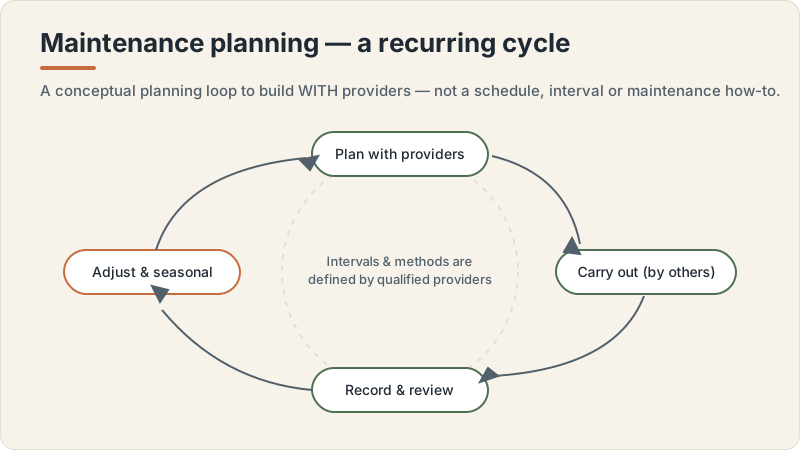
Maintenance planning cycle concept
Conceptual editorial diagram — not a construction drawing, specification, to-scale plan or proof of a real project. It is not engineering, structural, fire/life-safety, crowd-safety or accessibility-compliance guidance. Capacities, dimensions, standards, requirements and costs vary by facility type, audience, site, use case and governing body, and are confirmed with qualified professionals, relevant authorities and governing bodies. Build Design Hub does not design, build, inspect, certify, recommend or match anyone.
What this guide helps you prepare
This guide helps you build the owner-side preparation that sits underneath a seasonal maintenance review: the documents you should be holding, the questions you should be ready to ask, and the framework you can use to keep decisions, responsibilities and records in one place. It focuses on getting you organised so that when you speak with qualified grounds and maintenance professionals, you can describe your facility accurately, surface the gaps in your own knowledge and ask informed questions rather than accepting generic answers.
It is deliberately a planning and project-preparation resource, not a technical one. You will not find intervals, frequencies, chemicals, machinery settings or step-by-step procedures here, because those depend on your specific surfaces, systems, climate, warranty terms, supplier documentation and the scope a contractor agrees with you. Instead, this guide helps you assemble the inputs and the questions that let qualified professionals give you advice that actually fits your facility.
- A clear inventory of what you own: surfaces, systems, plant, equipment and the documentation that came with each
- A record of who currently holds responsibility for which areas, and where those responsibilities are unwritten
- A list of the warranty, handover and supplier documents you hold, and the ones you suspect are missing
- A framework for capturing seasonal changes in use, booking patterns and facility demands as questions, not assumptions
- A set of prompts to take into conversations with grounds and maintenance professionals so reviews stay structured
- An honest note of what you do not yet know and need a qualified professional to confirm
What tends to change by season and what to ask about it
Seasonal review planning starts with recognising that demands on a sports facility are not constant. Patterns of use rise and fall, certain periods see heavier booking or rest, and the conditions a surface or system faces can shift noticeably across the year. Rather than assuming you know how these changes affect upkeep, the planning task is to write down what appears to change at your facility and turn each observation into a question for a qualified professional. This keeps you from guessing at causes or remedies that are properly decided with someone who understands your specific surfaces and systems.
The value of doing this before a review is that it gives the conversation structure. When you can describe how usage, scheduling and conditions differ across seasons at your site, a grounds or maintenance professional can respond to your actual situation instead of offering generic guidance. The goal is not to predetermine what should happen in each season, which varies and must be confirmed, but to make sure the seasonal context of your facility is on the table and that nothing important is left unspoken because it felt obvious.
- Which seasons bring your heaviest use, and how should that inform what we discuss with a professional?
- What changes in weather or conditions does our facility experience, and which surfaces or systems might that affect?
- Are there periods when parts of the facility are rested, and how should rest periods be planned and recorded?
- How do booking and event schedules shift across the year, and where might they conflict with planned upkeep windows?
- What seasonal observations have staff or users reported, and have we logged them for a professional to review?
- Which questions are season-specific for our facility type and should be raised with a qualified provider rather than assumed?
Building a maintenance-planning framework and record system
A seasonal review is only as useful as the records that feed it. Before involving professionals, it helps to establish a simple, durable way of holding the information that decisions depend on: an asset and documentation register, a log of issues and observations raised over time, a record of who is responsible for what, and a place to capture the questions you intend to confirm with qualified providers. This framework is owner-side governance, not maintenance activity, and it is something you can build and keep current regardless of who carries out any work.
Good records change the character of a review. Instead of trying to remember what happened, who said what, or which document covers a given system, you can point to a maintained set of references. This also makes handover and continuity far easier when staff, committees or contractors change. The framework should make clear what you know, what you are unsure of and what remains to be confirmed, so that the boundary between owner decisions and professional advice stays visible and nothing falls into a gap because everyone assumed someone else owned it.
- An asset and documentation register listing surfaces, systems, plant and the manuals or specifications you hold for each
- An issue and observation log where staff and users can record concerns for later professional review
- A responsibilities matrix showing who owns each area and where ownership is currently undefined
- A warranty and supplier-document index noting what you hold, what is missing and where to request copies
- A decisions and questions record separating what you have confirmed from what still needs a qualified professional
- A continuity note so reviews, records and responsibilities survive changes in staff, committee or contractor
Planning questions before speaking with professionals
Before you contact grounds or maintenance professionals, it is worth working through the questions you can answer for yourself and clearly marking the ones you cannot. This internal preparation helps you avoid presenting assumptions as facts and stops you from accepting a generic answer because you were not specific about your facility. The questions below are for your own planning: they help you describe your situation accurately and identify where qualified input is genuinely needed rather than where you simply have not organised your own information.
Working through these prompts also helps you separate owner decisions from professional advice. Some matters are yours to decide, such as how you keep records, who holds responsibility and how you prioritise competing demands. Others, including anything about intervals, methods, materials, condition or compliance, are not yours to settle and should be confirmed with qualified professionals, suppliers, contractors, manufacturers, relevant authorities and governing bodies. Knowing which is which before a conversation makes that conversation far more productive.
- What do we actually know about each surface and system, and where is our information incomplete or second-hand?
- Which seasonal patterns have we observed and documented, and which are assumptions we have never checked?
- Do we hold the handover, warranty and supplier documents for our facility, and if not, who should we ask?
- Which decisions are genuinely ours to make, and which must be confirmed with a qualified professional or governing body?
- Have we recorded outstanding issues and questions in one place so nothing is raised from memory alone?
- What governing-body or warranty terms might apply to our facility that we need a professional to interpret for us?
Questions for qualified professionals
When you do involve qualified grounds and maintenance professionals, suppliers or contractors, the most useful questions are those that ask them to apply their expertise to your specific facility rather than to confirm something you have already decided. Because maintenance requirements vary by facility type, use intensity, surface, system, climate, season, governing body, warranty terms, supplier documentation, contractor scope and local professional requirements, the questions below are framed to draw out advice that fits your site and to make clear where their scope of responsibility begins and ends.
Treat the answers as professional input to be recorded in your own framework, not as fixed rules you then publish as fact. Ask each provider to be explicit about what is within their scope, what is excluded, what assumptions their advice rests on and what would change it. Keep a written record of what is confirmed, by whom and when, so that your seasonal reviews build on documented professional input rather than on recollection or generic information.
- How do our specific surfaces, systems and use patterns affect what a seasonal review should focus on?
- What falls inside your scope for our facility, and what is explicitly excluded or someone else's responsibility?
- Which of our assumptions about seasonal demands are reasonable, and which would you challenge or qualify?
- What documentation, warranty terms or governing-body requirements should we obtain or confirm before deciding anything?
- What would you need to see or know about our facility to give advice we can rely on?
- How should we record your input so future reviews and any change of provider remain consistent and traceable?
What this does not replace
This is an educational planning resource only. It is not a maintenance manual and not inspection, certification, engineering, architectural, structural, HVAC, electrical, safety-compliance, fire or life-safety, or accessibility-compliance advice, and it is not legal, tax, insurance or procurement advice. It does not maintain, operate, inspect, certify, audit or specify anything, gives no maintenance intervals or procedures as universal rules, and offers no warranty interpretation, estimate, price, ROI or capacity figure. Maintenance requirements and costs vary by facility type, use intensity, surface, system, climate, season, governing body, warranty terms, supplier documentation, contractor scope and local professional requirements, and are confirmed with qualified professionals, suppliers, contractors, relevant authorities and governing bodies.
Build Design Hub does not operate, maintain, inspect, certify, audit, design, build, recommend, rank, verify, introduce, broker or match suppliers, contractors, maintenance providers or facility managers, and HELPERG LLC is publisher/operator only. Use this resource to prepare your own thinking and records, then have qualified professionals you engage directly review your facility. Decisions about maintenance, inspection, safety, compliance, warranties, procurement and suitability must rest on those professionals, suppliers, the relevant authorities and the governing bodies for your sport and location.
- Not a maintenance manual and not maintenance instructions, intervals or procedures as universal rules
- Not inspection, certification, safety-compliance, fire/life-safety or accessibility-compliance advice
- Not engineering, architectural, warranty-interpretation, legal, tax, insurance or procurement advice
- Not a supplier, contractor, maintenance-provider or facility-manager recommendation, ranking, directory or matching service
- Not an estimate, price or cost figure — maintenance requirements and costs vary
- Qualified professional review is required before any operations or maintenance decision
Seasonal maintenance review preparation worksheet
- 1Compile an asset and documentation register listing every surface, system, item of plant and piece of equipment you can identify
- 2Gather the handover pack, warranty documents, supplier manuals and specifications you currently hold, and note what appears to be missing
- 3Record who holds responsibility for each area of the facility, marking any responsibilities that are unwritten or unclear
- 4Create an issue and observation log and ask staff and users to record concerns there for professional review
- 5Write down the seasonal patterns you have observed in use, booking, rest periods and conditions, labelling each as observed or assumed
- 6List the governing bodies, authorities or manufacturers whose terms or documentation may apply to your facility
- 7Note every question you intend to confirm with a qualified professional, separating it from matters you can decide yourself
- 8Organise booking and event schedules so seasonal conflicts with potential upkeep windows are visible in advance
- 9Index your warranty and supplier documents and note from whom you would request any missing copies
- 10Prepare a short, accurate description of your facility to share with professionals so advice is tailored to your site
- 11Set up a decisions record that captures what is confirmed, by whom and when, separately from open questions
- 12Establish a continuity note so records, responsibilities and review history survive changes of staff, committee or contractor
- 13Review your preparation for assumptions presented as facts and reframe any of them as questions for a qualified professional
Common mistakes to avoid
- Treating an interval, frequency or schedule found somewhere as a universal rule rather than something defined with a qualified provider for your specific facility
- Assuming a warranty covers a particular issue without obtaining and confirming the actual terms with the supplier or a professional
- Skipping professional review because a seasonal change felt obvious or because staff had a confident opinion
- Relying on memory and conversation instead of a written register, issue log and decisions record
- Letting responsibilities stay unwritten, so areas fall into a gap where everyone assumes someone else owns them
- Carrying assumptions about seasonal demands into a review as if they were confirmed facts
- Losing handover, warranty and supplier documents and only discovering the gap when a question arises
- Failing to record who confirmed what and when, so reviews repeat ground already covered or contradict earlier advice
When to involve a professional
- When any question touches intervals, frequencies, methods, materials, machinery or procedures, which must be defined with qualified professionals and suppliers
- When warranty terms or supplier documentation need interpreting or a claim or coverage question arises
- When a surface, system or piece of equipment shows a condition or behaviour you cannot confidently describe or explain
- When governing-body, authority or manufacturer requirements may apply and need to be confirmed for your facility
- When responsibilities, scope or handover obligations between owner, operator and contractor are unclear or disputed
- When seasonal observations suggest a recurring or worsening issue that should be assessed by a qualified provider
Frequently asked questions
Questions readers ask about this topic
Does Build Design Hub maintain, inspect or certify our facility, or recommend providers?
No. Build Design Hub is an educational publisher only. It does not operate, maintain, inspect, certify, audit or design facilities, and it does not recommend, rank, verify, introduce or match suppliers, contractors, maintenance providers or facility managers. It also does not provide costs, intervals, lifespans or requirements. This guide only helps you prepare questions and documentation to discuss with qualified professionals you engage yourself.
Why does this guide not give seasonal maintenance schedules or intervals?
Because they vary. Maintenance requirements depend on facility type, use intensity, surface, system, climate, season, governing body, warranty terms, supplier documentation, contractor scope and local professional requirements. Any schedule, interval or method should be defined with qualified professionals, suppliers and manufacturers for your specific facility, not taken from a general guide and treated as a fixed rule.
How should we use the questions in this guide?
Use them to prepare. Work through the planning questions internally to organise what you know and what you do not, then take the questions for qualified professionals into your conversations so advice is tailored to your facility. Record the answers in your own framework, noting who confirmed what and when, rather than treating any answer as a universal fact.
What does a seasonal review preparation framework actually include?
On the owner side, it typically includes an asset and documentation register, an issue and observation log, a responsibilities matrix, a warranty and supplier-document index, and a decisions and questions record. These are governance and record-keeping tools, not maintenance activities, and they help you arrive at reviews organised and able to ask informed questions.
Keep reading