
Who this guide is for
- Owners commissioning or inheriting a natural-grass or synthetic sports field who want to plan upkeep responsibly
- Facility managers and operators structuring an owner-side maintenance-planning framework and document set
- Schools and education estates teams organising governance and budgets around shared playing fields
- Sports clubs and committees clarifying who is responsible for what and how upkeep decisions are recorded
- Municipalities and developers preparing handover, warranty and lifecycle documentation for new or transferred facilities
- Project teams getting ready to brief grounds professionals, suppliers and contractors with clear questions
Planning diagram
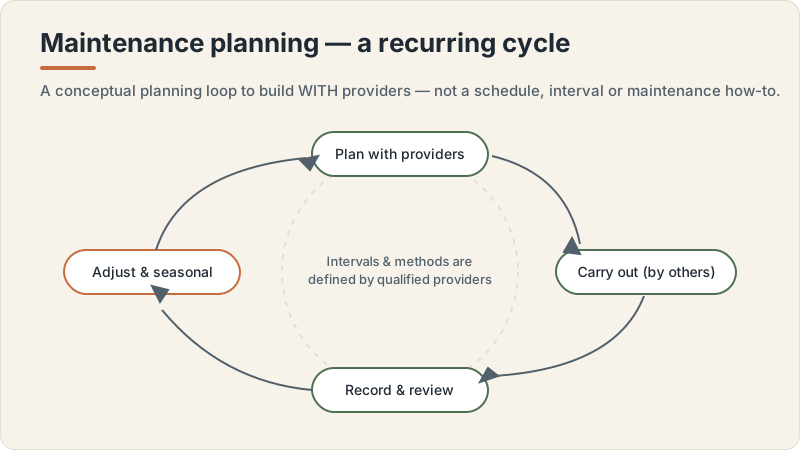
Maintenance planning cycle concept
Conceptual editorial diagram — not a construction drawing, specification, to-scale plan or proof of a real project. It is not engineering, structural, fire/life-safety, crowd-safety or accessibility-compliance guidance. Capacities, dimensions, standards, requirements and costs vary by facility type, audience, site, use case and governing body, and are confirmed with qualified professionals, relevant authorities and governing bodies. Build Design Hub does not design, build, inspect, certify, recommend or match anyone.
What this guide helps you prepare
This guide helps you assemble the owner-side groundwork that makes maintenance conversations productive: a clear picture of the field and its systems, the documents you should ask for at handover, the questions you still need answered, and a structure for recording decisions over time. The aim is operations readiness, so that when you speak with a grounds professional, supplier or contractor you arrive with organised information rather than a blank page. It does not tell you how to maintain anything, when to do it, or what to use; those are matters for qualified providers who can assess your specific surface, systems, use and setting.
Preparation here means turning a vague sense that a field needs looking after into a concrete set of artefacts: an asset and systems inventory, a handover-document request list, a defect and warranty log, a risk register, a responsibilities map and a seasonal-review structure. Each of these is something you record, gather or organise, not a maintenance action you perform on the surface or equipment. Because requirements vary by facility type, use intensity, surface, system, climate, season, governing body, warranty terms, supplier documentation, contractor scope and local professional requirements, this guide keeps everything at the planning level and routes the technical specifics to the people qualified to define them.
- Build an asset and systems inventory: surface type, drainage, irrigation, lighting, fencing, line markings and surrounds, recorded as items you track rather than tasks you prescribe
- Assemble a handover-document request list so warranties, supplier care documentation and as-built information are gathered in one place
- Set up a defect, warranty and observation log that captures what you notice and when, without drawing inspection conclusions yourself
- Map responsibilities: who organises upkeep, who holds budget, who is the point of contact for suppliers and contractors
- Prepare a question set for each provider conversation so technical specifics are confirmed by qualified professionals, not assumed
- Create a seasonal-review structure that prompts you to revisit the plan with professionals rather than locking in fixed rules
Building a maintenance-planning framework for a field or pitch
A useful framework starts by separating the field into the elements that age and behave differently, then attaching a planning question to each rather than a prescribed routine. A natural-grass pitch, a synthetic surface, a hybrid system, drainage, irrigation, floodlighting, fencing and line markings each carry their own considerations, and treating them as one undifferentiated lawn tends to leave gaps. At the planning stage your job is to name each element, note who supplied or installed it, identify which supplier documentation or warranty applies, and record the open questions you want a qualified professional to answer. The framework holds the questions; the providers supply the answers.
The framework also benefits from distinguishing between what you can sensibly organise on the owner side, such as record-keeping, scheduling conversations and coordinating access, and what belongs firmly with qualified providers, such as how a particular surface should be cared for, what any system needs and how often. Resist the temptation to convert a provider's past advice into a universal rule, because intervals and methods that suited one site, season or warranty may not transfer. A framework that captures the source and context of every piece of advice, and flags when it should be reconfirmed, stays honest about how much depends on the specific facility.
- List each element separately and attach the supplier, installer and applicable documentation rather than a generic care assumption
- Record open questions per element so technical decisions stay with qualified professionals and suppliers
- Note the source, date and context of any advice you receive so it is not mistaken for a universal rule
- Distinguish owner-side organisation (records, access, coordination) from provider-side technical decisions
- Capture warranty and supplier-documentation references against each element instead of interpreting them yourself
- Flag elements where governing-body requirements may apply, to confirm with the relevant federation or authority
Lifecycle and seasonal-review thinking for owners
Lifecycle thinking shifts attention from this week's tasks to the whole working life of the field: handover, the early defect-liability period, ongoing operation, periodic renewal of consumable elements, and eventual major resurfacing or replacement. Rather than estimating lifespans or renewal timings yourself, lifecycle planning on the owner side means keeping the records and questions that let qualified professionals advise on condition and timing when the moment comes. A well-kept history of observations, works carried out, warranty references and provider advice is what turns a future resurfacing or renewal conversation from guesswork into an informed discussion. This guide does not state how long anything lasts; it helps you hold the information that informs those judgements.
Seasonal-review thinking gives the lifecycle a practical rhythm without hardening into fixed rules. A seasonal review is an owner-side checkpoint at which you revisit your inventory, log and risk register, gather what has changed, and prepare questions for the next provider conversation; it is not a prompt to perform particular tasks on particular dates. Climate, use intensity, governing-body fixtures, warranty terms and supplier guidance all shape when and how a field's needs change, so the review's purpose is to keep your planning current and to schedule the professional input that the season ahead may call for. The output of a review is updated records and a refreshed question set, not a maintenance instruction.
- Frame lifecycle stages as handover, defect-liability, operation, renewal and eventual replacement, without assigning your own timings
- Keep a running history of observations, works, warranty references and provider advice to inform future renewal discussions
- Treat seasonal reviews as owner-side checkpoints that refresh records and questions, not as task schedules
- Note which governing-body fixtures, climate factors or use patterns may change needs, to raise with professionals
- Record condition observations factually and route any condition conclusions to qualified providers
- Plan to reconfirm earlier advice at each review rather than assuming it still applies
Planning questions before speaking with professionals
Before you contact a grounds professional, supplier or contractor, it helps to settle the questions you can answer yourself and surface the ones you cannot. Owner-side questions clarify how the field is used, who is responsible for what, what documentation you already hold, and where the gaps are. Working through them first means your provider conversations focus on genuine technical decisions rather than basic facts you could have gathered, and it reduces the risk of accepting a generic answer that does not fit your facility. None of these questions ask you to decide technical specifics; they prepare you to ask for them.
This preparation also protects you from common planning errors, such as assuming a warranty covers ongoing upkeep, treating a single quoted interval as a permanent rule, or letting responsibilities stay informal until something is missed. By documenting use intensity, access constraints, existing records and open uncertainties in advance, you give every provider the same clear starting point and make it easier to compare the scope of what each can offer. Remember that requirements vary by facility type, use intensity, surface, system, climate, season, governing body, warranty terms, supplier documentation, contractor scope and local professional requirements, so the goal is to confirm, not to conclude.
- How is the field used, by whom, and how intensively across the year, and where is that recorded?
- What handover and warranty documents do we already hold, and what is missing?
- Who on the owner side is responsible for organising upkeep, holding budget and liaising with providers?
- What have we observed about the field's condition, recorded factually and without drawing conclusions?
- Which elements are under warranty or supplier documentation, and what do those references actually say?
- Where are our biggest uncertainties, so we can put them to qualified professionals rather than guessing?
Questions for qualified professionals
When you do engage qualified grounds professionals, suppliers, contractors and, where relevant, governing bodies and local authorities, your prepared records let you ask focused questions about the things only they can responsibly answer. These cover how your specific surface and systems should be cared for, what any warranty actually requires of you, how scope is divided between providers, and what local or governing-body requirements apply. Ask providers to set their advice in the context of your facility and to be explicit about what their answers depend on, so you can record the reasoning alongside the recommendation and revisit it when conditions change.
Because Build Design Hub does not maintain, inspect, certify, recommend, rank, verify or match providers and gives no intervals, costs or requirements, these questions are where the substantive answers come from. Treat each provider's response as specific to the context they were given, confirm anything that affects warranties or governing-body compliance with the relevant party in writing, and keep the answers in your log so your planning stays grounded in advice from people who have assessed your actual field rather than in general assumptions.
- For our specific surface and systems, what care considerations apply, and what does your advice depend on?
- What do our warranty terms and supplier documentation require of us to keep cover valid, and who confirms that?
- How is scope divided between providers, and what falls inside or outside any maintenance agreement?
- Which governing-body or local-authority requirements apply to our field, and how should we confirm them?
- What records and access would you need from us to advise accurately over time?
- When and how should earlier advice be reconfirmed as use, season or warranty terms change?
What this does not replace
This is an educational planning resource only. It is not a maintenance manual and not inspection, certification, engineering, architectural, structural, HVAC, electrical, safety-compliance, fire or life-safety, or accessibility-compliance advice, and it is not legal, tax, insurance or procurement advice. It does not maintain, operate, inspect, certify, audit or specify anything, gives no maintenance intervals or procedures as universal rules, and offers no warranty interpretation, estimate, price, ROI or capacity figure. Maintenance requirements and costs vary by facility type, use intensity, surface, system, climate, season, governing body, warranty terms, supplier documentation, contractor scope and local professional requirements, and are confirmed with qualified professionals, suppliers, contractors, relevant authorities and governing bodies.
Build Design Hub does not operate, maintain, inspect, certify, audit, design, build, recommend, rank, verify, introduce, broker or match suppliers, contractors, maintenance providers or facility managers, and HELPERG LLC is publisher/operator only. Use this resource to prepare your own thinking and records, then have qualified professionals you engage directly review your facility. Decisions about maintenance, inspection, safety, compliance, warranties, procurement and suitability must rest on those professionals, suppliers, the relevant authorities and the governing bodies for your sport and location.
- Not a maintenance manual and not maintenance instructions, intervals or procedures as universal rules
- Not inspection, certification, safety-compliance, fire/life-safety or accessibility-compliance advice
- Not engineering, architectural, warranty-interpretation, legal, tax, insurance or procurement advice
- Not a supplier, contractor, maintenance-provider or facility-manager recommendation, ranking, directory or matching service
- Not an estimate, price or cost figure — maintenance requirements and costs vary
- Qualified professional review is required before any operations or maintenance decision
Field maintenance-planning preparation worksheet
- 1Record the field type and each major element: surface, drainage, irrigation, lighting, fencing, line markings and surrounds
- 2Gather all handover documents into one place and note any that are missing or unclear
- 3List every applicable warranty and supplier care document, with reference numbers and contact points
- 4Note the supplier and installer for each element so questions reach the right party
- 5Document how the field is used and how intensively across the year, as recorded fact
- 6Set up a defect and observation log that captures what is noticed and when, without drawing conclusions
- 7Create a risk register of uncertainties to raise with qualified professionals
- 8Map owner-side responsibilities for organising upkeep, budget and provider liaison
- 9Prepare a question set for each provider conversation rather than assuming technical answers
- 10Record the source, date and context of any advice received so it is not treated as a universal rule
- 11Establish a seasonal-review checkpoint structure that refreshes records and questions
- 12List governing-body or local-authority points to confirm with the relevant party
- 13Keep a running history of works and advice to inform future renewal or replacement discussions
- 14Note where professional review is needed before any technical decision is made
Common mistakes to avoid
- Treating an interval, frequency or method mentioned by one provider as a universal rule for your field
- Assuming a warranty automatically covers ongoing upkeep, or that cover continues without owner-side conditions being met
- Skipping handover-document collection and discovering later that warranty or supplier care references are missing
- Drawing your own condition or inspection conclusions instead of recording observations and routing judgements to professionals
- Leaving responsibilities informal until something is overlooked, with no record of who organises what
- Copying advice from another site, season or surface without reconfirming that it applies to yours
- Locking a seasonal review into fixed tasks and dates rather than using it to refresh records and questions
- Assuming Build Design Hub or any general guide can supply intervals, costs or requirements specific to your facility
When to involve a professional
- Before deciding how any surface or system should be cared for, or how often, since these are provider-defined and vary by site
- When warranty terms, supplier documentation or defect-liability conditions need interpreting or confirming for your facility
- When governing-body or local-authority requirements may apply to the field, its markings, water use or works
- Before any renewal, resurfacing or replacement decision, where condition and timing should be assessed by qualified professionals
- When dividing maintenance scope between providers or entering an agreement, so responsibilities and exclusions are clear
- Whenever an observation in your log suggests a possible condition issue that should be evaluated by a qualified provider
Frequently asked questions
Questions readers ask about this topic
Does Build Design Hub maintain, inspect or certify sports fields, or recommend providers?
No. Build Design Hub is an educational publisher operated by HELPERG LLC. It does not maintain, inspect, certify, audit, design, build, recommend, rank, verify, introduce, broker or match fields, surfaces, maintenance providers, facility managers, suppliers or contractors, and it gives no costs, intervals or requirements. This guide only helps you prepare questions and records to take to qualified professionals.
Why does this guide not tell me how often to maintain my field or what to use?
Because those specifics genuinely depend on your facility. Maintenance requirements vary by facility type, use intensity, surface, system, climate, season, governing body, warranty terms, supplier documentation, contractor scope and local professional requirements. Stating a fixed interval or method as fact would be misleading; confirm the specifics with qualified professionals and suppliers who have assessed your field.
Can I treat advice from one provider as a rule for the whole field?
It is safer not to. Advice that suited one element, season, surface or warranty may not transfer. Record the source, date and context of any advice, flag it to be reconfirmed at your seasonal reviews, and ask providers what their recommendation depends on so you understand its limits.
What should I prepare before contacting a grounds professional or contractor?
An asset and systems inventory, your handover and warranty documents, a factual log of how the field is used and what you have observed, a map of owner-side responsibilities, and a list of open questions. Arriving with organised records lets professionals focus on the technical decisions only they can responsibly make.
Is a seasonal review a maintenance schedule?
No. In this guide a seasonal review is an owner-side checkpoint to revisit your inventory, logs and questions and to schedule professional input for the season ahead. It is not a list of tasks to perform on set dates; what the field actually needs, and when, is for qualified providers to determine.
Keep reading