
Who this guide is for
- Stadium and arena owners preparing a project brief before engaging an accessibility specialist
- Sports clubs and venue operators planning a spectator-access review or upgrade programme
- Municipalities and public bodies scoping accessibility questions for a stadium project
- Schools, colleges and universities planning spectator facilities and gathering advisory input
- Developers and project teams assembling the accessibility strand of a stadium brief
- Facility managers documenting current access arrangements ahead of professional review
Planning diagram
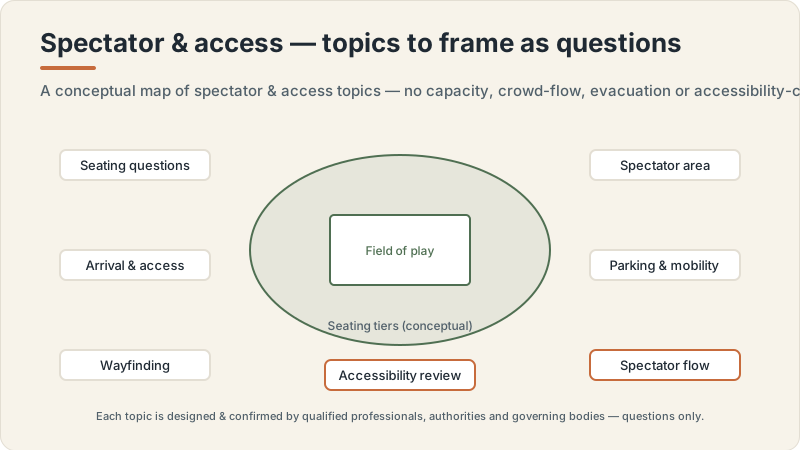
Stadium spectator and access concept
Conceptual editorial diagram — not a construction drawing, specification, to-scale plan or proof of a real project. It is not engineering, structural, fire/life-safety, crowd-safety or accessibility-compliance guidance. Capacities, dimensions, standards, requirements and costs vary by facility type, audience, site, use case and governing body, and are confirmed with qualified professionals, relevant authorities and governing bodies. Build Design Hub does not design, build, inspect, certify, recommend or match anyone.
What this guide helps you prepare
This guide helps you organise your thinking before you speak with a qualified accessibility specialist about a stadium project. Engaging a specialist tends to be far more productive when you arrive with a clear picture of your venue, your intended events and audiences, the range of people you want to plan for, and the questions you already know you need answered. The purpose here is to help you assemble that picture: a project brief, a description of current conditions, a list of assumptions to test, and a structured set of questions to raise. None of this replaces the specialist's assessment; it simply makes the conversation focused and helps you compare the advice you receive.
It also helps you understand the boundary between preparation and professional judgement. Deciding what a stadium should provide for accessibility, and how that maps to the applicable rules for your location and events, is work for qualified professionals, the relevant authorities and the governing bodies for your sport or venue type. This guide deliberately avoids stating any requirement, dimension, quantity or standard, because those vary by location, facility type, use case, governing body, owner, site, authority, professional team and project scope. What you can do here is prepare the questions, gather the records and frame the topics so a specialist can advise on your specific situation.
- Draft a plain-language description of your stadium, its events, seasons and expected audience mix
- Note what you already know, what you are assuming, and what you need a specialist to confirm
- List the spectator journeys you want reviewed, from arrival and ticketing through to seating and exit
- Record current access arrangements and any known pain points reported by users or staff
- Identify which authorities, governing bodies and professional disciplines may need to be involved
- Prepare questions about scope, deliverables, timing and how findings will be documented
Spectator journeys and access touchpoints to map before a review
Accessibility across a stadium is easier to discuss when you describe it as a series of journeys rather than a single feature. A useful preparation exercise is to walk through the full spectator experience on paper and note every touchpoint where access matters: arrival by different transport modes, wayfinding, entry and ticketing, moving between concourses and levels, reaching a seating position or viewing area, using amenities, and leaving the venue after an event. Mapping these journeys for a range of visitors, including people with mobility, sensory, cognitive and other access needs, helps you and a specialist see where questions concentrate. This is a description exercise, not a design exercise; you are recording what exists and what you want reviewed, not deciding solutions.
As you map journeys, avoid assuming that any particular provision is or is not needed. Whether a given touchpoint is adequate, what should change, and how any change relates to the applicable rules are all matters for qualified professionals and the relevant authorities to assess for your venue. Requirements and expectations vary by location, facility type, use case, governing body, owner, site, authority, professional team and project scope. Your job in preparation is to make the journeys and touchpoints visible and to capture the questions each one raises, so nothing is overlooked when a specialist conducts a proper review.
- List transport and arrival options and note how spectators reach the venue perimeter
- Map entry, ticketing and security touchpoints and where queuing and wayfinding occur
- Describe how spectators move between concourses, levels and different seating areas
- Note viewing positions, amenities, hospitality areas and any assistance points to review
- Record egress and emergency-related journeys as topics to raise with the relevant professionals
- Capture the questions each touchpoint raises rather than proposing fixes yourself
Framing an inclusive brief across diverse access needs
A strong preparation brief describes the breadth of people you want the specialist to consider, without you attempting to prescribe outcomes. People arrive at a stadium with a wide range of access needs, which may relate to mobility, vision, hearing, cognition, stamina, communication, temporary conditions or the needs of companions and assistance animals. Rather than guessing what each group requires, you can note the range you want covered and ask the specialist how their review will account for it. Framing the brief this way signals that you want an inclusive approach and gives the professional the context to advise on your specific venue and events.
It also helps to record the operational and event context that shapes access, because a stadium is not a static building. Different events, crowd sizes, seasonal conditions, temporary structures and matchday operations can all affect the spectator experience. Documenting this context as background, and listing the questions it raises, lets a specialist consider how access is planned and managed over time. Remember that what is appropriate varies by location, facility type, use case, governing body, owner, site, authority, professional team and project scope; the brief captures your intentions and questions, and the specialist and relevant authorities provide the assessment.
- Describe the range of access needs you want the review to consider, without prescribing solutions
- Note companion, assistance-animal and group-booking considerations as topics to discuss
- Record the different event types, crowd sizes and seasons that affect the spectator experience
- Capture matchday operational context and any temporary structures used at events
- List communication, wayfinding and information-access topics you want a specialist to address
- Ask how the review will reflect a diverse audience rather than assuming a single user profile
Planning questions before speaking with professionals
Before you contact an accessibility specialist, it helps to answer some internal questions so your brief is coherent and your expectations are realistic. Clarify who owns the project, who will make decisions, and who needs to be consulted, including operations, facilities, event and safety colleagues. Confirm what you are trying to achieve at this stage: an initial review, input into a wider design or refurbishment project, or preparation for engaging with an authority or governing body. Being clear about the stage and purpose helps you ask a specialist the right questions and helps them scope their involvement appropriately.
It also helps to test your own assumptions before the conversation. If you find yourself believing that a certain provision is required, permitted, sufficient or unnecessary, treat that as an assumption to verify rather than a fact. Write these assumptions down and turn them into questions. Because requirements and expectations vary by location, facility type, use case, governing body, owner, site, authority, professional team and project scope, the safest posture in preparation is to hold everything as a question until a qualified professional or the relevant authority confirms it for your situation.
- Who owns this project, who decides, and which internal teams must be consulted?
- What is the purpose of this stage, and what outcome do we want from the specialist's input?
- What do we currently know, what are we assuming, and what must be confirmed by others?
- Which authorities and governing bodies may have an interest in our venue and events?
- What records, drawings and existing reports can we gather before the first conversation?
- How will we capture and compare the advice and options we receive?
Questions for qualified professionals
When you engage an accessibility specialist and the wider professional team, the goal is to understand how they will assess your stadium and what you can expect from their involvement. Rather than asking them to confirm your assumptions, ask open questions about their approach, the scope of their review, the disciplines they will coordinate with, and how their findings relate to the applicable rules for your location, events and governing bodies. Because this guide does not provide compliance advice or state requirements, these questions are framed to draw out the specialist's professional judgement on your specific situation.
It also helps to ask how the specialist's work fits with the rest of the project and its lifecycle. Accessibility often connects with architectural design, structural and services engineering, crowd-safety and life-safety considerations, operations, and ongoing management, all of which sit with the relevant qualified professionals and authorities. Ask how their findings will be documented, how they interface with other disciplines, and how any recommendations should be validated with the authority having jurisdiction and applicable governing bodies. This keeps responsibilities clear and helps you plan the professional team you may need.
- How will you assess accessibility for our venue, events and audience, and what is in and out of scope?
- Which rules, governing bodies and authorities apply to our situation, and how will you engage them?
- How does your review coordinate with architects, engineers and safety and operations disciplines?
- What deliverables, records and documentation will we receive, and in what form?
- What are the limits of your advice, and what should we confirm separately with an authority?
- How should accessibility be considered across construction, handover, operation and future changes?
What this does not replace
This is an educational planning resource only. It is not a stadium construction manual and not structural, architectural, seating or stand engineering, crowd-safety, crowd-flow, evacuation, fire or life-safety, or accessibility-compliance advice, and it is not permit, zoning, inspection, certification, legal, tax, insurance or procurement advice. It does not design, build, engineer, specify, certify, inspect or approve anything, gives no capacities, dimensions, loads, revenue, ROI or costs, and offers no warranty interpretation or estimate. Requirements, standards, capacities and costs vary by location, facility type, use case, governing body, owner, site, authority, professional team and project scope, and are confirmed with qualified professionals, relevant authorities and governing bodies.
Build Design Hub does not design, build, engineer, inspect, certify, recommend, rank, verify, introduce, broker or match suppliers, contractors, consultants or professionals, and HELPERG LLC is publisher/operator only. Use this resource to prepare your own thinking and briefs, then have qualified professionals you engage directly review your project. Decisions about design, engineering, structure, crowd safety, fire and life safety, accessibility, compliance, capacity, procurement and cost must rest on those professionals, the relevant authorities and the governing bodies for your sport and location.
- Not a stadium construction manual and not structural, architectural or seating/stand engineering
- Not crowd-safety, crowd-flow, evacuation, fire/life-safety or accessibility-compliance advice
- Not permit/zoning, inspection, certification, warranty-interpretation, legal, tax, insurance or procurement advice
- Not a supplier, contractor, consultant or professional recommendation, ranking, directory or matching service
- Not an estimate and gives no capacity, dimension, revenue, ROI or cost figures — requirements and costs vary
- Qualified professional review is required before any stadium project decision
Stadium accessibility review preparation worksheet
- 1Record a plain-language description of the stadium, its events, seasons and expected audience
- 2Document current spectator access arrangements and any known pain points from users or staff
- 3Map the full spectator journey and list every access touchpoint you want reviewed
- 4Note the range of access needs you want the specialist to consider, without prescribing solutions
- 5Write down each assumption about accessibility and reframe it as a question to confirm
- 6Gather existing drawings, surveys, previous reports and operational plans for the venue
- 7Identify the authorities and governing bodies that may have an interest in your venue and events
- 8List the internal stakeholders and decision-makers who need to be consulted
- 9Prepare open questions about the specialist's scope, approach and deliverables
- 10Record which professional disciplines may need to coordinate with the accessibility review
- 11Note the project stage and the specific outcome you want from professional input
- 12Prepare a structure for capturing and comparing the advice and options you receive
- 13List lifecycle topics: construction, handover, operation and future changes to raise with professionals
- 14Keep a log of open questions still to be confirmed with a qualified professional or authority
Common mistakes to avoid
- Treating accessibility expectations as fixed facts rather than confirming them with professionals and authorities for your venue
- Assuming a particular provision is required, sufficient or unnecessary without asking a qualified specialist
- Stating stadium capacity, quantities, dimensions or gradients as settled before any professional review
- Skipping the mapping of spectator journeys and focusing only on isolated features
- Planning for a single user profile instead of the diverse range of access needs a stadium serves
- Engaging a specialist without a clear brief, purpose or record of current conditions
- Overlooking operational, event and lifecycle context that affects how access is planned and managed
- Assuming Build Design Hub or any guide can confirm compliance, rather than the relevant professionals and authorities
When to involve a professional
- When you are ready to move from preparation to an actual assessment of your stadium's accessibility
- When you need to understand how the applicable rules, governing bodies and authorities relate to your venue and events
- When accessibility questions intersect with architectural design, structural or services engineering
- When crowd-safety, life-safety, egress or evacuation considerations arise, which sit with qualified professionals
- When you are scoping a construction, refurbishment or handover project and need coordinated professional input
- When you must validate any option or recommendation with the authority having jurisdiction before acting
Frequently asked questions
Questions readers ask about this topic
Does this guide tell me what my stadium must provide for accessibility?
No. This is an educational preparation guide, not accessibility-compliance advice. It does not state requirements, dimensions, quantities or standards, because these vary by location, facility type, use case, governing body, owner, site, authority, professional team and project scope. It helps you prepare questions and records to take to qualified professionals and the relevant authorities, who confirm what applies to your specific situation.
Can Build Design Hub design, review or certify my stadium's accessibility, or recommend a specialist?
No. Build Design Hub does not design, build, engineer, inspect, certify, recommend, rank, verify or match suppliers, contractors, consultants or professionals, and it gives no capacities, costs or requirements. This guide is educational preparation only. You engage your own qualified accessibility specialists, designers, engineers and the relevant authorities, who assess your venue and give advice you can rely on.
How should I use the questions in this guide?
Use them to build your own brief and to structure conversations with qualified professionals. The questions are prompts to draw out the specialist's judgement on your situation, not answers themselves. Treat any belief you hold about what is required or sufficient as an assumption to confirm with a professional or the authority having jurisdiction rather than a fact.
Who confirms which rules and governing-body expectations apply to my venue?
Qualified professionals, the authority having jurisdiction and the governing bodies for your sport or venue type confirm what applies to your specific stadium, events and location. This guide intentionally avoids stating any of that, because it varies widely. Preparing clear questions in advance helps those professionals and authorities give you focused, situation-specific guidance.
Keep reading