
Who this guide is for
- Owners and boards commissioning a new or refurbished stadium or large venue who need to prepare a clear brief
- Clubs and event-hosting organisations planning how spectators will experience arrival, movement and departure
- Municipalities, schools and community bodies scoping a public venue project and its stakeholder conversations
- Developers and project teams assembling scope, risk and consultant briefs before design begins
- Facility and operations managers preparing questions about day-to-day circulation, events and handover
- Project sponsors coordinating conversations among crowd-safety, fire, accessibility and design specialists
Planning diagram
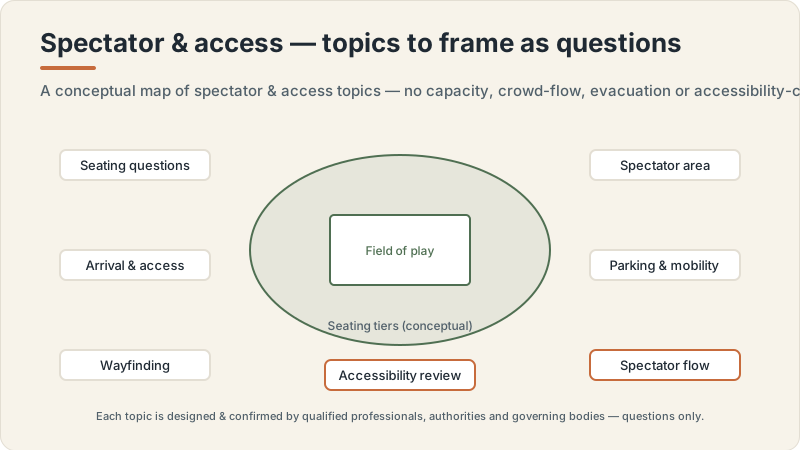
Stadium spectator and access concept
Conceptual editorial diagram — not a construction drawing, specification, to-scale plan or proof of a real project. It is not engineering, structural, fire/life-safety, crowd-safety or accessibility-compliance guidance. Capacities, dimensions, standards, requirements and costs vary by facility type, audience, site, use case and governing body, and are confirmed with qualified professionals, relevant authorities and governing bodies. Build Design Hub does not design, build, inspect, certify, recommend or match anyone.
What this guide helps you prepare
This guide helps you assemble the questions, context and background material you will need before spectator circulation is discussed in earnest with qualified professionals. Spectator flow in a stadium is a specialist, life-safety-sensitive discipline, and the people who model movement, plan for crowds and design egress hold professional qualifications and carry professional responsibility. Your role as a client or project sponsor is different: to describe how you expect the venue to be used, to record your assumptions and open questions, and to give the specialist team a clear, honest picture of your intentions so their work rests on accurate inputs.
Used this way, the guide supports project briefing, stakeholder alignment, scope definition, supplier and contractor research, risk conversations, and lifecycle and handover planning. It deliberately stops short of any design content. You will not find movement instructions, evacuation strategies, capacity figures or thresholds here, because those belong to qualified crowd-safety, fire, accessibility and design professionals working with your specific site, use case and the relevant authorities and governing bodies. Instead, you will find prompts that make your early conversations more productive and your brief more complete.
- Clarify how you intend the venue to be used across event types, seasons and non-event days
- Record open questions and assumptions rather than treating any figure as fixed
- Identify which specialist disciplines your project may need to involve and when
- Gather background context (site, expected uses, stakeholders) to brief professionals accurately
- Structure your thinking so quote comparisons and scope discussions are consistent
- Separate what you can decide as an owner from what only qualified professionals should determine
Mapping the spectator journey as planning context
A useful way to organise your early thinking is to describe the spectator journey as a sequence of stages, purely as context for professionals rather than as a design. Spectators typically approach the site, arrive at the perimeter, pass through entry points, move along concourses, reach their seating area or standing zone, use facilities and concessions, and eventually leave. Writing down how you imagine each stage working — without assigning any numbers, dimensions or capacities — gives the specialist team a clear statement of intent they can test, challenge and translate into professional analysis.
As you describe each stage, focus on intentions and open questions rather than solutions. Note where you are uncertain, where different event types might behave differently, and where you are simply assuming something will work. This journey mapping is not a movement model and carries no safety conclusions; it is a communication tool. The moment questions turn to how many people, how fast, how wide or how quickly, those belong to qualified professionals working with the relevant authorities and governing bodies, whose determinations vary by location, facility type, use case, owner, site and project scope.
- Describe how spectators are expected to approach and arrive at the site
- Note the intended relationship between entry points, concourses and seating or standing areas
- Record where facilities, concessions and services sit relative to circulation routes
- Flag stages where different event types might change how the venue is used
- Capture assumptions you are making so professionals can confirm or correct them
- Identify points where public realm, transport and neighbouring uses may interact with the venue
Access, inclusion and mixed-use considerations to raise early
Spectator circulation is not only about the majority of attendees moving between spaces; it also involves people with a wide range of access needs, staff and operational movement, media and hospitality flows, and the way ordinary days differ from major events. Rather than making any accessibility claims or determinations, this guide encourages you to record the range of people and situations you expect the venue to serve, so that qualified accessibility, crowd-safety and design professionals can consider them properly. Inclusion, dignity and equal experience are questions to explore openly with specialists and the relevant authorities, not matters to resolve in a client brief.
Mixed use adds further considerations worth surfacing early. A venue may host sport, concerts, community events and non-event activity, and the way spectators and other users move can differ significantly between them. Documenting these intended uses, and the tensions you anticipate between them, helps professionals understand the brief without you attempting to design solutions. Keep every entry framed as a question or an intention, and defer all requirements, thresholds and compliance matters to qualified professionals, who will confirm what applies to your specific location, facility type, use case, governing body and project scope.
- List the range of spectators and users you expect the venue to serve, including varied access needs
- Note operational and staff movement, and how it may differ from spectator movement
- Record the different event types the venue is intended to host
- Flag where hospitality, media or premium areas may interact with general circulation
- Capture how non-event and community-day use might differ from event-day use
- Frame accessibility and inclusion as topics for qualified professionals, not as claims to make
Planning questions before speaking with professionals
Before you engage crowd-safety, fire, accessibility and design specialists, it is worth spending time on internal questions that only you and your stakeholders can answer. These clarify intent, expose disagreements within your own team, and ensure the brief you bring to professionals reflects a settled view of what the venue is for. The clearer you are about intended uses, priorities and constraints, the more focused and useful the specialist conversations become, and the less likely you are to rework the brief later.
Approach these questions as a way to prepare, not to conclude. None of them should lead you toward capacities, thresholds, dimensions or safety judgements; those remain firmly with qualified professionals and the relevant authorities. Instead, use them to build a shared understanding among owners, operators and stakeholders so that when specialists begin their work, they receive consistent, honest inputs rather than contradictory assumptions.
- What event types, seasons and non-event uses do we genuinely expect this venue to serve?
- Which spectator experience priorities matter most to us, and where might they conflict?
- What assumptions are we making that we have not yet tested with anyone qualified?
- Who are the stakeholders whose input we need before the brief is considered stable?
- What existing site, transport or neighbouring context should professionals be told about?
- Where do we currently disagree internally, and how will we resolve those questions?
Questions for qualified professionals
Once you have prepared your context and internal alignment, the next step is to bring questions to qualified crowd-safety, fire, accessibility and design professionals. These questions are not requests for you to receive design outputs to act on independently; they are prompts to help you understand scope, sequencing, responsibilities and the boundaries of each discipline. A well-prepared client asks how the specialists intend to approach the work, what inputs they need, and how their findings will interact with the relevant authorities and governing bodies.
Keep the framing consistent: you are seeking to understand and to be advised, not to extract figures you will treat as final. Requirements, thresholds, capacities and standards vary by location, facility type, use case, governing body, owner, site, authority, professional team and project scope, and only qualified professionals can determine what applies to your project. Use these questions to clarify who is responsible for what, how disciplines coordinate, and how you as client should support the process.
- Which specialist disciplines does our project require, and how do they coordinate?
- How do you approach spectator circulation for a venue of our intended uses, and what inputs do you need from us?
- Which authorities and governing bodies will be involved, and at what stages?
- How will accessibility, fire, crowd-safety and design considerations be reconciled?
- What are the boundaries of your scope, and what remains the owner's responsibility?
- How and when will your findings be reviewed, and what should we avoid assuming in the meantime?
What this does not replace
This is an educational planning resource only. It is not a stadium construction manual and not structural, architectural, seating or stand engineering, crowd-safety, crowd-flow, evacuation, fire or life-safety, or accessibility-compliance advice, and it is not permit, zoning, inspection, certification, legal, tax, insurance or procurement advice. It does not design, build, engineer, specify, certify, inspect or approve anything, gives no capacities, dimensions, loads, revenue, ROI or costs, and offers no warranty interpretation or estimate. Requirements, standards, capacities and costs vary by location, facility type, use case, governing body, owner, site, authority, professional team and project scope, and are confirmed with qualified professionals, relevant authorities and governing bodies.
Build Design Hub does not design, build, engineer, inspect, certify, recommend, rank, verify, introduce, broker or match suppliers, contractors, consultants or professionals, and HELPERG LLC is publisher/operator only. Use this resource to prepare your own thinking and briefs, then have qualified professionals you engage directly review your project. Decisions about design, engineering, structure, crowd safety, fire and life safety, accessibility, compliance, capacity, procurement and cost must rest on those professionals, the relevant authorities and the governing bodies for your sport and location.
- Not a stadium construction manual and not structural, architectural or seating/stand engineering
- Not crowd-safety, crowd-flow, evacuation, fire/life-safety or accessibility-compliance advice
- Not permit/zoning, inspection, certification, warranty-interpretation, legal, tax, insurance or procurement advice
- Not a supplier, contractor, consultant or professional recommendation, ranking, directory or matching service
- Not an estimate and gives no capacity, dimension, revenue, ROI or cost figures — requirements and costs vary
- Qualified professional review is required before any stadium project decision
Spectator flow preparation register
- 1Record the venue's intended event types, seasons and non-event uses in plain language
- 2Write down how you imagine spectators approaching, arriving and entering the site
- 3Describe the intended relationship between entry, concourses, seating or standing, and exits as context only
- 4List the range of spectators and users you expect to serve, including varied access needs
- 5Note operational, staff, media and hospitality movement separately from spectator movement
- 6Capture every assumption you are making so professionals can confirm or correct it
- 7Gather site, transport and neighbouring-context information to brief specialists accurately
- 8Identify the specialist disciplines your project may need and note open questions for each
- 9Record which authorities and governing bodies your team believes may be involved, to confirm
- 10List internal stakeholders and any disagreements to resolve before the brief is stabilised
- 11Note lifecycle, operations and handover questions you want professionals to address
- 12Prepare a consistent structure for comparing supplier or contractor scope descriptions
- 13Flag any figure, threshold or requirement you have encountered so it can be confirmed, never assumed
- 14Document what you as owner can decide versus what must be left to qualified professionals
Common mistakes to avoid
- Treating a capacity, dimension, gradient or threshold as a fixed fact instead of confirming it with qualified professionals
- Assuming requirements or standards from another venue, event or jurisdiction apply to your project
- Attempting to sketch spectator movement or evacuation solutions inside the client brief rather than leaving them to specialists
- Making accessibility claims or determinations instead of raising inclusion as a topic for qualified professionals
- Skipping early internal alignment, so professionals receive contradictory assumptions about intended use
- Bringing only a single event type to the brief when the venue is intended for mixed use
- Delaying involvement of crowd-safety, fire and accessibility professionals until design decisions are hard to change
- Confusing an owner's role of describing intent with a professional's role of analysis and determination
When to involve a professional
- When any conversation begins to involve capacities, movement rates, dimensions, gradients or thresholds, defer to qualified crowd-safety and design professionals
- When evacuation, egress, fire or life-safety matters arise, involve appropriately qualified specialists before proceeding
- When accessibility and inclusion need to move from intention to determination, engage qualified accessibility professionals
- When mixed-use or multi-event scenarios create tensions your team cannot reconcile at a briefing level
- When authorities, governing bodies or approvals may be involved and you need to understand scope and sequencing
- When you are comparing supplier or contractor scope and need help understanding what falls to which discipline
Frequently asked questions
Questions readers ask about this topic
Does Build Design Hub design stadiums, model spectator flow or tell me how many people a venue holds?
No. Build Design Hub is an educational resource only. It does not design, build, engineer, inspect, certify, model movement, produce evacuation plans, recommend, rank, verify, introduce, broker or match suppliers, contractors or professionals, and it provides no capacities, dimensions, costs, requirements or standards. This guide only helps you prepare questions and context for qualified professionals, who determine what applies to your specific project.
Can I use this guide to work out how wide my concourses or exits should be?
No. Widths, capacities, gradients, thresholds and any life-safety matters are specialist determinations that vary by location, facility type, use case, governing body, owner, site, authority, professional team and project scope. This guide gives no such figures. It is designed to help you describe your intentions and raise the right questions with qualified crowd-safety, fire, accessibility and design professionals.
What is the point of preparing all this if professionals do the real work?
Qualified professionals produce far better, more accurate work when they receive a clear, honest brief and consistent inputs. Preparing your intended uses, assumptions, open questions and stakeholder context helps specialists understand what you are trying to achieve, reduces rework, and makes your conversations, scope discussions and quote comparisons more productive.
When should I involve crowd-safety or accessibility professionals?
Consider involving qualified professionals early, and certainly before any conversation moves from intent to numbers, thresholds, movement or safety determinations. Requirements vary by location, facility type, use case, governing body, owner, site, authority, professional team and project scope, so confirm timing and scope with qualified professionals and the relevant authorities and governing bodies.
Keep reading