
Who this guide is for
- Stadium and venue owners scoping a new or refurbished spectator facility who want to prepare seating-related questions before engaging designers.
- Sports clubs and their operations staff clarifying how different seating experiences might align with their intended use and audiences.
- Municipalities and public bodies preparing a brief for a community stadium or multi-use venue.
- Schools, colleges and universities planning grandstand or spectator seating for their grounds.
- Property developers and project teams assembling scope and risk questions for a professional design team.
- Facility managers preparing for a refurbishment, lifecycle review or handover involving seating areas.
Planning diagram
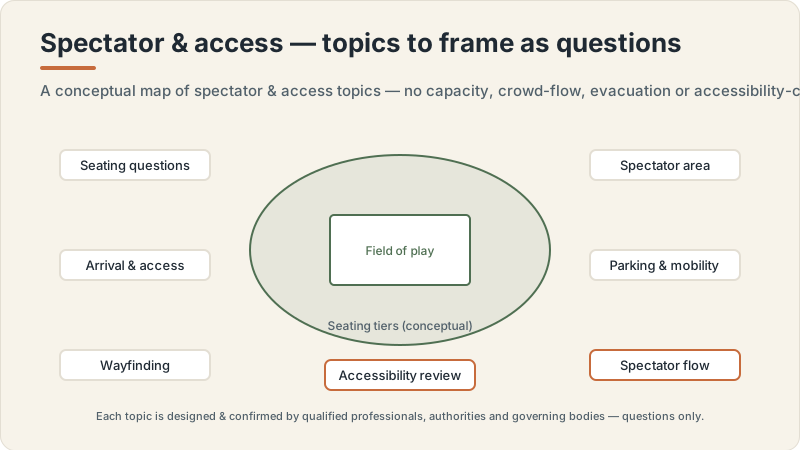
Stadium spectator and access concept
Conceptual editorial diagram — not a construction drawing, specification, to-scale plan or proof of a real project. It is not engineering, structural, fire/life-safety, crowd-safety or accessibility-compliance guidance. Capacities, dimensions, standards, requirements and costs vary by facility type, audience, site, use case and governing body, and are confirmed with qualified professionals, relevant authorities and governing bodies. Build Design Hub does not design, build, inspect, certify, recommend or match anyone.
What this guide helps you prepare
This guide helps you organise your thinking about stadium seating before you sit down with architects, engineers and other qualified professionals. Seating is one of the most visible elements of any spectator venue, and it touches many other decisions: how the bowl is shaped, how people move around, what the atmosphere feels like, and how the venue serves people with a wide range of needs. By preparing questions in advance, you give your professional team a clearer picture of your priorities and reduce the risk of important considerations surfacing late, when they are harder and more disruptive to address.
The purpose here is preparation, not specification. This guide will not tell you how many seats to plan for, what gradient a viewing area should have, how far a spectator can comfortably sit from the action, or what any authority requires, because those are matters for qualified professionals and the relevant governing bodies to determine for your specific project. Instead, it helps you frame those topics as questions, capture your own priorities and constraints, and understand where professional input and verification will be essential.
- Draft a plain-language statement of what experiences and audiences the seating is intended to serve, without committing to numbers.
- List the events and uses you anticipate, and note where a single seating approach may need to serve very different occasions.
- Record open questions about sightlines, comfort and accessibility to raise with designers rather than deciding them yourself.
- Identify the stakeholders whose input the seating decisions will affect, from operations staff to community representatives.
- Note lifecycle concerns you want the team to address, such as maintenance access, cleaning and eventual replacement of seating.
- Capture any existing constraints (site, heritage, prior structures) that a professional team will need to assess.
Understanding seating types at a high level
At a planning level it helps to understand that spectator seating comes in broad categories rather than a single option, and each category carries different implications for experience, operations and cost of ownership. Common distinctions people discuss include individual fixed seats versus bench or terrace-style seating, seating with backs versus without, tip-up seats versus fixed, and premium or hospitality areas versus general spectator areas. Venues also often combine several types across different zones. None of these is inherently correct; the right mix depends on your intended use, audiences, operating model and many factors that only a qualified design team can weigh against the applicable requirements for your project.
It is worth being cautious about treating any seating type as a fixed decision this early. Whether a particular seating arrangement is suitable, permitted or appropriate for a given area is not something a planning guide can determine, because requirements vary by location, facility type, use case, governing body, owner, site, authority, professional team and project scope. The most useful thing you can do at this stage is understand that choices exist, record which experiences matter to you and why, and prepare to ask designers how different seating approaches would interact with sightlines, comfort, accessibility, operations and lifecycle for your specific venue.
- Ask designers to explain the trade-offs between individual seats, benches and terrace-style seating for your intended uses.
- Discuss where premium, hospitality or family zones might sit relative to general seating, and what each implies operationally.
- Explore how tip-up or fixed seating choices could affect movement, cleaning and event turnaround.
- Consider how mixed-use events might place different demands on the same seating areas.
- Ask how seating material and finish choices relate to durability, weather exposure and long-term maintenance.
- Note which seating experiences are priorities for you and which are open, so professionals can advise rather than guess.
Sightline, comfort and accessibility questions to raise
Sightlines, comfort and accessibility are the experience factors people most often associate with seating, and they are deeply interdependent. Sightlines concern whether spectators can see the field of play or performance clearly from their position; comfort concerns seat space, backing, weather protection, circulation and the general sense of ease; accessibility concerns how the venue serves people with a wide range of mobility, sensory and other needs. These topics are technical and heavily influenced by requirements that qualified professionals and relevant authorities determine. This guide does not state what is required, adequate or compliant; it helps you prepare the questions.
When you raise these topics, the aim is to understand how your professional team approaches them and where verification will be needed, not to pre-decide outcomes. Accessibility in particular is an area where you should rely on qualified professionals and the applicable authorities rather than any general resource, and where claims of compliance should never be assumed. Frame your priorities clearly, ask how the design will accommodate a diverse audience, and ask who will be responsible for confirming that the finished venue meets the applicable requirements for your project.
- Ask how the design approach to sightlines accounts for the different vantage points across the venue, and who verifies them.
- Discuss what comfort factors (seat space, backing, shelter, circulation) matter most for your audiences, framed as questions.
- Ask how accessibility for spectators with a range of needs is being addressed, and which authority sets the applicable requirements.
- Ask who is responsible for confirming accessibility outcomes, and avoid treating any arrangement as compliant by assumption.
- Explore how sightline, comfort and accessibility choices interact, since improving one can affect another.
- Ask how these factors will be reviewed and documented through design, delivery and handover.
Planning questions before speaking with professionals
Before you engage designers and engineers, it is worth doing internal preparation so your conversations are focused and productive. This means clarifying, in your own words, what you are trying to achieve with the seating, who the venue serves, and what matters most to your stakeholders. It also means being honest about what you do not yet know, so that professionals can fill those gaps rather than working around unstated assumptions. Preparation of this kind does not require any technical knowledge; it requires you to organise priorities, constraints and open questions clearly.
As you prepare, resist the temptation to lock in numbers, seating types or performance expectations. Treat anything that sounds like a fact about capacity, dimensions, gradients, requirements, costs or timelines as a question to confirm with qualified professionals and the relevant authorities, because these vary by location, facility type, use case, governing body, owner, site, authority, professional team and project scope. Your job at this stage is to define intent and gather context, not to specify a design.
- What experiences do we want spectators to have, and which audiences and events must the seating serve?
- What existing constraints (site, heritage, budgetary boundaries, prior structures) should the professional team know about up front?
- Which stakeholders need to be consulted, and how will we capture and reconcile their input?
- What questions about sightlines, comfort and accessibility are most important for us to have answered?
- What lifecycle and operational concerns (maintenance, cleaning, replacement, event turnaround) do we want addressed?
- Where are we uncertain, and which topics do we expect to defer entirely to qualified professionals and authorities?
Questions for qualified professionals
Once you engage a qualified design and engineering team, the seating conversation shifts from your priorities to their expertise. This is the point to ask how they will translate your intent into a design that meets the applicable requirements, who will be responsible for each decision, and how outcomes will be verified. Good questions here focus on process, responsibility and verification rather than asking the professional to confirm a figure you have pre-decided. The professionals and relevant authorities are the appropriate source for anything involving requirements, capacities, dimensions, gradients, loads, accessibility compliance, safety or standards.
Use these conversations to understand how the team handles the interdependencies between seating and everything around it, how they will document decisions for handover and lifecycle management, and how they will keep you informed as the applicable requirements are confirmed for your project. Remember that Build Design Hub does not provide any of these services, does not verify or certify anything, and does not recommend or match professionals; the answers must come from the qualified professionals you engage and the authorities with jurisdiction over your venue.
- How will you determine the appropriate seating approach for our intended uses, and which requirements and authorities govern that?
- Who is responsible for sightline, comfort and accessibility outcomes, and how will each be verified before handover?
- How do the applicable accessibility requirements for our project get confirmed, and by whom?
- How will seating decisions interact with other parts of the venue, and how are those trade-offs documented?
- What lifecycle information (maintenance, replacement, warranties) will be provided at handover, and how should we interpret it?
- Which decisions must be confirmed with governing bodies or authorities rather than settled within the design team?
What this does not replace
This is an educational planning resource only. It is not a stadium construction manual and not structural, architectural, seating or stand engineering, crowd-safety, crowd-flow, evacuation, fire or life-safety, or accessibility-compliance advice, and it is not permit, zoning, inspection, certification, legal, tax, insurance or procurement advice. It does not design, build, engineer, specify, certify, inspect or approve anything, gives no capacities, dimensions, loads, revenue, ROI or costs, and offers no warranty interpretation or estimate. Requirements, standards, capacities and costs vary by location, facility type, use case, governing body, owner, site, authority, professional team and project scope, and are confirmed with qualified professionals, relevant authorities and governing bodies.
Build Design Hub does not design, build, engineer, inspect, certify, recommend, rank, verify, introduce, broker or match suppliers, contractors, consultants or professionals, and HELPERG LLC is publisher/operator only. Use this resource to prepare your own thinking and briefs, then have qualified professionals you engage directly review your project. Decisions about design, engineering, structure, crowd safety, fire and life safety, accessibility, compliance, capacity, procurement and cost must rest on those professionals, the relevant authorities and the governing bodies for your sport and location.
- Not a stadium construction manual and not structural, architectural or seating/stand engineering
- Not crowd-safety, crowd-flow, evacuation, fire/life-safety or accessibility-compliance advice
- Not permit/zoning, inspection, certification, warranty-interpretation, legal, tax, insurance or procurement advice
- Not a supplier, contractor, consultant or professional recommendation, ranking, directory or matching service
- Not an estimate and gives no capacity, dimension, revenue, ROI or cost figures — requirements and costs vary
- Qualified professional review is required before any stadium project decision
Stadium seating planning preparation worksheet
- 1Record a plain-language statement of the spectator experiences and audiences the seating is intended to serve.
- 2List all anticipated events and uses, noting where different occasions may place different demands on the same seating.
- 3Capture existing site, heritage or structural constraints for the professional team to assess.
- 4Note which broad seating categories you want designers to explain and compare, without pre-selecting one.
- 5Write down the sightline questions you want the design team to answer for your venue.
- 6Write down the comfort priorities (seat space, backing, shelter, circulation) that matter most to your audiences.
- 7Record the accessibility questions to raise, and note that outcomes must be confirmed by qualified professionals and authorities.
- 8Identify which authority or governing body you will be told sets the applicable requirements for your project.
- 9List the stakeholders whose input affects seating decisions and how you will gather and reconcile it.
- 10Capture lifecycle concerns: maintenance access, cleaning, replacement and event turnaround.
- 11Record who will be responsible for verifying sightline, comfort and accessibility outcomes before handover.
- 12Note every topic you intend to defer entirely to qualified professionals rather than decide internally.
- 13List the handover and documentation items you will request, such as maintenance and warranty information.
- 14Keep a running register of assumptions to challenge, flagging anything stated as a fixed number or requirement.
Common mistakes to avoid
- Treating a capacity figure, seating type or layout as a fixed decision before any qualified professional has been engaged.
- Assuming a seating arrangement is compliant or accessible without confirmation from qualified professionals and the relevant authorities.
- Stating dimensions, gradients, sightline distances or loads as facts rather than questions to confirm.
- Skipping professional review of sightlines, comfort and accessibility because they seem intuitive or self-evident.
- Letting one experience factor drive the plan without recognising how sightlines, comfort and accessibility interact.
- Failing to involve affected stakeholders early, so their needs surface late when changes are costly.
- Overlooking lifecycle and operational realities such as cleaning, maintenance access and eventual seat replacement.
- Assuming a general resource can substitute for qualified professionals, authorities and governing bodies on requirements.
When to involve a professional
- Before committing to any seating type, layout or capacity direction, so qualified professionals can assess your specific site and uses.
- Whenever sightlines, comfort or accessibility outcomes need to be determined, because these depend on requirements only professionals and authorities can confirm.
- As soon as accessibility for spectators with a range of needs is discussed, since compliance must never be assumed.
- When existing site, heritage or structural constraints could affect seating, so engineers and designers can evaluate them.
- Before finalising a project brief that mentions numbers, dimensions or requirements, to convert assumptions into professionally confirmed inputs.
- At handover and lifecycle planning stages, so maintenance, warranty and replacement information is interpreted by qualified professionals.
Frequently asked questions
Questions readers ask about this topic
Does Build Design Hub design, build, engineer, inspect or certify stadium seating, or recommend suppliers and contractors?
No. Build Design Hub is an educational resource only. It does not design, build, engineer, inspect, certify, verify, recommend, rank, introduce, broker or match suppliers, contractors, consultants or professionals, and it provides no capacities, dimensions, costs or requirements. This guide only helps you prepare questions; the actual design, verification and any compliance determinations must come from qualified professionals you engage and the authorities with jurisdiction over your venue.
Can this guide tell me how many seats my venue should have or how steep the seating should be?
No. Capacities, dimensions, gradients and similar figures are not stated here as facts because they vary by location, facility type, use case, governing body, owner, site, authority, professional team and project scope. Treat any such number as a question to confirm with qualified professionals and the relevant authorities rather than something to decide from a general guide.
How should I use this guide when I meet my design and engineering team?
Use it to arrive with organised priorities and clear questions about sightlines, comfort, accessibility, seating types, operations and lifecycle. Ask the professionals how they will determine appropriate solutions, who is responsible for each outcome, and how everything will be verified against the applicable requirements. The guide structures the conversation; it does not provide the answers.
Is anything in this guide accessibility-compliance advice?
No. Nothing here is accessibility-compliance advice or a claim of compliance. Accessibility outcomes must be determined and verified by qualified professionals and the authorities that set the applicable requirements for your project. This guide only helps you prepare accessibility-related questions to raise with them.
Keep reading