
Who this guide is for
- Owners and club administrators scoping a new or upgraded venue who need structured arrival and access questions before engaging consultants.
- Municipalities and public authorities coordinating transport, roads and public realm around a proposed or existing stadium.
- Schools, colleges and community organisations planning shared or multi-use sports facilities with spectator access.
- Developers and project teams assembling a brief and stakeholder list for a spectator venue.
- Facility and operations managers preparing matchday and event-day access, movement and handover discussions.
- Project sponsors comparing consultant and contractor scopes and wanting a neutral question set to structure those talks.
Planning diagram
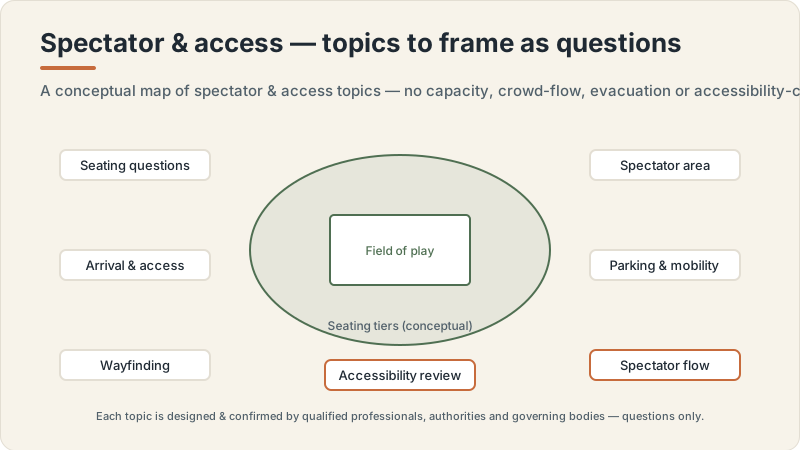
Stadium spectator and access concept
Conceptual editorial diagram — not a construction drawing, specification, to-scale plan or proof of a real project. It is not engineering, structural, fire/life-safety, crowd-safety or accessibility-compliance guidance. Capacities, dimensions, standards, requirements and costs vary by facility type, audience, site, use case and governing body, and are confirmed with qualified professionals, relevant authorities and governing bodies. Build Design Hub does not design, build, inspect, certify, recommend or match anyone.
What this guide helps you prepare
This guide helps you build a structured picture of the arrival and access questions worth raising before a stadium project takes shape. Rather than telling you how a venue should be built, it helps you assemble a project brief, identify the stakeholders and authorities who hold the answers, and frame conversations so that transport, entries and approaches are considered early rather than retrofitted. The aim is to arrive at professional discussions already knowing which questions matter and who is responsible for confirming each answer.
It also helps you organise the surrounding context: the site and its connections to roads, public transport, walking and cycling routes; the range of events a venue might host; and how arrival patterns differ between a sell-out fixture and a smaller event. Treating arrival and access as a planning conversation, not a fixed specification, keeps your brief flexible while decisions are still open. Requirements vary by location, facility type, use case, governing body, owner, site, authority, professional team and project scope; confirm with qualified professionals.
- Draft a plain-language statement of who arrives at the venue, by what means, and for which kinds of events.
- List the transport modes serving the site today and the modes stakeholders hope it might serve in future.
- Identify which authorities, transport operators and governing bodies will need to be part of arrival and access discussions.
- Capture open questions about approaches, entries and the surrounding public realm rather than proposing solutions.
- Note where existing conditions (roads, stations, footways) are assumptions rather than confirmed facts.
- Record which decisions must be confirmed by qualified professionals before they enter the brief.
Framing transport and approach questions for the site
Transport and approach planning is where a venue meets its surroundings, so it is worth mapping the questions before proposing any answer. Consider how spectators, staff, officials, media, coaches, emergency services and deliveries might each reach the site, and how those journeys interact. Different arrival modes place different demands on roads, transport interchanges, drop-off areas and walking routes, and the balance between them is a matter for transport planners and the relevant authorities to assess, not something to assume from a comparable venue elsewhere.
It also helps to separate the site's current transport context from its potential future context. A location may sit near existing public transport or road connections, but whether those can serve an event audience, and under what conditions, is a question for professionals and operators. Framing these as questions keeps your brief honest about what is known versus hoped-for. Transport, approach and connection requirements vary by location, facility type, use case, governing body, owner, site, authority, professional team and project scope; confirm with qualified professionals and the relevant authorities.
- Which transport modes could realistically serve the site, and which stakeholders and operators should confirm their feasibility?
- How might arrival by public transport, walking, cycling, coach, car and drop-off interact on event days, and who assesses that?
- What questions should go to the local highway or roads authority and transport operators about the surrounding network?
- How do arrival patterns differ between the largest anticipated event and smaller or non-event uses?
- Which approach routes serve emergency services, officials, media and deliveries, and who confirms their needs?
- What is confirmed about existing connections versus assumed, and who should verify each point?
Framing entry, wayfinding and egress questions
Entries and approaches are more than doors: they shape how people find, reach and leave a venue, and how staff manage arrival over time. At the planning stage the useful work is identifying the questions, such as how different visitor groups might be directed, how wayfinding could guide people from transport points to the venue, and how arrival and departure spread across an event. These are matters for qualified professionals and, where relevant, governing bodies to resolve; this guide only helps you know what to ask and who to ask.
It also helps to think about how entries and approaches connect to the wider access experience without straying into engineering or safety design. Consider how the brief describes the intended visitor journey in plain terms, and where accessibility, staffing and operations questions should be routed to the appropriate specialists and authorities rather than resolved on paper. Entry, wayfinding and egress requirements vary by location, facility type, use case, governing body, owner, site, authority, professional team and project scope; confirm with qualified professionals, relevant authorities and governing bodies.
- How should the brief describe the intended arrival-to-seat and seat-to-exit journey in plain language?
- Which visitor groups (general spectators, hospitality, officials, media, staff) may need distinct entries or approaches, and who confirms this?
- What wayfinding questions link transport points, approaches, entries and the surrounding public realm?
- How might arrival and departure spread over time, and which professionals assess that pattern?
- Where should accessibility of arrival and access be raised with appropriate specialists rather than assumed?
- How do entries and approaches interact with staffing and operations questions that professionals should resolve?
Planning questions before speaking with professionals
Before you engage consultants, it helps to settle what you already know, what you are assuming, and what only a professional can confirm. Writing this down turns a vague ambition into a brief that specialists can respond to precisely. Focus on describing the site, the intended uses, the people who will arrive and leave, and the authorities and operators who hold parts of the answer, so that early conversations start from shared, honest ground rather than untested assumptions.
It is equally valuable to be explicit about the limits of your own knowledge. Any figure, capacity, standard, timeline or requirement you have heard about should be treated as a question to confirm, not a fact to build on. Preparing this way lets you compare consultant and contractor scopes on a like-for-like basis later. Requirements vary by location, facility type, use case, governing body, owner, site, authority, professional team and project scope; confirm with qualified professionals.
- What is the plain-language purpose of the venue and the range of events it might host?
- Which arrival modes matter most to stakeholders, and which are aspirations still to be tested?
- What do we genuinely know about the site's transport and access context, and what are we assuming?
- Which authorities, operators and governing bodies must be part of the conversation, and have they been listed?
- What questions about entries, approaches and egress should be prepared for each specialist discipline?
- Have we avoided stating any capacity, dimension, standard, cost or timeline as a fixed fact in our brief?
Questions for qualified professionals
When you engage qualified professionals, arrive with organised questions so that each discipline can advise within its own scope. Transport planners, access and inclusive-design specialists, safety and operations advisers, architects and engineers, and the relevant authorities each own different parts of arrival and access, and clarifying who confirms what avoids gaps and duplication. Ask each professional to state the assumptions behind their advice and which authorities or governing bodies must ultimately confirm it.
Use these conversations to understand scope boundaries and coordination points rather than to extract fixed numbers. A professional can explain how arrival, entries and approaches should be studied for your specific site, what further assessments may be needed, and how their work interacts with others'. Keep asking what varies and why, so decisions stay grounded in your project's context. Requirements vary by location, facility type, use case, governing body, owner, site, authority, professional team and project scope; confirm with qualified professionals.
- Which discipline is responsible for assessing transport, approaches, entries, egress, accessibility and operations respectively?
- What assessments, studies or authority engagements would you recommend for arrival and access on this specific site?
- Which requirements are set by authorities or governing bodies, and how do we confirm current expectations with them?
- What assumptions underlie your advice, and what would change it as the design and use case evolve?
- How does your scope coordinate with the other professionals and authorities involved in arrival and access?
- What should we not treat as fixed at this stage, and what remains to be confirmed later in the project?
What this does not replace
This is an educational planning resource only. It is not a stadium construction manual and not structural, architectural, seating or stand engineering, crowd-safety, crowd-flow, evacuation, fire or life-safety, or accessibility-compliance advice, and it is not permit, zoning, inspection, certification, legal, tax, insurance or procurement advice. It does not design, build, engineer, specify, certify, inspect or approve anything, gives no capacities, dimensions, loads, revenue, ROI or costs, and offers no warranty interpretation or estimate. Requirements, standards, capacities and costs vary by location, facility type, use case, governing body, owner, site, authority, professional team and project scope, and are confirmed with qualified professionals, relevant authorities and governing bodies.
Build Design Hub does not design, build, engineer, inspect, certify, recommend, rank, verify, introduce, broker or match suppliers, contractors, consultants or professionals, and HELPERG LLC is publisher/operator only. Use this resource to prepare your own thinking and briefs, then have qualified professionals you engage directly review your project. Decisions about design, engineering, structure, crowd safety, fire and life safety, accessibility, compliance, capacity, procurement and cost must rest on those professionals, the relevant authorities and the governing bodies for your sport and location.
- Not a stadium construction manual and not structural, architectural or seating/stand engineering
- Not crowd-safety, crowd-flow, evacuation, fire/life-safety or accessibility-compliance advice
- Not permit/zoning, inspection, certification, warranty-interpretation, legal, tax, insurance or procurement advice
- Not a supplier, contractor, consultant or professional recommendation, ranking, directory or matching service
- Not an estimate and gives no capacity, dimension, revenue, ROI or cost figures — requirements and costs vary
- Qualified professional review is required before any stadium project decision
Stadium arrival and access preparation register
- 1Record a plain-language statement of the venue's purpose and the range of events it may host.
- 2List every group who arrives and leaves: spectators, hospitality, officials, media, staff, emergency services, deliveries.
- 3Note the transport modes serving the site today and the modes stakeholders hope it might serve.
- 4Identify the authorities, roads or highway bodies, transport operators and governing bodies to consult.
- 5Capture questions about approach routes for different user groups without proposing solutions.
- 6Log open questions about entries, wayfinding and egress to route to the right specialists.
- 7Mark which existing conditions are confirmed facts and which are assumptions to be verified.
- 8Gather any figures, standards or timelines you have heard and label each as unconfirmed pending professional input.
- 9Record which accessibility-of-arrival questions should go to appropriate specialists and authorities.
- 10Note how arrival and departure patterns might differ between the largest and smaller events, as questions for professionals.
- 11List the professional disciplines likely needed and the question set prepared for each.
- 12Assemble the stakeholder contact list and note who owns which part of the arrival and access picture.
- 13Prepare a neutral scope-comparison structure so consultant and contractor proposals can be reviewed like-for-like.
- 14Document outstanding items that must be confirmed by qualified professionals before entering the final brief.
Common mistakes to avoid
- Stating a venue capacity, arrival figure or catchment as fixed instead of a question for qualified professionals.
- Assuming a nearby comparable stadium's transport or access arrangements apply to your own site.
- Treating existing roads, stations or footways as confirmed when they are only assumptions to be verified.
- Skipping early engagement with transport authorities, operators and governing bodies until the design is set.
- Writing standards, dimensions, gradients or timelines into the brief as facts rather than items to confirm.
- Assuming entries and approaches are only physical doors, ignoring wayfinding, staffing and operations questions.
- Overlooking distinct user groups such as officials, media, emergency services and deliveries in arrival planning.
- Bypassing professional review by resolving accessibility, safety or crowd-related questions internally on paper.
When to involve a professional
- Engage a transport or highways professional before committing to any arrival, approach or drop-off assumption for the site.
- Involve access and inclusive-design specialists whenever accessibility of arrival, entries or approaches is in question.
- Bring in safety and operations advisers before making assumptions about how arrival, movement and egress are managed.
- Consult the relevant authorities and governing bodies before treating any requirement, standard or expectation as settled.
- Engage architects and engineers before translating access ideas into site layout, structure or infrastructure decisions.
- Seek qualified professional input whenever a stakeholder asserts a capacity, dimension, cost or timeline as fact.
Frequently asked questions
Questions readers ask about this topic
Does Build Design Hub design, build or engineer the stadium arrival and access for my project?
No. Build Design Hub is an educational resource only. It does not design, build, engineer, inspect, certify, recommend, rank, verify, introduce, broker or match suppliers, contractors, consultants or professionals, and it provides no capacities, dimensions, costs, timelines, standards or code, safety or accessibility-compliance advice. This guide helps you prepare questions to raise with qualified professionals and the relevant authorities, who confirm everything for your specific project.
Can this guide tell me how many people my stadium can hold or how wide the approaches should be?
No. This guide does not provide capacities, dimensions, gradients, loads or any similar figures, and you should not treat any number you have heard as fixed. Such matters vary by location, facility type, use case, governing body, owner, site, authority, professional team and project scope, and must be confirmed by qualified professionals and the relevant authorities and governing bodies.
When should I involve qualified professionals in arrival and access planning?
As early as possible, and certainly before any assumption about transport, entries, approaches or capacity is treated as fact. Transport planners, access and inclusive-design specialists, safety and operations advisers, architects, engineers and the relevant authorities each own part of the picture. Use this guide to prepare organised questions so those conversations are productive and clearly scoped.
How should I use the questions and checklist in this guide?
Use them to build a project brief, record what you know versus what you are assuming, and structure discussions with stakeholders, authorities and professionals. They are prompts for preparation, not answers or requirements. Every item that touches a requirement, standard, figure or design decision should be confirmed with qualified professionals and the appropriate authorities.
Keep reading